Showing posts sorted by relevance for query jack pierce. Sort by date Show all posts

Tuesday, October 23, 2018

Jack Pierce and the Creation of Frankenstein's Monster

The word "Frankenstein" conjures up in most people's mind the image of Dr. Frankenstein's creation, his pastiche of bodily parts that he gave life to. We picture him as a huge fearsome man with a flat head, bolts protruding from his neck, scars on his face, long arms, and wearing tightly fitted clothes and giant heavy boots. This image is often credited to Mary Shelley, the author of the original novel "Frankenstein", published in 1818. But is this creature really her creation or Jack Pierce's, the make-up artist who re-imagined Frankenstein for the 1931 Universal horror picture?

As Mary Shelley describes Dr. Frankenstein's creation, he seems to have been intended as quite a handsome fellow but what resulted was not what the doctor had ordered: 

"His limbs were in proportion, and I had selected his features as beautiful. Beautiful! Great God! His yellow skin scarcely covered the work of muscles and arteries beneath; his hair was of a lustrous black, and flowing; his teeth of a pearly whiteness; but these luxuriances only formed a more horrid contrast with his watery eyes, that seemed almost of the same color as the dun-white sockets in which they were set, his shriveled complexion and straight black lips."

Black flowing hair, watery white eyes, a shriveled complexion, and black lips.....quite a horrible sight, indeed! 

Charles Stanton Ogle as the "monster" ( 1910 )

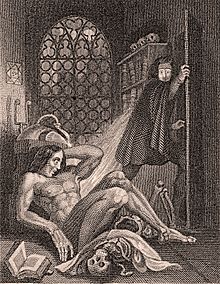
The first illustrations for the book - steel engravings dating from the 1831 edition - display the size of the creature, his thin skin covering, and his long black hair ( see illustration above ). Other drawings show him wearing a cloak, a toga-like covering. 

For the first film adaptation, made in 1910 by Edison Studios, the monster had a grotesque face hidden under mounds of unruly strands of hair and long deformed fingers. As you can see in the close-up, he was beastly. In 1920, an Italian silent film Il mostro di Frankenstein - now considered lost - portrayed him as a bald giant with facial features not unlike the Deutsch vampire Nosferatu. 

It was eleven years later that the monster returned to the screen, this time in the Universal Pictures film Frankenstein ( 1931 ). Jack Pierce, an extraordinary make-up artist heralding from Greece, was assigned to create the monster, portrayed by the fabulous Boris Karloff. 

In 1926, Pierce had helped director Raoul Walsh create the right look for actor Jacques Lerner who played a man impersonating a primate in the film The Monkey Talks. His make-up work was so richly detailed that it caught the attention of Carl Laemmle, then head of Universal Studios. He hired Pierce for a full-time position as a makeup artist and promptly put him to work in The Man Who Laughs, where he created the iconic look of Conrad Veidt's character Gwynplain, which in turn inspired Bob Kane's character of The Joker in his "Batman" comic book series. 
His most important work prior to Frankenstein was undoubtedly that of creating Bela Lugosi's ghostly pale Count Dracula in Dracula ( 1930 ). After the resounding success of this film, Universal Studios decided to adapt other classic horror novels into films, selecting Mary Shelley's "Frankenstein" as their next project. It was Pierce's task to take Dr. Frankenstein's monster from the pages of her book and transform him into a monster that could walk on-screen.

As James L. Neibar describes in his book "The Monster Movies of Universal Studios" : 

"Make-up artist Jack Pierce is responsible for creating the iconic makeup for the monster. Collaborating with Karloff, it was Pierce who designed the rectangular shape of the head with the flat top, the protruding brow, and the electrodes on either side of the monster's neck, while Karloff removed his partial dental plate, causing his face to indent......Pierce's vision of the Frankenstein monster has since become the most noted representation of the character. "
Envisioning what kind of creation a doctor from that period of time could have assembled took Pierce nearly six months of research. Before tests were undertaken on Karloff, Pierce had created a clay model of what he hoped to achieve. Jack Pierce describes this process...

“It was a lot of hard work, trying to find ways and means, what can you do? Frankenstein wasn’t a doctor; he was a scientist, so he had to take the head and open it, and he took wires to rivet the head. I had to add the electrical outlets to connect electricity in here on the neck. I made it out of clay and put hair on it and took it in to Junior Laemmle’s office. He said, ‘you mean you can do this on a human being?’ I said, ‘positively’. He said, ‘all right we will go to the limit.’"

Boris Karloff spent four hours each morning in the makeup chair, letting Pierce apply heavy putty to his eyelids, thick grey makeup all over his face, and heavy electrodes to his neck....makeup which in addition took nearly an hour each day to remove.

When Frankenstein was released in theatres, it was an immediate box-office hit. This imagining of Mary Shelley's character became so famous that within four years the monster had to be resurrected from his untimely death to return to frighten other villagers, this time in The Bride of Frankenstein. He would also return in Son of Frankenstein ( 1939 ), and The Ghost of Frankenstein ( 1942 )...the first film that Jack Pierce received screen-credit for his work on the monster. 
That is perhaps the saddest foot-note of all; that viewers at the time did not know and could not know who was the real inventor of the monster that they loved to watch onscreen - Jack Pierce. During the 1930s, make-up artists were often not given credit for their work, but Pierce certainly deserved screen-credit for this creation since it was so imaginative and so unlike Mary Shelley's description of the creature. 

Thankfully, today most film fans recognize the name of Jack Pierce and know his body of work. But to help educate others, the next time you dress up as the monster or see him at a Halloween costume party, be sure to call him by his proper name - Dr. Pierce's Monster. 

To read more about Jack Pierce and his work in Hollywood check out our article The Faces of Jack Pierce.

Friday, October 24, 2014

The Faces of Jack Pierce

Jack Pierce himself only had one face, one which wasn't particularly liked in Hollywood, but - as a makeup artist - Pierce created many faces. So many that the few we will highlight in this post will only scratch the grease-painted surface of this man's talent. 

These days Pierce is best remembered for his work in the creation of the "look" of the Universal monsters with the exception of The Creature from the Black Lagoon. It is for this work that he - posthumously - earned a lifetime achievement award from the Hollywood Make-Up Artist and Hairstyle Guild. 

Jack Pierce was born in Greece in 1889 ( he was christened Janus Piccoulas by birth ) and came to America with his parents in the early 1900s. He started in the film industry working as a projectionist and then a stuntman before becoming an actor. Between 1915 and 1925 he played in twelve different films, usually being cast as a villain.

Pierce often applied his own makeup while being an actor and he enjoyed creating different effects to detract from his shortness ( he was 5' 5" ). He got his first chance at applying makeup to other actors when he stepped in to transform actor Jacques Lernier into a speaking simian for his role in Raoul Walsh's The Monkey Talks ( 1926 ). This work was observed by Carl Laemmle who hired him full-time at Universal, where one of his very first assignments was applying the makeup for Conrad Viedt in The Man Who Laughs ( 1928 ). 

In 1930, Pierce was assigned to work on Dracula and created a special color greasepaint for the sanguinary count, portrayed by Bela Lugosi. However, Lugosi had always applied his own makeup ( a common practice for stage actors ) and so he refused to let Jack Pierce do his makeup. Lugosi reflected later that Pierce got his revenge on him when he designed such torturous makeup as Ygor and the Frankenstein for him to wear. 


The 1930s 


Frankenstein ( 1931 )

It was during the 1930s that Pierce rose to fame beginning with his work on The Monster in Carl Laemle Jr.'s FrankentsteinMary Shelley wasn't all too specific about the Monster's appearance in her 1818 novel, and so Pierce let his imagination run free and decided to give the pastiched character a flat-topped head with very heavy eyelids. A nice sleepy look. Unfortunately for Karloff, the makeup application was a six hour process involving the attachment of a skullpiece for the black hair, then a layer of cotton and spirit gum for the forehead, followed by a glob of specially designed putty around the eyes, a nice dirty scar, some electrifying bolts, and a topping of green-grey greasepaint. Karloff personally contributed the sunken cheekbones by having a dental bridge removed. 


Murders in the Rue Morgue ( 1932 )

This juicy horror flick gave Pierce a chance to paint Bela Lugosi an entirely different face. The bushy eyebrows of the Count can be seen again, but now they are connected with a bridge of hair, making Dr. Mirakle look like he has one giant eyebrow. 


White Zombie ( 1932 ) 

Once again Bela got to sit in the makeup chair, with Jack Pierce transforming him this time into the devilish voodoo master, Murder Legendre. With curling beard strands, heavy dark eyebrows and a very low widow's peak, Murder was a character guaranteed to frighten women and children out of the theatres. 


The Mummy ( 1932 ) 

Karloff thought the Monster was an elaborate makeup process, but The Mummy offered him a chance to really test his patience. It was complete head-to-toe makeup application. The wrappings of the mummy were treated with flames and acid to age it properly then dipped in collodion ( a strong smelling liquid plastic ) and stretched over Boris Karloff's face. Pierce applied Fuller's Earth over the wrappings after it was dried to give it an "arid" look. Check out this great article on the mummifying process, originally printed in Mechanix magazine. 


The Invisible Man ( 1933 ) 

There really wasn't much monster makeup involved in The Invisible Man, but the coloring applied to all of the supporting players really enhanced the look of the film. This scene doesn't display any of Pierce's skill, just Una O'Connor's facial expression was so good we had to include it. 


The Bride of Frankenstein ( 1935 ) 

One of the reasons that Jack Pierce was not very much loved in the Hollywood circle was because he was such a demanding make-up artist. Film Historian Greg Mank interviewed Elsa Lanchester at one time and this is what she had to say about the Bride's makeup process, " [Pierce] took ages to make a scar that hardly shows under my chin. For a whole hour he would draw two lines of glue, put a red line down the middle, then start making up the white edges of the scar - meticulously done. Well, frankly, I'm sure he could have bought such a scar for ten cents in a joke shop.....After the scar came the eyebrows, and the hair. It's my own hair. I had it lifted up from my face, all the way around; then they placed a cage on my head and combed my own hair over that cage. Then they put the gray-streak hairpieces in afterwards."


The Werewolf of London ( 1935 ) 

This was the first of the Universal "wolf man" films, even though it often gets overlooked in favor of the Lon Chaney version. Henry Hull, who was cast in the title role, objected to Pierce's original concept of how Wolfie should look, claiming that it obscured his features. The final design pleased both Pierce and Hull even though it left barely a resemblance to the actor.
                   _____________________________________________________

In addition to all of these monster classics, Jack Pierce was kept busy working as the makeup artist for Great Expectations ( 1934 ), Diamond Jim ( 1935 ), Magnificent Obsession ( 1935 ), Show Boat ( 1936 ), and Three Smart Girls ( 1936 ), to name a few. 


The 1940s 


The 1940s was Pierce's busiest decade and he worked on all of the Mummy sequels ( regardless of Chaney's personal dislike for him ), the Frankenstein sequels, and the Dracula sequels. He also created some menacing new faces in films like Man Made Monster ( 1941 ) The Phantom of the Opera ( 1943 ), The Mad Ghoul ( 1943 ) and Cobra Woman ( 1944 ).

The Wolf Man ( 1941 ) 

For Universal's second venture into lycanthrope land, Pierce created an entirely different look for the "wolf man", adding much more hair around the cheekbones and a bushy head of hair. Chaney reportedly hated working with Pierce due to the tedious transformation process he made him undergo, which included having yak hair glued to his face. 


The Scarlet Claw ( 1944 )

This film was the eighth entry in the popular Universal Sherlock Holmes series starring Basil Rathbone and Nigel Bruce. The detective duo set out to the backwoods of Canada to capture a criminal who was once a former actor ( and a makeup artist himself ) and this fellow uses his skill to create different identities for himself, one of which is a fleeting glowing shadow in the marshland. Holmes got to try out some disguises himself and in this scene he is seeing if Watson can recognize him as a messenger. We can't even recognize him as being Rathbone.

In addition to working on The Scarlet Claw, Pierce also designed the makeup for four other Sherlock Holmes films. By the mid-1940s however, mystery and horror films were beginning to wane with the public taste. Pierce found himself doing the work of an everyday Hollywood makeup artist and applying cakes of powder and rouge to celebrities such as Deanna Durbin ( Because of Him, I'll Be Yours ), Susan Hayward ( Canyon Passage, Smash Up: The Story of a Woman ) and Abbott and Costello ( Little Giant and The Time of Their Lives ).

The 1940s brought about unwanted change for a traditionalist like Jack Pierce. Younger makeup artists were dropping the "out of the kit" techniques in favor of the quicker and more comfortable latex forms. Studio heads at Universal were in favor of these techniques because they saved time and cost during the making of a film. Pierce held on to his style and was eventually let go from Universal in 1946. 

Jack Pierce turned to doing television work in the early 1950s and when budget monster classics became the rage in the latter years of the decade he once again took to creating monsters. Some of these included the Beast ( Beauty and the Beast ), The Amazing Transparent Man, and burly conquistador in The Giant from the Unknown. His final work was on Mister Ed, where he was the show's regular makeup artist.

Saturday, October 5, 2024

From the Archives: Son of Frankenstein (1939)

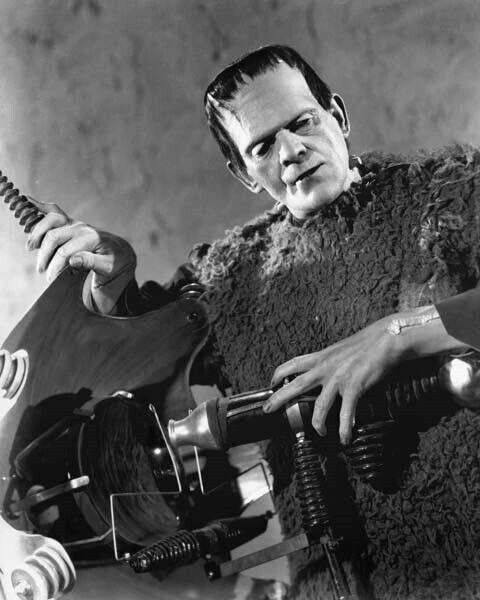
Boris Karloff as the famous "Monster" from the Frankenstein films (in this photo, The Son of Frankenstein). The make-up for all of the early Frankenstein movies was done by Jack Pierce, whom you could read more about in our previous articles here

From the Archives is our latest series of posts where we share photos from the Silverbanks Pictures collection. Some of these may have been sold in the past, and others may still be available for purchase at our eBay store: http://stores.ebay.com/Silverbanks-Pictures

Friday, October 2, 2015

Announcing the Universal Pictures Blogathon!

UPDATE : The blogathon has begun and you can view all of the links of the posts down below or head on over to Universal Pictures Blogathon : The Guests Arrive to view the entries day by day. Enjoy!

Universal Pictures turned 100 years old this year, and to celebrate this landmark film studio's centennial we are hosting The Universal Pictures Blogathon beginning Oct. 29th. Carl Laemmle would be proud.


Boys and ghouls, this will be a mad monster bash taking place the week of Halloween so invite your friends, your enemies, your daddy, your mummy, and all the spooks in your life to attend. Any one, any age, is welcome and...children of the night, any topic you vant to write about is fine with us!  

Universal Pictures distributed some of the most iconic motion pictures in Hollywood's history including a castle-full of delicious monster classics. 


What kind of articles could you write about for this event? You can cover a film, a series of films, a profile of a Universal contract player, a director, behind-the-scenes personnel, or the history of the studio itself. You've got a Universe of topics to choose from, but in case your brain went stiff for the moment, here are some suggestions to spark the flames of inspiration : 

Stars : Lon Chaney, Deanna Durbin, Laura La Plante, Rock Hudson and Doris Day, Abbott and Costello, Sandra Dee, Lana Turner, Audie Murphy, Claudette Colbert, Fred MacMurray, Barbara Stanwyck, David Niven, Hoot Gibson, Don Knotts, Mae Murray, Harry Carey, Lon Chaney Jr., Bela Lugosi, Basil Rathbone, Marlene Dietrich, W.C. Fields, Mae West, Jon Hall, Maria Montez, Burt Lancaster, Irene Dunne, James Stewart, Tony Curtis. 


Films and Series : The Phantom of the Opera, Show Boat, The Hunchback of Notre Dame, All Quiet on the Western Front, The Mummy, Cohen and Kelly, Sherlock Holmes, The Black Cat, Three Smart Girls, My Man Godfrey, The Ghost and Mr. Chicken, Torn Curtain, Tammy and the Bachelor, Destry Rides Again, Spartacus, Creature from the Black Lagoon, Ma & Pa Kettle, The Chalk Garden, Francis the Talking Mule, The Bank Dick, Shadow of a Doubt, The Birds, Marnie, The Killers, Harvey, The Glenn Miller Story, All That Heaven Allows, Imitation of Life,  The Incredible Shrinking Man, Touch of Evil, Back Street, To Kill a Mockingbird,  Munster Go Home. 

Behind-the-Scenes : Carl Laemmle, Tod Browning, Alfred Hitchcock, Clarence Brown, Erich von Stroheim, Lois Weber, Douglas Sirk, Ross Hunter, Jean Louis, Mervyn LeRoy, Jack Pierce, Walter Seltzer, Frank De Vol, Elmer Bernstein, Delbert Mann, Henry Koster. 


Did you know that thirteen of the classic Hammer Horror films were released through Universal Pictures too? 

If you are new to blogathons, let us explain the rules of the party : 

  • All platters are served on a first come, first serve basis. 
  • If you don't post your post within the posting time, we'll miss your post and it won't be posted until our next post. 
  • Please park your carriage in the gate-house behind the castle. 
  • Listen to your host, especially since she has the longest fangs. 
  • The deadline for accepting walk-in invitations is midnight on Halloween - a bewitching time, don't you think? 
We know you vant to bite into this event, so what are you vaiting for? Drop a comment in the comment box below, or use the Contact Us tab at the top of the site to send us an email with your choice, then grab yourself a banner - or two or three - and help us spread the news. 

We hope you can join the party, we're going to have a howling good-time!


The Master List of Guests

                                   Correspondence from Carl Laemmle - Stars and Letters
The Invisible Man ( 1933 ) - Reel Distracted
Never Give a Sucker an Even Break ( 1941 ) - Mildred's Fat Burgers

Friday, November 15, 2013

The Wolf Man ( 1941 )

"Even a man who is pure in heart and says his prayers at night, may become a wolf when the wolf bane blooms and the autumn moon is bright"

Larry Talbot may not have been a man “pure in heart” but he was a man who certainly didn’t expect to be turned into a howling beast when the wolf bane bloomed. Who does for that matter? Poor guy. He was just a luckless lump who happened to be in the wrong place at the wrong time. 

After 18 years spent abroad in America, Larry Talbot returns to his ancestral home in Llanwelly, Wales, only to find that a dangerous date with destiny awaits him. 

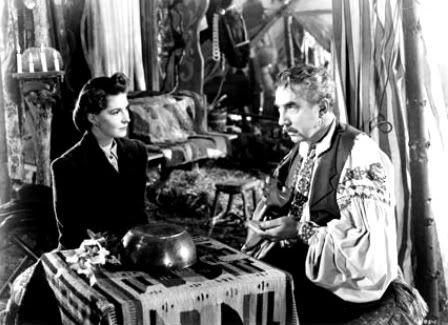
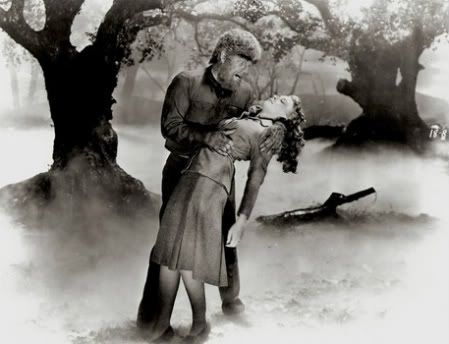
While escorting his sweetheart, the lovely Evelyn Ankers, through a gypsy encampment, he hears the scream of her friend Jenny in the woods, runs to rescue her from a wolf….and gets bitten in the process!

With his newly purchased silver handled wolf-carved cane, he had bludgeoned the wolf to death during the struggle. But lo! the next morning he finds his wound has disappeared and the police are questioning him about the death of Bela (played by the inimitable legend of horror, Bela Lugosi) …..the gypsy he had supposedly mistaken for a wolf. 


To make matters worse, Bela’s mother (Maria Ospenskaya) tells Larry that he will become a wolf as well. But, being our everyday all-American disbelieving film hero, he promptly disregards the wise old gypsy’s warning and the protective charm she gives him, a foolish act that leads him straight into danger. Oh dear, won’t these guys ever learn? 

Filming on The Wolf Man began just before Halloween 1941. It was completed and released in December and went on to become one of the top grossing pictures of the year. 


Dick Foran, a popular B film and cowboy star, was originally intended for the role of Larry Talbot but was replaced one week prior to filming. A good thing too, for Lon Chaney Jr. was very fond and proud of the Wolf Man character and made a career of playing him. He welcomed the opportunity of starring in the many sequels such as Frankenstein Meets the Wolf Man, House of Frankenstein, House of Dracula and the really horrifying classic, Abbott and Costello Meet Frankenstein. 

When Lon Chaney Jr., the son of the famous "Man of a Thousands Faces" Lon Chaney Sr, was offered the lead role in The Wolf Man, he was not yet known for being a horror film actor. He had enjoyed success on stage in Steinbeck's Of Mice and Men and had appeared in the film adaptation in 1939. Chaney was up for the lead in Universal's remake of The Phantom of the Opera in 1940, but alas..it was his Wolf Man father, Claude Rains who won that choice part. Instead, Chaney starred in Man Made Monster (1941) and director George Waggner was so pleased with his performance that he quickly plopped him into his next picture, The Wolf Man. A legendary horror icon was born! 
Although he played an innocent victim of circumstances on screen, off-screen Chaney was quite a hooligan. He had vandalized studio property one day while drunk and, as punishment, Waggner assigned his star dressing room to Ankers. After spending grueling hours having Jack Pierce apply yak hair and a rubber schnozz to him every morning, and then wait another 45 minutes after shooting to have it removed, Chaney was upset at having his dressing room taken. He had a fondness for playing practical jokes and Ankers quickly became the prime recipient of them. He enjoyed sneaking up on her in full makeup and scaring her. One incident, however, was not Chaney's fault....a 600 pound bear which was used in an eliminated sequence, escaped one afternoon from its trainer and chased Ms.Ankers up a ladder. 

Evelyn Ankers - who played Larry's gal Gwenn Conliffe in the film - was known as the “Scream Queen” of the 1940s and was very busy that decade making horror films such as The Ghost of Frankenstein, Son of Dracula, and The Invisible Man’s Revenge. She also starred in a couple entries in the popular Universal Sherlock Holmes film series: The Pearl of Death and Sherlock Holmes and the Voice of Terror. 


The Wolf Man was not the first film to feature hairy lycanthropes. Six years earlier Universal had made The Werewolf of London starring Henry Hull as a botanist who receives that notorious wolf bite while hunting for a rare flower in the mountains of Tibet. 

This film did not gross much at the box-office, so Universal so they gave it another try and in 1941 the viewing public was much more gullible and embraced The Wolf Man. It was released just days after the attack on Pearl Harbor so it proved to be escapism at its finest. To this day it remains a classic and justly so; with its smothering foggy atmosphere, superb supporting cast (including Claude Rains, Ralph Bellamy, Warren William and Patric Knowles), and excellent set design it leaves a lasting impression. So much so that when the autumn moon is bright, our thoughts naturally turn to the Wolf Man of the night.


This post is our contribution to The Chaney Blogathon, a celebration of father-and-son and the memorable ( and forgettable ) films that they made. The Last Drive-In and Movies Silently have teamed up to host this event, so don't linger around here...head on over to either of their blogs to view a complete schedule of posts!

Monday, November 18, 2013

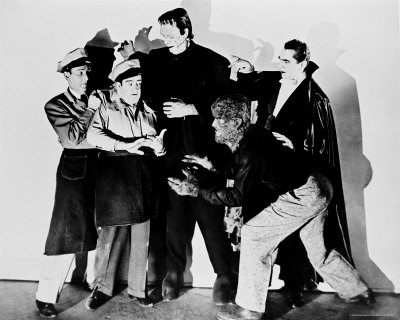
Abbott and Costello Meet Frankenstein ( 1948 )

The Bob Hope classic, The Cat and the Canary ( 1939 ), was one of the first films to successfully combine comedy with mystery and horror. It was such a hit that Paramount quickly plopped the dynamic duo of Hope and Goddard into yet another comedy horror film, The Ghost Breakers ( 1940 ). These films launched an entire genre of pairing comedy stars in horror films, and of all the movies that emerged from this genre,  none was more popular than Bud Abbott and Lou Costello Meet Frankenstein ( 1948 ).

Universal studios had made their mark in cinema history with their horror classics such as Dracula ( 1931 ), Frankenstein ( 1931 ), The Mummy ( 1932 ), The Invisible Man ( 1933 ), , and The Wolf Man ( 1941 ). These monster movies were so successful that a string of sequels were made for each film. Unfortunately, some of these were not up to par with the originals and by 1946 the producers at Universal sensed that the monster era was coming to a close. Sigh....parting with old ( and prosperous ) friends is such sweet sorrow. 


As early as 1943, Abbott and Costello was toying around with an idea of doing a Broadway show co-starring the famous monsters. Their busy filming schedule at Universal did not allow enough time for the team to mount a live production, but by the late 1940s the ideal opportunity presented itself. Universal embraced the idea of the comedy using the monsters and after several story outlines were developed and discarded ( one by Bertram Milhauser, the screenwriter on numerous Sherlock Holmes films ), an idea by Frederic I. Rinaldo and Robert Lees hit home. Everyone was pleased with the new story except for Lou Costello. As producer Robert Arthur recalled, "Lou hated the script. 'My [ five-year old ] daughter could write a better script than this. You're not serious about making it, are you?' he said" 

Yep, they were. Arthur promised Costello his favorite director, Charles Barton, a tidy sum ( Abbott and Costello were paid $105,000 ), and by the time shooting began in early February 1948, Costello had warmed up to the film. 

What was this sure-fire plot? Abbott and Costello play baggage clerks at a Florida railway station. Mr. McDougal ( Frank Ferguson ), who operates the local House of Horrors, is expecting a shipment of large crates from Europe which he wants delivered in person to his wax museum. Before leaving the warehouse, the duo receive a phone call from Laurence Talbot warning them not to deliver those crates. "They must be destroyed!". This is about the only dialogue poor Larry gets to utter throughout the film. Of course, Larry knows best. The crates contain the coffin - and body - of Dracula, as well as Dr. Frankenstein's Monster. 


When Chick and Wilbur unpack the crates at the wax museum that night, Wilbur sees both the Dracula and the Monster come alive. But before he can convince Chick of what is going on, the fiends escape to Dracula's castle ( yes, he had a castle in Florida too evidently! ) where Sandra Mornay ( Lenore Aubrey ) is waiting. Dracula and Miss Mornay, a surgeon, have teamed up to create the ultimate mind-controlled Monster, but...unlike Dr. Frankenstein, who used the brain of an intelligent man in his experimentations with the original Monster, Miss Mornay intends on using the brain of a man much more innocent and ignorant, someone "with no will of his own, no fiendish intellect". Hmm...who's brain could they have in mind for that? 


With the aid of Laurence Talbot, Chick and Wilbur attempt to destroy Dracula and the Monster before they can steal Wilbur's brain. Little do they know that Talbot transforms into a hairy lycanthrope when the moon is full and bright....and there's an awful lot of full moons in this film!

"Chick! Oh Chick, oooh Chick!!" 


Some of the plot gets a bit muddled up during the film but as most A&C fans know, the story always takes a backseat to the dynamic duo's gags. And this flick is chock full of 'em....memorable one-liners, the famous moving candle routine ( recycled from Hold that Ghost ), Bud's customary slaps, and Costello's inimitable fright-takes. Alas, the script left little room for the team to do any of their famous rapid-fire repartee.

Reprising the classic roles that made them famous in earlier Universal Studio outings were Bela Lugosi as Dracula, Lon Chaney Jr. as the Wolf Man and Glenn Strange as Frankenstein's Monster.


No one could play the tormented Laurence Talbot as well as Lon Chaney Jr. and there was no doubt that he would accept the part, an opportunity to return to one of his favorite screen roles. Unlike the previous Wolf Man films, Chaney's makeup was applied by Bud Westmore and Jack Kevan. Make-up maestro Jack P. Pierce, who had done work on all the previous Universal classic monster films, was notoriously cantankerous and difficult to work with. His makeup applying techniques were extremely time-consuming, often taking several hours every morning to prepare just one monster. Since this film including several monsters in one scene, the production would have been held up for weeks. Bud Westmore, Pierce's protege, was a pioneer at the more comfortable ( and time-saving ) foam latex technique and Old Wolfie and Dracula never looked as good as they did in this classic comedy. 


As for the Monster....Boris Karloff, who had long since retired from playing the part, refused to reprise his role because he feared the film would be a parody of the empathetic beast he had helped to create. He agreed to cooperate and help promote the final picture but refused to watch it, "I'm too fond of the monster. I'm grateful to him for all he did for me, and I wouldn't like to watch anybody make sport of him". Instead, Glenn Strange took over as the Monster. Strange was the fourth actor to play the man-made human pastiche and had played the role in The House of Frankenstein ( 1944 ) and The House of Dracula ( 1945 ). 

Bela Lugosi, who was slated to revive his immortal portrayal of the sanguinary count after a 17 year absence, harbored the same doubts as Karloff but was relieved upon reading the script, "There is no burlesque for me. All I have to do is frighten the boys, a perfectly appropriate activity. My trademark will be unblemished."


Perhaps it was Lugosi who frightened the comedy duo on screen, but off screen it was quite another story. As director Charles Barton recalled, "There were time when I thought Bela was going to have a stroke on the set. You have to understand that working with two zanies like Abbott and Costello was not the normal Hollywood set. They never went by the script and at least once a day there would be a pie fight. Bela of course would have nothing to do with any of this. He would just glare at those involved with his famous deadly stare and the only emotion he would show physically was one of utter disgust."


Glenn Strange and Lon Chaney Jr. enjoyed circulating around the studio in full costume. At the time, Peabody and the Mermaid and One Touch of Venus were in production and it was not unusual for tourists on the Universal backlot tours to spy a few stray monsters meandering around outside the sound stages. 

Production wrapped in just under two months and Bud Abbott and Lou Costello Meet Frankenstein was released on June 15, 1948 to packed theatre houses across America. The film received rave reviews, with The Hollywood Reporter setting the tone when they proclaimed it "a crazy, giddy show that combines chills and laughs in one zany sequence after another". 

Today the Abbott and Costello Meet Frankenstein has grown in popularity and transformed into a cult status. The film is sub par to some of Abbott and Costello's earlier hits, but the overall monster theme is such a delight that it has consistently risen to the top of fan's favorites. In 2001, The National Film Registry added the title to their list of films selected for future preservation, deeming it "culturally, historically and aesthetically significant". Even Dracula would have been pleased with this. 


This post is our contribution to the fabulous Chaney Blogathon, a celebration of the legendary Lon Chaney senior and junior who made their mark in horror films of the 1920s-1960s. Check out the complete schedule at The Last Drive-In or Movies Silently to read more great posts on the Chaneys.