Showing posts with label Boris Karloff. Show all posts

Saturday, October 5, 2024

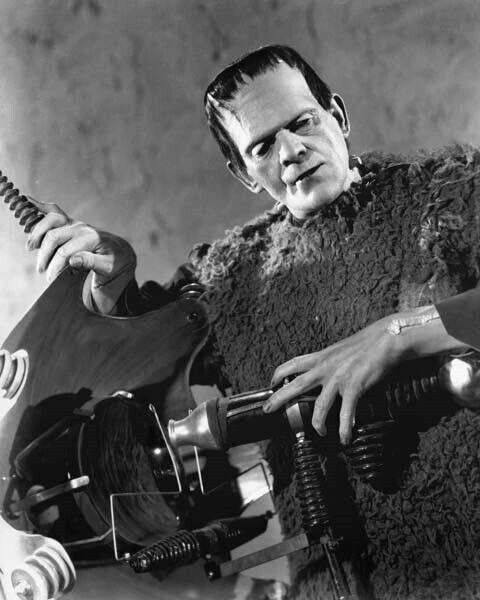
From the Archives: Son of Frankenstein (1939)

Boris Karloff as the famous "Monster" from the Frankenstein films (in this photo, The Son of Frankenstein). The make-up for all of the early Frankenstein movies was done by Jack Pierce, whom you could read more about in our previous articles here

From the Archives is our latest series of posts where we share photos from the Silverbanks Pictures collection. Some of these may have been sold in the past, and others may still be available for purchase at our eBay store: http://stores.ebay.com/Silverbanks-Pictures

Thursday, October 30, 2014

The Mummy Trilogy

O Amon-Ra. O God of Gods. Death is but the doorway to new life —we live today; we shall live again….In many forms shall we return, O mighty one."
With these immortal utterances from the Scroll of Thoth, impetuous assistant Ralph Norton ( Branwall Fletcher ) conjured up to life the embalmed remains of 3,700 year old Im-ho-tep, an Ancient Egyptian priest. Shrouded in musty, tattered strips of cloth, Im-ho-tep’s eyes sleepily awoke to gaze at his resurrector before walking off with the scroll in quest of the reincarnation of the soul of his love, Princess Ankh-es-en-amon.
Before he ventures off to Cairo to search for his beloved he removes his bandaged covering and guises himself as a modern Egyptian….an Egyptian who bears a striking resemblance to none other than - Boris Karloff. Zoinks!
The 1932 version of The Mummy created by Dracula director Carl Laemmle Jr. started a box-office bonanza of mummy sagas which spanned over 80 years. To this day he remains quite a powerful character of horror despite his relatively recent creation. Whilst fiendish foes like our sanguinary Count Dracula or the Wolf Man or Frankenstein were developed from legends dating from the 1700-1800s, The Mummy was a character conceived solely for the purpose of this film.

Universal Studio’s story editor Richard Shay was commissioned by Carl Laemmle Jr. to write a Egyptian-themed horror story loosely based on the mystery surrounding the opening of King Tutankhamen’s tomb in 1922. Laemmle was pleased with a nine-page treatment Shay and writer Nina Wilcox Putnam developed about a 3,000 year old magician who never dies and hired John L. Balderstone to write a script surrounding it…he changed the name of our mummy to Im-ho-tep, after the famous architect of the period and history was made.
Although The Mummy was not favored by critics at the time of its release it still remains a cult horror classic and Universal saw enough potential in the story line to resurrect it in a re-make only eight years later, The Mummy's Hand. Unlike the first film, the Mummy remains under-cloth until his supposed demise at the finale of the film.

“ Anck-es-en-Amon, my love has lasted longer than the temples of our gods. No man ever suffered as I did for you. ”
Of course, with all good stories one re-telling is simply not enough and so out popped The Mummy's Tomb in 1942, a completely new take on the story. The writers even went so far as changing the mummy's name from Im-ho-tep to Kharis! This film was set in Massachusetts in the 1970s and featured Lon Chaney Jr. as the mummy, a role he was to reprise in the next two sequels.

The Mummy's Hand ( 1940 ) Western star Tom Tyler portrays the obedient Kharis who, with the aid of a little tana-leaf tea, is sent to kill the defilers of an Egyptian tomb ( played that other Western star, Dick Foran ). George Zucco co-stars as the control-agent of the ancient assassin, and Peggy Moran as his look-alike lover.
The Mummy's Tomb ( 1942 ) - Lon Chaney Jr. gets all wrapped up in the role of the mummy when he is taken to New England by an Egyptian priest to once again revenge the archeologists who defiled his tomb. Tsk, tsk, tsk…those archeologists are something else. Dick Foran, Turhan Bey and Elyse Knox star.
The Mummy's Ghost ( 1943 ) - While experimenting with the Egyptian practice of burning tana-leaves during a full moon to revive a mummy, a college professor "calls" the mummy to himself...it just so happens that one of the students at the college resembles his long-lost love, Princess Ananka. What a small world! Lon Chaney Jr., John Carradine, Ramsay Ames, and Robert Lowery star.
The Mummy's Curse ( 1944 ) – By some inexplicable happening, the mummy and his ancient princess Anaka are found in a swamp in Louisiana by a construction crew – after they died in a bog in Massachusetts in the last film! In spite of this slight oversight, this film abounds with Bayou atmosphere and contains some great scenes. Dennis Moore, Holmes Herbert, Martin Kosleck, Kay Harding.
In 1958, Hammer Studios, the famed British film company known for horror films began a series of monster classics based on the original Universal Films..... The Curse of Frankenstein ( 1957 ) starring Christopher Lee, The Horror of Dracula ( 1958 ) also starring Christopher Lee, and of course The Mummy ( 1959 ) starring - you guessed it - Christopher Lee. This time shot in Eastmancolor it basically followed the same story line as The Mummy's Hand...namely, a follower of an Egyptian god of yore seeks out to revenge the sacrilege of the princess's tomb by sending the Mummy out to annihilate those who desecrated her gravesite. In this case, it is Stephan Banning and his expedition ( Peter Cushing, Felix Aylmer, and Raymond Huntley ) Once again the success of this film inspired a series of continuing stories....
The Mummy ( 1958 ) – Quite simply a colorized version of The Mummy’s Hand and the Mummy’s Tomb combined, although it has a nice twist at the end with Peter Cushing’s wife bearing a striking resemblance to Princess Anaka and thus saving him from strangulation.
Curse of the Mummy's Tomb ( 1964 ) – European Egyptologists discover the tomb of the ancient prince Ra and are intent on shipping the artifacts to London…against the wishes of someone dead intent on making sure they remain at their rightful place in Egypt. Ronald Howard, Fred Clark, Jeanne Roland, and Terence Morgan star.
The Mummy’s Shroud ( 1966 ) – Once again, The Mummy’s Hand remade. The only standout feature in this film is its corny tagline… “ Beware the beat of the cloth-wrapped feet! ” Starring Andre Morell, John Phillips, and Elizabeth Sellars.
Blood from the Mummy’s Tomb ( 1971 ) – In this retelling of the story there is quite a notable change…the mummy is not a man but a mommy! Yes, the shapely Valerie Leon portrays Queen Tera, an ancient Egyptian queen known for her magical powers. She has a few immortable powers up her sleeve too. James Villiers and Andrew Kier co-star.
But wait there's more! Ah yes, we come to the third set in the Mummy Trilogy. For all the little tikes that weren't born in the golden age of film Universal conjured up a new series of action-adventures in 1999 surrounding our beloved wrapped-up ghoul.
The Mummy ( 1999 ) – An English librarian and an American Foreign Legion officer accidentally unleash the curse of the ancient high-priest Im-ho-tep and must fight off the life-sucking mummy. Brendan Fraser, Rachel Weisz and John Hannah star.
The Mummy Returns ( 2001 ) – In Ancient Egypt, the Scorpion King sold his soul to the god Anubi and was forgotten forever…until that is, Rick ( Brendan Fraser ) and his wife and son discover the bracelet of Anubis which leads them to oasis of Ahm Shere and the Scorpion King and his jackal headed henchmen’s revival. Rachal Weisz, John Hannah and Arnold Vosloo costar.
The Mummy: Tomb of the Dragon Emperor ( 2008 ) – The O’Connell family are once again fighting dead people, this time in the Far East where they must battle with a shape-shifting Samurai emperor cursed many a year ago by a witch. Brendan Fraser, Jet Li and Luke Ford star.


 Well, I think this here blog wraps up the trilogy series quite well...pardon the pun.
“ Death is only the beginning ”

Friday, October 24, 2014

The Faces of Jack Pierce

Jack Pierce himself only had one face, one which wasn't particularly liked in Hollywood, but - as a makeup artist - Pierce created many faces. So many that the few we will highlight in this post will only scratch the grease-painted surface of this man's talent. 

These days Pierce is best remembered for his work in the creation of the "look" of the Universal monsters with the exception of The Creature from the Black Lagoon. It is for this work that he - posthumously - earned a lifetime achievement award from the Hollywood Make-Up Artist and Hairstyle Guild. 

Jack Pierce was born in Greece in 1889 ( he was christened Janus Piccoulas by birth ) and came to America with his parents in the early 1900s. He started in the film industry working as a projectionist and then a stuntman before becoming an actor. Between 1915 and 1925 he played in twelve different films, usually being cast as a villain.

Pierce often applied his own makeup while being an actor and he enjoyed creating different effects to detract from his shortness ( he was 5' 5" ). He got his first chance at applying makeup to other actors when he stepped in to transform actor Jacques Lernier into a speaking simian for his role in Raoul Walsh's The Monkey Talks ( 1926 ). This work was observed by Carl Laemmle who hired him full-time at Universal, where one of his very first assignments was applying the makeup for Conrad Viedt in The Man Who Laughs ( 1928 ). 

In 1930, Pierce was assigned to work on Dracula and created a special color greasepaint for the sanguinary count, portrayed by Bela Lugosi. However, Lugosi had always applied his own makeup ( a common practice for stage actors ) and so he refused to let Jack Pierce do his makeup. Lugosi reflected later that Pierce got his revenge on him when he designed such torturous makeup as Ygor and the Frankenstein for him to wear. 


The 1930s 


Frankenstein ( 1931 )

It was during the 1930s that Pierce rose to fame beginning with his work on The Monster in Carl Laemle Jr.'s FrankentsteinMary Shelley wasn't all too specific about the Monster's appearance in her 1818 novel, and so Pierce let his imagination run free and decided to give the pastiched character a flat-topped head with very heavy eyelids. A nice sleepy look. Unfortunately for Karloff, the makeup application was a six hour process involving the attachment of a skullpiece for the black hair, then a layer of cotton and spirit gum for the forehead, followed by a glob of specially designed putty around the eyes, a nice dirty scar, some electrifying bolts, and a topping of green-grey greasepaint. Karloff personally contributed the sunken cheekbones by having a dental bridge removed. 


Murders in the Rue Morgue ( 1932 )

This juicy horror flick gave Pierce a chance to paint Bela Lugosi an entirely different face. The bushy eyebrows of the Count can be seen again, but now they are connected with a bridge of hair, making Dr. Mirakle look like he has one giant eyebrow. 


White Zombie ( 1932 ) 

Once again Bela got to sit in the makeup chair, with Jack Pierce transforming him this time into the devilish voodoo master, Murder Legendre. With curling beard strands, heavy dark eyebrows and a very low widow's peak, Murder was a character guaranteed to frighten women and children out of the theatres. 


The Mummy ( 1932 ) 

Karloff thought the Monster was an elaborate makeup process, but The Mummy offered him a chance to really test his patience. It was complete head-to-toe makeup application. The wrappings of the mummy were treated with flames and acid to age it properly then dipped in collodion ( a strong smelling liquid plastic ) and stretched over Boris Karloff's face. Pierce applied Fuller's Earth over the wrappings after it was dried to give it an "arid" look. Check out this great article on the mummifying process, originally printed in Mechanix magazine. 


The Invisible Man ( 1933 ) 

There really wasn't much monster makeup involved in The Invisible Man, but the coloring applied to all of the supporting players really enhanced the look of the film. This scene doesn't display any of Pierce's skill, just Una O'Connor's facial expression was so good we had to include it. 


The Bride of Frankenstein ( 1935 ) 

One of the reasons that Jack Pierce was not very much loved in the Hollywood circle was because he was such a demanding make-up artist. Film Historian Greg Mank interviewed Elsa Lanchester at one time and this is what she had to say about the Bride's makeup process, " [Pierce] took ages to make a scar that hardly shows under my chin. For a whole hour he would draw two lines of glue, put a red line down the middle, then start making up the white edges of the scar - meticulously done. Well, frankly, I'm sure he could have bought such a scar for ten cents in a joke shop.....After the scar came the eyebrows, and the hair. It's my own hair. I had it lifted up from my face, all the way around; then they placed a cage on my head and combed my own hair over that cage. Then they put the gray-streak hairpieces in afterwards."


The Werewolf of London ( 1935 ) 

This was the first of the Universal "wolf man" films, even though it often gets overlooked in favor of the Lon Chaney version. Henry Hull, who was cast in the title role, objected to Pierce's original concept of how Wolfie should look, claiming that it obscured his features. The final design pleased both Pierce and Hull even though it left barely a resemblance to the actor.
                   _____________________________________________________

In addition to all of these monster classics, Jack Pierce was kept busy working as the makeup artist for Great Expectations ( 1934 ), Diamond Jim ( 1935 ), Magnificent Obsession ( 1935 ), Show Boat ( 1936 ), and Three Smart Girls ( 1936 ), to name a few. 


The 1940s 


The 1940s was Pierce's busiest decade and he worked on all of the Mummy sequels ( regardless of Chaney's personal dislike for him ), the Frankenstein sequels, and the Dracula sequels. He also created some menacing new faces in films like Man Made Monster ( 1941 ) The Phantom of the Opera ( 1943 ), The Mad Ghoul ( 1943 ) and Cobra Woman ( 1944 ).

The Wolf Man ( 1941 ) 

For Universal's second venture into lycanthrope land, Pierce created an entirely different look for the "wolf man", adding much more hair around the cheekbones and a bushy head of hair. Chaney reportedly hated working with Pierce due to the tedious transformation process he made him undergo, which included having yak hair glued to his face. 


The Scarlet Claw ( 1944 )

This film was the eighth entry in the popular Universal Sherlock Holmes series starring Basil Rathbone and Nigel Bruce. The detective duo set out to the backwoods of Canada to capture a criminal who was once a former actor ( and a makeup artist himself ) and this fellow uses his skill to create different identities for himself, one of which is a fleeting glowing shadow in the marshland. Holmes got to try out some disguises himself and in this scene he is seeing if Watson can recognize him as a messenger. We can't even recognize him as being Rathbone.

In addition to working on The Scarlet Claw, Pierce also designed the makeup for four other Sherlock Holmes films. By the mid-1940s however, mystery and horror films were beginning to wane with the public taste. Pierce found himself doing the work of an everyday Hollywood makeup artist and applying cakes of powder and rouge to celebrities such as Deanna Durbin ( Because of Him, I'll Be Yours ), Susan Hayward ( Canyon Passage, Smash Up: The Story of a Woman ) and Abbott and Costello ( Little Giant and The Time of Their Lives ).

The 1940s brought about unwanted change for a traditionalist like Jack Pierce. Younger makeup artists were dropping the "out of the kit" techniques in favor of the quicker and more comfortable latex forms. Studio heads at Universal were in favor of these techniques because they saved time and cost during the making of a film. Pierce held on to his style and was eventually let go from Universal in 1946. 

Jack Pierce turned to doing television work in the early 1950s and when budget monster classics became the rage in the latter years of the decade he once again took to creating monsters. Some of these included the Beast ( Beauty and the Beast ), The Amazing Transparent Man, and burly conquistador in The Giant from the Unknown. His final work was on Mister Ed, where he was the show's regular makeup artist.

Monday, November 18, 2013

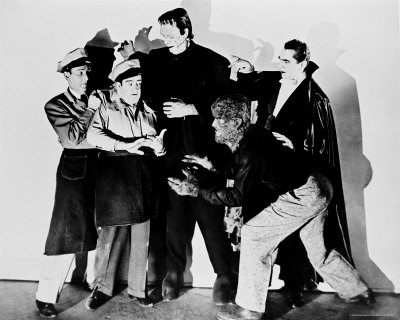
Abbott and Costello Meet Frankenstein ( 1948 )

The Bob Hope classic, The Cat and the Canary ( 1939 ), was one of the first films to successfully combine comedy with mystery and horror. It was such a hit that Paramount quickly plopped the dynamic duo of Hope and Goddard into yet another comedy horror film, The Ghost Breakers ( 1940 ). These films launched an entire genre of pairing comedy stars in horror films, and of all the movies that emerged from this genre,  none was more popular than Bud Abbott and Lou Costello Meet Frankenstein ( 1948 ).

Universal studios had made their mark in cinema history with their horror classics such as Dracula ( 1931 ), Frankenstein ( 1931 ), The Mummy ( 1932 ), The Invisible Man ( 1933 ), , and The Wolf Man ( 1941 ). These monster movies were so successful that a string of sequels were made for each film. Unfortunately, some of these were not up to par with the originals and by 1946 the producers at Universal sensed that the monster era was coming to a close. Sigh....parting with old ( and prosperous ) friends is such sweet sorrow. 


As early as 1943, Abbott and Costello was toying around with an idea of doing a Broadway show co-starring the famous monsters. Their busy filming schedule at Universal did not allow enough time for the team to mount a live production, but by the late 1940s the ideal opportunity presented itself. Universal embraced the idea of the comedy using the monsters and after several story outlines were developed and discarded ( one by Bertram Milhauser, the screenwriter on numerous Sherlock Holmes films ), an idea by Frederic I. Rinaldo and Robert Lees hit home. Everyone was pleased with the new story except for Lou Costello. As producer Robert Arthur recalled, "Lou hated the script. 'My [ five-year old ] daughter could write a better script than this. You're not serious about making it, are you?' he said" 

Yep, they were. Arthur promised Costello his favorite director, Charles Barton, a tidy sum ( Abbott and Costello were paid $105,000 ), and by the time shooting began in early February 1948, Costello had warmed up to the film. 

What was this sure-fire plot? Abbott and Costello play baggage clerks at a Florida railway station. Mr. McDougal ( Frank Ferguson ), who operates the local House of Horrors, is expecting a shipment of large crates from Europe which he wants delivered in person to his wax museum. Before leaving the warehouse, the duo receive a phone call from Laurence Talbot warning them not to deliver those crates. "They must be destroyed!". This is about the only dialogue poor Larry gets to utter throughout the film. Of course, Larry knows best. The crates contain the coffin - and body - of Dracula, as well as Dr. Frankenstein's Monster. 


When Chick and Wilbur unpack the crates at the wax museum that night, Wilbur sees both the Dracula and the Monster come alive. But before he can convince Chick of what is going on, the fiends escape to Dracula's castle ( yes, he had a castle in Florida too evidently! ) where Sandra Mornay ( Lenore Aubrey ) is waiting. Dracula and Miss Mornay, a surgeon, have teamed up to create the ultimate mind-controlled Monster, but...unlike Dr. Frankenstein, who used the brain of an intelligent man in his experimentations with the original Monster, Miss Mornay intends on using the brain of a man much more innocent and ignorant, someone "with no will of his own, no fiendish intellect". Hmm...who's brain could they have in mind for that? 


With the aid of Laurence Talbot, Chick and Wilbur attempt to destroy Dracula and the Monster before they can steal Wilbur's brain. Little do they know that Talbot transforms into a hairy lycanthrope when the moon is full and bright....and there's an awful lot of full moons in this film!

"Chick! Oh Chick, oooh Chick!!" 


Some of the plot gets a bit muddled up during the film but as most A&C fans know, the story always takes a backseat to the dynamic duo's gags. And this flick is chock full of 'em....memorable one-liners, the famous moving candle routine ( recycled from Hold that Ghost ), Bud's customary slaps, and Costello's inimitable fright-takes. Alas, the script left little room for the team to do any of their famous rapid-fire repartee.

Reprising the classic roles that made them famous in earlier Universal Studio outings were Bela Lugosi as Dracula, Lon Chaney Jr. as the Wolf Man and Glenn Strange as Frankenstein's Monster.


No one could play the tormented Laurence Talbot as well as Lon Chaney Jr. and there was no doubt that he would accept the part, an opportunity to return to one of his favorite screen roles. Unlike the previous Wolf Man films, Chaney's makeup was applied by Bud Westmore and Jack Kevan. Make-up maestro Jack P. Pierce, who had done work on all the previous Universal classic monster films, was notoriously cantankerous and difficult to work with. His makeup applying techniques were extremely time-consuming, often taking several hours every morning to prepare just one monster. Since this film including several monsters in one scene, the production would have been held up for weeks. Bud Westmore, Pierce's protege, was a pioneer at the more comfortable ( and time-saving ) foam latex technique and Old Wolfie and Dracula never looked as good as they did in this classic comedy. 


As for the Monster....Boris Karloff, who had long since retired from playing the part, refused to reprise his role because he feared the film would be a parody of the empathetic beast he had helped to create. He agreed to cooperate and help promote the final picture but refused to watch it, "I'm too fond of the monster. I'm grateful to him for all he did for me, and I wouldn't like to watch anybody make sport of him". Instead, Glenn Strange took over as the Monster. Strange was the fourth actor to play the man-made human pastiche and had played the role in The House of Frankenstein ( 1944 ) and The House of Dracula ( 1945 ). 

Bela Lugosi, who was slated to revive his immortal portrayal of the sanguinary count after a 17 year absence, harbored the same doubts as Karloff but was relieved upon reading the script, "There is no burlesque for me. All I have to do is frighten the boys, a perfectly appropriate activity. My trademark will be unblemished."


Perhaps it was Lugosi who frightened the comedy duo on screen, but off screen it was quite another story. As director Charles Barton recalled, "There were time when I thought Bela was going to have a stroke on the set. You have to understand that working with two zanies like Abbott and Costello was not the normal Hollywood set. They never went by the script and at least once a day there would be a pie fight. Bela of course would have nothing to do with any of this. He would just glare at those involved with his famous deadly stare and the only emotion he would show physically was one of utter disgust."


Glenn Strange and Lon Chaney Jr. enjoyed circulating around the studio in full costume. At the time, Peabody and the Mermaid and One Touch of Venus were in production and it was not unusual for tourists on the Universal backlot tours to spy a few stray monsters meandering around outside the sound stages. 

Production wrapped in just under two months and Bud Abbott and Lou Costello Meet Frankenstein was released on June 15, 1948 to packed theatre houses across America. The film received rave reviews, with The Hollywood Reporter setting the tone when they proclaimed it "a crazy, giddy show that combines chills and laughs in one zany sequence after another". 

Today the Abbott and Costello Meet Frankenstein has grown in popularity and transformed into a cult status. The film is sub par to some of Abbott and Costello's earlier hits, but the overall monster theme is such a delight that it has consistently risen to the top of fan's favorites. In 2001, The National Film Registry added the title to their list of films selected for future preservation, deeming it "culturally, historically and aesthetically significant". Even Dracula would have been pleased with this. 


This post is our contribution to the fabulous Chaney Blogathon, a celebration of the legendary Lon Chaney senior and junior who made their mark in horror films of the 1920s-1960s. Check out the complete schedule at The Last Drive-In or Movies Silently to read more great posts on the Chaneys.