Showing posts with label Universal Horror. Show all posts

Friday, October 9, 2026

The Universal Monsters Mystery Games of 1963

Hasbro is one of the largest toy and game manufacturers in the world today, but when they first started (back when they were labeled the Hassenfeld Brothers) they were primarily known as a toy maker and barely dabbled in the gaming industry. The few games that they did release met with little success. 

However - just like today - the Hassenfeld Brothers knew that any game would sell if it had a popular Movie/TV theme linked with it. So what would be popular with children in the early 1960s? Monsters! And what kind of monsters? The good ol' Universal monsters: Dracula, Frankenstein, The Mummy, The Creature from the Black Lagoon, etc, etc. So, in 1963, Hasbro released a board game for each of these famous monsters.... the only one that was missing was The Invisible Man. 

The Mummy Mystery Game

"Explore the Ancient Crypts of Egypt" teases the front box, but inside it is a simple spin-and-move game where you land on spaces marked "Take a Crypt Card" and must reach the end with 10 of these. Getting caught by the Mummy simply holds you back a little in this race game. The highlight of the game is the board itself with its marvelous painted mummy and the Egyptian desert scene. 

The Creature from the Black Lagoon Mystery Game

This game's object is "to escape from the Black Lagoon" but it appears that the fun part of the game is getting caught by the creature and being taken to its cave, so so much for wanting to escape....

Dracula Mystery Game

This one features some great early 1960s color schemes and once again is a simple roll-and-move race game. It appears that the players are attempting to escape Dracula's Castle and he has his own spinner as well, so he probably foils you if you are not lucky. Too bad he didn't "bite" your character and then you have to chase your opponents down and land on their space to turn them into vampires as well. That would be too imaginative a game for Hasbro. 


Frankenstein Mystery Game

This is another race game whose graphics are better than the game itself. Oddly enough, all of these games have the players using cardboard standees of the monsters as their own playing pieces and yet trying to escape from the monster via the board route. This one has little Monsters that are placed on a stylized German village. 


Wolfman Mystery Game

Another not-too-imaginative game involving the Wolf Man. Here players race to get from one camp to another and pass various dangers along the way, including a snake pit. Unfortunately, there are no gypsies and no Maria Ouspenskaya chanting the legend, "Even a man who is pure in heart and says his prayers at night....." featured in the game. Too bad....


The Phantom of the Opera Mystery Game

Lastly, there was The Phantom of the Opera and once again it features great art of the ghoulish organist. Sadly, it's pretty much the same game as the others with a simple spinner and playing pieces in the form of the phantom (why would players be dressed as the phantom and attempt to escape the phantom?), with the object being to - you guessed it! - escape the phantom's dungeon. 

Hasbro had the phan-tastic idea of making games themed around the famous Universal monsters - and they probably appealed to youngsters - but they are a little too simple for the 12-year old+ crowd... especially today's 12-year-olds! 

Today, these games are popular among collectors because of its monster theme. The Phantom of the Opera seems to be the rarest among the lot and most of these games fetch between $250-$400 a piece with better condition games topping $900. Now that's scary!

Note: All photos are courtesy of The Board Game Geek website. Check it out to read more about these games. 

Saturday, October 5, 2024

From the Archives: Son of Frankenstein (1939)

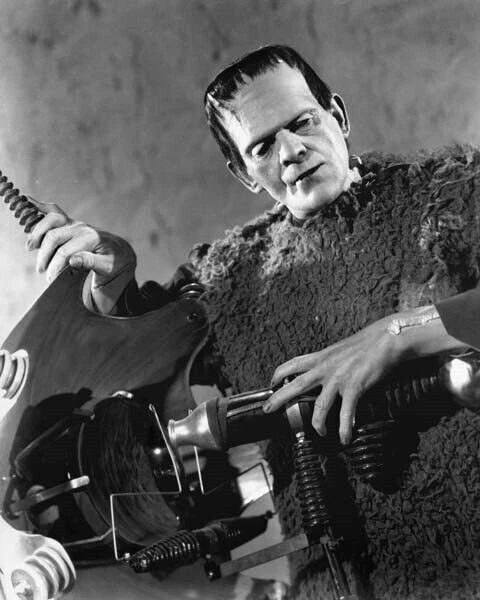
Boris Karloff as the famous "Monster" from the Frankenstein films (in this photo, The Son of Frankenstein). The make-up for all of the early Frankenstein movies was done by Jack Pierce, whom you could read more about in our previous articles here. 

From the Archives is our latest series of posts where we share photos from the Silverbanks Pictures collection. Some of these may have been sold in the past, and others may still be available for purchase at our eBay store: http://stores.ebay.com/Silverbanks-Pictures

Wednesday, October 26, 2022

From the Archives: Werewolf of London ( 1935 )


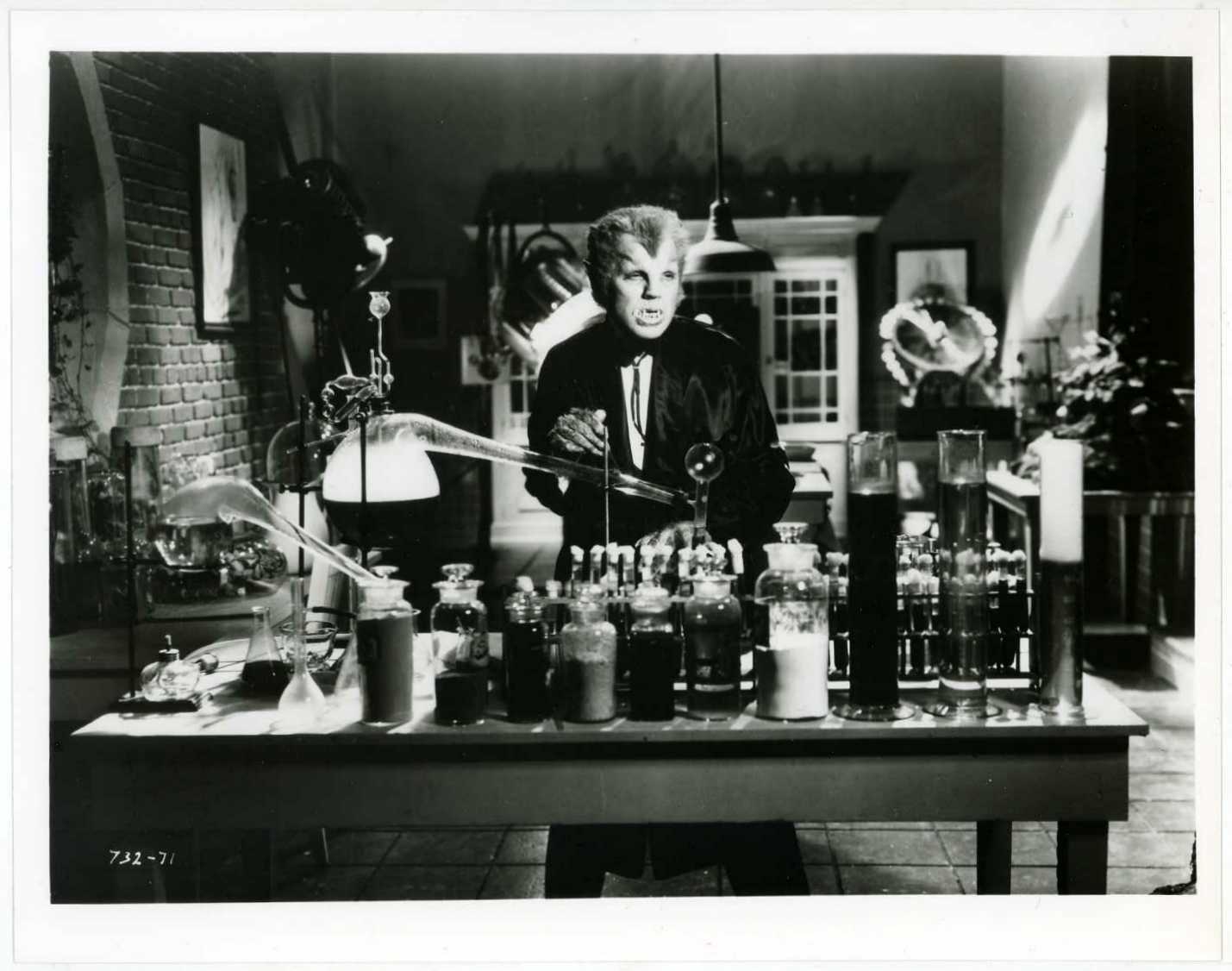
Henry Hull, who usually plays kindly men in films, turned vicious in Universal Pictures' Werewolf of London ( 1935 ). Luckily, his friends and family only had to put up with his fierce lycanthropic side when the moon was full. 

From the Archives is our latest series of posts where we share photos from the Silverbanks Pictures collection. Some of these may have been sold in the past, and others may still be available for purchase at our eBay store : http://stores.ebay.com/Silverbanks-Pictures


Sunday, October 24, 2021

Hold That Ghost! ( 1941 )

Gas station attendants Chuck (Bud Abbott) and Ferdie (Lou Costello) happen to be present when gangster Moose Matson (William Davidson) is shot by the police during a car chase. His last will and testament leave all that he owns to those who are present at his death, hence the boys inherit Moose's fortune which happens to be a rundown roadhouse in the outskirts of town. While checking out the property they inherited, they get stranded there on a stormy night with an odd conglomerate of travelers from the cab they were sharing. Moose's old cronies believe that Matson hid a fortune in the roadhouse and so they attempt to frighten Chuck and Ferdie and the other guests away from the house so they can search for the loot. 

Hold That Ghost was the fourth of 35 films that the comedy team of Abbott and Costello made during the 1940s and 1950s and it ranks as one of their best. It has all the spooktacular features you would want to see in a haunted house comedy plus the added bonus of a great cast. Scream-queen Evelyn Ankers joins the duo as one of the guests at the roadhouse, as does Richard Carlson and slapschtick sensation Joan Davis. Marc Lawrence, one of the most famous film gangsters of the era, plays Charlie Smith who turns up stiff. Also making appearances are Shemp Howard, Mischa Auer, Bobby Barber (who later played Stinky on The Abbott and Costello Show), and Ted Lewis and the Andrews Sisters. 

Abbott and Costello never needed any help from supporting players to add to their comedic fun, but Hold That Ghost is a real treat because of the presence of Joan Davis. This marvelous comedienne made a number of films as a leading star but her best performances were in films where she had a supporting role. In Hold That Ghost, she plays a fellow passenger who is stranded at the inn. Ferdie (Costello) finds her annoying and it is in the scenes where the two banter that most of the humor is to be found. They also share one of the best comedic dance scenes put on film. Davis should have reteamed with Costello in their second mystery-comedy Who Done It? ( 1942 ) but instead that film featured Mary Wickes.

"You boys ready to leave?" - Joan Davis

"I was ready to leave when he put the key in the front door!" - Lou Costello

From its wonderful animated opening credits to its peppy closing number ("Aurora" sung by the Andrews Sisters ), Hold That Ghost never lets up on the laughs. Many of the routines that Abbott and Costello would perform in this film, such as the moving candle trick, were later reused in future films and television episodes. 

The duo had skyrocketed to stardom after their first picture was released just a year earlier and it is amazing how quickly they had to be able to come up with comedy routines thereafter. Universal Studios had screenwriters penning scripts for them and the boys were busy filming month after month. In 1941 alone, four Abbott and Costello movies were released. 


Hold that Ghost, originally titled Oh, Charlie!, was slated to be released right after Buck Privates but when that film became a blockbuster hit for Universal, the studio decided to put Oh, Charlie! on the shelf to give them time to make another service comedy in the vein of Buck Privates. In the Navy was quickly put into production and released right after completion. Since the Andrews Sisters had appeared in both films, it was decided that they would make a great addition to Hold That Ghost as well, so Abbott and Costello were brought back to the studio to film a new opening and closing that featured the singing threesome. 

In spite of the popularity of both Hold That Ghost and Who Done It?, Abbott and Costello did not return to the mystery/horror genre until 1948 when they made Abbott and Costello Meet Frankenstein, which not only brought them back to the top of the box-office charts but launched a series of similarly themed monster comedies....unfortunately, none of which were as good as this gem. 

Friday, October 15, 2021

From the Archives: The Wolf Man ( 1942 )


Poor Larry Talbot, all he wanted was to enjoy himself at the gypsy fair with his newfound sweetheart.  Instead, he got himself cursed and covered from head to toe with hair.....wolf's hair! In this publicity photo from The Wolf Man ( 1942 ), Lon Chaney Jr. dons the makeup of the wolfman and strikes this great pose with a bare tree. 

From the Archives is our latest series of posts where we share photos from the Silverbanks Pictures collection. Some of these may have been sold in the past, and others may still be available for purchase at our eBay store : http://stores.ebay.com/Silverbanks-Pictures

Sunday, October 25, 2020

The Phantom Stage - Universal's Haunted Stage 28

The old story of a phantom haunting a Hollywood sound stage was brought to television in a number of episodes of various series throughout the 1970s-1980s ( most notably in the two-part "The Hollywood Phantom" episode from The Hardy Boys/Nancy Drew Mysteries ) but did you know that this plot idea was actually based on a real legend? 

Stage 28 was one of the oldest sound stages built on the Universal Pictures lot in Hollywood. The studio was planning to film the horror classic The Phantom of the Opera ( featuring Lon Chaney ) and needed a stage large enough to house their own creation of the interior of the Paris Opera House. Construction on the 21,000 square foot stage began in July of 1924 and was completed in a few months. Because the set would need to be able to support hundreds of extras, the stage was built with steel girders in concrete...one of the first steel stages of its kind. The beautiful Opera House set was built inside and filming of The Phantom of the Opera began shortly thereafter. A strange occurrence also happened at that time: an electrician fell to his death, presumably while maneuvering around the catwalks at the top of the stage. 

Years later, rumors began to circulate that the ghost of a "phantom" running along the catwalks was seen. Others reported the lights flickering on and off suddenly and doors opening and shutting. 

The set to the Opera House remained at Stage 28 long after the film was completed. The studio thought that it may come in use in a future production...and indeed it did. Its most famous reappearances were in Todd Browning's Dracula ( as The Royal Albert Hall ), the 1943 color remake of The Phantom of the Opera starring Claude Rains, and the theatre sequences in Charade ( 1963 ). 

Even with the Opera House set still in place, there was plenty of space in Stage 28 to construct other sets and this stage was one of the most used at Universal Studios. The special effects department from The Bride of Frankenstein ( 1935 ) used this stage to film the destruction of Frankenstein's laboratory, Abbott and Costello's Here Come the Co-Eds ( 1945 ) was filmed within its doors, and the interiors of the Bates Motel in Psycho ( 1960 ) was also filmed inside Stage 28. 

In 2014, Universal Studios demolished the stage to make room for expanding their theme park but not before carefully dismantling The Phantom's famous Opera House set and putting it in storage. Perhaps one day, it will reappear in another film or be put on display for film fans to see. 

Wednesday, October 30, 2019

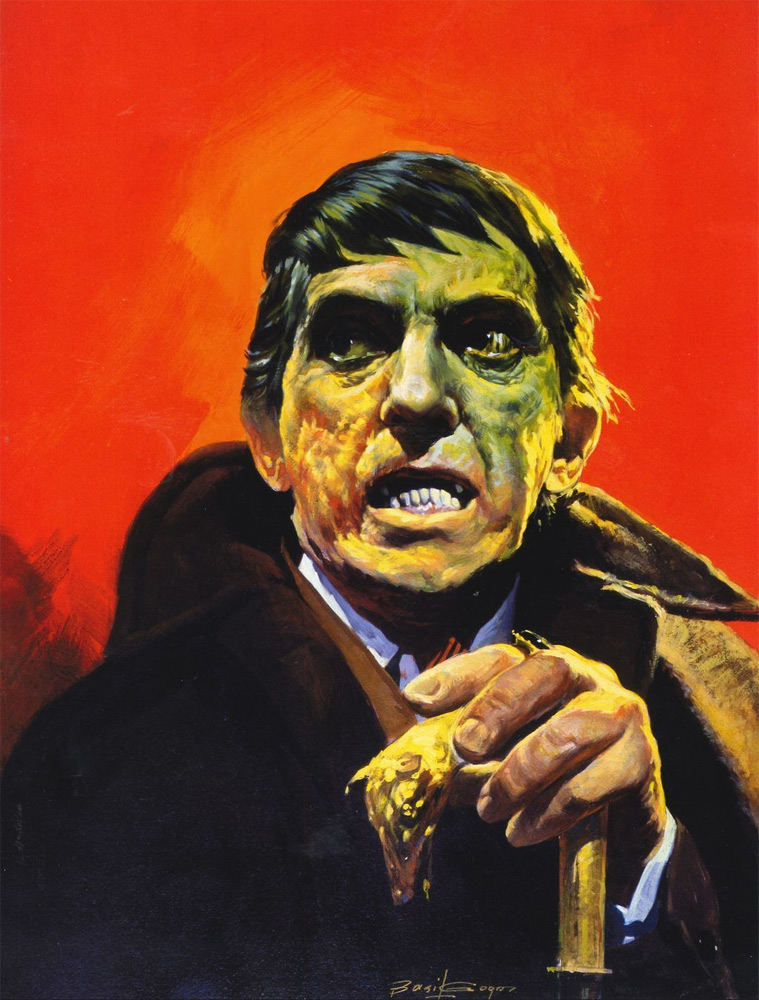
Basil Gogos and the Monster Art of Universal Horror Films

Basil Gogos was a fabulous illustrator who is best known for his movie monster portraits which graced the covers of Famous Monsters of Filmland magazines during the 1960s and 1970s. He combined his passion for art with his love of movie monsters to create these colorful and highly detailed oil portraits of such iconic creatures as Frankenstein's monster, Dracula, and the Wolf Man. 

Gogos was a Greek who came to America at the age of 16 to study art. He worked with the noted illustrator Frank J. Reilly and began his professional career of painting book and magazine covers when he received his first assignment to paint the cover to the western novel "Pursuit" in 1959. 

Throughout the 1960s, Gogos kept busy working as a commercial illustrator. The majority of his paintings were created for men's pulp adventure magazines and the monster magazines being issued by Warren Publishing ( Eerie, Creepy, Famous Monsters of Filmland ). During the 1970s, he took time off as a commercial illustrator to pursue his own personal fine art but still worked part-time at United Artists as a photo retouch artist in the ad department. His monster art found a new audience in the 1990s and Gogos returned to that genre to create more paintings that paid tribute to the great monsters of filmdom. 

Today, his paintings can be found in museums across the world and in two fantastic coffee table books, Famous Monster Movie Art of Basil Gogos by Kerry Gammill and The Monster Art of Basil Gogos by Linda Touby.

Since Halloween is just around the corner, we thought we would share some images of Gogos' best works. Let's begin with Dr. Frankenstein's monster....


THE BRIDE OF FRANKENSTEIN


THE MUMMY


DRACULA


THE WOLFMAN


CREATURE FROM THE BLACK LAGOON


OTHER MONSTERS OF FILM AND TV


THE USPS STAMP SERIES

In the 1990s, Basil Gogos had submitted these designs to the USPS for a Universal Monster series of stamps, but unfortunately, they were not chosen. They would have made fantastic stamps! 

Tuesday, October 23, 2018

Jack Pierce and the Creation of Frankenstein's Monster

The word "Frankenstein" conjures up in most people's mind the image of Dr. Frankenstein's creation, his pastiche of bodily parts that he gave life to. We picture him as a huge fearsome man with a flat head, bolts protruding from his neck, scars on his face, long arms, and wearing tightly fitted clothes and giant heavy boots. This image is often credited to Mary Shelley, the author of the original novel "Frankenstein", published in 1818. But is this creature really her creation or Jack Pierce's, the make-up artist who re-imagined Frankenstein for the 1931 Universal horror picture?

As Mary Shelley describes Dr. Frankenstein's creation, he seems to have been intended as quite a handsome fellow but what resulted was not what the doctor had ordered: 

"His limbs were in proportion, and I had selected his features as beautiful. Beautiful! Great God! His yellow skin scarcely covered the work of muscles and arteries beneath; his hair was of a lustrous black, and flowing; his teeth of a pearly whiteness; but these luxuriances only formed a more horrid contrast with his watery eyes, that seemed almost of the same color as the dun-white sockets in which they were set, his shriveled complexion and straight black lips."

Black flowing hair, watery white eyes, a shriveled complexion, and black lips.....quite a horrible sight, indeed! 

Charles Stanton Ogle as the "monster" ( 1910 )

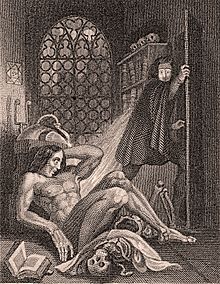
The first illustrations for the book - steel engravings dating from the 1831 edition - display the size of the creature, his thin skin covering, and his long black hair ( see illustration above ). Other drawings show him wearing a cloak, a toga-like covering. 

For the first film adaptation, made in 1910 by Edison Studios, the monster had a grotesque face hidden under mounds of unruly strands of hair and long deformed fingers. As you can see in the close-up, he was beastly. In 1920, an Italian silent film Il mostro di Frankenstein - now considered lost - portrayed him as a bald giant with facial features not unlike the Deutsch vampire Nosferatu. 

It was eleven years later that the monster returned to the screen, this time in the Universal Pictures film Frankenstein ( 1931 ). Jack Pierce, an extraordinary make-up artist heralding from Greece, was assigned to create the monster, portrayed by the fabulous Boris Karloff. 

In 1926, Pierce had helped director Raoul Walsh create the right look for actor Jacques Lerner who played a man impersonating a primate in the film The Monkey Talks. His make-up work was so richly detailed that it caught the attention of Carl Laemmle, then head of Universal Studios. He hired Pierce for a full-time position as a makeup artist and promptly put him to work in The Man Who Laughs, where he created the iconic look of Conrad Veidt's character Gwynplain, which in turn inspired Bob Kane's character of The Joker in his "Batman" comic book series. 
His most important work prior to Frankenstein was undoubtedly that of creating Bela Lugosi's ghostly pale Count Dracula in Dracula ( 1930 ). After the resounding success of this film, Universal Studios decided to adapt other classic horror novels into films, selecting Mary Shelley's "Frankenstein" as their next project. It was Pierce's task to take Dr. Frankenstein's monster from the pages of her book and transform him into a monster that could walk on-screen.

As James L. Neibar describes in his book "The Monster Movies of Universal Studios" : 

"Make-up artist Jack Pierce is responsible for creating the iconic makeup for the monster. Collaborating with Karloff, it was Pierce who designed the rectangular shape of the head with the flat top, the protruding brow, and the electrodes on either side of the monster's neck, while Karloff removed his partial dental plate, causing his face to indent......Pierce's vision of the Frankenstein monster has since become the most noted representation of the character. "
Envisioning what kind of creation a doctor from that period of time could have assembled took Pierce nearly six months of research. Before tests were undertaken on Karloff, Pierce had created a clay model of what he hoped to achieve. Jack Pierce describes this process...

“It was a lot of hard work, trying to find ways and means, what can you do? Frankenstein wasn’t a doctor; he was a scientist, so he had to take the head and open it, and he took wires to rivet the head. I had to add the electrical outlets to connect electricity in here on the neck. I made it out of clay and put hair on it and took it in to Junior Laemmle’s office. He said, ‘you mean you can do this on a human being?’ I said, ‘positively’. He said, ‘all right we will go to the limit.’"

Boris Karloff spent four hours each morning in the makeup chair, letting Pierce apply heavy putty to his eyelids, thick grey makeup all over his face, and heavy electrodes to his neck....makeup which in addition took nearly an hour each day to remove.

When Frankenstein was released in theatres, it was an immediate box-office hit. This imagining of Mary Shelley's character became so famous that within four years the monster had to be resurrected from his untimely death to return to frighten other villagers, this time in The Bride of Frankenstein. He would also return in Son of Frankenstein ( 1939 ), and The Ghost of Frankenstein ( 1942 )...the first film that Jack Pierce received screen-credit for his work on the monster. 
That is perhaps the saddest foot-note of all; that viewers at the time did not know and could not know who was the real inventor of the monster that they loved to watch onscreen - Jack Pierce. During the 1930s, make-up artists were often not given credit for their work, but Pierce certainly deserved screen-credit for this creation since it was so imaginative and so unlike Mary Shelley's description of the creature. 

Thankfully, today most film fans recognize the name of Jack Pierce and know his body of work. But to help educate others, the next time you dress up as the monster or see him at a Halloween costume party, be sure to call him by his proper name - Dr. Pierce's Monster. 

To read more about Jack Pierce and his work in Hollywood check out our article The Faces of Jack Pierce.