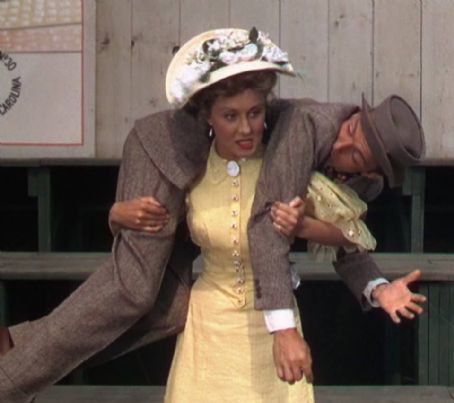
Showing posts with label Gene Kelly. Show all posts

Saturday, August 9, 2025

Take Me Out to the Ball Game (1949)

In 1948, Busby Berkeley was hired to direct the all-American musical Take Me Out to the Ball Game but midway through production he had to withdraw due to health issues. That's when Gene Kelly stepped up to the plate and hit a homerun with a blockbuster! 

Take Me Out to the Ball Game was the first film to team Gene Kelly, Frank Sinatra, and Jules Munshin and this winning threesome were so entertaining they joined forces right afterwards for the classic On the Town, both directed by Stanley Donen and Gene Kelly. 

The Donen-Kelly duo were also responsible for penning this story, a wholesome blend of Americana, baseball, and good ol' gambling. Gene Kelly stars as Eddie O'Brien, short-stop of the fictional Wolves pro-ball team. When playing with his buddies, first baseman Dennis Ryan (Sinatra) and third baseman Nat Goldberg (Munshin), they're unbeatable. The owner of the Wolves recently passed away and his niece K.C. Higgins (Williams) arrives to take a "hands on" approach to ownership. At first, they resent this, but then they come to admire her.... all except Eddie, who is steamed that she moved up their curfew and increased the fine for breaking it. Eddie likes to entertain the girls at night, so that cramps his style. 

Eddie likes to entertain, period. When he isn't playing ball, he is cutting capers. Off season, he and Dennis are a popular vaudeville act. When Joe Lorgan (Edward Arnold), a big gambler in town, bets heavily against the Wolves, he uses Eddie's love of show business to lure him away from training. But when Eddie learns he has been made a stooge he rallies back to help the Wolves - and his buddies - win the pennant. 
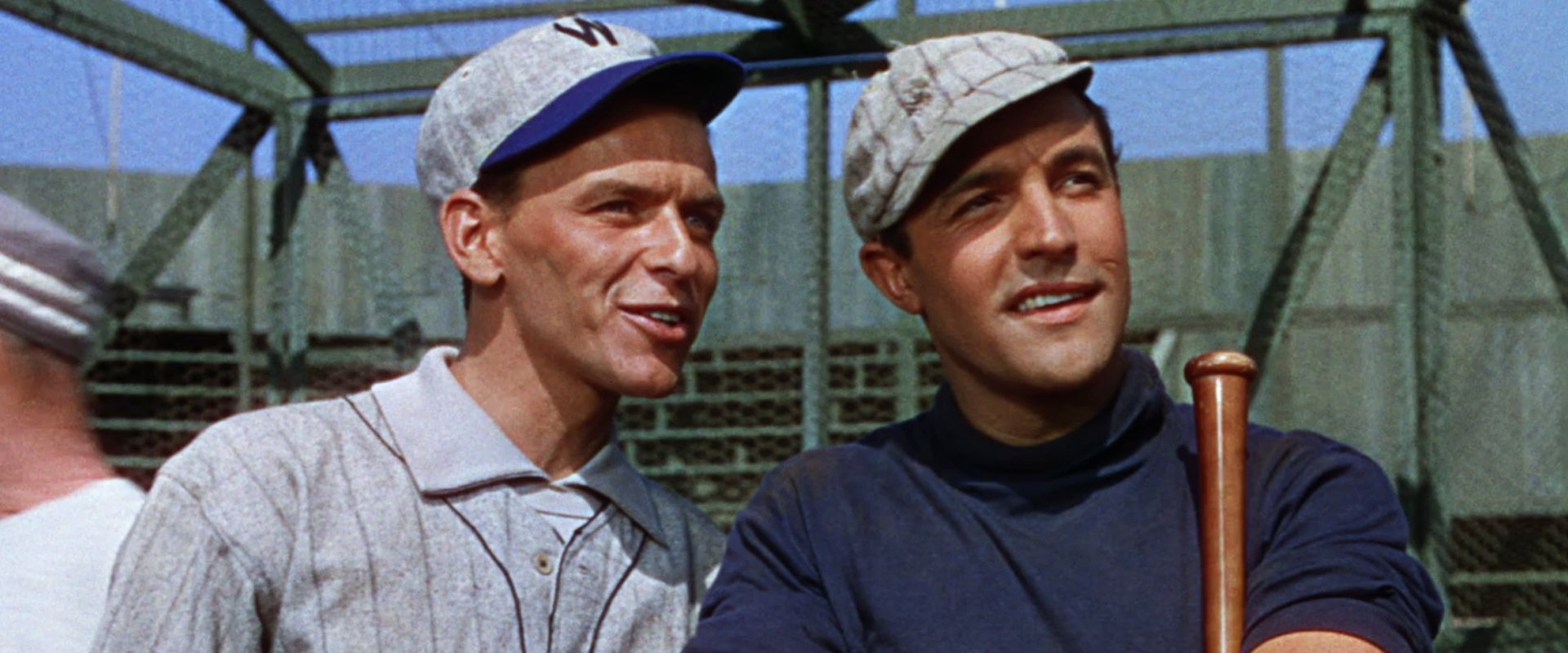
Take Me Out to the Ball Game was a box-office success on its release and raked in nearly $3,000,000. It had that magical aura that only the Arthur Freed unit at Metro-Goldwyn-Mayer could create. This one also bore the unique stamp of Busby Berkeley, Stanley Donen, and Gene Kelly, who directed most of the dance sequences. 

Berkeley and Kelly originally wanted Judy Garland to play the leading lady but she was having substance problems, so Ginger Rogers was cast as her replacement. Ginger then backed out a month prior to filming and Esther Williams took over. What a jim dandy substitute! 
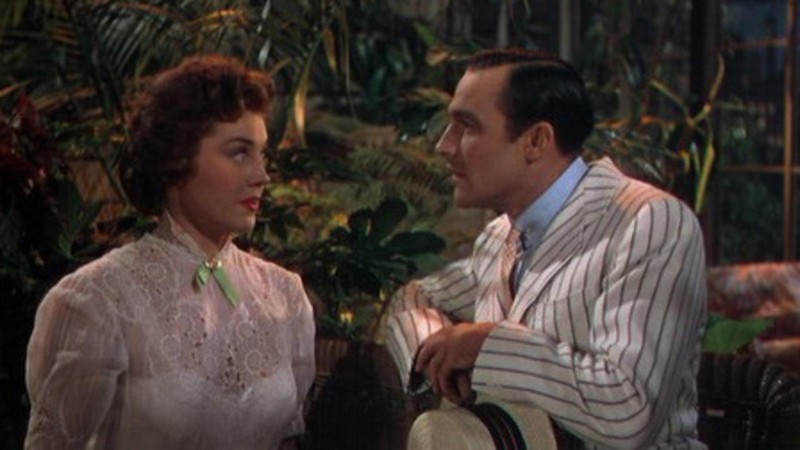
Williams was ideal for the role and perfectly cast. She was already a leading star and this role let her take a quick break from swimming - she only had one simple pool routine in the picture. However, as Williams put it in her autobiography, filming Take Me Out to the Ball Game was an experience of "pure misery." Kelly was too demanding as a director and, along with Donen, seemed to resent her. 

Betty Garrett, who had a wonderful role as a boy-crazy girl chasing the girl-shy Dennis Ryan, had a different experience. In her autobiography she wrote that "making Ball Game.. was pure joy and Frank was an absolute delight to work with." 

"Why don't you pick on somebody your own size?"

"There ain't nobody my size!"

Jules Munshin was making his breakthrough screen role in Take Me Out to the Ball Game. He had previously had a bit part in Easter Parade (1948) as a waiter and, on the strength of that performance, got this role. He made a great "third wheel" and was even more entertaining in On the Town.

Take Me Out to the Ball Game included a number of pleasant - albeit forgettable - musical numbers, the best of which feature Gene Kelly dancing. "O'Brien to Ryan to Goldberg" and "It's Fate Baby, It's Fate" are the most fun to watch, but the patriotic "Strictly U.S.A" number is classic MGM - lavish and entertaining. 

All in all, Take Me Out to the Ball Game is a pitch-perfect blend of song, slapstick, and sentiment and - with Gene Kelly and Frank Sinatra rounding the bases - the film scores big in every inning so, if you're in a baseball mood, this one's a grand slam in entertainment. 

Wednesday, March 25, 2020

Brigadoon ( 1954 )

"If you love someone deeply enough, anything is possible."

'Tis true. Tommy Albright (Gene Kelly) learns just how powerful love is when he comes to the enchanted village of Brigadoon and meets his true love Fiona (Cyd Charisse). Tommy and his friend Jeff Douglas (Van Johnson) come across the village when they are lost in Scotland during a hunting trip. Life in Brigadoon, which only appears for one day every 100 years, is unchanged since the 1700s. Tommy meets and falls in love with the beautiful Fiona and then must make the decision whether to stay in the magical world of Brigadoon and turn his back on the world he knows or whether to depart from it forever. 

"Why do people have to lose things to find out what they really mean?" -Tommy  

Of all of the musicals made during MGM's golden era, Brigadoon has received the most motley assortment of reviews from critics and fans alike. Director Vincente Minnelli and Gene Kelly himself felt that the entire production did not reflect what they had originally envisioned for it. 
Kelly was especially disappointed that the picture would not be shot on location in Scotland (due to the weather) and that, because of budget cuts, he would not be permitted to experiment with different dance sequences. 

Most viewers can see the potential in Brigadoon that was not realized, hence, it seems like the film is only a shadow of what it could have been. However, what was made is mighty fine entertainment regardless!
Brigadoon has a lovely magical feel to it and the staged setting actually helps create this effect rather than hinder it. 

Unlike many of the characters Gene Kelly plays in musicals, Tommy is not a happy-go-lucky fellow out to have a night on the town. Instead, we see him as a confused man. He went on a hunting trip to Scotland with the hope that a vacation would clear his mind and help him to decide what he wants in life, but his brief visit to Brigadoon confuses him all the more. Prior to his trip, he was engaged to a beautiful socialite in New York City but continually put off the wedding because he was discontented with his fiancee. Once he meets Fiona, his love for her clears the fog in his heart, but then he is torn between staying in what Jeff calls a "fairyland" or returning to "reality."
"Sometimes the things you believe in can become more real than all the things you can explain away or understand."

The film could have been developed into a light-hearted musical, much in the vein of Seven Brides for Seven Brothers, but then it would have risked losing its romantic mystic quality which really is the heart of the picture.  

Brigadoon, which was based on the 1947 Broadway show of the same name, features a number of excellent songs by Alan Jay Lerner and Frederick Loewe including "Waitin' for my Dearie," "Almost Like Being in Love," the titular "Brigadoon," "Heather on the Hill." The balletic dance sequences - especially "Heather on the Hill" and its reprise - are beautiful to watch, as are the more lively numbers such as "I'll Go Home with Bonnie Jean."  Unfortunately, the film version cut several of Lerner and Loewe's best songs including "Come to Me, Bend to Me," "There But for You Go I," and "From This Day On."

Brigadoon went into production the same time that director Stanley Donen was planning his musical extravaganza Seven Brides for Seven Brothers. Metro-Goldwyn-Mayer debated whether to drop one of the two productions because they felt they could not fund both projects at once but Seven Brides producer Jack Cummings insisted on continuing with the film on a cut budget. It was presumed that Brigadoon would be the more successful of the two films. Instead, Seven Brides reaped nearly four times its budget, while Brigadoon took a loss at the box-office.

In spite of the setbacks during its production, Kelly was pleased to be starring alongside his good friend Van Johnson. Originally, actors David Wayne, Donald O'Connor, and Alec Guinness were considered for the role of Jeff instead of Johnson. Surprisingly, Oscar Levant was not considered, even though the sarcastic nature of Jeff would have suited him perfectly. 
Cyd Charisse was ideally cast as Fiona; she never looked or danced better. Charisse was happy to reunite with director Vincente Minnelli whom she worked with in The Band Wagon just one year prior. Albert Sharpe (Darby O'Gill and the Little People) and Barry Jones were also perfectly cast. Hugh Laing, a ballet dancer with the New York City Ballet, was cast as Harry Beaton, the one discontented citizen of Brigadoon. Jimmy Thompson (Singin' in the Rain) was the handsome Charlie Dalrymple and upcoming stars George Chakiris and Stuart Whitman appear as extras. 

Brigadoon's failure at the box-office and its poor critical response marred its initial release but years later it can be seen as a highlight in MGM's output of musicals. It may not be what the director or Kelly intended it to be, but what was created was a colorful gem in itself. Aye, a bonnie good film. 

Friday, June 7, 2019

The Happy Road ( 1957 )

Gene Kelly was at the peak of his career in the early 1950s, making such memorable musicals as Summer Stock, An American in Paris, Singin' in the Rain and Brigadoon. One side adventure he took away from musicals was a delightful family film called The Happy Road ( 1957 ). It had no singing or dance sequences. Kelly directed the picture himself and you can see his little touches throughout the film, especially in the mannerisms of the two leading child actors Bobby Clark and Brigitte Fossey.  

The story revolves around these two children - Danny and Janine - who escape from a private school in Switzerland in order to be with their parents in Paris. Danny's father Mike ( Gene Kelly ) is a widower who is in France on business. He is frustrated with the inefficiency of the French workers and just wants to finish up his work in order to return to the States, where he believes people are much more sensible. Janine's mother Suzanne ( Barbara Laage ) is a divorcee who is about to be remarried in Monte Carlo. 

After these two parents discover that their children have run away together they decide, with the aid of the police, to head the children off before they get too far along the journey to Paris. Much to their chagrin, these youngsters travel at a faster pace then they imagined and are always one town ahead of them on the chase. It is this chase through France that makes up much of the picture. 
Filmed entirely in France, The Happy Road takes its audience throughout the petites villes enroute to Paris. Danny and Janine find aid from other children and people they meet along the way, including a mute giant, a picnicking family, and members of a bicycle road race. They travel by foot, truck, and canal boat whereas Mike and Suzanne go via the main roads by motorcycle and scooter. 

While the story itself revolves around the children, the main characters are the parents, who realize that perhaps they were putting their own interests and desires before their children. Mike comes to learn that the French people are indeed living the better way; they consider life itself more important than the busyness of life that Mike takes part in. 

The Happy Road is a charming film and it earned the UN award as well as the 1958 Golden Globe for best film in Promoting International Understanding. Also in the cast is Michael Redgrave as a thoroughly British military general and Roger Treville. Maurice Chevalier sings the sparkling title song. 
The Happy Road is available on DVD from the Warner Archive Collection. 

Friday, April 27, 2018

Invitation to the Dance ( 1956 )

Most fans of MGM musicals of the 1950s can rattle off the titles of Gene Kelly's pictures when called upon, but I bet you 23-80 that the majority of these musical aficionados will forget to include Invitation to the Dance among those titles. 

This 1956 dance extravaganza features Kelly in not one, nor two, but three separate stories all told through the art of dance, sans dialogue. As early as 1947, Kelly had envisioned a film where dance could take center-stage. He wanted it to be a showcase of some of the most talented ballet artists of his time, gathered from around the world, but the brass at MGM - knowing that Gene Kelly's name would be drawing the audiences in - insisted that he star in all three segments. 

Some critics felt that Invitation to the Dance was too much dance to handle in one sitting and that may be. Kelly himself agreed with "those who found the whole thing a bit much", but, having seen it over the course of three days ( one segment each day ), I found it to be delightful. Each segment is entirely different from the others with the costumes, art direction, music, and dance styles all being unique. 

The first segment, "Circus" set in 18th-century Italy, features Kelly as a clown who is in love with a ballerina ( Claire Sombert ) that only has eyes for a great tightrope walker ( Igor Youskevitch ). The clown's love story parallels that of the character which he enacts daily in front of his audience. At the beginning of this segment, Kelly does a fantastic pantomime dance with the other members of the dance troupe and, later, Youskevitch's muscular prowess is a marvel to behold. 
The second segment, "Ring Around the Rosy", takes us from Italy to Paris, where a mad party is taking place. The host of the party has just given his wife ( Dephne Dale ) a new bracelet as an anniversary gift but shortly thereafter she passes the bracelet onto her lover, an artist ( Igor Youskevitch ). Then, within the span of one night, it goes from hand to hand ( with Claude Bessy, Belita, Diana Adams, Tommy Rall, Gene Kelly, and Tamara Toumanova all being recipients ) until it returns to the possession of the party host. This was the most explosive and creative of the three segments, featuring some very imaginative modern dance sequences. 

"Sinbad the Sailor", the last segment, is set in modern Arabia. Kelly portrays a sailor on shore leave who befriends a boy ( David Kasday ) with a magic lamp. Together they embark on a journey to the palace of a sultan, meeting a princess ( Carol Haney ) en route. This segment felt like the weakest of the three, because of the focus on the animation. The animation, while novel, extended too long, and seeing dancers in Arabian costume performing traditional dance would have been more welcoming. 
In the early 1950s, MGM had millions in frozen assets in England that they could not take out of the country. These funds could be used only if they employed British artists, and so in 1952, production on Invitation to the Dance began at Elstree Studios outside London. Since the majority of the dancers were from Europe, this seemed like a clever decision, but Gene Kelly, who also directed the film, later regretted the move because the soundstages were not nearly as large as the MGM soundstages in Hollywood and the smaller space made filming the large production numbers more difficult. 

In fact, Kelly later regretted the entire project. The production took much longer than planned. Since most of the ballet dancers had other dance engagements throughout the Continent, much of the film had to be shot in bits and pieces, and Kelly's quest for perfection led him to overwork his dancers. Russian dancer Igor Youskevitch said, "There were times, I think, when [Kelly] overdid things. He rehearsed us all so rigidly - and on cement floors! - that it required superhuman energy to not collapse."
After two years, Invitation to the Dance was completed. But MGM's distributors felt that there was no audience for it, especially with motion-picture attendance rapidly declining and television becoming increasingly more popular. The film sat on a shelf for two more years until it was finally released in special "art house" theaters throughout New York City in 1956. Ultimately, it grossed only $200,000 in North America ( $415,000 overseas ) making it MGM's biggest creative flop of the year. 

Tuesday, June 6, 2017

Fred Astaire and his Long Lost Hair

A bald Fred in 1944
Fred Astaire has always been more famous for his fancy feet than for his hair, but if one was to take a closer examination of his hair style one would notice that it was quite unique. So unique that even as a Rankin/Bass puppet ( in The Easter Bunny is Coming to Town ) he was recognizable. Not too many Hollywood actors could boast such a large forehead as Fred. 

But what many do not know is that some of that hair was attached. Like other actors such as Gene Kelly, Bing Crosby, and John Wayne, poor Fred had a receding hairline....even at an early age he was showing signs of baldness. His toupee stylist did a marvelous job of creating a piece that not only looked natural but appeared to be thinning itself. And what's most impressive is it stayed on while Fred waltzed with Ginger, jumped up on tables, and tapped his way around rooms, even up walls! 

Like most men of his generation, Fred never went out of doors without a hat and always wore his pieces on stage and for public performances. But he was happy to be rid of them when the public eye was not on him. After filming wrapped for Blue Skies, what Fred thought was his final film, he was said to have tore off his hairpiece and stomped on it in glee! Alas, his film career did not come to an end in 1946 and Fred continued to appear in films and television up until the mid-1980s, always sporting his "top hat", that famous hair-piece. 

Astaire, with and without his hair

This post is a part of our latest series entitled "Did You Know?".....sometimes we just feel like sharing interesting fragments of television and movie history and now we have a place to do just that. If you have a hot tip that you would like us to share on Silver Scenes, drop us a line!

Thursday, August 4, 2016

Take Me Out to the Ballgame ( 1949 )

" Like a hotdog covered with mustard, Or an amateur hometown play, Like a circus parade or lemonade, It's strictly USA. 

These are the lyrics to just one of the many exuberant songs to be heard in Take Me Out to the Ballgame, Metro-Goldwyn-Mayer's baseball themed musical of 1948. 

Bobby-sox idol Frank Sinatra, and the star of the tap field, Gene Kelly, were a great pair of sailors in Anchor's Aweigh ( 1945 ), and so they teamed up again for this outing ( or should I say "inning"? ) on the baseball diamond, this time donning the knickers and knee-highs of ballplayers. When they aren't leading their team, the Wolves, to victory, they're singing and dancing on stage as vaudevillians. Eddie O'Brien ( Gene Kelly ) feels the greatest thrill when he has an audience to entertain, whereas Denny Ryan ( Frank Sinatra ) finds nothing as absorbing as a baseball game.....that is, until K.C. Higgins ( Esther Williams ), the shapely new manager of the Wolves, comes along and sends his heart flying out of the ballpark. 
MGM loaded the bases for Take Me Out to the Ballgame with a stellar cast, gorgeous Technicolor, and memorable songs by Adolph Green/Roger Edens/Betty Comden, but the film fails to make a true home run. 

Esther Williams gave an adequate performance as Miss Higgins but she failed to make a splash ( not surprisingly since she didn't have a pool to swim in ). Judy Garland could have done wonders with the part. Also, this project was Busby Berkeley's last full assignment as director and, while he directed it with his customary flair, the script he had to work with could have featured less romance and more baseball fun. However, there are a few curve balls thrown in that give it an added punch ( Kelly does an especially rousing tap sequence to "The Hat Me Dear Old Father Wore" ) and it offers a wonderful foretaste of the fun to be had in On the Town, released just four months later. 
Take Me Out to the Ballgame was a box-office success upon its release and it was because it did so well that the big brass at MGM gave Stanley Donen and Gene Kelly the green light for On the Town, Kelly's directorial debut. All three of the Sinatra-Kelly films were made within the "Arthur Freed Unit" at MGM and really showcased the wonderful talent that the studio had during the late 1940s. Helen Rose and Valles created some eye-popping turn-of-the-century costumes and the production design was top-notch. 

Also cast in the film were Betty Garrett ( who reprised her man-hungry role in On the Town ), Jules Munshin, Edward Arnold, and Tom Dugan. Keep your eyes peeled for an uncredited appearance by Danny Kaye too, he's reading a newspaper on board the train.