Showing posts with label Natalie Wood. Show all posts

Tuesday, October 9, 2018

The Ghost and Mrs. Muir ( 1947 )

"Haunted.....how perfectly fascinating!" 

Recently widowed Lucy Muir desires to start a new life. In pursuit of this, she has left her London lodgings, and her in-laws, to come to Whitecliff-by-the-sea with her daughter and loyal housemaid. There, situated atop a lovely coastal cliff, she finds her ideal home....Gull Cottage. It is up for rent.

"And priced at only 54 pounds per week. That's very inexpensive for a furnished house."

Strong-minded Lucy will not even let the thought of a ghost scare her away from Gull Cottage. The idea of returning to London and the life she led before is not a choice she wants to consider. Even the gruff and determined Captain Daniel Gregg - the apparition she comes to meet there one dark and stormy night - yields to her wish to remain at his beloved home.

He had been frightening away, with his boyish pranks, all prospective tenants to Gull Cottage for the last several years and the fact that Mrs. Muir chooses to stay in spite of knowing he haunts the house wins her his admiration. 

During their coming year together, a gentle love blossoms between this ghost of a roguish sea captain and the spirited Victorian widow. She comes to see Captain Gregg not only as a dear friend but as an anchor and a pillar of support. Their relationship deepens when Lucy – forced to earn money for payment of the cottage – pens the captain’s memoirs, “Blood and Swash”. However, when she meets the suave author Miles Fairley (George Sanders) while at the publishing house, the Captain realizes that his “Lucia” may be wanting the love, companionship, and reality of a mortal man.

"Real happiness is worth almost any risk…. but be careful me dear, there may be breakers ahead" 

Joseph Mankiewicz's wonderfully whimsical fantasy was released in theatres in 1947 to great commercial success. It was based on the novel, “The Ghost and Mrs. Muir" written two years earlier by author Josephine Leslie, who - like her character Lucy Muir - published her book under a much more masculine pseudonym...R.A. Dick.

20th Century Fox purchased the rights to the story shortly after its publication and selected Philip Dunne to rework it into a fitting screenplay for a feature film. Philip Dunne was a very talented screenwriter who had been nominated for an Academy Award in 1941 for How Green Was My Valley. He retained much of the essence of the book, and much of the plot, too - with the exception of eliminating the character of Mrs. Muir's son. 
What resulted from his penwork was a sweeping romance like none other of the era. The script, the actors, Mankiewicz’s direction, the breathtaking cinematography (by Charles Lang Jr.) and Bernard Herrman’s beautifully haunting score all combined to make The Ghost and Mrs. Muir one of the most enchanting, timeless, and delightful films ever made in Hollywood.

Rex Harrison is superb as our beloved sea captain – handsome, brawny, and blazed-eyed….a man in every sense of the word. While Gene Tierney is his perfect mate - beautiful, prim and respectable. What they both shared was the spirit of adventure in their souls.

"How you’d of loved the North Cape and the fjords and the midnight sun…to sail across the reef at Barbados where the blue waters turn to green….to the Falklands, where a southerly gale rips the whole sea white…..Oh, what we’ve missed Lucia! What we’ve both missed." 

The rest of this excellent cast includes George Sanders (playing his usual deliciously sly self), character actress Edna Best as Mrs. Muir’s right hand arm and dear companion Martha, little Natalie Wood as daughter Anna, English stage legend Isobel Elsom as Lucy’s mother-in-law,Robert Coote as the real-estate agent, Anna Lee as “the wife”, and Austrian actress Vanessa Brown as the grown-up Anna. 

While “flesh and blood”, Captain Gregg must have been a magnificent seaman and one can imagine the loyalty he inspired in his men aboard ship. Square shouldered, steadfast and weathered from his voyages, he was wise beyond his years, or as he described himself…

"I did not lead a very wise life but it was a full one and a grown-up one. You come to age very quickly through shipwreck and disaster and at the heart of the whirlpool some men find God."

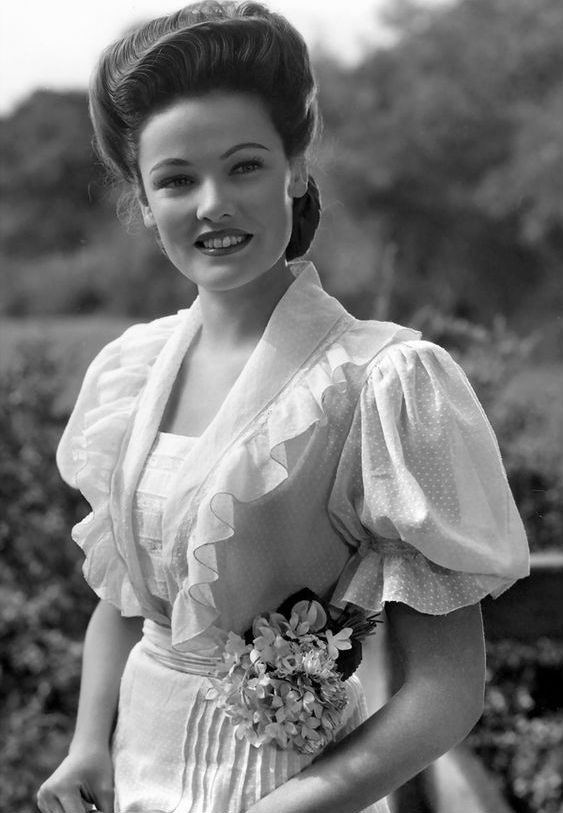
Lucy Muir is quite an independent woman for the turn-of-the-century. Young, innocent and idealistic, she had married a man who had swept her off her feet, only to discover that he was not the romantic she had thought him to be. After his death, she wants to live a life of her own, free to make decisions without anyone warning her of society’s views on her actions. She finds her true self and her peace at Gull Cottage. And there amongst the splendor of the ocean she does not dream of her husband returning to life, but rather of a Gothic hero, a spirit like the Flying Dutchman, a man who worships her as much as the fairest lady he ever knew...the mighty Sea herself.

But is Captain Gregg a dream, or is he a man full of life and vigor just as much as Lucy? 

Years later, when Mrs. Muir’s hair is white and the driftwood by the beach battered and worn by the crashing tide, she still reflects upon her “dream” of the captain. In spite of being a very beautiful woman, she had chosen to live her days in the seclusion of Gull Cottage. We have the notion that men were not something Mrs. Muir ever pursued again. The ideal nature of the captain and the comradery they shared would be hard for any mere mortal man to duplicate.


Instead, all of Lucy’s real relationships are with other women….her maid being the only lasting friendship she has known. Her daughter has her own life to lead and as she grows older she becomes as remote as the rest of the world that Lucy has turned her back against. But loneliness is something our heroine never knows, for she feels content and secure in her memories and secretly lives in hope of something as real as what she was dreaming of all those years.

In the hands of another director, The Ghost and Mrs. Muir may have been a tragic story, a story of lost love and regret and of a woman living out an empty life of isolation. But instead, under the direction of Joseph Mankiewicz, it becomes a magnificent mystical romance. Gentle and warm and humorous, too. It is a tale of love transcending all boundaries.

Wednesday, September 23, 2015

Moments of Intuition from Seven Actresses - Part Three

Doris Day

When I was 12, I was bedridden for weeks because an accident had injured my legs and both of them were in heavy plaster casts. One morning, finally, the doctor had come to my hospital room and very carefully removed them. This was a happy day for me, for my dancing lessons had been long neglected, and I knew that if I was ever to become a professional dancer, I'd have to practice twice as hard now. 

The doctor usually had a poker face - you could never tell what he was thinking - but this time his look frightened me. When they had finished removing the plaster, they took me to the X-ray room. After they made the films, they brought me back to my room and left me alone. About half an hour later, the doctor and my mother came in. Mom was trying desperately to be cheerful. So was the doctor. He took my foot, raised it gently and said, "Wiggle your toes, Doris." I tried as hard as I could, but my toes didn't move. Then the doctor did something to the soles of my feet and said, "Did you feel that, Doris?" I just stared at him and shook m head. I was never so scared in my life. The doctor looked at my mother. Mom sensed the verdict. She started to cry. It was strange, but the moment I saw the first tear in her eye, I wasn't afraid any more. I said, "Don't cry, Mom. I'll be all right." Then the doctor said, "I'm sorry, Doris, you shouldn't hope. I'm afraid you won't walk any more."

But, intuitively, I knew the doctor had made a mistake. 

Six weeks later, I walked again. 

Natalie Wood

The one time that intuition hit me the hardest was on an evening in September, 1955. Nick Adams, Sal Mineo, Richard Davalos, Mrs. Davalos and I were having dinner at a Chinese restaurant in New York City. I guess we were the happiest group in the place. Nick and Sal started us laughing while we were eating wonton soup and kept us in stitches all through the egg rolls, chop suey and fortune cookies. After we finished dinner, we were still laughing. I don't remember at what. 

Suddenly, although until then I wasn't concerned at all, I had to know what time it was. I stopped laughing and asked Sal to let me see his watch. He was talking and didn't hear me. I had spoken in a low voice. Then I said, "Sal, Sal, what time is it?" I felt as if I were dreaming. Sal checked his watch and said, "It's nine thirty-one, Nat. Why?"

I said, "I don't know, but I think I'm going to cry." For no reason I could understand, my whole being was swept by a wave of almost unbearable sadness. It only lasted for an instant. Then I told the others to forget it. 

The next day, Nick told me that Jimmy Dean had been killed in an auto accident in California the night before. 

It wasn't until days later that I realized that Jimmy's death had occurred at about 5:30pm in California. At that moment, because of the difference in time zones across the states, it was 9:30pm in New York. 


This post is the final part of our republication of the 1957 Motion Picture magazine article that featured seven actresses sharing stories of moments of intuition. We hope you enjoyed reading it. Please be sure to check out the first post and the second part here! 

Saturday, April 26, 2014

Professor Fate of "The Great Race" ( 1965 )

Blogathon season is in full force and Speakeasy, Shadows and Satin, and Silver Screenings have teamed up to devise the fiendishly clever Great Villain Blogathon to add to the mix. In our opinion there is no dastardly scheming archetypal villain greater than Professor Fate and so, naturally, we have chosen to spotlight him as our contribution to the event. 

The maniacal evil laugh of Professor Fate rings throughout The Great Race, Blake Edward's 1965 epic homage to the Golden Age of slapstick comedy. When he is not playing his four-tiered player-organ, Fate spends his energy hatching deviously diabolical plans to foil the Great Leslie. His all consuming passion is to become the greatest daredevil in the world, and only the tan-faced, spotlessly clean, lily-white clad Leslie stands in his way. When Leslie proposes a world-wide automobile race - the ultimate test in endurance - Professor Fate cannot resist the challenge to prove his superiority and what results is a wild and wacky adventurous match of two of the greatest slapstick daredevils filmdom has ever seen. 

Blake Edwards had great success in the early 1960s with such blockbuster hits as Breakfast at Tiffany's, The Pink Panther and A Shot in the Dark, but he had yet to make a epic comedy ( which he later became known for ) in the vein of It's a Mad, Mad, Mad, Mad World ( 1963 ).


The Great Race was to be his greatest comedy to date and, with such lofty intentions in mind, he plunged the generous sum of $6 million dollars into the project. Natalie Wood was - reluctantly - cast as the beautiful heroine of the picture, Maggie DuBois, a spunky suffragette who was always more than willing to put herself in peril for "the cause". 

Robert Wagner was Edwards original choice for Leslie Gallant III, but when he turned it down Edwards offered it to Charleton Heston, who thought it highly amusing, but nevertheless declined the part as well. George Peppard and Burt Lancaster were also considered before Tony Curtis was given the part ( Jack Warner's original choice ). 

" Ha, ha, ha.....Haaaaaaaa! "

While choices for the lead actors were hopping to and fro, there was no doubt in Edwards mind that Jack Lemmon was the man he wanted as Professor Fate. Complete with curling mustache, black cape and his sinister crooked top hat, Lemmon created a magnificent character role that defined what we have come to know as cliches of the "master villain". 

Peter Falk, who had given a marvelous performance as the Brooklyn taxi cab driver in It's a Mad, Mad, Mad, Mad World was cast as Professor Fates faithful servant, mechanic, henchman, and all-around dog, Max. Kennan Wynn, Arthur O'Connell, Dorothy Provine, Vivian Vance, and Larry Storch rounded out the "Great" cast. 


The Great Race took five months to complete and by the time it was ready for release, the enormous sum of $12,000,000 had been racked up on its bill. It became the most expensive comedy every made. In spite of Edward's great hopes for the film, it floundered desperately upon its initial release, with critics giving it mixed reviews ranging from "weak" to "adequate" in terms of belly-laugh ratings. Since then it has gained an enormous following with Professor Fate's engaging character being one of its most notable drawing features.

Professor Fate's Inventions

For years Fate and Leslie have been building elaborate contraptions to break speed records, soar to new heights, and make ladies swoon in terror of their unabashed bravery and continually Fate has tried to sabotage Leslie and send him to his doom. When the Great Leslie announces he will strap himself in a stray-jacket, hang upside down while an air balloon carries him high in the sky and wriggle free in time to descend safely to the ground, Fate is there - with a missile in hand - prepared to shoot him down. 


Like Wiley Coyote, destroying Leslie becomes Fate's all-consuming passion and he is ever ready with his ACME inventions to hail disaster down on his singular enemy. 

" Maaaaaaaaax!!!! "

When the Great Leslie attempts to break the speed record on water in his glittering white speedboat, Professor Fate and Max bring out their latest sound-seeking torpedo to blow him to smithereens. The plan backfires on him.

When the Great Leslie announces that he will drive the custom-built Leslie Special in an automobile race to end all automobile races, Fate hovers above in a two-cycled powered miniature zeppelin, prepared to destroy the car before it is even unveiled. He blows himself and Max up.

Fate is not just foiling the Great Leslie at every chance he can get....he is busily working at establishing himself as a great daredevil too. However, while Leslie has women swarming around him with puckered lips ready for kissing, the only crowds Fate manages to draw are jeering children and skeptical reporters. With his skull-faced equipment and loyal Max by his side, Fate always attempts the impossible, begins to get away with it...and then finds himself covered in the dirt of a humiliating crash. 


When the Great New York to Paris automobile race is announced, Fate takes up the gauntlet and enters himself and his greatest invention to date into the race - the Hannibal Twin-8. This machine, which hardly resembles an automobile, was built with endurance and villainy in mind. It features six wheels ( complete with caterpillar tracks ), an ice-melting heat iron, miniature cannon, smoke generator and an escalating mechanism. 

Jack Lemmon took the typical silent-era style villain and raised him to magnificent heights in his portrayal of Professor Fate, creating a character that entices the audience to hiss, jeer, boo, and cheer all in one breath. What other villain inspires children to write "Fate is a Fink" on the gates outside his house? He is a failure through and through ( even his initials bring to mind the dreaded school grade of "F" ) and yet one can't help applauding him for his marvelously cunning mind and unstoppable drive. 


Professor Fate became such an inspiring creation that Hanna-Barbera continued the character on in their cartoonified Great Race animated series, The Wacky Races. Fate became the famous Dastardly Dan, while Max was incarnated into what he truly was - a big shaggy dog. Today, children the world over still love these cartoons and they are introducing them to the great film that is The Great Race.