Showing posts with label Fantasy. Show all posts

Thursday, January 30, 2020

A Hitch in Time ( 1978 )

What would it be like to travel back in time? This is a fantasy most children indulge in thinking about but for Paul ( Michael McVey ) and Fiona ( Pheona McLellan ) it becomes a reality when they meet Professor Wagstaff ( Patrick Troughton ) on the way to school one day. 
The professor has invented a time-traveling machine that operates on a computer named OSKA. He intends to use it to travel back in time himself but the machine cannot hold his weight and so the children volunteer to go in his place. However, when the machine begins to malfunction, Paul and Fiona realize that traveling back in time can be awfully confusing. They never know what era they are going to stop in!

"Where are we??" - Paul
"You mean, when are we?!" - Fiona 

A Hitch in Time, also known as Professor Wagstaff's Time Machine, is a fun Saturday morning children's film that was released in England through the CFF ( Children's Film Foundation ) in 1978. 

T.E.B. Clarke's script was clearly aimed towards juveniles and spirals into silliness towards the end, but the film can be appealing to adults as well, especially those who enjoy Patrick Troughton's work. It is amusing to see him in another time-traveling predicament like he often was in on Doctor Who, where he played the second Doctor. 
The story seems like it was based upon a book but T.E.B. Clarke wrote it directly for the film. Clarke was quite a popular screenwriter in England and was equally adept at writing comedies ( The Titfield Thunderbolt, The Lavender Hill Mob ) as well as dramas ( The Blue Lamp, Sons and Lovers ). A Hitch in Time is definitely more amusing than dramatic and Clarke adds a few clever touches to the story to make it less predictable than one may think. What is especially clever is that the children continually run into ancestors of "old Sniffy" ( Jeff Rawle of Harry Potter fame ), the schoolmaster Paul dislikes, and Fiona's grandfather.

The film has a runtime of less than one hour which speeds along like a flash of light. It is available online to rent via the BFI Player and is also available on the DVD collection of CFF films called Weird Adventures

Saturday, November 23, 2019

Arabian Adventure ( 1979 )

If you are looking for a fun 1970s adventure film set in Arabia, then here is a title to keep in mind: Arabian Adventure. Director Kevin Connor and producer John Dark, who made such corny classics as The Land That Time Forgot ( 1974 ), At the Earth's Core ( 1976 ), and Warlords of Atlantis ( 1978 ) turned from the Edgar Rice Burrough's themed adventure films to try his hand at an Arabian fantasy....and the result was pretty good. 

Variety dubbed Arabian Adventure "Star Wars with flying carpets" when it was released in November 21, 1979. It doesn't have any humanoids or loyal wookies like Chewbacca, but the film does bear a slight resemblance to George Lucas' space epic in its black and white portrayal of evil and goodness. 

Christopher Lee stars as Alquazar, an evil caliph who rules the Arabian kingdom of Jadur. Like most wicked rulers, he desires to be the most powerful man in all the world. In order to do this, he needs to obtain the Rose of Elil which can only be retrieved by someone who is pure and honest. When the handsome Prince Hasan ( Oliver Tobias ) comes to Jadur to woo Alquazar's stepdaughter Princess Zuleira ( Emma Samms ), Alquazar seizes his opportunity and sends the prince on the journey to capture the rose in his place. He agrees to give him the princess's hand in marriage if his expedition is successful but, in order to guarantee that the rose will be returned to him, Alquazar sends his backstabbing henchman, the bubbling Khasim ( Milo O'Shea ) on the journey with Prince Hasan. Also tagging along is Majeed ( Puneet Sira ), a beggar orphan boy, and his pet monkey. Once they reach Elili, they must battle with a genie, a valley of fire-breathing "dragons", and a swamp filled with groping hands before they can capture the rose. 
The script, written by Brian Hayles ( Warlords of Atlantis ), is a motley blend of Eastern fantasy tales. "These Eastern tales abound with lovely excursions into pure fantasy," John Dark exclaimed in a 1979 interview for Starlog magazine. "It was a very beautiful period and a very beautiful territory. We hope to recreate, in our story, the exciting architecture and costumes, as well as some exciting special effects, like an army of flying carpets. It's an amalgam of a lot of stories, a lot of lore, magic mirrors, wicked spells, benign and evil jinnees and one or two very special ideas of our own."

Kevin Connor assembled a fantastic cast for Arabian Adventure. Christopher Lee is delightful as the evil caliph. As Lee himself described his character, "Very small children can go to see it and they'll have a lot of fun - they won't feel threatened by my evil nature because they'll know I'm going to be done in by the film's end."
Oliver Tobias, a Swiss stage actor, is the handsome prince, rather sullen but a good fighter; and Emma Samms, the lovely English actress, was making her film debut as the princess. But it is Puneet Sira who steals the show as the orphan Majeed. Like Sabu's character in Alexander Korda's The Thief of Bagdad ( 1940 ), it is Majeed who often comes to the aid of the prince and proves himself to be the real hero in the end. 

Arabian Adventure also features some great cameo appearances: Peter Cushing as the imprisoned old ruler of Jadur; Mickey Rooney as a befuddled machinist; and Capucine as a beautiful genie who resides in a gemstone. 

Most of Kevin Connor's films tend to feature a number of warring creatures and a hero who has to spend a lot of time trying to make his escape from these creatures. Arabian Adventure differs in that it has very few creatures, even though the script gave many opportunities to include them. Instead, Prince Hasan and Majeed must contend with Alquazar's sword-wielding Arab henchmen, robotic dragons that guard the volcano where the rose is kept, and an ungrateful genie ( also taken from The Thief of Bagdad ). 

The film is clearly aimed at a younger audience, and while it is entertaining, it could have had more elements that would appeal to adults. The adventure to retrieve the Rose of Elil also could have been more exciting. But all in all, it is a fun Saturday afternoon flick that will probably send a child's imagination wild with fantasies of flying carpets, evil caliphs, genies, and endangered princesses. 

Sunday, October 14, 2018

The Witches and the Grinnygog ( 1983 )

Those Brits have a knack for knowing how to spin a good yarn...especially when it comes to mystery, horror, and fantasy tales. Author Dorothy Edwards penned a particularly juicy children's mystery story entitled "The Witches and the Grinnygog" in 1981 which was made into an equally engrossing six-part miniseries for ITV in 1983. 
This intriguing tale of magic and witchcraft was aimed towards children of the pre-teen variety. Each 25-minute episode followed the adventures of four youngsters - two being the offspring of the local minister - as they try to piece together clues from an ancient diary belonging to an old vicar which are coinciding with strange events going on in their village. 

These bizarre happenings began to brew when the neighboring village's church of St. Cuthbert was dismantled. The old stone building is being rebuilt in a new location. A small gargoyle-like statue from the church falls off the back of the lorry carrying it en route to the new location. The mother of one of the children picks it up and, seeing that it would make a perfect "little man" for her father's garden, takes it home to Gramps ( John Barrard ). 

It happens to be a Grinnygog and its three guardians aka witches, magically appear in town to keep an eye on the garden statue. Also in town, is the enigmatic African anthropologist Mr. Alabaster ( Olu Jacobs ) who wants to see that the Grinnygog is returned to its rightful place. 

The Witches and the Grinnygog is very entertaining TV fare, but unfortunately, it ends with a number of loose ends not quite tied up. The audience is served bits and pieces of a puzzle in each episode that, at its conclusion, do not make a complete picture. Flashback sequences hint that witches were burned in the village in olden times but we are to suppose that the three guardians, endowed with eternal life, managed to escape with the Grinnygog, one of them losing her daughter as she fled. This girl comes to town later, appearing to not just the children, but the vicar as well, in search of her mother. But why did it take all these years for her to find her mother? Were the witches in limbo while the Grinnygog was safe and only now appear in the flesh again?
Sheila Grant, Anna Wing, and Patricia Hayes star as the three kindly guardians with Eva Griffith - whom some may recall as the blind girl in the BBC adaptation of The Day of the Triffids ( 1981 ) - portraying the missing daughter. The children's roles are played by Giles Harper, Heidi Mayo, Adam Woodyatt, and Zoe Loftin, who all give very natural and pleasing performances. 

Like most British kiddies, the appearance of witches in town does not startle them very much. This reminds me of the scene in Walt Disney's Bedknobs and Broomsticks when the children observe Mrs. Price taking her first whirl on the broom: "Look! She's flying on her broomstick," one of them says. "That's what witches do," the other calmly replies. Sure, everyone knows that...but it would startle most people to see it actually happen!

The Witches and the Grinnygog has not been released on DVD yet, but it is available for viewing on Youtube. Simply click here if you want to check it out - and I highly recommend that you do. Especially since it makes for great not-too-spooky Halloween viewing. 

Tuesday, October 9, 2018

The Ghost and Mrs. Muir ( 1947 )

"Haunted.....how perfectly fascinating!" 

Recently widowed Lucy Muir desires to start a new life. In pursuit of this, she has left her London lodgings, and her in-laws, to come to Whitecliff-by-the-sea with her daughter and loyal housemaid. There, situated atop a lovely coastal cliff, she finds her ideal home....Gull Cottage. It is up for rent.

"And priced at only 54 pounds per week. That's very inexpensive for a furnished house."

Strong-minded Lucy will not even let the thought of a ghost scare her away from Gull Cottage. The idea of returning to London and the life she led before is not a choice she wants to consider. Even the gruff and determined Captain Daniel Gregg - the apparition she comes to meet there one dark and stormy night - yields to her wish to remain at his beloved home.

He had been frightening away, with his boyish pranks, all prospective tenants to Gull Cottage for the last several years and the fact that Mrs. Muir chooses to stay in spite of knowing he haunts the house wins her his admiration. 

During their coming year together, a gentle love blossoms between this ghost of a roguish sea captain and the spirited Victorian widow. She comes to see Captain Gregg not only as a dear friend but as an anchor and a pillar of support. Their relationship deepens when Lucy – forced to earn money for payment of the cottage – pens the captain’s memoirs, “Blood and Swash”. However, when she meets the suave author Miles Fairley (George Sanders) while at the publishing house, the Captain realizes that his “Lucia” may be wanting the love, companionship, and reality of a mortal man.

"Real happiness is worth almost any risk…. but be careful me dear, there may be breakers ahead" 

Joseph Mankiewicz's wonderfully whimsical fantasy was released in theatres in 1947 to great commercial success. It was based on the novel, “The Ghost and Mrs. Muir" written two years earlier by author Josephine Leslie, who - like her character Lucy Muir - published her book under a much more masculine pseudonym...R.A. Dick.

20th Century Fox purchased the rights to the story shortly after its publication and selected Philip Dunne to rework it into a fitting screenplay for a feature film. Philip Dunne was a very talented screenwriter who had been nominated for an Academy Award in 1941 for How Green Was My Valley. He retained much of the essence of the book, and much of the plot, too - with the exception of eliminating the character of Mrs. Muir's son. 
What resulted from his penwork was a sweeping romance like none other of the era. The script, the actors, Mankiewicz’s direction, the breathtaking cinematography (by Charles Lang Jr.) and Bernard Herrman’s beautifully haunting score all combined to make The Ghost and Mrs. Muir one of the most enchanting, timeless, and delightful films ever made in Hollywood.

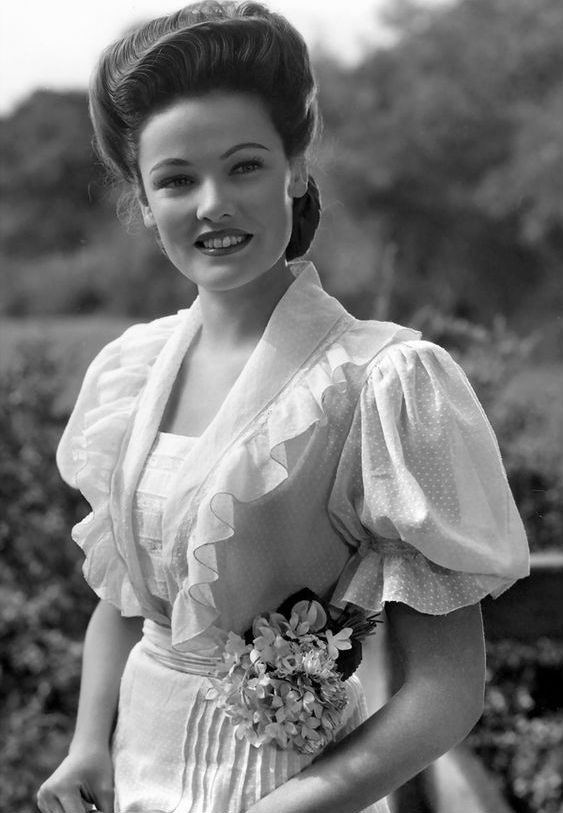
Rex Harrison is superb as our beloved sea captain – handsome, brawny, and blazed-eyed….a man in every sense of the word. While Gene Tierney is his perfect mate - beautiful, prim and respectable. What they both shared was the spirit of adventure in their souls.

"How you’d of loved the North Cape and the fjords and the midnight sun…to sail across the reef at Barbados where the blue waters turn to green….to the Falklands, where a southerly gale rips the whole sea white…..Oh, what we’ve missed Lucia! What we’ve both missed." 

The rest of this excellent cast includes George Sanders (playing his usual deliciously sly self), character actress Edna Best as Mrs. Muir’s right hand arm and dear companion Martha, little Natalie Wood as daughter Anna, English stage legend Isobel Elsom as Lucy’s mother-in-law,Robert Coote as the real-estate agent, Anna Lee as “the wife”, and Austrian actress Vanessa Brown as the grown-up Anna. 

While “flesh and blood”, Captain Gregg must have been a magnificent seaman and one can imagine the loyalty he inspired in his men aboard ship. Square shouldered, steadfast and weathered from his voyages, he was wise beyond his years, or as he described himself…

"I did not lead a very wise life but it was a full one and a grown-up one. You come to age very quickly through shipwreck and disaster and at the heart of the whirlpool some men find God."

Lucy Muir is quite an independent woman for the turn-of-the-century. Young, innocent and idealistic, she had married a man who had swept her off her feet, only to discover that he was not the romantic she had thought him to be. After his death, she wants to live a life of her own, free to make decisions without anyone warning her of society’s views on her actions. She finds her true self and her peace at Gull Cottage. And there amongst the splendor of the ocean she does not dream of her husband returning to life, but rather of a Gothic hero, a spirit like the Flying Dutchman, a man who worships her as much as the fairest lady he ever knew...the mighty Sea herself.

But is Captain Gregg a dream, or is he a man full of life and vigor just as much as Lucy? 

Years later, when Mrs. Muir’s hair is white and the driftwood by the beach battered and worn by the crashing tide, she still reflects upon her “dream” of the captain. In spite of being a very beautiful woman, she had chosen to live her days in the seclusion of Gull Cottage. We have the notion that men were not something Mrs. Muir ever pursued again. The ideal nature of the captain and the comradery they shared would be hard for any mere mortal man to duplicate.


Instead, all of Lucy’s real relationships are with other women….her maid being the only lasting friendship she has known. Her daughter has her own life to lead and as she grows older she becomes as remote as the rest of the world that Lucy has turned her back against. But loneliness is something our heroine never knows, for she feels content and secure in her memories and secretly lives in hope of something as real as what she was dreaming of all those years.

In the hands of another director, The Ghost and Mrs. Muir may have been a tragic story, a story of lost love and regret and of a woman living out an empty life of isolation. But instead, under the direction of Joseph Mankiewicz, it becomes a magnificent mystical romance. Gentle and warm and humorous, too. It is a tale of love transcending all boundaries.

Friday, October 5, 2018

Pandora and the Flying Dutchman ( 1951 )

"The measure of love is what one is willing to give up for it....

....Who said that?" muses archeologist Geoffrey Fielding. He had been observing American beauty Pandora Reynolds, an enchantress who lures men into loving her and then casts them aside when she discovers their love does not satisfy her longing. What is she longing for? Pandora herself does not know. That is, not until Hendrik van der Zee sails into the sleeping Spanish seaport of Esperanza and into her life. 

This mysterious, peaceful, and well-educated sea captain captures the attention of many, but particularly Pandora. Like the Grecian legend, it is he who is the box of delights that Pandora is curious to open and partake of. 

The measure of love is what one is willing to give up for it. The men Pandora ( Ava Gardner ) had dated were willing to give up anything for her. Bullfighter Juan Montalvo ( Mario Cabre ) had scorned his mother - an almost unpardonable sin for a Spaniard - to have the opportunity to spill his blood for her in the bullring. Reggie Demarest ( Marius Goring ) had given his life. He committed suicide. "I felt relieved," Pandora calmly exclaims. Her current beau, racing champion Stephen Cameron ( Nigel Patrick ) is willing to push his car, his beloved hand-built racer, over a cliff to prove his love for her. And yet, Pandora still is not happy. 

"Why don't you come down to earth, Pandora? Happiness lies in the simple things," Stephen tells her. 
It is not until she meets Captain van der Zee aboard his yacht one evening that she feels differently. Perhaps it is the first time she truly feels love and not merely selfish pride over the men she conquested. Indeed, she does become a gentler woman after having met the Dutchman. 

"I've changed so since I've known you. I'm not cruel and hateful as I used to be, hurting people because I was so unhappy myself. I know now where destructiveness comes from. It's a lack of love. It's as simple as that."

But what happens when the object of your love is a ghost? A sailor from the 17th-century doomed to an eternal life.....until he can find a woman willing to die for him. When Henrick tells her that the time for him to leave is fast approaching, Pandora's measure of love is put to the test. Will she be willing to make the sacrifice of death for him?

Pandora and the Flying Dutchman is an enticing blend of romance, mystery, fantasy, and tragedy. The story and script, written by the film's director Albert Lewin ( The Moon and Sixpence, The Picture of Dorian Grey ) draws the audience into the dramatic happenings of its characters, all of whom are well-fleshed. The story takes its inspiration primarily from Richard Wagner's 1843 opera "The Flying Dutchman" and the writings of Heinrich Heine, who created the concept of a man who is given a chance to return to earth once every seven years to search for a woman who can redeem him from his bondage of eternal life. 

"I would long for death, but death would deny me!"

James Mason gives a marvelous performance of this enigmatic gentleman and Ava Gardner is stunning, looking radiant in her first Technicolor film. Harold Warrender, who portrays the archeologist Geoffrey Fielding, acts as the narrator to the story and, with his inquisitive nature, becomes one of the few to uncover Hendrik's secret. Also in the cast is the lovely Sheila Sim, who plays a young woman in love with Stephen Cameron. 
Jack Cardiff, who had won an Academy Award in 1948 for his cinematographic work on The Red Shoes, beautifully filmed Pandora and the Flying Dutchman. Cardiff used a limited range of colors, emphasizing navy blue filters for the night sequences and muted tones to cleverly make the bold colors, when they were used, literally pop out of the screen. The racing sequence is particularly well-filmed and edited. Most of the picture was shot on location in Catalonia, Spain, where today, a statue of Ava Gardner has been erected on the hill overlooking the beach. 

Pandora and the Flying Dutchman was a British film released through Metro-Goldwyn-Mayer, who delayed the picture's release until after Show Boat was distributed in order to capitalize on the rising star power of Ava Gardner. It was a great success at the box-office and justly so - the film has a mysterious beauty that makes it timeless entertainment. Some legends never grow old.

This post is our contribution to The James Mason Blogathon being hosted by Maddy Loves Her Classic Films. If you like Mason - and who doesn't? - then check out the complete roster of reviews of James Mason's films by clicking here

Sunday, April 8, 2018

Old Man Khottabych ( 1957 )

Lenfilm Studios, one of Russia's most famous film production companies, made a number of great children's films in the 1940s and 1950s, one of which was Old Man Khottabych ( Старик Хоттабыч ). This 1957 classic was based on the 1938 children's book of the same name by author Lazar Lagin, who also penned the screenplay for this picture. 

It tells the story of a little boy named Volka, who discovers an ancient clay vessel that contains a 3,000-year-old genie named Khottabych. Like most depictions of genies in film, this fellow isn't what you would expect from the noble line of jinn and his acts of benevolence often result in trouble for Volka...especially since the old man is completely out of touch with modern times. However, no matter how much mischief he causes you can't help but love him as Volka does. He's a gentle old man with narrow eyes, a long white beard, a wily sense of humor, and a sweet-tooth for Eskimo pies. Much of his magical powers are contained in his beard which he needs to pluck a strand of hair from in order to weave his spells. 

Like Jeannie in the 1960s television series I Dream of Jeannie, old Khottabych is beholden to his "master" for freeing him from his bottled captivity and desires to honor his savior in extravagant ways. But little Volka is a Young Pioneer ( the Soviet version of the Scouting movement ) and, like a loyal Communist, does not consider it right or just to accept riches or favors without sharing them with others. Old Khottabych doesn't understand this way of thinking and by the end of the movie, he finds that the only way he can please Volka is by sharing his tricks with everyone at the circus...which he happily joins since they serve Eskimo pies there in abundance. 
Old Man Khottabych is one of Russia's most beloved family film classics and justly so. The story is an engaging mix of fantasy, adventure, and humor with great acting and some impressive special effects of flying carpets, disappearing people, and floating objects. Nikolai Volkov gives an especially good performance as Khottabych. His relationship to Volka is like a tender grandfather and you can clearly see why in his eyes he considers the lad "the illustrious Volshya, honored of all boys". Alyosha Litvinov ( Volka ) and Genya Khudyskov, who portrays Volka's schoolmate Zhenya, are also ideally cast. 
What is most interesting to see in the film is the images of city life in Moscow and the Communistic mindset of its citizens, even the children. When Khottabych desires to bestow upon Volka a palace with his name engraved on a plaque outside the gate, Volka adamantly refuses such a gift unless it is donated to his school and shared among his fellow students. An odd but admirable statement for a child to make. When Khottabych is upset with Volka's teacher, Olga, he desires to curse her but this, too, Volka puts an end to. He goes to great lengths to persuade the old man that he loves and admires his teacher. If this were an American film, Volka would be clapping his hands at the thought of his teacher having a curse put on her! Ah yes...the differences in cultures. 

Old Man Khottabych won the Moscow International Film Festival Award and the Vancouver International Film Festival Award upon its release in 1957. It was released in the States three years later under the title The Flying Carpet and is currently available on DVD, dubbed in three different languages with subtitles in thirteen different languages. Unfortunately, this is a Russia-issued DVD, so unless you have a region-free player you are better off viewing the film here on Youtube. It is not only in HD but also features English subtitles. Even old man Khottabych could not conjure up a copy of the film so easily as this!