Showing posts with label Quatermass. Show all posts

Tuesday, November 5, 2013

The Quatermass Report - Part Two

In our continuing look at the influential Quatermass series of the mid-century we turn the spotlight onto Nigel Kneale's final serial of the 1950s - Quatermass and the Pit, as well as the final episode, simply entitled Quatermass from 1979. Part One is available to read here. 


QUATERMASS AND THE PIT

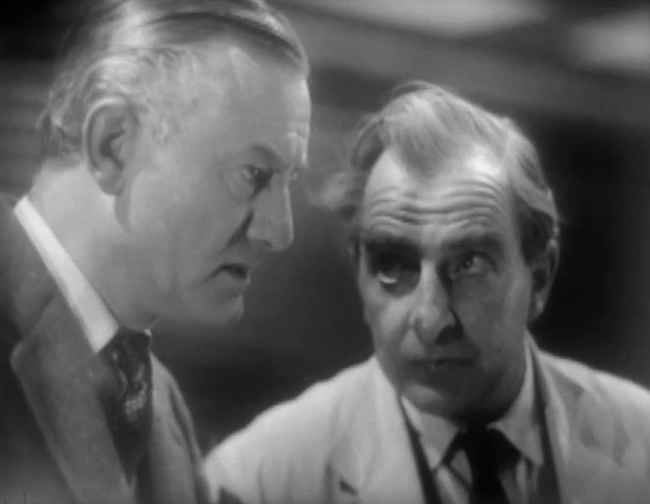
Andre Morrell, who had been the original choice for the role of Professor Quatermass when Kneale first conceived of the character in 1953, had finally consented to portray the now-famous bow-tied Brit. This third installment, released in 1958, combined the same elements of the previous series - an alien invasion through human takeover and a time-ticking race on Quatermass' part to stop this - but in a new and completely absorbing way. In fact, Quatermass and the Pit is one of the best of the series. 

"The last adventure, which I called Quatermass and the Pit, went way past the concerns of the time and into an ancient and diabolical race memory," said Kneale in an interview in 1996. "It sought to explain man's savagery and intolerance by way of imagines that had been throbbing away in the human brain since it first developed. Racial unrest, violence and purges were certainly with us in the 1950s, and I tried to speculate on where they first came from."


During routine engineering work at Hobbs' End underground station ( "Hob" is a folk name for Satan ), a group of bones and half complete skeletons of ape men are discovered, apparently drastically predating the era that scientists had established for those creatures. Later, an unusual metal container is unearthed. The authorities, led by the unimaginative Colonel Breen ( Julian Glover ), believe it to be an unexploded bomb left over from WW2, but when Professor Quatermass arrives on the scene, he proves otherwise. The contents inside reveal to him a discovery which shatters the accepted theory of Darwin's evolution and offers a dire warning for the future of mankind. 


Kneale ambitiously attempted to rationalize the nature of both supernatural hauntings and human concepts of the devil and, surprisingly, he translated those ideas into a convincing and plausible, if improbable, script. 

Quatermass and the Pit was broadcast in December 1958 and received much acclaim from television critics, with several reviewers praising Morell for having given the definitive portrayal of Professor Quatermass. Cic Linder, Anthony Bushnell, and John Stratton rounded out the great cast. 


As with the previous two serials, Hammer purchased the film rights to these monumental Pit episodes, however, partly due to the declining box-office receipts of Quatermass 2, Kneale's refusal to tolerate a drunken Donlevy once again, and Columbia disinterest in the series ( Hammer had recently struck a distribution deal with Columbia Pictures ), it was not brought to the big screen until February 16, 1968.

Instead, Hammer plunged into another film adaptation of a Kneale teleplay - this time of "The Creature" ( 1955 ), which they retitled The Abominable Snowman

Roy Ward Baker undertook the directorial responsibilities when Quatermass and the Pit was put into production in February 1967. Baker had directed a number of fine films during the 1950s, notably The October Man and A Night to Remember, but several recent failures made him turn to television, directing episodes of such popular crime-fighting series like The Saint and The Avengers. 
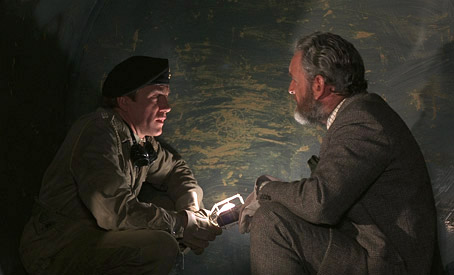


Kenneth More was Baker's original choice for the part of Quatermass, but eventually he selected Andrew Keir to replace Morell, who had turned down the chance to play the role again. This was a stroke of good fortune, for Keir brought an excellent steely determination to his characterization of the professor as well as injecting a very human fragility and vulnerability. 

James Donald adds great support to Keir, and Barbara Shelley, one of Hammer's most popular and prolific leading ladies, is excellent as fellow scientist, Barbara Judd. Quatermass and the Pit ( also known as Five Million Years to Earth ) was her final film for the studio. There are a swarm of delectable British character actors to enjoy as well, including Peter Copley, Bryan Marshall and Edwin Richfield.

Hammer's home base, the Associated British Studios in Elstree, Borehamwood did not allow for enough space to film and so the project was relocated to the MGM Borehamwood studios where no other film was being shot at the time, giving the crew - and especially the production designers - ample space to work with, which they utilized in creating the enormous Underground station and excavation settings. 


QUATERMASS 1979 

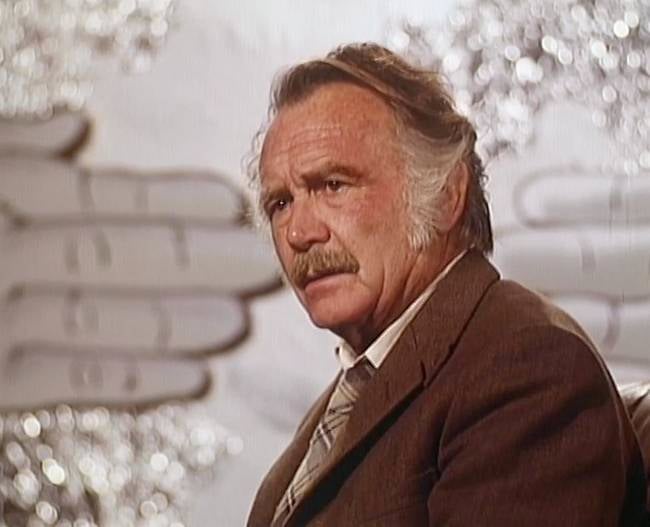
After Quatermass and the Pit, Hammer approached Kneale about the possibility of writing another script for a film follow-up but that idea never came to fruitation. Instead, Professor Quatermass made his final television appearance in the four-part 1979 Thames Television serial release, simply entitled Quatermass. Alas, it was a serial that should not have been made. In the mid 1960s, Nigel Kneale had written a dreary and depressing tale of the future state of London - and much of the world - where young people have formed violent gangs and attack bystanders without provocation while bands of hippies worship the ancient energies and dance around archaic stone monuments waiting to be transported by aliens into a faraway world. 


Quatermass was not put into production until late 1978, when these peace, love and hate incidents seemed oddly irrelevant.  What's worse, Professor Quatermass is no longer an optimistic man of science, but has warped into a bitter and discouraged old man. He has long been retired, living in retreat in the Scottish Highlands. His sole purpose in coming to London is to search for his missing teenage granddaughter. After a recent space mission goes horribly wrong, right before the public's eyes on live television, a young astronomer ( Simon MacCorkindale ) and Quatermass search to find the answers to this occurrence and other unusual happenings.

The series, and even the 100-minute feature film release The Quatermass Conclusion, progress along cumbersomely and convey a bleak dystopian setting, a far cry from the 1950s post-war Britain of the previous serials.

Whereas Kneale's original series were genre-defining and ground-breaking, this Quatermass lacks energy and quite frankly, fizzles out before it has a chance to begin. Not even John Mills' superb acting ability could inject new life into the character. 


THE QUATERMASS EXPERIMENT 2005

BBC Four attempted to revive Professor Quatermass for the younger generation 
in 2005, when they mounted a remake of the original Quatermass Experiment, this time with a much more youthful Jason Flemyng portraying the now tie-less Professor. More recently, Simon Oakes, the current CEO of Hammer Films has announced plans to dip into the archives and remake several of Hammer's post popular films, including the inimitable Quatermass.

The BBC Quatermass serials of yor did not rely on special effects but rather on interesting characters, good dialogue and an intelligent story, elements seen far too rarely in modern science fiction films, which hopefully will be remedied if a remake is undertaken. 

To this day Nigel Kneale's creation of Quatermass, and the serials that showcased this character, remain one of the BBC's finest achievements and influenced numerous science-fiction series including Doctor Who and Sapphire and Steele. 

Be sure to check out the Quatermass films available on DVD, as well as The Quatermass Film Music Collection. 

Tuesday, October 29, 2013

The Quatermass Report - Part One

A BIRD'S EYE VIEW

Before The Invaders and other television series such as The X-Files popularized investigations of alien invasions there was Professor Quatermass, a pioneer in the field of experimental science who often encountered bizarre extraterrestrial happenings in and around London.

Professor Bernard Quatermass, head of the British Experimental Rocket Group, was the brainchild of screenwriter Nigel Kneale. Kneale had won the prestigious Somerset Maugham Award in 1950 for his book, Tomato Cain and Other Stories and had joined the BBC staff of writers shortly after that. The professor's unusual surname was plucked from a London telephone book and his christian name was dubbed in honor of astronomer Bernard Lovell, who in the 1950s was making news experimenting with his telescope at Jodrell Bank observatory. 

Unlike scientists today who rely heavily on computer-generated data, Professor Quatermass did not need any technology to help him in his quest to explore the unknown. A few rubber gloves, a microscope and some crude radar equipment would suffice for him. Afterall, Britain was still recuperating from the destruction and chaos of WWII and it was make-do-and-mend men like Quatermass that were getting the nation firmly back on its feet again. Besides, Quatermass did not fight two-headed green-skinned aliens of mortal substance, but rather had to battle the most maddening of foes: the shifting, shapeless, unknown variety. Cardboard instruments would do quite well for that task.


Quatermass had an unlimited supply of confidence and resilience. He knew his duty lay in saving England from beastly intruders, wherever they came from, and when approached with bureaucratic setbacks he busted through the red tape like a juggernaut. 

Professor Quatermass was introduced to the public on July 18, 1953 in the first of six half-hour BBC episodes collectively entitled The Quatermass Experiment and it was this program that laid the foundation for what would become one of Britain's most memorable sci-fi franchises. 

THE QUATERMASS EXPERIMENT


When The Quatermass Experiment crackled onto teles all across Britain in the summer of 1953, the viewing public, two million Brits to be exact ( in a rough sort of way ), had not seen anything like it before. Television serials were a common programming feature but no show prior to this had been so engrossing and so plum absorbing to watch. At least, for adults. When majority of the sci-fi programming on television in the early 1950s was geared towards little tykes, Quatermass was meaty entertainment for adults. Nigel Kneale cheerfully admitted, "we didn't get the kids". The Quatermass Experiment reached out to the audience to ask the ultimate mind-engaging question, "What if?"....and it gave these viewers an entire week to ponder the answer before they found out what happened.

What exactly was the "if" question all about? An experimental B.E.R.G rocket, manned by three astronauts, crashes in the remote countryside of England after having been broken off orbit some time earlier. There is one surviving crew member. The other two men have been completing annihilated  Nothing remains but the empty suits they once wore....nothing except a gooey blob of sticky substance that is. Professor Quatermass attempts to discover what caused the rocket to break off of orbit and what creature - or alien presence - has entered the ship during flight and destroyed the two men. 

Andre Morrell was originally approached to portray the tired, desperate Professor Quatermass for this television serial but declined the part and so director Rudolph Cartier offered it to Reginald Tate, whom he had previously worked with for the teleplay It is Midnight, Dr. Schweitzer. Tate brought authenticity to the character which compelled audience members to tune in to their sets every Saturday night for the next five weeks to see how the brilliant prof could save mankind from the dreadful state it was in. Tate had had much experience on stage and this was fortuitous since most of television productions were broadcast live. 


Today, only one episode - the first - remains intact since video was a rather expensive film medium and many programs were taped over to cut costs. Although the sets were quite flaky, the lighting bad, and the "scientific procedures" alarmingly simple ( how does one test to see if a rocket's shell has cooled sufficiently? Pat it with your hands )...the story touched on the imagination of its viewers. In fact these primitive production techniques only helped to enhance the feeling of the impending chaos that Britain would find itself in had aliens attacked. 

In 1954, Hammer Film Productions, one of Britain's fledgling film studios, purchased the screen rights to the serial, shrewdly sensing a golden film property. Hammer Productions had yet to gain their reputation as one of the leading horror film factories, but their adaptation of The Quatermass Xperiment would be a key project in helping them reach that status. 


The Quatermass Xperiment, released in the US as The Creeping Unknown became Hammer's highest-grossing film to date and still remains one of the most memorable of the British sci-fi classics. Brian Donlevy starred as Professor Bernard Quatermass and was woefully miscast, portraying the professor more as a ruthless businessman than an inquisitive man of science. 

Most people remember this film because of Jack Warner's striking portrayal of the sole surviving member of the doomed experimental rocket ship. Without speaking one word, he conveyed the anguish he was feeling internally through the blank helpless look on his face. This character, with hardly any makeup, is one of Hammer's most frightening.

The British Board of Censors issued an X certificate for the film upon its release and in order to emphasize this the studio changed the title from The Quatermass Experiment to "X"periment. 


Hammer Productions were anxious to quickly create a sequel to follow-up on the wake of the success of The Quatermass Xperiment, and so they hired Jimmy Sangster to pen another oh-so-mysterioso science fiction tale. They entitled their film X-The Unknown but much to their dismay Kneale refused them the rights to use the name of Quatermass in that production, a decision made in part because of his disappointment with the studio casting Donlevy as Quatermass in the first adaptation. This film, however, did not feature Donlevy, but rather Dean Jagger in the role of the resolute professor. 


QUATERMASS II

The success of The Quatermass Experiment, and the launching of ITV network ( which ended BBC's broadcasting monopoly ) empowered the studio's programmers to develop more competitive programs, and the first thing they undertook was to commission Nigel Kneale to write a sequel to The Quatermass Experiment. 

Inspired by the news reports about the UK Ministry of Defense's secret research establishments and the fears they were creating to the reading public, Kneale devised a story around Quatermass doing top-secret research work for the Defense.


In this next series, originally aired in the autumn of 1955, Quatermass is asked to investigate unusual meteor showers. He discovers that aliens are conspiring to infiltrate mankind, targeting mainly the highest members of British government. 

Quatermass II has the distinction of being the earliest surviving complete British sci-fi television production. Like the original series, it was quite compelling and this time featured John Robinson as the renowned professor. The lead change came about for a very simple reason: Reginald Tate had passed away suddenly, at the age of 58, just one month prior to when filming was scheduled to begin. Robinson did an adequate job filling his shoes but had difficulty in learning some of the technical dialogue and his delivery of the lines has often been criticized. 

Hugh Griffith, the ebullient Welsh actor, portrayed Dr. Leo Pugh, Quatermass' chief assistant. Monica Grey ( as Quatermass' daughter Paula ), John Stone, and Roger Delgado ( Doctor Who ) also starred. 


Hammer Productions once again was anxious to receive the film rights for this second serial, and did so, this time with Kneale joining the staff of screenwriters to ensure that his characterization of Quatermass remained intact. 

Brian Donlevy returned in the role of Quatermass, inspite of Kneale's arguments to the contrary, and Quatermass II ( issued as Quatermass 2 in the states ), released in 1957, was once again a smashing success. The film featured John Longden, Sid James and Brian Forbes in supporting roles. Donlevy's portrayal of Quatermass mellowed a bit this time around but he still managed to succeed in looking frightfully out of place. 

James Bernard, who went to write the wonderfully eerie scores to so many Hammer films, concocted a beautiful medley of percussion and strings for Quatermass II. This was also production designer Bernard Robinson's first picture for Hammer, later he went on to create many of the beautiful sets for the studio's gothic films, such as The Phantom of the Opera and The Gorgon. 

To be continued....