During World War II, it was difficult enough trying to aid one British airman in escaping Germany under the watchful eyes of the Nazis, but one woman not only managed to sneak one airman out of the country but 150 soldiers! This woman was Etta Shiber, a Manhattan housewife who adopted Paris, France, as her new homeland.
In the spring of 1940, she was fleeing from her apartment in Paris, along with her friend Kitty and her two French poodles, in order to escape the Nazi invasion. As they were traveling south, they stopped at an inn where the innkeeper informed them that he had rescued a British airman and was hiding him. Etta and her friend decided to smuggle him across the border to safety in the trunk of their car. And then they were brave enough to remain in France and contact the "Paris underground" to see if there were any other airmen needing passage back to Britain.
Etta and Kitty were both captured by the Nazis in December 1940, just six months after she began this rescue operation. Etta was freed in the spring of 1942 when the United States did a prisoner swap and exchanged her for Johanna Hofmann, a German who was convicted of spying in the States.
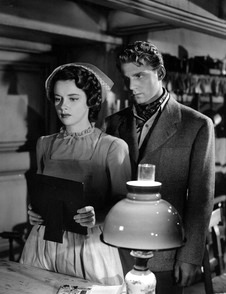
One year later she wrote a novel about her experiences smuggling soldiers and titled it "Paris Underground". This novel was turned into the film Paris Underground, released in Britain as Madame Pimpernel.
The film, produced by Constance Bennett, switches the main character to Kitty ( portrayed by Ms. Bennett ) and makes Etta, renamed Emmie, a secondary character. This part was given to Gracie Fields, the wonderful English actress/singer. Together, they make quite a good team.
Paris Underground was tautly directed by Gregory Ratoff ( All About Eve ) and features all the elements one would want to see in a World War II espionage film: underground agents, quaint "Parisian" settings, secret passageways, diabolical Gestapo men, and plenty of action. The film focuses on two smuggling missions that the gals undertake and then hastily skims over several months until we find them captured and put into prison. They are supposedly released together and honored with medals for their heroism, but in reality, Etta did not know whether Kitty was alive, even at the time of writing her novel.
Dame Gracie Fields, lovingly called "Our Gracie" by the Brits, had a long career in film, stage, radio, and television. Paris Underground was her last picture before she retired to the Isle of Capri where she operated a restaurant. The film does not showcase Gracie at her best ( comedy was her forte ) but she does a marvelous job with the role....as does Constance Bennett as Kitty. Also in the cast is George Rigaud as Kitty's husband, and Kurt Kreuger as the Nazi captain. Character parts were given to Eily Malyon, Vladimir Sokoloff, Andrew McLaglen, and Leslie Vincent ( who memorably played Dr. Watson's "nephew" Nicholas Watson in Pursuit to Algiers ).
Showing posts with label WW2. Show all posts
Saturday, February 8, 2020
Wednesday, October 23, 2019
The Seventh Cross ( 1944 )
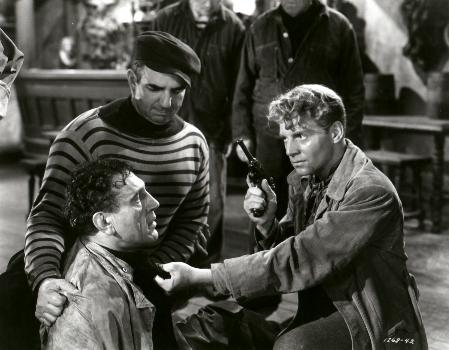
In Germany, in the year 1936, seven prisoners escape from a concentration camp. One by one they are caught and their bodies are placed on crucifixes at the camp as a warning to others who may attempt escape. Only one man from these seven, George Heisler ( Spencer Tracy ), remains uncaptured and it is his escape from the Nazi's Gestapo that becomes the dramatic premise of MGM's The Seventh Cross ( 1944 ).
Metro-Goldwyn-Mayer studios made a number of excellent espionage films right in the midst of the war. "The Seventh Cross" was a novel written by Anna Seghers that the studio had purchased to adapt as a film. The novel had all the makings of a blockbuster hit and indeed, the film itself raked in a tidy profit, but in comparison to other espionage pictures of the era, The Seventh Cross, lacks a few qualities that could have elevated the film to becoming a real classic.
While Spencer Tracy gave a wonderful performance as our lead character George Heisler, Robert Taylor would have been more suited to the role. Tracy just wasn't convincing enough to be a bitter hard-hearted escapee from a concentration camp. His character has little dialogue throughout much of the film and Tracy's eyes were not expressive enough to convey what he was feeling in these scenes.....hence, the audience is given off-screen narration by Ray Collins to help us better understand his plight.
At one point in the story, George hides at an inn where a pretty maid ( Signe Hasso ) aids him in hiding from the Gestapo. Within a few hours we are to believe that she falls in love with him, but this, too, would have seemed more plausible with Robert Taylor in the lead instead of Tracy.
George Heisler's past could have been established better, too. Helen Deutsch's script smoothly avoided the topic of why George was put in a concentration camp in the first place ( the novel explained that he was a Communist ). For a brief moment, we are shown a flashback of George's sweetheart Leni ( Kaaren Verne ) vowing that she will love him always. He flees to Leni's apartment as soon as he escapes the camp only to discover that she refuses to aid him - and is now married to a German officer! This, of course, is a major shock to George but it fails to elicit much emotion from the viewer because Leni's character was given less than 3-minutes of screentime in the flashback scene, which is hardly enough time to flesh out a character.
Nevertheless, The Seventh Cross has many redeeming highlights, most notably a fantastic performance from Hume Cronyn which earned him a Best Supporting Actor Academy Award nomination. Hume portrays Paul, an old friend of George's who is willing to shelter him from the Nazi's and help him find underground connections who can arrange his escape out of Germany. Cronyn's wife Jessica Tandy is also given a wonderful part as his character's wife Liesel. It is worth watching the film for the performance this dynamic duo alone gives.
Fred Zinnemann ( High Noon, From Here to Eternity, The Nun's Story ) helmed the production for the film and, even at this early stage in his career, it was evident what a skillful director he was.
The Seventh Cross also boasts an amazing cast of supporting players including Herbert Rudley, Agnes Moorehead, dear Felix Bressart, Stephen Geray, George Macready, George Zucco and Eily Malyon.
Metro-Goldwyn-Mayer studios made a number of excellent espionage films right in the midst of the war. "The Seventh Cross" was a novel written by Anna Seghers that the studio had purchased to adapt as a film. The novel had all the makings of a blockbuster hit and indeed, the film itself raked in a tidy profit, but in comparison to other espionage pictures of the era, The Seventh Cross, lacks a few qualities that could have elevated the film to becoming a real classic.
While Spencer Tracy gave a wonderful performance as our lead character George Heisler, Robert Taylor would have been more suited to the role. Tracy just wasn't convincing enough to be a bitter hard-hearted escapee from a concentration camp. His character has little dialogue throughout much of the film and Tracy's eyes were not expressive enough to convey what he was feeling in these scenes.....hence, the audience is given off-screen narration by Ray Collins to help us better understand his plight.
At one point in the story, George hides at an inn where a pretty maid ( Signe Hasso ) aids him in hiding from the Gestapo. Within a few hours we are to believe that she falls in love with him, but this, too, would have seemed more plausible with Robert Taylor in the lead instead of Tracy. George Heisler's past could have been established better, too. Helen Deutsch's script smoothly avoided the topic of why George was put in a concentration camp in the first place ( the novel explained that he was a Communist ). For a brief moment, we are shown a flashback of George's sweetheart Leni ( Kaaren Verne ) vowing that she will love him always. He flees to Leni's apartment as soon as he escapes the camp only to discover that she refuses to aid him - and is now married to a German officer! This, of course, is a major shock to George but it fails to elicit much emotion from the viewer because Leni's character was given less than 3-minutes of screentime in the flashback scene, which is hardly enough time to flesh out a character.
Nevertheless, The Seventh Cross has many redeeming highlights, most notably a fantastic performance from Hume Cronyn which earned him a Best Supporting Actor Academy Award nomination. Hume portrays Paul, an old friend of George's who is willing to shelter him from the Nazi's and help him find underground connections who can arrange his escape out of Germany. Cronyn's wife Jessica Tandy is also given a wonderful part as his character's wife Liesel. It is worth watching the film for the performance this dynamic duo alone gives.
Fred Zinnemann ( High Noon, From Here to Eternity, The Nun's Story ) helmed the production for the film and, even at this early stage in his career, it was evident what a skillful director he was.
The Seventh Cross also boasts an amazing cast of supporting players including Herbert Rudley, Agnes Moorehead, dear Felix Bressart, Stephen Geray, George Macready, George Zucco and Eily Malyon.
Wednesday, August 14, 2019
Assignment in Brittany ( 1943 )
"Every second throbs with suspense and danger!"
For once, those exclamatory theatrical heralds were right: Assignment in Brittany is packed to the brim with non-stop adventure. There is so much fast-paced excitement that if you do not have your ears pricked up and your eyes glued to the screen, you may lose some of the plot line.
French heart-throb Jean-Pierre Aumont plays Pierre Matard, a captain in the Free French forces, who is sent to a small village in France disguised as Bertrand Corlay (also Aumont), a suspected Nazi collaborator. Since Pierre bears such a striking resemblance to this man, his task is to weasel out information about the location of a U-Boat base that the British believe is in the vicinity. For the audiences benefit, he accomplishes this mission in one and one-half hours filled with exciting moments of danger.
Like many films that were made in the midst of the war, the brutality of war is not softened to appeal to audience tastes. In one scene, many of the friends that Aumont's character comes to know are executed in front of his eyes. The Nazis are portrayed as the fiendish brutes that they were. But there are tender moments as well. All good resistance fighters end up falling in love while on their missions and Captain Pierre has his moment of romance when his heart melts for the fiancee of his look-a-like Bertrand: Anne Pinot, portrayed by Susan Peters.
Assignment in Brittany (1943) marked the debut of Jean-Pierre Aumont, who had arrived in Hollywood just a year earlier and could barely speak English. It was stage actress Katharine Cornell who discovered the handsome Jean Gabin-esque actor and cast him in her play "Rose Burke". Shortly after he was signed to an MGM contract and made this film and another war drama, The Cross of Lorraine, that same year. Aumont himself had earned the Legion of Honor and Croix de Guerre medals for his service in North Africa with the Free French Forces from 1939-1940. While in Hollywood, he helped raise funds for the Resistance and returned to fight in 1944.
Also making her American debut was Swedish actress Signe Hasso. She made a number of excellent war films, usually playing a heroine but, in this film, she is quite the vixen.
Like most MGM pictures, the production values on Assignment in Brittany are top-notch with great sets by Cedric Gibbons and Edwin Willis, costumes by Gile Steele, music by Lennie Hayton, and excellent cinematography by Charles Rosher (Annie Get Your Gun). The script to the film was based on a Helen MacInnes novel that was serialized in 1942 in "The Saturday Evening Post". MacInnes was a prolific author of espionage novels and, in 1943, MGM had turned another one of her books into a box-office hit - Above Suspicion.
Assignment in Brittany has the usual elements that you would hope to find in an espionage film: suspicious double-face characters, secret codes, danger behind every corner, plenty of Gestapo agents, and the classic escape-in-disguise (this time taking place within a church in France).
For once, those exclamatory theatrical heralds were right: Assignment in Brittany is packed to the brim with non-stop adventure. There is so much fast-paced excitement that if you do not have your ears pricked up and your eyes glued to the screen, you may lose some of the plot line.
French heart-throb Jean-Pierre Aumont plays Pierre Matard, a captain in the Free French forces, who is sent to a small village in France disguised as Bertrand Corlay (also Aumont), a suspected Nazi collaborator. Since Pierre bears such a striking resemblance to this man, his task is to weasel out information about the location of a U-Boat base that the British believe is in the vicinity. For the audiences benefit, he accomplishes this mission in one and one-half hours filled with exciting moments of danger.
Like many films that were made in the midst of the war, the brutality of war is not softened to appeal to audience tastes. In one scene, many of the friends that Aumont's character comes to know are executed in front of his eyes. The Nazis are portrayed as the fiendish brutes that they were. But there are tender moments as well. All good resistance fighters end up falling in love while on their missions and Captain Pierre has his moment of romance when his heart melts for the fiancee of his look-a-like Bertrand: Anne Pinot, portrayed by Susan Peters.
Assignment in Brittany (1943) marked the debut of Jean-Pierre Aumont, who had arrived in Hollywood just a year earlier and could barely speak English. It was stage actress Katharine Cornell who discovered the handsome Jean Gabin-esque actor and cast him in her play "Rose Burke". Shortly after he was signed to an MGM contract and made this film and another war drama, The Cross of Lorraine, that same year. Aumont himself had earned the Legion of Honor and Croix de Guerre medals for his service in North Africa with the Free French Forces from 1939-1940. While in Hollywood, he helped raise funds for the Resistance and returned to fight in 1944.
Also making her American debut was Swedish actress Signe Hasso. She made a number of excellent war films, usually playing a heroine but, in this film, she is quite the vixen.
Like most MGM pictures, the production values on Assignment in Brittany are top-notch with great sets by Cedric Gibbons and Edwin Willis, costumes by Gile Steele, music by Lennie Hayton, and excellent cinematography by Charles Rosher (Annie Get Your Gun). The script to the film was based on a Helen MacInnes novel that was serialized in 1942 in "The Saturday Evening Post". MacInnes was a prolific author of espionage novels and, in 1943, MGM had turned another one of her books into a box-office hit - Above Suspicion.
Assignment in Brittany has the usual elements that you would hope to find in an espionage film: suspicious double-face characters, secret codes, danger behind every corner, plenty of Gestapo agents, and the classic escape-in-disguise (this time taking place within a church in France).
The film's director, Jack Conway, was a veteran of silent films and numerous MGM "A" pictures (A Tale of Two Cities, Libeled Lady, Boom Town, The Hucksters). He was an excellent director and was capable of handling comedies, dramas, and action films with equal ease. The final scene of the destruction of the U-boat base is especially well-filmed and really caps off the picture with a bang.
The movie also boasts a strong supporting cast of MGM stock actors such as Margaret Wycherly, Richard Whorf, Reginald Owen, Alan Napier, Miles Mander, and John Emery. A young Darryl Hickman is given a meaty role as a little French freedom fighter.
Friday, May 10, 2019
Me and the Colonel ( 1958 )
"In life, there are always two possibilities...."
It is quite common to find a film that begins terrifically, loses a bit of its appeal midway through and then flounders at the end. But it is rare to find a film that begins slowly and then gets better and better until it reaches its climax. This is because screenwriters desire to "hook" their audience within ten minutes through a compelling script. Me and the Colonel is one of those rare films that fall into the latter category of having a slow beginning - and yet, one cannot say that it does not feature a compelling script. Quite the contrary; Me and the Colonel is wonderful entertainment.
Danny Kaye stars as Jacobowsky, a Polish Jew who flees from town to town throughout France trying to avoid the Nazis - as this takes place at the beginning of WWII. He is a clever and extremely resourceful man, a practical survivor. He uses people and situations to help provide him with the tools and opportunities to make his escapes. It is during his attempt to flee Paris that he meets Colonel Prokoszny ( Curt Jurgens ), a proud and stubborn Polish officer, and his aide Szabuniewicz ( Akim Tamiroff ).
Jacobowsky is reluctant to use the colonel in his escape plan since he is unapologetically anti-semitic and extremely unhelpful. However, as the colonel is Jacobowsky's only chance, he uses him to drive the car that will take them to southern France and to safety in Spain. Their flight from the Nazis is immediately complicated when the colonel "goes the wrong direction" and heads north into German-occupied territory to rescue his mistress Suzanne ( Nicole Maurey ). The colonel has a penchant for getting them into trouble and it is left to Jacobowsky to continually use his inherent wiles to rescue them from one scrape after another along their journey. It is through Jacobowsky and the colonel's ordeal together that they manage to form a bond of friendship that transcends their differences.
It is quite common to find a film that begins terrifically, loses a bit of its appeal midway through and then flounders at the end. But it is rare to find a film that begins slowly and then gets better and better until it reaches its climax. This is because screenwriters desire to "hook" their audience within ten minutes through a compelling script. Me and the Colonel is one of those rare films that fall into the latter category of having a slow beginning - and yet, one cannot say that it does not feature a compelling script. Quite the contrary; Me and the Colonel is wonderful entertainment.
Danny Kaye stars as Jacobowsky, a Polish Jew who flees from town to town throughout France trying to avoid the Nazis - as this takes place at the beginning of WWII. He is a clever and extremely resourceful man, a practical survivor. He uses people and situations to help provide him with the tools and opportunities to make his escapes. It is during his attempt to flee Paris that he meets Colonel Prokoszny ( Curt Jurgens ), a proud and stubborn Polish officer, and his aide Szabuniewicz ( Akim Tamiroff ).
Jacobowsky is reluctant to use the colonel in his escape plan since he is unapologetically anti-semitic and extremely unhelpful. However, as the colonel is Jacobowsky's only chance, he uses him to drive the car that will take them to southern France and to safety in Spain. Their flight from the Nazis is immediately complicated when the colonel "goes the wrong direction" and heads north into German-occupied territory to rescue his mistress Suzanne ( Nicole Maurey ). The colonel has a penchant for getting them into trouble and it is left to Jacobowsky to continually use his inherent wiles to rescue them from one scrape after another along their journey. It is through Jacobowsky and the colonel's ordeal together that they manage to form a bond of friendship that transcends their differences.
"You have one of the finest minds of the 12th-century"
Danny Kaye was a marvelous actor. His skill at drama was often hidden behind the humorous masks of the characters he played. Me and the Colonel leans more towards drama than comedy and Kaye does not play Jacobosky for laughs. The publicity department at Columbia Studios attempted to warn Danny Kaye fans who were expecting zany comedy and tongue twisters that "Kaye pulls a switch". It was an uncharacteristic role which he played with impressive ease....and won a Golden Globe for his endeavor.
Jacobowsky has such a beautiful soul and it is so appealing to watch him unfold the various layers of his character throughout the film. Suzanne recognizes what a rare individual Jacobowsky is and is lovingly drawn to him. He - and the audience - are left to wonder whether she feels a romantic attachment to him or simply honors him for his noble character.
I have always been amazed at how well Danny Kaye was able to play the romantic. Perhaps it is because we expect him to be the clown that his moments of displaying genuine warmth are all the more touching. Me and the Colonel features one of the sweetest love scenes he ever did. Tucked away in a French palace during a thunderstorm, he confesses his love to Suzanne and the predicament he feels he is in due to his loyalty to the Colonel. Not revealing what she feels, she simply asks him if he would like to dance and there, on the beautiful marble floor of the palace, they waltz.
"More and more I like this Jacobowsky"
Me and the Colonel was nominated for Best Motion Picture at the 1959 Golden Globes and at the Mar del Plata Film Festival. It was based on a play by Franz Werfel ( "The Song of Bernadette" ) and S.N Behrman ( "The Pirate" ) that played for 417 performances on Broadway in 1944 with Louis Calhern, Annabella, Oskar Karlweis and Edward Bromberg as the four intrepid escapees.
It is a light-hearted but thought-provoking drama generously sprinkled with humorous dialogue. Touches of espionage and the serious undertone of its setting make it reminiscent of Ernst Lubitsch's To Be or Not To Be ( 1942 ) and Howard Hawks' I Was a Male War Bride ( 1949 ).
Curt Jurgens, who almost always give a top-notch performance, overdid it in this role and his performance of Prokoszny borders on buffoonery. Yet, he redeems himself at the end of the film and we catch a glimpse of a more tender-natured colonel. Prokoszny is stiff-necked and ego-maniacal but nonetheless endearing. Jacobowsky is willing to give up his life for this man and understandably so. He is courageous and fiercely loyal. The colonel's aide shows equal loyalty to him, as does Suzanne, even though she knows very well that he had affairs with women in every city he stopped at.
"In the cathedral of my heart, a candle will always burn for you!"
The lovely French actress, Nicole Maurey, is always a delight to watch. She is perhaps best known for appearing opposite Bing Crosby in the post-war drama Little Boy Lost ( 1953 ) and for her part in The Day of the Triffids ( 1963 ) where she was once again fleeing France for the Spanish border.
Me and the Colonel features beautiful location filming throughout France and a great supporting cast which includes Alexander Scourby, Françoise Rosay and the marvelous Martita Hunt in a brief part as a nun who aids our heroes in their escape.
Wednesday, November 22, 2017
The Small Back Room ( 1949 )
In the midst of World War II, bomb expert and research scientist Sammy Rice (David Farrar) is recruited by Army captain Dick Stuart (Michael Gough) to investigate a dangerous new bomb that the Germans are scattering throughout Britain's beaches. Sammy struggles with alcoholism and a sense of worthlessness because of a recent injury which left him with a wooden leg, but when he puts his life on the line to disengage one of these bombs he realizes just how beautiful life is - even with a game leg.
Director Michael Powell and screenwriter Emeric Pressburger made a number of excellent dramas in the 1940s which they released under the banner of their production company The Archers. The most famous of these films (A Matter of Life and Death, Black Narcissus, The Red Shoes) were beautifully shot in Technicolor by cinematographer Jack Cardiff. After the color explosion that audiences witnessed in The Red Shoes, Powell decided to return to using black and white film, which the Archers were known for throughout the 1930s. This was a good choice for it emphasized the despair and the struggles that our hero, Sammy, was facing. Adding to his worries, the research department that he works for happens to be undergoing a shift in management and Sammy feels that his prospects for the future seem as bleak as the work environment he is accustomed to. The title The Small Back Room cleverly refers to the department's makeshift offices. In the U.S, the film was released as Hour of Glory, an equally fitting title.
Like most of the Powell/Pressburger films, The Small Back Room features stunning camerawork (Christopher Challis was the cinematographer) and moving performances from all of the principal players, especially from underrated actor David Farrar. However, the film lacks the momentum of the Archer's other pictures. The mystery of the German bombs that are being randomly dropped throughout Britain is the thread that binds the story and yet it seems to be hidden among the tangled netting of Sammy's personal travails until the final quarter of the picture. Sammy's struggle with self-worth and his romance with Susan, a secretary, take center stage instead.
Director Michael Powell and screenwriter Emeric Pressburger made a number of excellent dramas in the 1940s which they released under the banner of their production company The Archers. The most famous of these films (A Matter of Life and Death, Black Narcissus, The Red Shoes) were beautifully shot in Technicolor by cinematographer Jack Cardiff. After the color explosion that audiences witnessed in The Red Shoes, Powell decided to return to using black and white film, which the Archers were known for throughout the 1930s. This was a good choice for it emphasized the despair and the struggles that our hero, Sammy, was facing. Adding to his worries, the research department that he works for happens to be undergoing a shift in management and Sammy feels that his prospects for the future seem as bleak as the work environment he is accustomed to. The title The Small Back Room cleverly refers to the department's makeshift offices. In the U.S, the film was released as Hour of Glory, an equally fitting title.
Like most of the Powell/Pressburger films, The Small Back Room features stunning camerawork (Christopher Challis was the cinematographer) and moving performances from all of the principal players, especially from underrated actor David Farrar. However, the film lacks the momentum of the Archer's other pictures. The mystery of the German bombs that are being randomly dropped throughout Britain is the thread that binds the story and yet it seems to be hidden among the tangled netting of Sammy's personal travails until the final quarter of the picture. Sammy's struggle with self-worth and his romance with Susan, a secretary, take center stage instead.
Kathleen Byron, another underrated actress (and one of Michael Powell's favorite players) portrays this secretary. This character is quite unlike the neurotic Sister Ruth that Byron is famous for playing in Black Narcissus (1947). Susan is a lovely woman who stands behind Sammy in his moments of darkness.
The Small Back Room is not one of Powell and Pressburger's best works but it has its moments of glory and it offers an insightful look into the emotional/moral struggles that many of the "back room boys" must have been wrestling with during the war. Cyril Cusack, Jack Hawkins, and Leslie Banks also star.
Monday, November 6, 2017
From the Archives : Miracle in the Rain ( 1956 )
Van Johnson and Jane Wyman tenderly embracing in a scene from Miracle in the Rain ( 1956 ), a touching World War II romance film. In this scene, Johnson's character was about to be called away overseas and he had a feeling it would be the last time he would see his sweetheart.
From the Archives is our latest series of posts where we share photos from the Silverbanks Pictures collection. Some of these may have been sold in the past, and others may still be available for purchase at our eBay store : http://stores.ebay.com/Silverbanks-Pictures
Subscribe to:
Posts (Atom)