Showing posts with label World War II. Show all posts

Friday, May 31, 2024

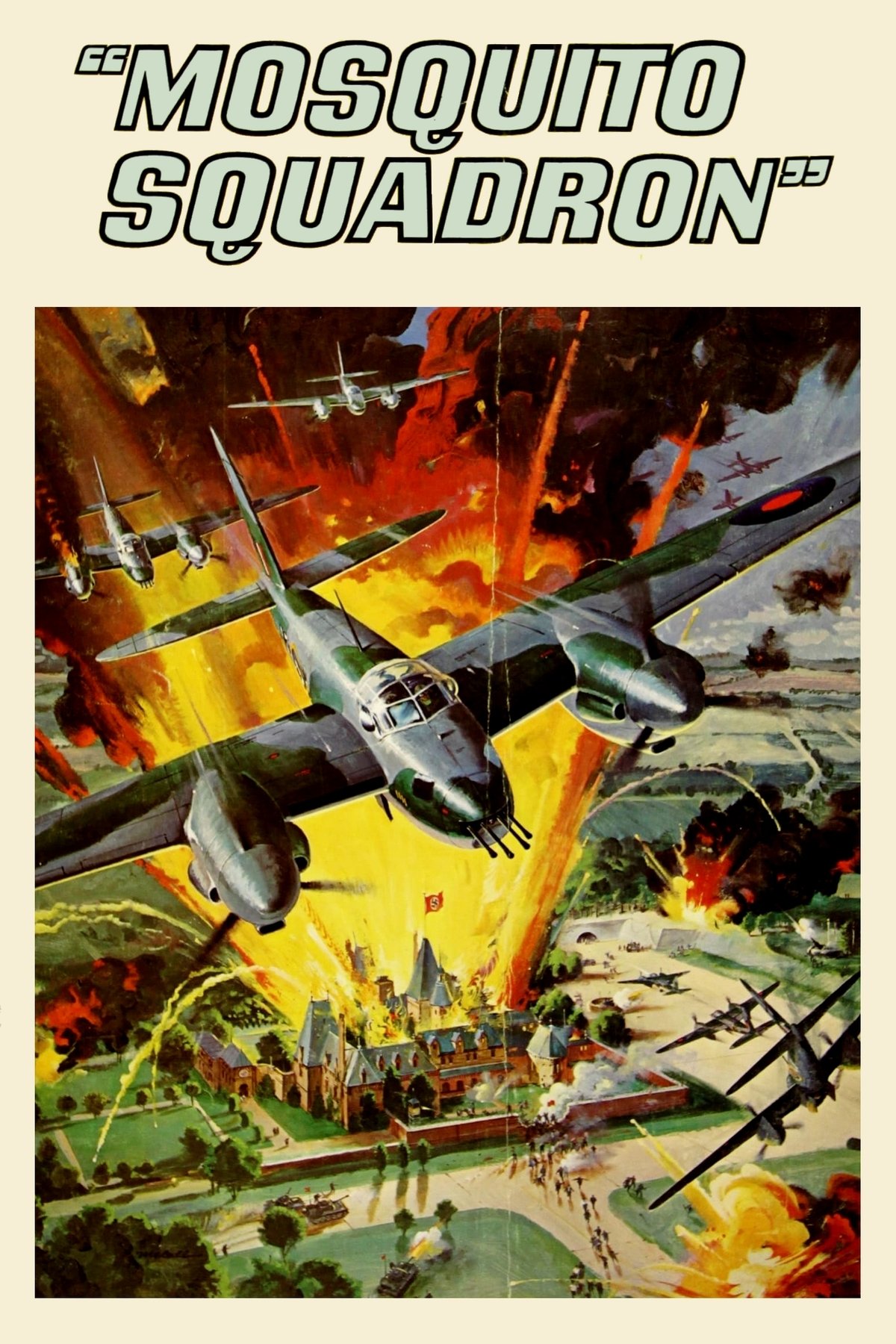
Mosquito Squadron (1969)

During World War II, Londoners not only had to contend with German bombers destroying the streets and homes of their fair city but with a new kind of ballistic missile as well. It was known as the "V2" and was developed by Wernher von Braun, whom the United States government later recruited for the U.S. Space program during the 1950s and 1960s. 

These V2 rockets were devilishly tricky to destroy since they were unmanned flying bombs that soared at speeds of over 2,000 mph and would land randomly on targets throughout London. Anti-aircraft guns positioned outside the city limits fired at them - if they were lucky enough to be forewarned of their approach - but rarely hit a V2.

In Mosquito Squadron, David McCallum plays Quint Monroe, a flight squadron leader whose mission is to destroy a factory where the new V3 long-range multi-stage rockets are being built. Sounds simple enough... until it is revealed that this "factory" is an underground bunker hidden in a tunnel within the confines of Château de Charlon, a chateau in Northern France. In order to drop bombs within the tunnel, the de Havilland Mosquito fighter-bombers are to be equipped with a newly developed "rolling bomb" (they bounce more than roll). Quint and his group have 10 days to practice aiming these rolling bombs with a makeshift tunnel set-up.

The mission becomes even more difficult when the Nazis drop a film canister at the RAF squadron base showing that the RAF prisoners they had previously captured are being held at Château de Charlon. "Come and bomb us!" they seem to tease, knowing a murderous mission such as that would be unthinkable.


Mosquito Squadron
is a grand WWII action-adventure film that packs in a lot of drama and tension within its 86-minute runtime. It also features a rousing theme by Frank Cordell (Khartoum). The film was made on a budget and so, if you're a WWII film fan, you will recognize some of the aerial footage from 633 Squadron which was released just five years prior by United Artists. 

David McCallum is a quiet leading man and not very expressive but fortunately his wooden features were convincing for this role. Like General Frank Savage in the television series Twelve O'Clock High, his character has seen a lot of this friends shot down and has come to view life impassively. When the plane of his surrogate brother Scotty (David Buck) is shot down before his very eyes, Quint has to break the news of his death to Scotty's wife and parents. Not an easy task. 

Suzanne Neve (Scrooge) portrays Scotty's wife Beth. Quint was once in love with Beth but after Scotty's death he finds it difficult to think of romancing her, even though she is welcoming to his approach. 

Unlike many films of the late 1960s, Mosquito Squadron is devoid of any bedroom scenes and what I like best about it is how colorful the movie is - another feature you don't often find in a film bordering the 1970s era of dark and drabby film-making. There are certainly no dark sequences in this picture and even the interior office shots are brightly lit. 

Quint drives a sporty red 1935 Godsal roadster and the scenes around the Hertfordshire country of England are lovely. Keen fans of The Avengers television series will recognize the old brick bridge where Diana Rigg fought an assailant in "You Have Just Been Murdered".

The remaining cast of military men include a number of familiar faces even though their names would elude most viewers: Charles Gray, Dinsdale Landen, Bryan Marshall, Robert Urquhart, and David Dundas. 

Mosquito Squadron is available via streaming on Tubi and also on DVD. 

Monday, November 6, 2017

From the Archives : Miracle in the Rain ( 1956 )

Van Johnson and Jane Wyman tenderly embracing in a scene from Miracle in the Rain ( 1956 ), a touching World War II romance film. In this scene, Johnson's character was about to be called away overseas and he had a feeling it would be the last time he would see his sweetheart. 

From the Archives is our latest series of posts where we share photos from the Silverbanks Pictures collection. Some of these may have been sold in the past, and others may still be available for purchase at our eBay store : http://stores.ebay.com/Silverbanks-Pictures

Friday, August 14, 2015

PT 109 ( 1963 )

"Nauro Island...Commander...native knows posit...he can pilot... 11 alive-need small boat... Kennedy".

So reads the carving on the coconut that sat upon President John F. Kennedy's desk for over twenty years. It's a coconut with a past and the film PT 109 tells the story of this coconut or rather, the story of the hard-shelled naval lieutenant that eventually became president of the United States. The two go hand in hand.

When Kennedy was but 26 years old he was made skipper of a Navy patrol boat ( PT boat ) stationed off of the Solomon islands during WW2. One night while on patrol, a Japanese destroyer bore down upon the vessel and rammed it, cutting it in two. Most of the men survived and managed to swim to a nearby island unoccupied by Japanese. For the next five days, Kennedy and his men tried to flag down passing American ships to no avail. It was not until several natives in a canoe landed on the island that Kennedy managed to get a message out. Having no paper, he carved his words on a coconut and told them "Rendova, Rendova" ( a nearby base ). The next day an Allied coastwatcher- Lt. Evans, received the coconut and instructed the natives to have Kennedy come back with them. After reaching Evans post, Kennedy returned with the two PT boats sent out to pick up his crew on the island. 

Kennedy didn't have an ideal group of men to be marooned with. While his fellow officers kept their cool, his crew were a lackluster bunch of fellows. At least, that's how they were portrayed in the film which was based upon the novel "PT 109: John F. Kennedy in WWII" written by Robert J. Donovan. JFK's father, Joseph Kennedy Sr. was one of the founding fathers of RKO studios and he used his influence in Hollywood to have Donovan's novel turned into a motion picture. 


Cliff Robertson was John F. Kennedy's personal choice of actor to portray him and he did a great job, especially considering that he was nearly twenty years older than Kennedy was at the time the events happened. Jacqueline Kennedy preferred Warren Beatty to play her husband. Other actors considered for the role were Ed "Kookie" Byrnes, Peter Fonda, and Jeffrey Hunter. Another choice was Peter Brown, who would have been stellar in the role.

Supporting Cliff Robertson was Ty Hardin (as Ensign Leonard J. Thom ) and Robert Culp ( as "Barney" Ross ) with James Gregory and Grant Williams portraying officers on the naval island base. The enlisted men included actors Robert Blake, Norman Fell, Biff Elliott and Errol John. 


In addition to having the choice of lead actor, President Kennedy set down two requirements prior to filming : he wanted the picture to be historically accurate and he wanted the profits from the movie to be donated to the PT 109 survivors.

PT 109 was released on June 19, 1963, just five months prior to Kennedy's assassination, and grossed 5.5 million worldwide. It was a far cry from a flop, but the studio had much greater hopes for the picture and its returns were disappointing. While PT 109 has a few exciting sequences, the story drags in places and its run-time of 140 minutes makes it too long for one sitting. Kennedy himself thought the film a "good product" but had a difficult time sitting through it all...especially with his bad back. At one time he could endure six days stranded on an island but knew that modern audiences liked their action fast, and remarked "It's just a question of whether there is too much of it".

Monday, June 16, 2014

On the Homefront : MGM and the War Effort

Sunlight streams through the shattered roof of a country church. There are empty places in the pews where, only a few weeks earlier, parishioners had sat - the local stationmaster, a choirboy, the young daughter-in-law of a much loved family. They are gone now, dead from the bullets or the bombs of an enemy they didn't know, in a war they hardly understood. 

Framed by the wreckage of his church, the vicar delivers a ringing sermon : "Why, in all conscience, should these be the ones to suffer? I shall tell you why! Because this is not only a war of soldiers in uniform. It is a war of the people - of all people - and it must be fought not only on the battlefield but in the cities and in the villages, in the factories and on the farms, in the home and in the heart of every man, woman, and child who loves freedom...This is a people's war! It is our war! We are the fighters! " 

The camera pans upward, through the sundered roof of the church.  "Onward Christian Soldiers" rises on the soundtrack as British fighter places - like a gathering flock of graceful birds - wing overhead, toward the enemy. 

So ends Mrs. Miniver, MGM's most popular and award-winning film of World War II. Moviegoers around the world thrilled to it, and with good cause. MGM was at its best during the war years, making movies to build the morale of fighting men and women, and the families awaiting their return. 


It was a time of pure patriotism, the fan club, the screen magazine, and the star system. MGM's male stars traded costumes for khaki and marched off to war. Clark Gable, James Stewart, Robert Taylor, Gene Kelly, Jackie Cooper, Stewart Granger, Van Heflin, Robert Montogomery, and Robert Sterling all served in the armed services. 

Other stars of both sexes went overseas to perform in USO shows; some washed dishes, served food, or danced with lonely GIs in the Hollywood Canteen. And still others traveled around the United States,  selling war by the thousands, sometimes quite creatively. MGM, for instance, conducted a "Tanks for Yanks" campaign that featured Johnny Sheffield, the "Boy" in the Tarzan series, touring the country and speaking, from the turret of a tank, about "A Boy's Place in America". 

In another promotion, MGM conducted a contest in several cities to pick seven girls who were "...doing the most to promote the war effort on the homefront". Their prizes were corsages and dinner with seven sailors, all paid for by MGM. 

Meanwhile, back at the studio, the sound stages busily produced war-related short subjects, such as National Defense, a documentary honoring all of the Rosie the Riveters and Max the Mechanics in the country. One of Pete Smith's lighthearted short subjects, Victory Vittles, advised home-front housewives to make do with leftovers, while an intriguing series on the medieval prophet Nostradamus revealed his provocative predictions for the advent and end of the war. Don't Talk and Mr. Blabbermouth warned home-front warriors about the consequences of rumor-mongering and spilling war secrets to unsuspected spies. 

For the young and the young-of-heart, the studio's cartoon department penned, among others, The Blitz Wolf, in which Adolf the cartoon wolf, who bore a "striking resemblance to Adolph the Phewrer" was ultimately defeated by the three little pigs of Pigmania - once they abandoned isolationism and fought together for the common good. 


Still, MGM's most effective weapons were its stirring home-front feature films. "Motion pictures are of the utmost importance to....build up mroale", said General Dwight Eisenhower in 1942, "...feature productions bring home their country vividly to the memories of soldiers. Let's have more motion pictures!" An MGM obliged, with multi-star musical extravaganzas such as Thousands Cheer ( 1943 ), Family musicals such as Meet Me in St. Louis ( 1944 ), comedies such as Swing Shift Maisie ( 1943 ), and, most movingly, tributes to the family values the Allied forces were fighting to defend. 

MGM's Mrs. Miniver gently dissolved class distinctions in England and celebrated the enduring power of the family - itself a miniature world at peace. Its American counterpart was The Human Comedy ( 1943 ), William Saroyan's semi-autobiographical story about the Macauley family of Ithaca, California. In his own, spun-glass way, Saroyan created a town and a family with whom practically every American could identify and sympathize. 

The Macauleys are poor in terms of money but affluent in the abundant, boundless love they have for each other. Since his father is dead and brother Marcus ( Van Johnson ) is in the army, young Homer Macauley ( Mickey Rooney ) works at a postal telegraph office to support the family. At the beginning of the film, Homer is a boy; by its end, the war has made him a man, as it has the American soldiers overseas. The telegraph office where he works receives and delivers wires from the War Department announcing the deaths of sons on the battlefield. Inevitably, it receives the news of the death of Homer's brother Marcus. As Homer tries desperately to cope with his terrible loss, the voices of Marcus and his father - like the vicar's words in Mrs. Miniver - comfort him, and the theater audience, too : "You are what we're fighting the war for. You are what we have left behind - to live the hopes we only dreamed ". 

This post is an excerpt from Peter Hay's excellent book on the history of Metro-Goldwyn-Mayer studios, "MGM: When the Lion Roars" published by Turner Publishing in 1991. For those who have not yet read it, it is the authoritative book on the studio and a truly delightful read, packed with over 700 photographs from the MGM's golden era.