Showing posts with label Walter Pidgeon. Show all posts

Saturday, January 18, 2025

From the Archives: Voyage to the Bottom of the Sea (1961)

Walter Pidgeon and his group of submarine sailors head down into deep waters in the 1961 action-adventure film Voyage to the Bottom of the Sea, produced by 20th Century Fox. In this scene, Robert Sterling and John Litel share Walter Pidgeon's concern that the Earth will burn up and sync their watches as the Seaview races to launch a rocket to blow up the Van Allen belt before the Earth is destroyed. 

From the Archives is our latest series of posts where we share photos from the Silverbanks Pictures collection. Some of these may have been sold in the past, and others may still be available for purchase at our eBay store: http://stores.ebay.com/Silverbanks-Pictures

Saturday, July 11, 2020

Magic Couples of Metro-Goldwyn-Mayer

Movies have always reflected the hopes and dreams of the public, especially in terms of romance. Since almost every movie genre - from mysteries to swashbucklers, from war to love stories - features a leading man and a woman, it is not surprising that thousands of different screen couples exist on film. Only a relatively few couples created real magic, and of these, a surprising number worked for MGM.

At the studio with "more stars than there are in heaven," Louis B. Mayer and Irving Thalberg acted as divine matchmakers. If a couple proved successful in a film, it was likely they would be recast as a team, especially if they were both under contract to MGM. Thalberg, for example, noticed a chemistry between Joan Crawford and Clark Gable when they co-starred for the first time in Dance, Fools, Dance ( 1931 ). He set the story department to finding scripts that would suit the two actors. Subsequently, Crawford and Gable made eight films together, in most of which she played the working girl who rose to fame and glamour, and he was the rugged he-man who loved her. Judy Garland and Mickey Rooney, the perennial happy-go-lucky teenagers, co-starred in nine MGM movies. And Myrna Loy and William Powell, the quintessential happily married couple of the forties, made thirteen films together in as many years. 

What made a great screen couple? The answer is as difficult to determine as it is to explain what makes a relationship work in real life. Like all great lovers, screen couples exude mystery and wonder. "We're inevitable, " John Gilbert tells Greta Garbo in Queen Christina ( 1934 ), "Don't you feel it?" She does and so do we. Great lovers always seem inevitable, part kismet, and part coincidence. 

Casting two actors together creates a third entity, a single ideal. And no movie studio in the world paired couples together with as much frequency as MGM. In some cases, screen couples served to perpetuate a series, such as Johnny Weissmuller and Maureen O'Sullivan in the Tarzan films, or Lew Ayres and Laraine Day in a succession of Dr. Kildare episodes. But the great MGM screen couples came to symbolize a singular aspect of romance: Greta Garbo and John Gilbert ( Temptation ); Clark Gable and Jean Harlow ( Lust ); Joan Crawford and Clark Gable ( Glamour ); Myrna Loy and William Powell ( Sophistication ); Jeanette MacDonald and Nelson Eddy ( Sentimental Love ); Judy Garland and Mickey Rooney ( Good, Clean Fun ); Greer Garson and Walter Pidgeon ( Enduring Love ); Spencer Tracy and Katharine Hepburn ( Mutual Admiration ). 

Perhaps the popularity of these couples can be attributed to moviegoers' longing for the romantic ideals these costars projected on the screen. Certainly, their popularity also was a reflection of the times. Jeanette MacDonald and Nelson Eddy sang sentimental arias to each other, lavishly adorned in period costumes, while the world suffered through the Great Depression. Their love was always chaste and their relationship was as idealized as someone like Louis B. Mayer couple imagine. In Mrs. Miniver ( 1942 ), Greer Garson and Walter Pidgeon stoically endured the hardships of World War II. ( Winston Churchill said that the movie did more for the war effort than a fleet of destroyers ). But the common bond and the lasting appeal of the majority of screen couples from this era also had to do with equality of the sexes. 
We may think of the liberated woman as a phenomenon of the seventies, but just look at the female characters of the thirties and forties. They were women who stood up to their men; Women who could wisecrack, work, even fight, if necessary, for the things they wanted and for the men they loved. They were equal partners in solving a crime, running a business, singing duets, or dancing on Broadway. These women held their own with men in the bedroom, the boardroom, and even the barroom, when necessary. In a classic scene from The Thin Man ( 1934 ), Myrna Loy discovers that William Powell has consumed six martinis, and tells the waiter, "....bring me five more martinis, Leo, and line they right up here."

These women matched their men, drink for drink, or any other way, and the men loved them for it. 

The influence of MGM's screen couples continues today on late-night television and in video rental stores, where these movies of yesteryear are still popular, reinforcing the fantasies created by Hollywood's most powerful dream machine. Obviously, we still want to believe that, in real life, Loy and Powell or Garson and Pidgeon stay happily married for decades. "Ah! Sweet mystery of life, " as Jeanette MacDonald and Nelson Eddy would croon. And the mystery was this: Why can't real life work like the movies?

- Peter Hay

The above article was an excerpt from "MGM: When the Lion Roars", written by Peter Hay and published by Turner Publishing Inc ( 1991 ). 

Saturday, June 20, 2020

Voyage to the Bottom of the Sea ( 1961 )

"Dive! Dive!"

Film producer/director Irwin Allen let audiences dive deep into the waters of adventure with Voyage of the Bottom of the Sea, his second of three feature films that he made at 20th Century Fox studios in the early 1960s. Prior to gaining a reputation as "The Master of Disaster" because of his disaster-themed films of the 1970s, Allen tried his hand at writing, producing and directing adventure pictures. His first production for Fox - Lost World ( 1960 ) - was co-written by Charles Bennett and its success at the box-office led to the two men collaborating on another Jules Vernes-like story. They took some inspiration from "20,000 Leagues Under the Sea" and created a clever story about a modern era atomic submarine 

Walter Pidgeon stars as the cigar-chomping Admiral Nelson, inventor and commander of the newly-built atomic sub Seaview. The Seaview is on diving trials in the Arctic Ocean when they discover boulder-size pieces of ice crashing into the sea around them. They surface and find that temperatures are over 100 degrees and the sky is aflame. A meteor shower had pierced the Van Allen radiation belt and caused it to catch on fire. Admiral Nelson and his right-hand man, Commodore Emery ( Peter Lorre ) believe that the Earth can be saved from burn-up if a missile were to be shot into the Van Allen belt to create an explosion. According to their calculations, this missile can only be launched from the Mariana Islands, and so the Seaview races to the south to reach the islands before the entire world burns. 
Along for the ride is Dr. Susan Hiller ( Joan Fontaine ), a psychologist who is studying crews for their reaction to stress, Vice-Admiral B.J. Crawford ( John Litel ), and Congressman Parker ( Howard McNear ). The voyage progresses smoothly until doubts begin to arise in the mind of Captain Lee Crane ( Robert Sterling ) as to whether the admiral is making a sound and safe decision. Lt. Connors ( Barbara Eden ) has complete faith in the admiral but cannot explain the unusual happenings onboard the Seaview...acts of sabotage that appear to be of Admiral Nelson's doing. 
Voyage to the Bottom of the Sea is a fun adventure flick packed with action. The race-against-time element makes the story exciting enough, but Allen threw in a touch of mystery with the added story of the saboteur. There are also two octopus attacks and a great mine-field sequence. 

The Van Allen radiation belts had only recently been discovered when Irwin Allen began writing Voyage to the Bottom of the Sea, and so much about them was still unknown. The idea of the Van Allen belt catching on fire was later proven to be impossible, but at the time, it probably sent shivers down audiences thinking about it being an actual possibility. 

Even though most of the film takes place within the confines of the Seaview, the film never feels stagebound. The sets, created by Herman Blumenthal, were very imaginative ( they were later reused for the television series ). The Seaview itself is an especially good design. 
Irwin Allen plunged $1.5 million dollars into the making of Voyage to the Bottom of the Sea and it paid off handsomely. Critics gave the picture mixed reviews but audiences loved it and the movie raked in over $8 million dollars. 

Teen singing-sensation Frankie Avalon helped to lure in the young female audience. His part was not very dramatic and, surprisingly, he didn't sing in the film but you can hear his voice crooning the opening credits. 

Also in the cast was Michael Ansara ( who fell in love with and married Eden after making the movie ), Regis Toomey, Henry Daniell, Skip Ward and Mark Slade. 

Monday, February 17, 2020

The Girl of the Golden West ( 1938 )

Ramerez ( Nelson Eddy ) is a carefree caballero with a tremendous sombrero on his head. Also on his head is the price of $5,000 in gold, for Ramerez is a great bandito. Along with his band of hard-riding hombres, he holds up stagecoaches and steals their passenger's gold. But he is a good man in spite of his thieving blood. Like a Robin Hood of the Wild West, Ramerez takes his portion of the gold that he steals and secretly gives it to Father Sienna to give to the poor Indians.

One day, en route to Monterey, this masked bandit holds up the stagecoach carrying Mary Robbins ( Jeannette MacDonald ) and, instantly smitten with the feisty lass, pursues her to Monterey to the governor's ball. There, incognito as Lieutenant Richard Johnson, he woos her beneath the Monterey pines with fancy words and sweet melodies. 

"I suspect you tell all your girls that their eyes are like two spoonfuls of blue Pacific." - Mary

Ramerez is playing the part of a gentleman and Mary is also playing a part. She is not the lace-and-satin lady he believes her to be, but the owner of a saloon - "The Poker". Mary is proud of her saloon and, being the only woman in the gold-mining town of Cloudee, she is beloved by all the men there, especially Sheriff Jack Rance ( Walter Pidgeon ) who intends to wed her.

When the sheriff gets wind that Ramerez is town, he sets up a trap to catch the bandit at "The Poker". This is when Mary realizes that her beloved lieutenant is none other than the infamous Ramerez and must decide whether her love for him is great enough to shield him from the law and the sheriff. 

The Girl of the Golden West was the fourth film to feature "America's Singing Sweethearts": Nelson Eddy and Jeanette MacDonald ( known as "MacEddy" to fans ). Metro-Goldwyn-Mayer struck gold when they first teamed them up in the operetta Naughty Marietta in 1935. They were a dynamic duo whose on-screen personalities were a match made in heaven. They were often cast in operetta films with period settings and the Old California atmosphere of this picture suited them particularly well. 

Like many of their films, The Girl of the Golden West was based on an opera - Puccini's La Fanciulla del West which, in turn, was based on David Belasco's original play. Instead of featuring Puccini's music, MGM producers decided to hire Sigmund Romberg to write an entirely new score for the picture. Romberg had penned many popular operettas including The Student Prince, New Moon, and The Desert Song. Along with lyricist Gus Kahn, he wrote seven songs for this film: the robust "Soldiers of Fortune", the lovely ballads "Shadows on the Moon" and "The Wind in the Trees", the duets "Who Are We to Say?" and "Señorita", the grand "Mariachi" and Buddy Ebsen's solo "The West Ain't Wild Anymore". MacDonald also performs two classical pieces: "Ave Maria" and "Liebestraum". 

The Girl of the Golden West received mixed reviews at the time of its release but has since become a MacEddy classic. It is a charming mixture of romance and adventure with a touch of humor. What is especially appealing is the back history of Mary and Ramerez as children. Prior to becoming the great bandito, Ramerez was a little boy ( played by Bill Cody Jr. ) known affectionally as "Little Gringo" by his surrogate father, "The General" ( Noah Beery ). While riding with the General's gang, Little Gringo witnesses a group of settlers gathered around a campfire and hears a girl singing a song that he would never forget - "Shadows on the Moon". That girl is Mary. The long-lost love from his youth is found again...in true operetta fashion. 
Jeanette MacDonald was such a spunky actress and her character Mary is a glove-fit for her. Mary has no qualms about living by herself in a cabin in the mountains, nor does she mind being the only gal in town...on the contrary, she basks in the attention she receives from "the boys"! If such a character was portrayed in a film today, she would probably be acted out in an overly masculine fashion, but MacDonald doesn't lose any of her womanly charms in her portrayal. 

Nelson Eddy, who was often referred to as a wooden actor, was quite lively in this production and it is easy to see why Mary falls for the handsome luuuu-tenant. Eddy makes a hero out of his bandit character, just like Errol Flynn did with Robin Hood. 

The Girl of the Golden West also boasts an impressive supporting cast. Walter Pidgeon is ideal as the gamblin' Sheriff Jack Rance. He is not a bad man in any sense, yet he becomes the villain when he threatens the happiness of the two lovebirds. Leo Carillo also stars as Mosquito, Ramerez's right-hand man. H.B. Warner is the kindly Father Sienna; Buddy Ebsen has a charming part as a blacksmith smitten with "Miss Mary" and some of the bar-room boys include Bob Murphy, Cliff Edwards, Billy Bevan, and Brandon Tynan. 

Friday, June 9, 2017

Listen, Darling ( 1938 )

For many years, Freddie Bartholomew was one of Metro-Goldwyn-Mayer's biggest box-office drawing child actors but, like most child stars, he found his popularity waning as he grew into adolescence. In 1938, he was no longer a wide-eyed little aristocratic tyke, but had matured into a handsome - if a tad bit scrawny - teenager, just ripe enough in age to play a second-fiddle beau to the child actor who would succeed him as star of the studio - Judy Garland - in the family melodrama Listen, Darling

Judy Garland had been signed to a MGM contract in 1935 and had quickly become such a favorite with audiences across the country that within three short years the studio was already preparing an adaptation of Frank L.Baum's The Wizard of Oz to be a starring vehicle for their newfound talent. 

Her characters were often shy, giggly, awkward little girls, but they were strangely appealing. Judy had a way of brightening up the screen the moment she walked into a scene and, when she opened her mouth to sing, that powerful voice of hers would transfix audiences. Her singing was very mature and heart-felt for one so young. 


Judy had starred in only a handful of roles, her most recent being opposite Mickey Rooney in Love Finds Andy Hardy, when she was cast in Listen, Darling, a light-hearted melodrama aimed towards juvenile audiences. Today, it is remembered primarily for her performance of the song "Zing! Went the Strings of my Heart" (which Judy kept in her stage repertoire until her final show some thirty years later) but the film itself has many endearing qualities. It is quite touching and often humorous. 
Judy stars as young Pinkie Wingate who, with her pal Buzz (Freddie), will stop at nothing - including kidnapping - to keep her mother (Mary Astor) from entering a loveless marriage with the town's pompous banker (Gene Lockhart). Together they stow mother and baby brother into the old family trailer and head onto the open road to look for a handsome man who could whisk her mother off her feet. They think it will be a bumpy road to love but their mother quickly catches the eye of two suitors (Walter Pidgeon and Alan Hale), who, in Pinky's eyes, are both preferable to the banker.

Freddie Bartholomew and Judy Garland make a winning team of cupids but, since they were at opposite arcs in their careers, this would be their only screen pairing. Bartholomew confessed that he had a crush on Judy during the making of the movie but she only looked upon him as a younger brother, being a whole two years older than he. 


Listen, Darling is a sweet film and features that unabashed sentimentality which only MGM could capture on film so well. I especially enjoy it because of the fond memories I associate with the movie. One beautiful Saturday morning, my father, sister, and I were returning home from a camping trip at the lakeside town of Geneva, Ohio, when we stopped at a small library and found a mother-load of classic movies on VHS tape in their collection.... one of which was Listen, Darling. On most Saturday nights we watch MGM musicals or Walt Disney films, so we saw Listen, Darling that very evening to cap off that wonderful day and zing! went the strings of my heart.... the film drew me in completely. Its fun camping theme and the spot-on performances from all the principal players made it a delight to watch and it has always remained a favorite. 

This post is our contribution to The Judy Garland Blogathon being hosted by In the Good Old Days of Classic Hollywood. Click here to read more posts about Judy, her films, and her career. 

Thursday, February 11, 2016

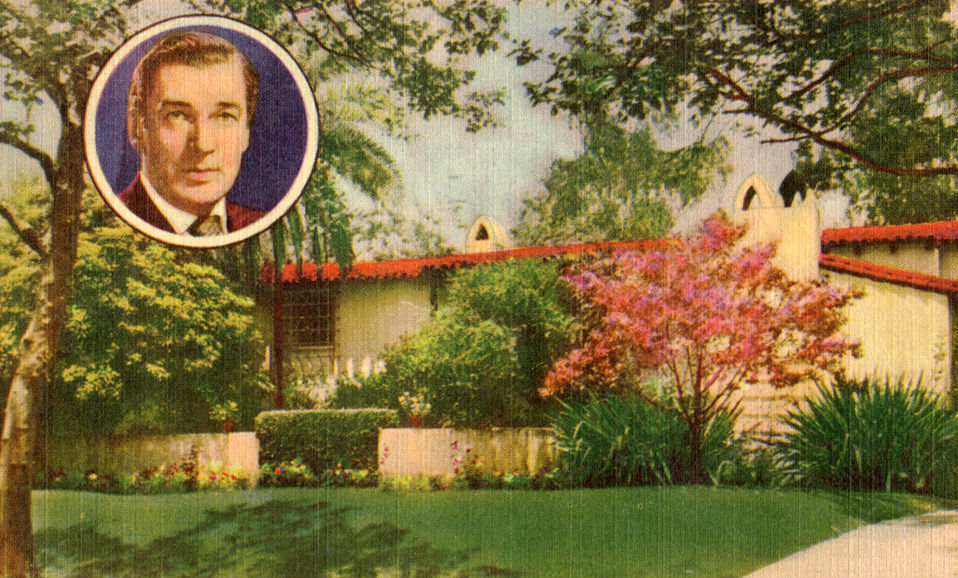
Hollywood Home Tour - Walter Pidgeon

"All aboard the Silver Scenes Hollywood Home Tour Bus! Make sure you got all your belongings. Everybody in now? Off we go! 

"Since we've had a long lunch break, I'll be speeding up the bus quite a bit and showing you folks a number of beautiful Hollywood homes before we take our next break. So sit back, relax, and enjoy the ride. 

710 Walden Drive, Beverly Hills

"The first home will be coming up on your left in just a couple hundred yards. This is Walter Pidgeon's Spanish stucco estate that he purchased in the late 1930s, just about the time when he was really making a name for himself in Hollywood. His mother, Edna, also lived with him and his wife, Ruth Walker, for a time at this house. The famous architect Walter Neff built this lovely home in 1926, but don't be deceived by its humble front, it is over 5000 square feet in size. 

"You enter the house through a rotund foyer and then as you make a turn into the living room you'll catch your breath as you see the two story cathedral beamed ceilings and exquisite iron railings throughout the place.

"Pidgeon's neighbors at the time included his long-time screen partner Greer Garson, as well as Arthur Hornblow Jr ( 704 ), Joe E. Brown ( 707 ), Gloria DeHaven and John Payne ( 708 ). 

"However, no use straining your eyes trying to catch a glimpse of Pidgeon...he no longer lives here. In the 1940s he purchased an English-style home ( very befitting to his onscreen persona ) over on Strata Corda Road in Bel-Air, where he still lives today. We'll be driving over that way later in the tour, so you can bring out your cameras at that time."

Up-to-Date News : This Neff estate fetched a whopping $7 million in 2013 when it was listed for sale. Pidgeon passed on in 1984 after suffering a series of strokes at his home in Bel-Air. 


Monday, June 16, 2014

On the Homefront : MGM and the War Effort

Sunlight streams through the shattered roof of a country church. There are empty places in the pews where, only a few weeks earlier, parishioners had sat - the local stationmaster, a choirboy, the young daughter-in-law of a much loved family. They are gone now, dead from the bullets or the bombs of an enemy they didn't know, in a war they hardly understood. 

Framed by the wreckage of his church, the vicar delivers a ringing sermon : "Why, in all conscience, should these be the ones to suffer? I shall tell you why! Because this is not only a war of soldiers in uniform. It is a war of the people - of all people - and it must be fought not only on the battlefield but in the cities and in the villages, in the factories and on the farms, in the home and in the heart of every man, woman, and child who loves freedom...This is a people's war! It is our war! We are the fighters! " 

The camera pans upward, through the sundered roof of the church.  "Onward Christian Soldiers" rises on the soundtrack as British fighter places - like a gathering flock of graceful birds - wing overhead, toward the enemy. 

So ends Mrs. Miniver, MGM's most popular and award-winning film of World War II. Moviegoers around the world thrilled to it, and with good cause. MGM was at its best during the war years, making movies to build the morale of fighting men and women, and the families awaiting their return. 


It was a time of pure patriotism, the fan club, the screen magazine, and the star system. MGM's male stars traded costumes for khaki and marched off to war. Clark Gable, James Stewart, Robert Taylor, Gene Kelly, Jackie Cooper, Stewart Granger, Van Heflin, Robert Montogomery, and Robert Sterling all served in the armed services. 

Other stars of both sexes went overseas to perform in USO shows; some washed dishes, served food, or danced with lonely GIs in the Hollywood Canteen. And still others traveled around the United States,  selling war by the thousands, sometimes quite creatively. MGM, for instance, conducted a "Tanks for Yanks" campaign that featured Johnny Sheffield, the "Boy" in the Tarzan series, touring the country and speaking, from the turret of a tank, about "A Boy's Place in America". 

In another promotion, MGM conducted a contest in several cities to pick seven girls who were "...doing the most to promote the war effort on the homefront". Their prizes were corsages and dinner with seven sailors, all paid for by MGM. 

Meanwhile, back at the studio, the sound stages busily produced war-related short subjects, such as National Defense, a documentary honoring all of the Rosie the Riveters and Max the Mechanics in the country. One of Pete Smith's lighthearted short subjects, Victory Vittles, advised home-front housewives to make do with leftovers, while an intriguing series on the medieval prophet Nostradamus revealed his provocative predictions for the advent and end of the war. Don't Talk and Mr. Blabbermouth warned home-front warriors about the consequences of rumor-mongering and spilling war secrets to unsuspected spies. 

For the young and the young-of-heart, the studio's cartoon department penned, among others, The Blitz Wolf, in which Adolf the cartoon wolf, who bore a "striking resemblance to Adolph the Phewrer" was ultimately defeated by the three little pigs of Pigmania - once they abandoned isolationism and fought together for the common good. 


Still, MGM's most effective weapons were its stirring home-front feature films. "Motion pictures are of the utmost importance to....build up mroale", said General Dwight Eisenhower in 1942, "...feature productions bring home their country vividly to the memories of soldiers. Let's have more motion pictures!" An MGM obliged, with multi-star musical extravaganzas such as Thousands Cheer ( 1943 ), Family musicals such as Meet Me in St. Louis ( 1944 ), comedies such as Swing Shift Maisie ( 1943 ), and, most movingly, tributes to the family values the Allied forces were fighting to defend. 

MGM's Mrs. Miniver gently dissolved class distinctions in England and celebrated the enduring power of the family - itself a miniature world at peace. Its American counterpart was The Human Comedy ( 1943 ), William Saroyan's semi-autobiographical story about the Macauley family of Ithaca, California. In his own, spun-glass way, Saroyan created a town and a family with whom practically every American could identify and sympathize. 

The Macauleys are poor in terms of money but affluent in the abundant, boundless love they have for each other. Since his father is dead and brother Marcus ( Van Johnson ) is in the army, young Homer Macauley ( Mickey Rooney ) works at a postal telegraph office to support the family. At the beginning of the film, Homer is a boy; by its end, the war has made him a man, as it has the American soldiers overseas. The telegraph office where he works receives and delivers wires from the War Department announcing the deaths of sons on the battlefield. Inevitably, it receives the news of the death of Homer's brother Marcus. As Homer tries desperately to cope with his terrible loss, the voices of Marcus and his father - like the vicar's words in Mrs. Miniver - comfort him, and the theater audience, too : "You are what we're fighting the war for. You are what we have left behind - to live the hopes we only dreamed ". 

This post is an excerpt from Peter Hay's excellent book on the history of Metro-Goldwyn-Mayer studios, "MGM: When the Lion Roars" published by Turner Publishing in 1991. For those who have not yet read it, it is the authoritative book on the studio and a truly delightful read, packed with over 700 photographs from the MGM's golden era. 

Sunday, January 26, 2014

The South-of-the-Border Musicals

When Carmen Miranda sambaed her way into the Broadway musical revue scene in 1939, her energetic style and eye-rolling fractured musical interpretations of English words, took America by storm. Soon everyone was swaying their hips to the bongo-beating rhythm of the Bando de Lua and taking six easy dance lessons from Madame La Zonga. 

Meanwhile, in Hollywood, 20th Century Fox was getting their top talents together to produce a colorful musical treat to dazzle the moviegoers and please the president. President Roosevelt, that is. He was reaching his hand across the border to encourage trade and wanted all of Latin America to know we were their neighbors. Darryl Zanuck, always a friend of the Washington politicians, was more than glad to help. He saw the Good Neighbor Policy as a good box-office policy and quickly thrust the studio's loveliest leading lady, Alice Faye, into their most entertaining new musical to date, Down Argentine Way. Alas, the lovely lady had an attack of appendicitis and so the glamorous Betty Grable stepped into a role that would ultimately launch her into pin-up stardom. 

Down Argentine Way tells the story of a wealthy girl who has a romance with a dashing and equally wealthy Argentine horse breeder, Don Ameche. The movie dispensed good cheer and tropical radiance to moviegoers nationwide whilst it gaudily painted a Utopian perspective of the elite Argentine horse set in lush Techni-colors. But, more astonishing than the fiery new Latin scenery it showcased, was the introduction of the much publicized Brazilian sensation, Carmen Miranda. Never was there a performer more delightful and engaging to watch. She was mesmerizing. With arms waving, fingers clicking, and her fruit bowl top jiggling, she cheerfully invited the audience to taste life, love, and romance "The South American Way". In one short musical number she did more to promote South America then ten ambassadors could have. A strong supporting cast which included Charlotte Greenwood, Henry Stephenson, and J. Carroll Naish, and Fox's customary vivid tones and razor sharp imagery helped to ignite Down Argentine Way into a zesty box-office bombshell. 


In 1941, Betty Grable took a trip to the sunshine state in Moon Over Miami and then paused for some dramatic roles in black and white films, which gave Alice Faye plenty of time to recuperate and then have a moonlit romance with Don Ameche south of the border herself - this time in Rio. In That Night in Rio, Don Ameche takes on the duel roles of an aristocratic baron and a debonair entertainer, with Faye playing the baron's confused wife. The story was a reworking of Folies Bergere ( 1935 ) starring Maurice Chevalier. Even though the risque quality of the original was replaced by Ameche's more humorous performance, the film was visually appealing, featured a supporting cast including S.Z. Sakall, J. Carroll Naish, Frank Puglia and Leonid Kinskey and spotlighted some splendid Mack Gordon/Harry Warren numbers, including two of Miranda's most imitated songs, "Chica Chica Boom Chic" and "I'yi, Yi, Yi, I Like You Very Much". 


Having a look-a-like husband must have been too much stress for Faye, for that very same year she was off with the tall, dark, and handsome John Payne for a Weekend in Havana. This light-hearted comedy/musical cast Payne as the son of a ship company's owner who travels to Cuba to handle a case involving one of the company's ships which has gone aground. One passenger ( Faye ) refuses to sign a waiver unless she gets reimbursed for her vacation...now. And with a guarantee that she'll have a good time. Payne undertakes to personally show her a "good time" and ends up falling for her charms instead. 


Weekend in Havana was originally written as a Henry Fonda vehicle, but when he declined the part it was offered to Don Ameche, who also refused. Step in Payne! The movie has a quick pace, beautiful sets, lovely costumes ( by Gwen Wakeling ) and a great supporting cast including George Barbier, Cobina Wright, Leonid Kinsky and Billy Gilbert. Cesar Romero, the debonair dancer, was featured in an entertaining supporting role as Carmen Miranda's wayward beau who had a fancy for the pretty women and high stakes gambling tables. The role suited Romero's personality and gave him a chance to showoff his fancy footwork in several numbers.

In 1942, Fred Astaire danced his way across the border to Argentina with Rita Hayworth, who never looked lovelier than in You Were Never LovelierThis monochrome musical told the story of the Acunas, a rich family who must marry their daughters off in accordance with famiyl tradition...eldest first, down to the youngest. As second sibling, Rita feels the pressure from her younger sisters but has not yet met a man that she liked.....until an American dancer ( Astaire ) stumbles into her life. 

Shortly before the United States' entry into WWII, the US Department of State commissioned a Disney goodwill tour of South America in the hopes that Walt Disney would produce a film based on the material he gathered on the journey...which he did. Nelson Rockefeller guided Walt Disney and a staff of animators, technicians and composers on a several week tour of the samba land. They came back with rumba on their brains, tropical colors in their washes, and a heap of new material to work with, resulting in a series of short cartoons inspired by the colorful nations. The government wasn't all too pleased with this however, since each cartoon would only be valid in the country at head, so Walt Disney had his four shorts strung together and filled with some of the 16mm color footage taken during the trip. What then resulted was a cartoon too long to be a short, and too short to be a feature. Nevertheless, upon its release ( in 1942 ), Saludos Amigos was a tremendous success and unlike the previous Fox musicals, actually showed its audience footage of South America. 


In the first of the four cartoon segments we find Donald Duck, a typical tourist, exploring the surrounding mountainside region of Lake Titicaca with a stubborn llama. We are given a brief aerial tour of the route from Santiago, Chile to Mendoza through the eyes of Pedro, the little airplane, and then Goofy learns the way of the gauchos in the Pampas region. A visit to South America is not complete without seeing the Carnival in Rio and so, in the final segment, Joe Carioca gives Donald a watercolor tour of the continent. 

Saludos Amigos allowed the Disney animators to dabble with new animation "gags" and its commercial success encouraged Disney to produce a similar South American cartoon - The Three Caballeros, released in 1945. This kaleidoscopic film centered around Donald Duck's birthday and the special box he received as a present from his South American pal, Joe Carioca. Inside he finds a reel of film bearing the titles Aves Raras ( rare birds ) which introduces us to a Pablo the penguin cartoon. An old Uruguayan gaucho then tells us the story of another "strange bird" - the flying donkey : the playful Burrito and his young friend Gauchito. Donald opens his last gifts which include a wild rooster and Joe Carioca himself, who then take Donald on a whirlwind flying carpet tour over the beaches of Acapulco. 


Metro-Goldwyn-Mayer missed the Latin frenzy of the early 1940s but decided it was better late than never to join the bandwagon and in 1945 they released Holiday in Mexico starring their newest singing sensation Jane Powell.  In this frothy musical, Jane Powell plays mother to her widowed father ( Walter Pidgeon ) and gets into a tither when she finds out he is about to remarry to an opera star ( Ilona Massey ). A puppy love romance with another MGM juvenile star, Roddy McDowall, drew in the younger crowds.  


Jane Powell was Louis B. Mayer's latest find and Holiday in Mexico was the perfect vehicle to showcase her beautiful voice and delightful personality. Alas, this role would also determine the character for all her future projects with the studio - that of a sprightly ingenue determined to take matters in her own hands with the help of a few benevolent friends - in this case, pianist Jose Iturbi and bandleader Xavier Cugat. 

Iturbi was a famed pianist who signed a contract with Metro in 1943 and, even though he was Spanish, often portrayed Latin Americans. "Turbolent Iturbi", as he had come to be nicknamed, had refused an earlier offer to perform on film but later excepted MGM's request since they allowed him more creative freedom. He also had an easy job of acting, since he portrayed himself! Some of his best films included Anchors Aweigh, Two Girls and a Sailor, That Midnight Kiss, and Three Daring Daughters. 

Xavier Cugat was another talented musician who reached his peak in popularity during the early and mid-1940s when he appeared in a number of MGM musicals with his orchestra and his pet chihuahua, whom he often smuggled under his dinner jacket. Prior to the South American film fever, Cugat appeared in several short films in the late 1920s and 30s : A Spanish Ensemble ( 1928 ), Mexicana ( 1929 ), and Let's Go Latin ( 1937 ). Like Carmen Miranda, he had a magnifico personality that lit up the screen when he appeared and his infectious rhythms always gave the films a boost.  

The studio kept Jane Powell busy in three pictures in 1948 - Three Daring Daughters, A Date with Judy ( also featuring Miranda and Cugat ) and Luxury Liner - before sending her south-of-the-border once again in Nancy Goes to Rio, a tepid - albeit colorful - remake of a Deanna Durbin classic ( It's a Date ). Aside from some cardboard backdrops, very little of Rio is seen while the cameras instead focus their close-up lens on its two leading ladies ( Powell and Ann Sothern ) and the tutti-frutti Carmen Miranda, this time appearing in a refreshing change of role - that of Barry Sullivan's secretary. 


By 1945 Bing Crosby and the Andrews Sisters were singing "South America Take it Away!" , pleading for them to "take back your samba - ay! - your rumba - ay! - and your conga - ay, yi, yi!" and complaining of aching spines and creaky sacroiliacs. Audiences still adored Latin American themed films in spite of the fun words, but by the late 1940s the movie studios had gone Continental and wanted to showcase the glamorous post-war Paris and London scene. 

One exception however, was Carnival in Costa Rica ( 1947 ), a now forgotten musical starring crooner Dick Haymes, Vera-Ellen, Cesar Romero and Celeste Holm. It told the story of two pairs of Costa Rican lovebirds both trying to thwart their arranged marriages with each other. Anne Revere, J. Carroll Naish, and Pedro de Cordorba rounded out a great cast. Many of the location shots used in Carnival in Costa Rica were filmed just prior to the civil war of 1948, and many Costa Ricans consider this film to be of historical value because of that. 

One of the last forays MGM would take south of the Tropic of Cancer would be Latin Lovers, released in 1953, a vibrantly colored musical featuring the beautiful Lana Turner and a true red-blooded Mexican, Ricardo Montalban. Fernando Lamas, the Beunos Aires born playboy, was originally slated to play Montalban's role, but recently he had broke off an affair with Lana Turner and she insisted he be replaced. They be Latin lovers no more. 

Latin Lovers told the story of the hazards of being a wealthy woman. Nora Taylor, a millionairess, is afraid that every man she meets is just after her money, until she falls in love with Roberto, a man she thinks is a poor farmer...but in fact has a crop of healthy cabbage of his own sitting in the bank. The film featured plenty of samba, romance, lush settings and even a polo playing sequence. 


The south-of-the-border musicals were a product of their time and it is unlikely that a Latin frenzy will ignite in Hollywood anytime again soon, at least not one resulting in such colorful and entertaining musicals. These were stress-free, light-hearted films that captured the essence of South America - the gaiety, the charm, the romance and the hip-shaking splendor of the continent. If you cannot afford a trip to South America yourself, sit back, grab some bananas and a bowl of fruit and enjoy one of these south-of-the-border musicals. Ay yi! they will surely not disappoint you!  

Friday, July 12, 2013

Walter Pidgeon and Greer Garson - A Dynamic Duo

The Classic Movie Hub and Once Upon a Screen are co-hosting The Dynamic Duo blogathon, a thrilling collection of posts from over 50 different blogs highlighting the most memorable teams ever to grace the silver screen - and the small tele. Our choice of pair is handsome Walter Pidgeon and the always graceful Greer Garson. 


Greer Garson and Walter Pidgeon were the epitome of enduring love. In the majority of their films together they played married couples, a husband and wife perfectly balanced : Garson's dignified but gentle and kind nature opposite Pidgeon's strong and stable nature. They were a match made in MGM Studio's heaven and were one of Hollywood's most durable box-office teams. Off screen they were life-long friends. ''I did eight pictures with that gal and we never had a bad word between us,'' Pidgeon once told an interviewer.

In 1937, during a trip to London, MGM's head Louis B. Mayer's noticed Greer Garson in a dramatic play called "Old Music", and being very much impressed with her demeanor he quickly signed her to a contract. MGM had recently scored successes with Boys Town and Men of Boys Town, two films dealing with child welfare, and so, in 1940, Louis B. Mayer decided that adapting Ralph Wheelwright's best selling novel "Blossoms in the Dust" would be a great follow-up film and an excellent vehicle to showcase his new lovely leading lady, Greer Garson, who had triumphed as Robert Donat's wife in Goodbye Mr. Chips ( 1939 ) and opposite Laurence Olivier in Pride and Prejudice ( 1940 ).
 

Garson would be teamed with Walter Pidgeon, one of MGM's most seasoned actors, having gone through the fire of refinery by starring in a string of successful B films as detective Nick Carter. The rugged Canadian had first met Ms.Garson in a screen test and had quipped, "I'll bet we're starring together and running this studio before you know it!". Prophetic words.

Blossoms in the Dust was a heartwarming drama about Edna Gladney, a welfare worker for children who was spurned on in her maternal efforts to help children find a good home through the premature death of her own dearly loved son. The film had an air of gentility and quiet gallantry which set the tone for Garson and Pidgeon's subsequent teamings, most notably Mrs. Miniver, their second film together and one of their most fondly remembered films today.

The Minivers were an average British couple who braved the Blitz heroically, remaining courageous and hopeful even when the deaths of those near and dear to them hit hard. Although war and its ravaging effects was spreading like wildfire across Europe and Great Britain, the Miniver's proved that bravery and stability still remained in England, if not in the land at whole but within each citizen's hearts. 


Independently the fight could be daunting, but together they became an indestructible rock. As a couple, they depended on each other and drew off of each other for strength and encouragement. This was to be one of their strongest assets as a team.

Mrs. Miniver was an enormous critical and box-office success. Movie-goers around the world thrilled to it and President Roosevelt was so impressed with the film - and its propaganda value - that he ordered millions of leaflets containing the vicar's speech near the end of the picture to be scattered over occupied Europe by Allied warplanes. 


Mrs. Miniver was followed by the equally successful Madame Curie ( 1943 ), an autobiographical account of the Curie's quest to discover radium. Walter Pidgeon claimed this was his favorite film to make, and in his opinion, one of his best performances. 

While they portrayed the ideal married couple on screen, off screen there was no romantic involvement between the actors. Walter Pidgeon was wed in 1931 to his second wife, Ruth Walker and they remained happily married until his death in 1984. Greer Garson's first marriage had ended during the honeymoon. The same year that Madame Curie was released, 
Garson wed Richard Ney, the young actor who had played her son in Mrs. Miniver. Despite the fourteen year age gap, they had fallen in love during the making of the film but due to pressure from MGM postponed their nuptials until after Miniver's release. The marriage would not last. Within four years they were divorced. It was not until she met E.E Fogelson during the making of Julia Misbehaves that she found lasting love. They were married until his death in 1987. 


Garson and Pidgeon's next project together was an adaption of Louis Bromfield's novel "Mrs. Parkington". Set in the late 1800s, it followed the life of an Irish girl in America, from her early days helping her mother run a hotel out west, to her marriage to the illustrious Major Parkington, and their rise to becoming one of the most powerful industrialists in the states. It also followed - in the years ahead - what became of their children and grandchildren. This allowed Greer Garson to be "aged" from a young woman to an elderly matriarch in her eighties. Pidgeon was excellent as the rambunctious Major, ready to face any challenge that may come to America, but unaware of the tempest brewing within his own home.  


Walter Pidgeon was busy in the mid 1940s making films such as Weekend at the Waldorf, The Secret Heart and If Winter Comes while Greer Garson made The Valley of Decision and the ill-fated Adventure. By 1948, the powers-that-be at MGM thought it was time to re-team the golden couple, but fearing the public's disinterest in noble portrayals, they decided to cast the duo in a comedy - Julia Misbehaves. This proved to be a mistake. Although the film had a great cast including Elizabeth Taylor and Peter Lawford, Garson was much too prim for the flippant role of a mother who abandons her children and home-life for the stage. Her new hairstyle was not nearly as flattering either!

And so, the following year they returned to the splendor of the Gilded Age in That Forsyte Woman, an adaptation of John Galsworthy's novel "A Man of Property", part one of his epic Forsyte Saga. Errol Flynn gave one of his best performances as Soames Forsyte, the wealthy heir who dearly loved Irene ( Garson ) but, once again, it was gentle Walter Pidgeon who won her hand at the end. 


Television was slowly creeping its way into America's living rooms and the big movie studios were seeing their cash-flow slipping away. With nostalgic fortitude, MGM turned to trying to recapture its past magic with re-releases of its former box-office successes as well as turning to sequels. The Miniver Story was one such try which also proved to be a failure. It's somber tone was not welcome when audiences were clambering back to the theatres to watch grand musicals in glorious Technicolor. 

Their last picture together would be in "Scandal at Scourie" made three years later. This color melodrama returned to the theme of their first film - orphans. This time, instead of aiding orphans, they were fighting for the opportunity to keep a little girl that caught their fancy. 


Walter Pidgeon and Greer Garson were both extremely talented actors and, unlike many other actors of the era, were very much in real life the characters they portrayed so often onscreen. This brought to their characters and the pictures themselves an honesty that kept them from becoming trite.  

Garson once defined in an interview what she considered a film ought to achieve,  " I think the mirror should be tilted slightly upward when it's reflecting life -- toward the cheerful, the tender, the compassionate, the brave, the funny, the encouraging, all those things -- and not tilted down to the gutter part of the time, into the troubled vistas of conflict."

As a couple onscreen, Walter Pidgeon and Greer Garson often showed us how to live life by looking on the brighter side, ever remaining hopeful despite what conditions you face, and always helping your fellow man knowing that he often faces similar struggles.


To read about more Dynamic Duos check out the complete list of participating blogs at Once Upon a Screen, or The Classic Movie Hub.