Showing posts with label William Holden. Show all posts

Wednesday, August 14, 2024

Rewind Review: William Holden in "Dear Ruth" (1947)

When most people think of William Holden and the parts he played, they think of gritty characters such as Sheers (The Bridge on the River Kwai) and Pike Bishop (The Wild Bunch), or military men like Major Ferris (The 7th Dawn) and Lt. Col. Black (The Proud and the Profane), or even perhaps businessmen such as MacDonald Walling (Executive Suite); but very few think of him as "that handsome and pleasant young star of light-hearted comedies". Yet, that is exactly how one movie-goer dubbed him in a 1940s fan magazine. 

William "Bill" Holden was indeed a handsome and pleasant young star during his days as a Paramount contract player, starring in such comedies as Those Were the Days (1940), Meet the Stewarts (1942), The Fleet's In (1942), and The Remarkable Andrew (1942). After his marriage to Brenda Marshall in 1941, he even gained a reputation as being a devoted family man. It was not until he was cast as Joe Gillis, the ambitious screenwriter, in Sunset Boulevard (1950) that he received recognition for his dramatic acting ability. 

One of the best of his "handsome and pleasant young man" portrayals was that of Lieutenant Bill Seacroft in Paramount's Dear Ruth, released in 1947. 


Norman Krasna's "Dear Ruth" was one of the funniest comedies to hit the stage in the years following World War II. There wasn't a theater in America that wasn't putting on their own version of "Dear Ruth" at the time. John Dall had starred in a successful Broadway performance of the play (it ran for 20 months); Guy Madison and Diana Lynn were raising the roof in a performance at the newly-created La Jolla Playhouse in California (founded by Gregory Peck); and William Talman, who would later find fame as District Attorney Hamilton Burger on the Perry Mason television series, also starred in a successful run of "Dear Ruth" in New York. It wasn't surprising then, that Hollywood would snag the opportunity to replicate its success on film. 

Dear Ruth centered around the Wilkins family, primarily their teenage daughter Miriam ( Mona Freeman ). Believing it to be her patriotic duty to support the morale of soldiers overseas, she begins writing letters to an Air Force lieutenant, Bill Secroft (William Holden), signing them with her older sister's name - Ruth. As might be expected, when the airman gets his leave he decides to make a surprise visit to meet the girl he has fallen in love with through her letters. Ruth (Joan Caulfield), surprised and unaware of Miriam's military pen-pal, decides to play along with the charade only until the soldier's leave is up, much to the chagrin of her fiance (Billy De Wolfe). Only it becomes apparent that Bill's intentions are marriage, and Ruth finds she does not want to brush off the soldier after all. 

Director William Russell kept the cast busy throughout handling one comedic situation after another in the film. Edward Arnold and the inimitable Billy De Wolfe stole all the scenes, but it was William Holden who really shined as the bewildered airman. 


At first, Bill Seacroft strikes audiences as a rather brash fellow, walking into the Wilkins household unannounced and boldly declaring to Ruth's father his intentions to marry his daughter...without even having met her. Once he does meet her, we see that it was just nervousness that made him so bold. All those hours spent in a bomber over Germany with only Ruth on his mind...it was a long awaited first-meeting finally coming true for him. To find that the girl he thought so much about was even more lovely in person would naturally make him puff his feathers. 

Seacroft was a part that suited William Holden to a tee (in real life he served in the Air Force during WWII as a lieutenant) and he brought an innocence to the role that made audiences, just like Ruth, feel sorry for him and yet love and admire him at the same time. 


The film's success with the movie public left it wide open for a sequel and it arrived, albeit two years late, in the equally amusing Dear Wife (1949) with, thankfully, the complete cast intact. This film focused on Bill and his father-in-law, Judge Wilkins (Edward Arnold), vying for a Senatorial seat. 

If William Holden's roles in comedies are unfamiliar to you, then I would highly recommend viewing Dear Ruth and Dear Wife. Both of these films showcase Holden in top form and at his most endearing. 

Wednesday, May 31, 2023

Rewind Review: Those Were the Days ( 1940 )

William Holden displays the good ol' Siwash spirit of horseplay in Paramount Pictures minor wisp of nostalgia Those Were the Days set in the fictional college of Siwash at the turn of the century. 


After getting himself in a scrape that ought to land him six months in jail ( the film proves that collegians were wild hooligans even in 1904 ), Petey Simmons ( Holden ) ardently woos the judge's daughter in order to win favor with her pop ( Vaughn Glaser ) when it comes time for the sentence to be ruled. The hapless youth finds his weasel of a plan backfires when he falls in love with the sparkling lass, played by Bonita Granville. 

Squeaky-voiced Ezra Stone, famous for portraying Henry Aldrich on radio and later directing The Addams Family series, provided ample support to Holden and his hi-jinks. Also cast were Judith Barrett, William Frawley, Richard Denning, and Alan Ladd in a flash one-line part. Those Were the Days aka Good Ol' Siwash was based on the popular Siwash stories written by Knox College alum George Helgeson Fitch.


To promote the film, Paramount's publicity team strapped Jeanne Cagney and William Henry in a 1902 runabout and set them off puttering to a gala hosted by the Los Angeles Horseless Carriage Club.

William Holden started his career at Paramount where he was one of the members of the studio's "Golden Circle" of young players in 1938, along with Susan Hayward, Betty Field, Robert Preston, Patricia Morison, Ellen Drew, Louise Campbell, William Henry, and Evelyn Keyes. Columbia Pictures borrowed Holden for Golden Boy and then returned him to Paramount a star. 

Those Were the Days gave Holden his first star billing and a chance to demonstrate that winsome charisma that would soon launch him to stardom. Alas, that's about all it did. Unlike the splendid A Yank at Oxford ( MGM, 1938 ), the film failed to capture a love for the college nor sympathetic support for its hero. Theodore Reed's direction was sluggish from the start and the script could have used a greater dose of humor and wit. Today, Those Were the Days is forgotten along with good ol' Siwash University. 

This post was originally published on Silver Scenes in July 2014. 

Friday, February 10, 2023

From the Archives: Sabrina ( 1954 )


Audrey Hepburn falls in love in the delightful romantic comedy Sabrina ( 1954 ). In this scene, the chauffeur's daughter Sabrina ( Hepburn ) has just arrived home from Paris and catches the eye of her father's employer David Larabee ( William Holden ). 

From the Archives is our latest series of posts where we share photos from the Silverbanks Pictures collection. Some of these may have been sold in the past, and others may still be available for purchase at our eBay store : http://stores.ebay.com/Silverbanks-Pictures

Sunday, April 17, 2016

William Holden in "Dear Ruth" ( 1947 )

When most people think of William Holden and the parts he played, they think of gritty characters such as Sheers ( The Bridge on the River Kwai ) and Pike Bishop ( The Wild Bunch ), or military men like Major Ferris ( The 7th Dawn ) and Lt. Col. Black ( The Proud and the Profane ), or even perhaps businessmen such as MacDonald Walling ( Executive Suite ); but very few think of him as "that handsome and pleasant young star of light-hearted comedies". Yet, that is exactly how one movie-goer dubbed him in a 1940s fan magazine. 

William "Bill" Holden was indeed a handsome and pleasant young star during his days as a Paramount contract player, starring in such comedies as Those Were the Days ( 1940 ), Meet the Stewarts ( 1942 ), The Fleet's In ( 1942 ), and The Remarkable Andrew ( 1942 ). After his marriage to Brenda Marshall in 1941, he even gained a reputation as being a devoted family man. It was not until he was cast as Joe Gillis, the ambitious screenwriter, in Sunset Boulevard ( 1950 ) that he received recognition for his dramatic acting ability. 

One of the best of his "handsome and pleasant young man" portrayals was that of Lieutenant Bill Seacroft in Paramount's Dear Ruth, released in 1947. 


Norman Krasna's "Dear Ruth" was one of the funniest comedies to hit the stage in the years following World War II. There wasn't a theater in America that wasn't putting on their own version of "Dear Ruth" at the time. John Dall had starred in a successful Broadway performance of the play ( it ran for 20 months ); Guy Madison and Diana Lynn were raising the roof in a performance at the newly-created La Jolla Playhouse in California ( founded by Gregory Peck ); and William Talman, who would later find fame as District Attorney Hamilton Burger on the Perry Mason television series, also starred in a successful run of "Dear Ruth" in New York. It wasn't surprising then, that Hollywood would snag the opportunity to replicate its success on film. 

Dear Ruth centered around the Wilkins family, primarily their teenage daughter Miriam ( Mona Freeman ). Believing it to be her patriotic duty to support the morale of soldiers overseas, she begins writing letters to an Air Force lieutenant, Bill Secroft ( William Holden ), signing them with her older sister's name - Ruth. As might be expected, when the airman gets his leave he decides to make a surprise visit to meet the girl he has fallen in love with through her letters. Ruth ( Joan Caulfield ), surprised and unaware of Miriam's military pen-pal, decides to play along with the charade only until the soldier's leave is up, much to the chagrin of her fiance ( Billy De Wolfe ). Only it becomes apparent that Bill's intentions are marriage, and Ruth finds she does not want to brush off the soldier after all. 

Director William Russell kept the cast busy throughout handling one comedic situation after another in the film. Edward Arnold and the inimitable Billy De Wolfe stole all the scenes, but it was William Holden who really shined as the bewildered airman. 


At first, Bill Seacroft strikes audiences as a rather brash fellow, walking into the Wilkins household unannounced and boldly declaring to Ruth's father his intentions to marry his daughter...without even having met her. Once he does meet her, we see that it was just nervousness that made him so bold. All those hours spent in a bomber over Germany with only Ruth on his mind...it was a long awaited first-meeting finally coming true for him. To find that the girl he thought so much about was even more lovely in person would naturally make him puff his feathers. 

Seacroft was a part that suited William Holden to a tee ( in real life he served in the Air Force during WWII as a lieutenant ) and he brought an innocence to the role that made audiences, just like Ruth, feel sorry for him and yet love and admire him at the same time. 

The film's success with the movie public left it wide open for a sequel and it arrived, albeit two years late, in the equally amusing Dear Wife ( 1949 ) with, thankfully, the complete cast intact. This film focused on Bill and his father-in-law, Judge Wilkins ( Edward Arnold ), vying for a Senatorial seat. 


If William Holden's roles in comedies are unfamiliar to you, then I would highly recommend viewing Dear Ruth and Dear Wife. Both of these films showcase Holden in top form and at his most endearing. 

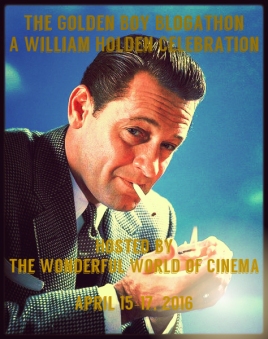
This post is our contribution to The William Holden Blogathon being hosted by The Wonderful World of Cinema. To read more posts on the life and films of William Holden simply click here. 

Friday, May 22, 2015

William Holden - Golden Boy

We got archaeological fever here at Silver Scenes! For our newest post series we will be digging up buried treasures from the tattered remains of movie magazines of yor and sharing these treasures with our readers. Movie magazines of the 1920s-1960s were filled with glamour photos and juicy tidbits on all of the major ( and minor ) screen stars of the day. In addition to film reviews and articles about the love lives of these public figures, the magazines also featured crossword puzzles, trivia games, gossip columns, and the ever-present mailbag.

Some of the articles we will be sharing will be in PDF format so you can save them for future reading or print them out to keep, while others we will put the scissors to and clip only portions that will pertain to a certain theme. If there are any film titles or stars that you would love to read articles on or see a picture-collage of, just let us know and we'll bring out our buried treasure map and start hunting them out for you! 

For starters, we unearthed these articles from a November 1939 issue of Modern Screen Magazine on William Holden's appearance in Golden Boy. Film fans today consider William Holden to be one of the great stars of the silver screen, but put yourself in the shoes of a theatre-goer in 1939. One of the most anticipated and hyped films of the year is Golden Boy, a story of a violinist turned boxer. Columbia Pictures passes over John Garfield in a glove-fit part to cast a newcomer, a fresh-looking lad with curly brown hair to star in their greatest film of 1939 - would this be a one-hit wonder for the actor or would he go on to greatness? Of course, we know the future... Golden Boy generated the birth of a star. Critics and audiences praised Holden's first appearance with Modern Screen Magazine's staff critic Lois Svensrud remarking : 
His acting has strength and sincerity, and the versatility shown in his characterization of the boy, who is torn between a love of music and the desire for fame and fortune, should mark Bill Holden as the "find" of the year.

The same issue also posted this quickie biography to highlight the new talent that was sure to become a star in the coming decade : 

Yesterday he was a college student, and today he is a star. To go back some, Bill was born in O'Fallen Ill., on April 17th, 1918 of non-professional parents. His family moved to California when Bill was a small child. Here the boy attended public and high schools with a dramatic career in view. Upon graduation from high school, Bill registered at the Pasadena Junior College where he studied dramatics and various other courses carrying off nearly all the honors in his class.   
While attending college, he became interested in the Pasadena Community Playhouse and appeared in several amateur plays. At school he received an assignment as the senior Curie in a play called "Manya". This production was quite successful and so three of the "Manya" playesr were asked to take screentests. Holden was one of the three.  About this time, Director Mamoulian was searching for the "Golden Boy" for his picture of the year and, while going through thousands of screen tests, came across Holden's. He immediately sent for him, gave him another test and the contract soon followed. Strangely enough, Bill knew of the year-long quest for the "Golden Boy" but, modest as he was, he felt he couldn't make the grade. 
Surprisingly, William can both play the violin and box — a hoped-for qualification for the "Golden Boy" role. He resides in California with his parents and two younger brothers. He is six feet tall, weighs one hundred and sixty-five pounds, and has brown hair and blue eyes. His favorite dish is anything his mother cooks, and his most prized possession is a clipping from a college paper with his picture and a little story about him as being in line for a great future as an athlete. Address him at Columbia Studios, Hollywood, Cal. 

Audiences too were in a whirl over Hollywood's new "Golden Boy", as this one fan proclaimed :
"When I walked out of the theatre after seeing "Golden Boy" my mind was in such a crazy whirl that I scarcely knew what was going on about me. The reason - William Holden. Without ever having appeared in films, this boy co-starred with screen-wise Barbara Stanwyck and such ace veterans as Adolph Menjou and Joseph Calleia and rendered one of the most brilliant performances I have ever seen. The talent scouts and directors who have been looking for new faces and new talent have really done themselves justice by giving the movie fans this natural, dynamic personality, Bill Holden. He's the 1939 Wonder Boy. With looks that would make any heart stand still and acting ability that holds you spellbound, Bill Holden has leapt to the top rung of the ladder of success. "

Movie Magazine Articles, our newest series, will feature articles like these reprinted for our reader's entertainment. Links to the original sources are available within the body of the text. In the future, simply search "Movie Magazine Articles" to find more posts in this series or click on the tag below. Enjoy! 

Tuesday, July 15, 2014

Those Were the Days ( 1940 )

William Holden displays the good ol' Siwash spirit of horseplay in Paramount Pictures minor wisp of nostalgia Those Were the Days set in the fictional college of Siwash at the turn of the century. 


After getting himself in a scrape that ought to land him six months in jail ( the film proves that collegians were wild hooligans even in 1904 ), Petey Simmons ( Holden ) ardently woos the judge's daughter in order to win favor with her pop ( Vaughn Glaser ) when it comes time for the sentence to be ruled. The hapless youth finds his weasel of a plan backfire when he falls in love with the sparkling lass, played by Bonita Granville. 

Squeaky-voiced Ezra Stone, famous for portraying Henry Aldrich on radio and later directing The Addams Family series, provided ample support to Holden and his hi-jinks. Also cast were Judith Barrett, William Frawley, Richard Denning and Alan Ladd in a flash one-line part. Those Were the Days aka Good Ol' Siwash was based on the popular Siwash stories written by Knox College alum George Helgeson Fitch.

To promote the film, Paramount's publicity team strapped Jeanne Cagney and William Henry in a 1902 runabout and set them off puttering to a gala hosted by the Los Angeles Horseless Carriage Club.

William Holden started his career at Paramount where he was one of the members of the studio's "Golden Circle" of young players in 1938, along with Susan Hayward, Betty Field, Robert Preston, Patricia Morison, Ellen Drew, Louise Campbell, William Henry, and Evelyn Keyes. Columbia Pictures borrowed Holden for Golden Boy and then returned him to Paramount a star. 

Those Were the Days gave Holden his first star billing and a chance to demonstrate that winsome charisma that would soon launch him to stardom. Alas, that's about all it did. Unlike the splendid A Yank at Oxford ( MGM, 1938 ), the film failed to capture a love for the college nor sympathetic support for its hero. Theodore Reed's direction was sluggish from the on start and the script could have used a greater dose of humor and wit. Today Those Were the Days is forgotten along with good ol' Siwash university. 

Thursday, May 22, 2014

Picnic ( 1955 )

The Classic Film and TV Association is hosting The Fabulous Films of the 1950s blogathon and I have chosen to highlight two films of the 1950s that are particularly dear to me - Picnic and Giant. Every year, when the flowers awaken from their dormant slumber and the magnolias begin to blossom, a familiar urge, as certain in approaching as spring itself, begins to stir within - the urge to watch Picnic. The film is indelibly linked in my mind with spring and, regardless of its Labor Day setting, the glow of May can be observed in every scene. 


Picnic focuses on the impact a vagabond drifter makes on the womenfolk in a sleepy Kansas town during the course of one summer day. Hal Carter (William Holden) is a bum who has come to Kansas to seek out his old college roommate Alan Benson (Cliff Robertson) in the hopes that he will find him a job at one of his father's granaries.

"I gotta get someplace in this world. I just gotta."

Upon arriving fresh off of a freight train, he meets Helen (the marvelous Verna Felton) a kindly old lady who gives him some apple pie and introduces him to her neighbors, Flo Owens (Betty Field) and Flo's two daughters, the tomboy intellectual Millie (a miscast Susan Strasberg) and the bashful beauty queen Madge (Kim Novak) who is going steady with Alan. Rooming with the Owens is Rosemary Sydney (Rosalind Russell), a spinster schoolteacher. 


On the surface, each of these women are satisfied and content with their lives, but within themselves they are frustrated and longing for something more. Flo Owens was deserted by her husband years ago and wants to see her daughters married off to better men than he. Rosemary Sydney, the amiable teacher always "good for a laugh" is tired of being a spinster and wants to marry Howard Bevans (Arthur O'Connell), a local shopkeeper. Millie is jealous of her older sister's beauty, while Madge thinks her mother favors Millie and is frustrated at being admired for her looks alone. 

"I'm tired of just being called pretty". 


When Hal arrives, his raw virility awakens in the women memories of bygone romances or, in the case of Rosemary, long-awaited for love. Every movement he makes, every muscle he flexes, sexually arouses suppressed feelings within these gals. 

William Inge's Pulitzer Prize winning play Picnic set pulses racing to packed crowds and enjoyed a successful 477-run performance at New York's Music Box Theatre in the spring of 1953. The original cast featured Ralph Meeker as Hal, Janice Rule as Madge, Eileen Heckart as Rosemary, and Paul Newman as Alan Benson. Incidentally, it was during the run of Picnic that Newman met his future wife, Joanne Woodward. Newman was also understudy for Meeker and often rehearsed his scenes with Rule's understudy, Joanne Woodward. 

Columbia Pictures head Harry Cohn purchased the rights to the play at the sum of $300,000. Cohn knew that he wanted William Holden to play the lead role, but it took some coaxing to convince the 37-year-old actor that his age would not make a difference to the essence of the story. Holden reluctantly agreed and, as this was the final film in his seven picture contract with the studio, had to settle for a paltry $30,000 fee. Holden worked out at a gym to get into shape for the part and even permitted to have his chest shaven for his brawny sequences. Carroll Baker was tested for the role of Madge but it was decided that she was too childlike for the role, and Columbia's newest sensation Kim Novak was signed instead. 

Susan Strasberg was making her screen debut as Millie, fresh off of a Broadway success with the lead role in The Diary of Anne Frank. Cliff Robertson also earned his first big screen role as rich boy Alan Benson. The role of Howard Bevens suited Arthur O'Connell so well that director Joshua Logan asked him to reprise it for the film. This launched O'Connell on a long and steady career as a Hollywood character actor. 

Production on Picnic began on May 16, 1955, on location around Hutchinson, Kansas. The production crew on Picnic was top-notch and included cinematographer James Wong Howe, screenwriter Daniel Taradesh (From Here to Eternity) and composer George Duning. Duning revived the 1930s big-band classic "Moonglow" for the famous dance sequence and it became a hit song once again, with the dance itself becoming one of the best remembered love scenes of the 1950s. 


Logan, the director of the stage play, was selected to take the helm for the film version and made an impressive directorial debut, in his subtle but compelling filming. His master strokes are in the scenes of the Labor Day picnic itself. As the camera slowly pans across the people, it unobtrusively captures vignettes straight out of a Norman Rockwell painting. There are mothers with their children, elderly couples, rowdy boys, girls warbling a duet, speeches being made, the band playing old sweet songs and marching tunes, and through it all two babies wailing. All of these elements combine to create a tapestry of American life during the early 1950s. 

The principal characters are enjoying the picnic as much as anyone there and compete in all of the group events - the balloon blowing contest, ring toss, spoon catching games, and best of all, the pie eating contest, where Howard bribes a boy to push the contestant's faces into the pies. 


After the festivities of the day the group lazily gather together under the shade of a grove of cottonwoods and here Hal begins to realize what it is he has been searching for in life. It is a town, a place, a home that he wants. Proud as he is of his father and his old man's boots, he does not want to fill them and be a drifter all of his life. He wants a sense of belonging, either to someone or someplace. 

As evening begins to fall, everyone wanders off in pairs... Hal walks with Millie and tells her of his admiration for people with artistic talent and the love for the finer things in life; Howard and Rosemary share a bench to admire the sunset; Helen and Flo gently swing together grateful for each others company; and Alan and Madge retreat to the river's edge to discuss their future together. 


"Look at the sunset. It's like the daytime didn't want to end. It's like the daytime was gonna put up a big scrap and set the world on fire to keep the nighttime from creeping on."

The picnic is a focal point for all of the principal characters and it is after the sun sets that their emotions begin to sizzle and finally ignite and explode like the Labor Day fireworks themselves. 


Picnic is an extremely well-written film rich with characters of substance and at its core it is a story about the inevitability of change happening to the best laid plans. Sometimes this change is welcome and sometimes it is not. 

"I got so used to things as they were. Everything was so prim. The geraniums in the window, the smell of mama's medicine, and then he walked in and it was different . He clomped around like it was still outdoors. There was a man in the house and it seemed good". 

Hal is a character that we have all met at one time or another, in a variety of different forms. He represents that person that comes into your life when you were least expecting it and disrupts everything and everyone around you. He is an intruder, and whether it is for good or bad, the change these intruders bring about cannot be ignored. 


Picnic opened in limited release on December 7, 1955, and was distributed nationally on February 16, 1956. It won critical acclaim, was nominated for six Academy Awards ( Best Picture, Best Supporting Actor, Best Music, Best Color Art Direction and Best Editing ) and grossed a whopping $6.3 million upon its release. Sixty years later, Picnic remains a gem of a picture and rightly deserves its place as one of the Fabulous Films of the 1950s.