Showing posts with label Alfred Hitchcock. Show all posts

Saturday, October 25, 2025

Alfred Hitchcock Presents: The Perfect Crime (1957)

On October 20, 1957, television audiences were treated to a rare pairing of two masters of suspense: Alfred Hitchcock and Vincent Price in, what is hard to believe, their only work together. In The Perfect Crime, the third episode of Season 3 of Alfred Hitchcock Presents, Price dons the role of Charles Courtney, a smug prosecutor with a penchant for collecting case mementos—each one neatly labeled and shelved like trophies in a macabre curio cabinet. But there’s one conspicuous gap on the shelf, reserved for what he calls “The Perfect Crime.” You can guess where this is going.

Enter James Gregory as John Gregory (yes, the names are confusing), a defense attorney with a bone to pick. He believes Courtney sent an innocent man to the gallows, and he’s got the evidence to prove it. What follows is a tense tête-à-tête that spirals into murder and a chilling twist that only Hitchcock could deliver with such dry wit.

Price is in his element here—oozing charm, arrogance, and just the right amount of menace. However, much of the episode unfolds through Gregory’s riveting narration, as he reconstructs the tragic events that lead to the innocent man's unjust prosecution. 

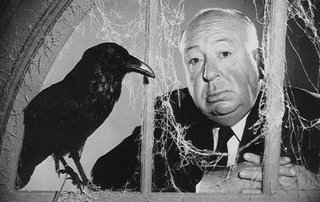
Hitchcock, ever the showman, introduces the episode wearing a deerstalker and puffing bubbles from a calabash pipe—a cheeky nod to Sherlock Holmes and a wink to the audience that this mystery is anything but elementary.

The episode is one of only seventeen directed by Hitchcock himself, and it shows. The pacing is taut, the dialogue crisp, and the conclusion deliciously absurd. It’s a compact gem that reminds us why Alfred Hitchcock Presents remains a gold standard in televised suspense.

So if you’re in the mood for a little murder, a lot of ego, and a kiln that doubles as a crime scene, The Perfect Crime is a must-watch. Just don’t ask what’s in the vase.

Thursday, October 17, 2024

The Alfred Hitchcock Hour: Don't Look Behind You (1962)

In 1962, The Alfred Hitchcock Hour premiered, expanding on the popular half-hour thriller series Alfred Hitchcock Presents. Like its predecessor, each episode opened with an introduction from the Master of Suspense himself Mr. Hitchcock, who teased his audience about the story to follow. 

"Don't Look Behind You" was only the second episode in this new hour-long format and, unfortunately, it played out like a half-hour episode stretched to fit the new timeslot. 

The episode, based on a novel by Samuel Rogers, was about a crazed killer who stalked the woods at night murdering young women in the college town of Woodside. One evening, Daphne (Vera Miles) decides to take a chance and crosses the woods as a shortcut to get to a dinner party - she makes it out alive but knows for certain that someone was following her close behind. At the party, arriving shortly later, is her fiancé Harold (Jeffrey Hunter), a psychology professor who looks a bit bedraggled. Also arriving late is Dave (Dick Sargaent) a science teacher who has a crush on Daphne. Another admirer of hers is Edwin (Alf Kjellin), a pianist who has a bent towards the morbid. 

Harold comes up with the brilliant idea of using Daphne as bait so he can catch the killer himself and throughout the episode we are supposed to wonder whether the lunatic is Harold himself, Dave, or Edwin, all of whom happen to be in the woods the same night Daphne is walking through it. All three men look crazy but Harold seems to be the most dangerous and one cannot help but wonder how Daphne can be so blind as to not realize it. 

"Pain is only a secret name for pleasure, my darling"

The wonderful director John Brahm (The Lodger, Hangover Square) directed "Don't Look Behind You" and, while the scenes through the woods are atmospheric, the episode as a whole is a letdown. This could have been a tense thriller with nail-biting "who can the killer be?" ending, but instead it is so obvious that most of the episode fails to build any tension. Jeffrey Hunter's character of Harold should have been a sympathetic intelligent man whom Daphne relies on, this would have given her plausible reason for staying in Woodside with a killer on the loose and would have made the ending have more of that Hitchcockian-twist. 

"Don't Look Behind You" features one of the best introductions of any of the Alfred Hitchcock episodes with Vera Miles walking in a flowing white dress down a secluded dark wooded shortcut, but overall, it just fails to stir up the shivers like any decent Alfred Hitchcock episode should. Nevertheless, Vera Miles gives a wonderful performance as the innocent victim and there is a cast of familiar faces including Abraham Sofaer (Elephant Walk), Madge Kennedy, and Ralph Roberts (Bells are Ringing).

Monday, October 14, 2024

Film Albums: Alfred Hitchcock Presents Ghost Stories for Young People

Halloween is fast approaching and what better time of the year to listen to ghost stories then the autumn season, when the leaves begin to change color and there is a cold nip in the air. There are plenty of ghost stories from radio programs of the olden days, but if you want a taste of something different, have a listen to Alfred Hitchcock Presents Ghost Stories for Young People. 

This LP was released in 1962 by Golden Records and features "tales of spooks, hobgoblins and spirits hauntingly introduced by the master of the unexpected". Six chilling short stories are narrated by John Allen who has a marvelously smooth voice. Unlike most ghost stories aired on the radio, which average 25-30 minutes in length, these tales are a mere 5-10 minutes each.... just enough time to give you a little fright before heading to slumberland.

The complete album is available on Youtube. Just click on the link below to enjoy: 

Alfred Hitchcock Presents Ghost Stories for Young People

Track Listing

Introduction

The Haunted and the Haunters

The Magician

Johnny Takes a Dare

The Open Window

The Helpful Hitchhiker

Jimmy Takes Vanishing Lessons

Top Picks: The Haunted and the Haunters, The Magician, The Open Window

Monday, October 23, 2023

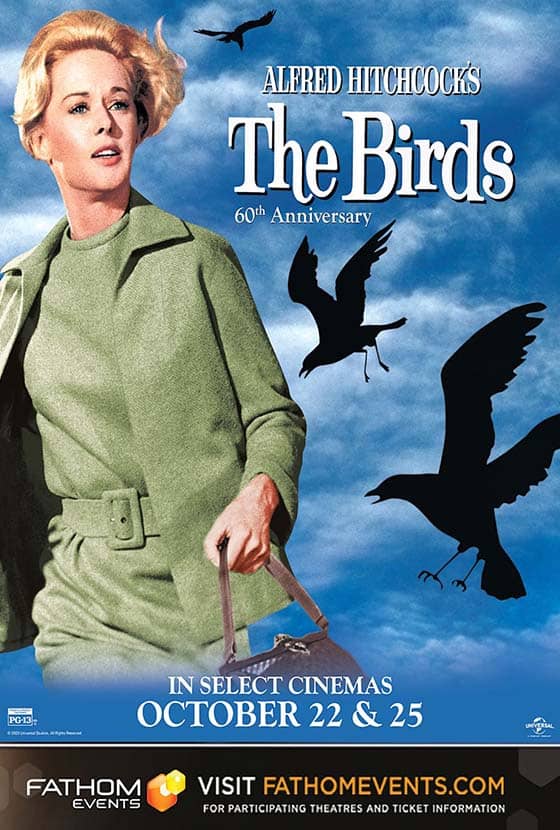
The Birds - 60th Anniversary in Theaters Tonight!

Alfred Hitchcock's suspense classic The Birds is back in theaters for one day (this evening, October 23rd) to honor its 60th anniversary. Check out Fanthom event's website to see if it is showing in a theater near you. 

Sunday, October 16, 2022

Orson Welles' Great Mysteries

Orson Welles always loved a scary tale. In 1938, he and other players of his Mercury Theater company put on a radio play of H.G. Wells' "War of the Worlds" for Halloween that scared the heebie-jeebies out of most of his listeners. Then in 1951, while taking a break from filming Othello in Ireland, he filmed a short horror film called Return to Glennascaul about a man who unknowingly gives two ghosts a ride on a deserted country road. 

While most of his films steered clear of horror or suspense, he delved deep into the muddy waters of mystery in 1973 when he played host to a British anthology series entitled Orson Welles' Great Mysteries. The series was very similar to the classic Alfred Hitchcock Presents and, like Hitchcock, Orson Welles merely had to act as host, introducing and closing each episode with some pithy words. Unlike Alfred Hitchcock Presents, the episodes of Great Mysteries were all based on famous works or short stories by authors like Sir Arthur Conan Doyle, Wilkie Collins, Honoré de Balzac, and Charles Dickens. 

Orson Welles had a long career as a director, producer, screenwriter, and actor, but by the early 1970s he was in debt ( owing money to the IRS for back taxes ) and, unable to fund his latest docudrama F for Fake, he began to do numerous television appearances to help raise money. In the early months of 1973, he crossed the pond to England to film the intros/outros to the series at the Anglia Television studios in Norwich ( East Anglia ).

Welles was known to be a difficult person to work with and the production team at Anglia studios found this to be true ( in fact, the Sky Arts series Urban Myths made an entire episode in 2020 about his visit called "Orson Welles in Norwich" ). Nevertheless, he gave a marvelous performance as a mystery host. He donned a black cape and hat and, purring sardonic wit, he beautifully introduced each tale of the macabre in his deep silky voice. 

Orson Welles' Great Mysteries ran for two seasons with a total of 26 episodes being produced. Some of the titles included were "The Monkey's Paw", based on the short story by W.W. Jacobs, and "La Grande Breteche" by Honoré de Balzac. What made the episodes entertaining was all of the stories selected had unexpected endings, usually with a sting.

John Barry composed a haunting but typically 70s theme for the series ( it could have worked equally well for a James Bond and the Haunted House film ) and the episodes were similarly chilling like other popular British anthology series of the time ( namely Brian Clemens' Thriller and Hammer House of Horror ) but not nearly as violent or gory. 

With a 25-minute runtime, the tales entertained without getting boring. Plus, there was the added bonus of playing spot the actor with each episode featuring numerous British character actors plus acting legends such as Eli Wallach, Joan Collins, Christopher Lee, Richard Johnson, Claire Bloom, Peter Cushing, Jane Seymour, Dean Stockwell, Jose Ferrer, and Shirley Knight. 

Network Distributing released the entire Orson Welles Great Mysteries on DVD in two volumes.

Saturday, May 5, 2018

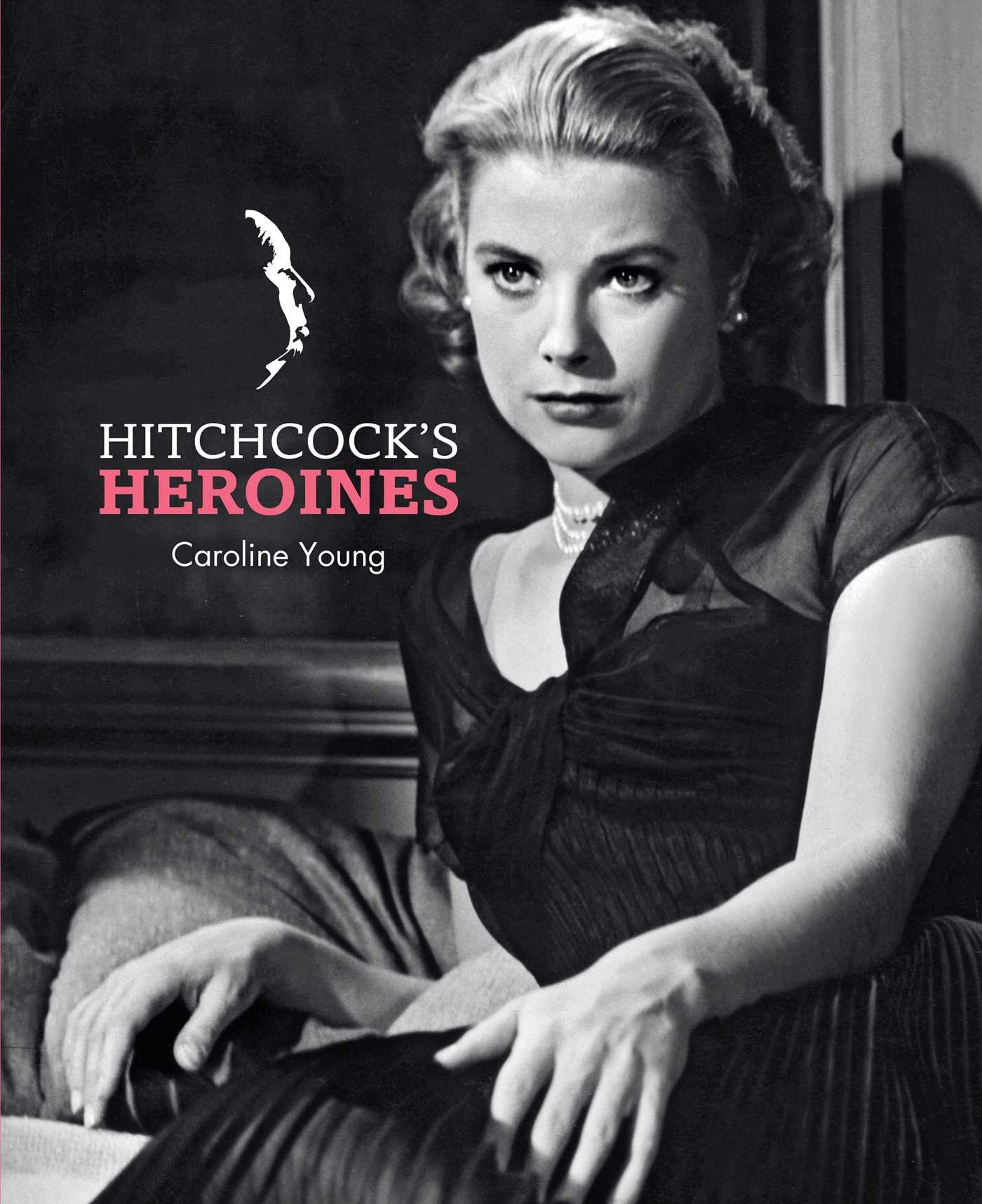
Book Review: Hitchcock's Heroines by Caroline Young

While a number of great books have been written about the Master of Suspense and the making of his films, few have focused on the leading ladies of Hitchcock's films. In Hitchcock's Heroines, which made its printed debut this week, author Caroline Young shines the spotlight on the stunning blondes ( and other actresses of various hair colors ) of 23 films dating back to Alfred Hitchcock's breakthrough motion picture, The Lodger ( 1927 ).

This beautiful 193-page book, published by Insight Editions, is filled with rare publicity photos, behind-the-scenes candids, and costume sketches, which makes it a delectable coffee-table book to peruse as well as being a great read. 

Madeleine Carroll, Teresa Wright, Ingrid Bergman, Joan Fontaine, Grace Kelly, Doris Day, Eva Marie Saint, and Tippi Hedren are just a few of the actresses that Young profiles. The author's easy-going writing style makes it an entertaining and highly-addictive book. For each film, Young delves into how the leading lady was cast, the production of the film itself, and the actress' experience on the set ( as well as her opinion of Mr. Hitchcock ). 

"Tallulah liked to drink, was witty, and had the mouth of a sailor—just the kind of woman Hitchcock enjoyed spending time with..."

There is also an emphasis throughout the text on the costumes the gals wore in each film, which will be a delight to classic film fashionistas. Hitchcock was particular about details and so many of these costumes helped to accentuate the nature of the characters themselves and provide compositional balance through color and silhouette. Since Young had blogged about Hollywood fashion ( Classic Hollywood Style ) for several years, and also authored a book focusing on fashion in "films of the golden age" entitled Classic Hollywood Style, it seems natural that she would highlight the costumes designers and their work in Hitchcock's films. 
"[Her] clothes had to match the budget of a woman in her first year as a member of staff, yet she was also to have pride in her appearance and look groomed." - describing Ingrid Bergman's appearance in Spellbound

Numerous quotes from vintage magazine articles and recent interviews with the stars liven up the text and the splendid layout by Katherine Winterson provides ample room for side columns featuring plot summaries and bios of each film and actress profiled. 

In short, if you like Hitch and his leading ladies, you'll love this book!

Hitchcock's Heroines retails for $29.99 and is available to purchase through Amazon,  Barnes & Noble, or directly from the publisher

Monday, April 24, 2017

From the Archives: Joan Fontaine in Suspicion ( 1941 )

Joan Fontaine posing for a quick costume shot during the making of Alfred Hitchcock's Suspicion. Joan always knew how to wear high collars and top-heavy hats like a queen. 

From the Archives is our latest series of posts where we share photos from the Silverbanks Pictures collection. Some of these may have been sold in the past, and others may still be available for purchase at our eBay store : http://stores.ebay.com/Silverbanks-Pictures

Thursday, November 12, 2015

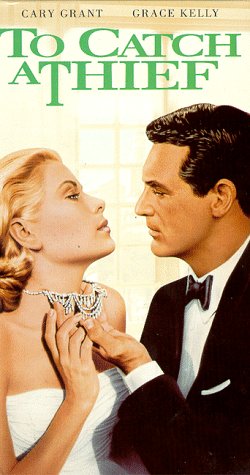
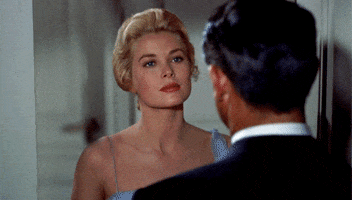
Grace Kelly in "To Catch a Thief" ( 1955 )

Alfred Hitchcock had just wrapped production on Rear Window when he plunged into his next film To Catch a Thief. This picture would unite Cary Grant, whom he coaxed away from retirement, and his favorite leading lady, Grace Kelly. Hitchcock had purchased the rights to David Dodge's Cannes caper in 1950 for the meager sum of $15,000 but it was not developed into a script until after he met John Michael Hayes ( Rear Window ), a screenwriter who had a great wit. Hitchcock wanted To Catch a Thief to have a comedic flair that was lighter than pastry.

The film begins with a series of daring night jewel thefts throughout the Riviera. John Robie "The Cat" has struck once again - or so the police are led to believe. The real John Robie, once a famous jewel thief, is blissfully enjoying his retirement at his cliff-side villa outside Monaco. He does not like this new cat burglar imitating his signature style nor having the police breath down his neck with their air of suspicion. And so he sets out to capture this "cat" himself, and what better way then to set a thief to catch a thief. 

With the aid of a Lloyds of London insurance broker ( John Williams ), Robie obtains a list of the most valuable pieces of jewelry insured in Monaco and the names of the fashionable tourists who own the baubles. First name on the list - Jessie and Francine Stevens ( Jessie Royce Landis, Grace Kelly ) a mother and daughter who have nearly $280,000 in jewels insured with the company. 

Robie finagles his way into meeting the American duo through a clever ploy of dropping a 10,000 franc piece down the bodice of a woman's dress while they are all gathered at the roulette table - the "whirling pickpocket" as Mrs. Stevens calls it. This gets her to laughing and leads him to introduce himself as Mr. Burns, a lumber tycoon from Oregon. 


The first time we see "Francie" she is perceived as being a jewel herself, sparkling but cold as a diamond. She and her mother stemmed from the backwoods until oil was discovered on their land; extensive travelling polished her country manners and accent. After years spent away in finishing schools, she has the stance and demeanor of a young princess. Her mother is quite captivated by Mr. Burns charms ( "If I were Francie's age, you'd sound too good to be true!" she declares ) while Francie seems disinterested. She's young, beautiful, and wealthy so she has been chased quite a bit by fortune hunters and is wary of handsome men. Perhaps Robie is too good to be true. 

"I'm sorry I ever sent her to that finishing school, I think they finished her there."

Edith Head designed all of the costumes seen in To Catch a Thief and they rank as some of her finest creations. Alfred Hitchcock had a hand in this design process too and the clothing that Francie wears throughout the film reflect on her different moods. In this scene her gorgeous white and icy blue layered chiffon gown make her regal and quite unattainable. 

Later, when John Robie escorts her to her hotel room, she spontaneously kisses him - and then gently shuts the door in his face. This kiss proved that she was neither as innocent or as frigid as she appeared, merely bored. Francie literally lets her hair down the next day. She appears dressed in sunny yellow and is eager to spend the day with Mr. Robie. After a swim in the rich blue Mediterranean and some verbal sparring with him and a young French woman, she invites Robie on a very informal outing, a picnic, en route to the villa that Mr. Burns is supposedly going to look at to purchase ( "I may even retire here" he says ). It's not a European champagne and cheese affair, but a classic American picnic of fried chicken complete with cold beer. 


It is during their drive from the villa that we see a different side of Francie emerge. Parts of her down-home heritage peep through showing she was not "finished" completely as her mother believed. 

"We're just common people with a bank account" - Francie Stevens

She's a gal with spunk and quite a large dose of womanly wiles, in spite of her demure pink and white summer dress. Francie has her suspicions about Mr. Burns and quickly becomes the hunter. She is eager to pin her "cat" into a corner to see him confess his real identify, that of being John Robie. She excitedly declares how she played Sherlock Holmes to discover all the clues that led to this conclusion. The scenes leading up to this moment are some of the best in the film featuring an exciting and humorous car chase, breathtaking Moyen Corniche location scenery, and extremely witty dialogue filled with double-entendres ( including the famous quote "a leg or a breast?", referring to the chicken, of course ).


Hitchcock loved the duel meaning the title suggested and it is after this scene that we see it come into play, the audience is eager to see Francie catch her thief - John Robie - regardless of whether Robie discovers the real culprit behind the jewel thefts or not. After she falls in love with him- as we, the audience, knew would eventually happen, she aids him in setting a trap for the burglar, leading to the climax at the costume ball, where Francie once again sports a head-turning gown, this time completely decked in gold.  


To Catch a Thief marked the third film that Kelly had made with Alfred Hitchcock and it is undoubtedly her best performance for the master of suspense. Like Lisa Fremont of Rear Window, Kelly portrays Francie Stevens as an extremely elegant young woman with a hint of mischief in her eyes. She isn't a china doll meant for display purposes only. She wants to love and serve a man and be a part of his life, even if it means endangering her own to prove this to him. 

The world premiere of To Catch a Thief took place in Los Angeles on August 3rd, 1955. It was a critical and commercial success upon its release and boosted Cary Grant's career, which eventually led him to postpone his retirement till over a decade later. To Catch a Thief is notable for leading up to the events of Grace Kelly's wedding. During the filming of the car sequence Grace Kelly had gazed out at the coastal countryside and spied a walled-in garden below. "Whose garden is that?" she asked screenwriter John Michael Hayes. He replied, "Prince Grimaldi's". Kelly had desired to tour the garden with her then-boyfriend costume designer Oleg Cassini but between her shooting schedule and the Prince's commitments was unable to arrange a visit. It was not until May 1955, when Grace Kelly returned to Monaco for the Cannes Film Festival showing of The Country Girl, that she was invited to the palace for a photo session and a tour of the garden. This meeting eventually led to the Prince visiting with Kelly's family in Philadelphia for three days and a marriage proposal. On April 18, 1956, Grace Kelly and Prince Ranier were wed and she became Princess Grace of Monaco. 

On a sadder note, the winding road where John Robie and Francie Stevens park for their picnic lunch was the site where Princess Grace had her fatal car crash on September 13, 1982. She suffered a stroke behind the wheel and passed away a day later, at the age of 52, from a brain hemorrhage sustained from the accident. 

This post is our contribution to The Wonderful Grace Kelly Blogathon being hosted by The Wonderful World of Cinema. Click on the links to read more posts on Grace Kelly's career and her films!

Thursday, October 31, 2013

The Alfred Hitchcock Hour - An Unlocked Window ( 1965 )

Today the Hitchcock Halloween blogathon, hosted by Lara Gabrielle Fowler on Backlots, has officially started and we are helping to celebrate the wide and varied film and television career of Alfred Hitchcock with our review of one of his lesser-known gems, "An Unlocked Window" ( 1965 ). Lesser known to those who are not familiar with The Alfred Hitchcock Hour that is, for to fans of the series "An Unlocked Window" is regarded as one of the most memorable and downright spine-tingling episodes ever made. 
The show opens up with the Master of Suspense doing one his customary droll introductions to the story about to be aired. This time we see him standing behind a microphone stating that he wanted to broadcast his portion of the program by radio since he had lost some weight and did not want to mar his "image". 

And then the thrills begin: we spy nurse Freda walking home at night - all alone - after caring for an elderly bedridden woman. A rash of murders has been occurring in the area but this doesn't seem to bother Freda...until she hears footsteps following closely behind. The camera quickly cuts to her feet walking, then to a man's feet walking behind her, back to hers, back to his, back to hers, back to his.... until suddenly we hear him speak "You are such a beautiful nurse Freda" followed by an unforgettable cackle-cackle as he snickers and strangles her simultaneously. 
Freda was not the first nurse to be victimized, for our serial killer has a particular fondness for strangling nurses - young pretty nurses as a matter of fact, which leads us to Stella ( Dana Wynter ), night nurse to the dreamy Mr.Glendon Baker ( John Kerr ), who's temporarily bedridden and under oxygen due to an illness. 

Baker, a young professor, lives in a dreary old house on the outskirts of town. He bought the property hoping to find it haunted but was sadly disappointed, "The real estate agent assured me there had never been a murder, suicide or any kind of violence within these walls...It's too bad a hideous old house like this has no hideous history to go along with it". He currently has his heart set on marrying Stella, an idea that keeps him cheerful despite his confinement to bed.
The news reports of the recent nurse killings have jangled Stella's nerves and she is pleased when another nurse, Miss Ames ( T.C Jones ), arrives to assist her in her work. Aside from the two nurses and Mr. Baker, only Maud the housekeeper ( Louise Lantham ) and her handyman husband Sam occupy the house. Miss Ames often reprimands Stella for her obvious forgetfulness in little matters, fearing that this will hinder her one day while on duty. Recently, Stella has forgotten to obtain extra oxygen tanks for Mr. Baker and so that night Sam is sent to the nearest hospital to bring some back. With a fierce storm raging outside and the fear that the killer will strike them next, the inhabitants of the house batten down the hatches and lock the place up tight - all except for that UNLOCKED WINDOW. Oh, nooo! 

********************************************************

"An Unlocked Window" was based on a short story written by Welsh novelist Ethel Lina White in 1939. Alfred Hitchcock had previously used one of White's novels, "The Wheel Spins", as a basis for The Lady Vanishes ( 1938 ). Many of Ethel Lina White's books focused on the vulnerability of women. This theme was emphasized brilliantly in Robert Siodmak's adaptation of White's novel, "Some Must Watch", re-titled The Spiral Staircase ( 1945 ), where our heroine is not only a young, timid woman needing protection but a mute as well. 

The concept of the defenseless female reverberates throughout "An Unlocked Window" . In one scene we see Stella, Miss Adams and Maud cowering in corners for fear of their lives, suspecting that the killer has snuck inside the house. When a frightened Maud anxiously turns on all of the lights in the house Stella quickly hushes her and shuts them off, remarking that "the darkness protects us, now if there is someone outside he can see in, and see that we are alone". Surely three women in a house - not counting an ill man in the upstairs bedroom - would not be considered "alone". This once again reinforced the idea that women, especially forgetful women like Stella, were helpless without the protection of a man. 

Other elements that Lina White liked to include in her novels echoed that of the devices American mystery authoress Mary Roberts Rinehart used : lonely country houses, mysterious men on the prowl, night scenes and nurses. This episode is dripping with MacGuffins and old dark house horrors and the exterior sets for the Bates Motel ( Psycho ) were appropriately used as the Baker residence. 

The Hitch himself directed a few episodes of The Alfred Hitchcock Hour but in this case all honors went to Joseph Newman ( This Island Earth ), whose taut direction kept the story at an edge-of-your-seat suspense level and claustrophobically confined to the house. But applause must also go to the great cinematographer Stanley Cortez ( The Magnificent Ambersons ). In several key sequences, he uses tilted shadows to create a feeling of approaching danger. In addition to these talents, Bernard Herrmann, a Hitchcock favorite, composed the subtle score for this episode and James Bridges, who penned the teleplay, won an Edgar Award the next year for this adaption.
"An Unlocked Window" aired on February 15, 1965. It was the 17th episode of the third season of the popular extended length, The Alfred Hitchcock Hour. This episode boasted a fantastic cast including Dana Wynter, a delicate lady who was no stranger to suspense films. In 1963 she had just completed starring in John Huston's thriller, The List of Adrian Messenger, while John Kerr was enjoying a respite from his usual melodramatic roles. Louise Lantham practically steals every scene she is in with her fear-begotten characterization of Maud, the boozy housekeeper, accented by her whinny lethargic drawl. It is a performance reminiscent of Agnes Moorehead's stellar portrayal of Velma in Robert Aldrich's Hush Hush Sweet Charlotte ( 1963 ). Lantham had made her film debut just one year prior in Alfred Hitchcock's Marnie, as Mrs.Edgar, Marnie's callous mother. 
"An Unlocked Window" was remade on The Alfred Hitchcock Show revival series in 1985. It was condensed to a half-hour episode and this time starred Annette O'Toole and Bruce Davison. Both episodes are available for viewing on Youtube, but viewer beware.....if you are watching these on a dark and stormy night, be sure to check that your doors and windows are securely locked before sitting back to enjoy these frightful delights. 

DO NOT PEEK! 

If you are familiar with "The Unlocked Window" and know its ending than here is an interesting article on one of its principal players...otherwise, do not peek! 

Monday, July 29, 2013

Busy Bodies - Promoting Castle's Camp

Consult your doctor! Bring your seatbelts! See it with someone with warm hands! 

If you were to ask any child in the 1960s if they would want to see a William Castle film over the weekend, you'd hear a resounding "Hurrah!" in response. Every loyal follower of cheap horror schlock such as The Little Shop of Horrors, The Crawling Eye, or The Brain that Wouldn't Die, knew who William Castle was. Heck, he was a household name. Even non-horror buffs were familiar with the King of Camp. What made this man so famous? It surely wasn't the quality of his films. It was showmanship. That's right, when it came to promoting films, he knew what the public loved ....sensationalism. Castle delivered exactly what you came to see...spine-tingling squirm-in-your-seats awkward horror ( or a lot of laughs, depending on your taste ). 

Macabre was William Castle's first film offering as an independent producer. After directing several dozen b-films for Columbia Pictures, he decided to be a man and venture out as an independent creator. 


It all began while watching Diabolique one rainy night with his wife Ellen. Castle was amazed at how many young people were standing in line, in the pouring rain, to watch a movie that will scare their pants off. Charged with the creative fuel of a good idea surging in his blood, he went on a search for a story that would surpass Diabolique in fright. He found that story...it was called "The Marble Forest" . He pitched it to several studios but none thought the movie would sell, and so Castle hocked his house, and with $90,000 in his pocket, became his own producer. 

The newly retitled Macabre was filmed in 12 days and looked to be equally as frightening as Diabolique, only it lacked one thing...a promotional gimmick. Then the idea hit Castle one night - an insurance policy! With nurses on standby and a hearst parked outside, audience members entered theatres with pen in hand ready to sign a Lloyds of London insurance policy guaranteeing that William Castle will pay the beneficiary that they name $1,000 in case they die of fright while watching the film ( hardly likely ). A small clause also read "I understand that if I have a known heart or nervous condition the One Thousand Dollars is not payable". It's always good to protect oneself. 


Macabre netted over $5,000,000 nationwide - a phenomenal return for such a small investment. The success of the picture also ingrained in Castle's mind a philosophy he always believed....showmanship is pure gold when it comes to the film industry. 


For his next film, House on Haunted Hill ( 1959 ) , he used one of the oldest promotional techniques in
the industry : a big name actor. Vincent Price to be precise. There isn't anything quite like a big name to draw audience members to theatres, but just in case certain kiddies weren't familiar with the legendary thespian, Castle concocted Emergo. It was promoted as "the new wonder where thrills fly right into the audience". It was really a lighted plastic skeleton that swooped down on the audience via a wire when the skeleton appeared onscreen. The effect was pretty good and the audience loved the trick, but most theatres disabled it after a few weeks...too many local hooligans would shoot rocks at it with their slingshots. Sometimes skeletons produce that effect.

House on Haunted Hill was a fun thriller and boasted a wonderful cast of characters. Aside from Vincent Price, it starred Richard Long, Alan Marshall, Elisha Cook and Carolyn Craig. The noted gossip columnist Louella Parsons hailed the film as being "more frightening than a graveyard on a cold, wet night". ( We didn't realize she frequented graveyards at night. )  


Vincent Price and William Castle teamed up again for this next picture, The Tingler ( 1959 ) . This remains Castle's most memorable movie...not so much for the film itself but for its publicity stunt - Percepto. Posters and trailers guaranteed that "the Tingler would break loose while you were in the audience". That is, providing you visited a theatre that purchased the Tingler kit in advance. Unsuspected audiences scarcely realized that Tinglers had to be purchased via mail-order. Each Percepto kit included 100 vibrato motors, a timing device and a 12-page installation manual. If Ol' Gus, the janitor, didn't read the instructions correctly, the "Tingler" just wouldn't visit your theatre.   


What exactly was Percepto? Electric buzzers installed in the bottom of the seats. 

Unfortunately, William Castle did not think about giving out rubber Tinglers to audience members as they exited. We would of much rather went home with a souvenir than a tingle down our spines. 

One of the most entertaining publicity gimmicks William Castle utilized was Illusion-O for his 1960 classic, 13 Ghosts. Audience members received supernatural viewers and could sit, with mouth agape, to perceive exctoplasmic ghosts whiz by them....in COLOR. Oooohhhh. Basically, Illusion-O was a piece of cardboard with thin pieces of colored cellophane attached as "lens". By looking through the red plastic the ghosts appeared on screen. For the faint at heart, a peep through the blue filter magically made them disappear. 


Dr. Plato Zorba developed his very own pair of glasses that enabled him to penetrate the supernatural world and hence, communicate with them on a face to face level, so what better way for the audience to participate then by offering them their very own supernatural viewers? Of course, at home these ghost glasses didn't seem to work as well when trying to see the spirit of Uncle Henry in the old barn out back. 

"13 Times the Thrills, 13 Times the Screams, 13 Times the Fun!"

13 Ghosts was heavily promoted through billboards, television spots, and news articles. William Castle also selected thirteen youngsters to dress as ghouls and travel up and down Hollywood Avenue on an elaborately decorated ghost float. They waved signs which read "Vote for Castle..the only candidate with a ghost of a chance" ( this was during the Kennedy/Nixon presidential campaigns ) while a recording of Castle's voice boomed through a megaphone, "Do you believe in ghosts?". 


Do you have a yellow streak down you back? Then don't walk out of Homicidal ( 1961 ) or you'll be labeled a coward! Just before the ending to Homicidal, a truly strange picture, a timer would appear onscreen announcing the "Fright Break"...while the clock ticked away you could sneak out of your seats with your little yellow "coward's only" certificate and receive a full refund. 


In small print, the certificate reads, "To protect patrons of tender years from the psychological dangers of being labeled a coward, this money-back guarantee applies only to members of the audience 15 years of age and over" . For some reason, I imagine that alot of youngsters in groups took advantage of this gimmick to save their money for an ice cream shake after the flick. 

For those who felt they wanted a little control over the ending of a film, attending Mr. Sardonicus ( 1961 ) enabled them to wield their voters right and decide whether the titled Mister received his come-uppance or not . The Punishment Poll allowed members of the audience to vote by raising glow-in-the-dark cards with a thumbs up or a thumbs down. Who stood behind the screen to count the votes, I'm sure I don't know. 


An alternate "happy" mercy ending to the movie may have been filmed, but no audience ever offered Mr. Sardonicus mercy and hence, it was never screened. We live in such an unsympathetic age. 

Mr. Sardonicus boasted some beautiful poster art of the grinning money-grabbing villian as well as this neat trailer, hosted by William Castle, whose facial expressions reminds me of a cross between Don Ameche and Ed Wynn in this trailer. 


Another film which featured take-home freebies was Zotz! ( 1962 ) . This film told the story of a school professor who finds a magical coin which, when used with the magic words, lets him "pause" movement or give pain to those he aimed his finger at ( no, not that finger! ). "Magical coins" were issued to loyal patrons and, while we're not sure what they did, they sure do look neato! 

Here's a coin that we found on Etsy, someone converted it into a kitchen magnet. Just imagine all that magical power sticking on your refrigerator, just waiting for the right person to come by and say the magic words.  

William Castle's films were selling themselves perfectly well without the help of gimmicks and promo stunts, and so after Zotz , they began to wind down. However, one interesting pre-release gimmick Castle used was in 1963's 13 Frightened Girls. In a worldwide contest, young girls from thirteen different countries were selected to be chosen as the students who appear in the film. Here is one of the girls from Sweden : 


Straight-Jacket ( 1965 ) didn't have much a promotional gimmick at all and quite frankly, didn't need one. Afterall, it featured Joan Crawford. She had recently created a sensation as Blanche in Robert Aldrich's has-been classic Whatever Happened to Baby Jane?. Joan Crawford seemed enthusiastic to be back in the spotlight again, even if it was for star billing in a horror film. To promote Straight-Jacket, Ms. Crawford smeared greasepaint on her face and went off on a national tour, visiting Lowes theatres and fan clubs across the nation, happily advertising the fact that she portrays a psychotic ax-murderer. The higher they climb, the lower they fall. 


Audience members in theatres received their very own little cardboard axes so they could practice their hacking technique on friends, neighbors, and enemies at home. We weren't able to find any photos of how these axes looked like, which makes us come to the conclusion that they must be a rare bit of memorabilia indeed! 


"Fate Dials the Number...Terror Answers the Phone!" 

Joan Crawford was back again as Amy Nelson, the girlfriend of Steve Marak ( John Ireland ), who recently did a Norman Bates and energetically stabbed his wife to death in the shower in I Saw What You Did ( 1965 ). Joan Crawford's character is a bit more sympathetic here and we, as the audience, are moved to pity. ( More so for that fact that an actress once so famous could play such a cheesy role...but that's another story in itself ). 

Posters advertising I Saw What You Did featured in bold letters the upcoming phenomena Uxoricide but obviously no one wanted to see a gimmick that sounded like a laundry detergent, so theatre chains didn't even bother installing them. What was Uxoricide? Seatbelts. You didn't follow that? We didn't either. 


And lastly - scraping the bottle of the barrel here - was The Night Walker ( 1965 ). Once again, the really big publicity drawing feature to this film was the fact that it starred Robert Taylor and Barbara Stanwyck, two big name actors who were once Hollywood's golden couple. Taylor up and left Stanwyck after twelve years of marriage ( for various reasons ) and this was their first teaming on screen in over 28 years. He plays a man out to kill her. Shouldn't it of been the other way around? 

This great poster advertises everything that we did not see in the film - as posters are apt to do. That fierce looking creature is certainly something we wouldn't want to meet in our dreams. Castle botched it up again when it came to the giveaways and didn't provide little glass eyeballs for his motion picture attendees. There was a freebie however...a paper sheet called a "Dream Interpreter". We couldn't quite figure out how it worked so if anyone remembers or still owns one of these please let us in on the secret. 


Oh, noooo!

We're not done yet! We got our very own special treat for those members of the audience who were patient enough to wade through our writing...an extra-special deluxe photo gallery insert! 

Let's take a peek at William Castle....


BEHIND THE SCREAMS!


William Castle and Mrs. Slydes on the set of House on Haunted Hill

Castle with an unknown man and an unknown head on the set of Straight-Jacket
The Master of Macabre hamming it up with some fan club members
Cary Grant, Joan Crawford, and John Ireland
Castle and Price practicing with ghouls
Castle with Mia Farrow on the set of Rosemary's Baby
Diane Baker, Joan Crawford and the Maestro
He's keeping his eye on you!
Some happy fan members get Castle's autograph
Castle enjoying a stroll down in the audience
William Castle ( Apr. 24, 1914 - May 31, 1977 ) 

This post, and The Films of William Castle, are our contributions to the fabulous William Castle Blogathon being hosted by The Last Drive-In and GoreGirl's Dungeon.  You can see a complete line-up of blogs participating in this event here.