Showing posts with label Vincent Price. Show all posts

Saturday, October 25, 2025

Alfred Hitchcock Presents: The Perfect Crime (1957)

On October 20, 1957, television audiences were treated to a rare pairing of two masters of suspense: Alfred Hitchcock and Vincent Price in, what is hard to believe, their only work together. In The Perfect Crime, the third episode of Season 3 of Alfred Hitchcock Presents, Price dons the role of Charles Courtney, a smug prosecutor with a penchant for collecting case mementos—each one neatly labeled and shelved like trophies in a macabre curio cabinet. But there’s one conspicuous gap on the shelf, reserved for what he calls “The Perfect Crime.” You can guess where this is going.

Enter James Gregory as John Gregory (yes, the names are confusing), a defense attorney with a bone to pick. He believes Courtney sent an innocent man to the gallows, and he’s got the evidence to prove it. What follows is a tense tête-à-tête that spirals into murder and a chilling twist that only Hitchcock could deliver with such dry wit.

Price is in his element here—oozing charm, arrogance, and just the right amount of menace. However, much of the episode unfolds through Gregory’s riveting narration, as he reconstructs the tragic events that lead to the innocent man's unjust prosecution. 

Hitchcock, ever the showman, introduces the episode wearing a deerstalker and puffing bubbles from a calabash pipe—a cheeky nod to Sherlock Holmes and a wink to the audience that this mystery is anything but elementary.

The episode is one of only seventeen directed by Hitchcock himself, and it shows. The pacing is taut, the dialogue crisp, and the conclusion deliciously absurd. It’s a compact gem that reminds us why Alfred Hitchcock Presents remains a gold standard in televised suspense.

So if you’re in the mood for a little murder, a lot of ego, and a kiln that doubles as a crime scene, The Perfect Crime is a must-watch. Just don’t ask what’s in the vase.

Tuesday, October 21, 2025

Tales of Witches, Ghosts and Goblins Told by Vincent Price

In the 1970s, Vincent Price was not only busy continuing his film work in Hollywood but he also returned to his old haunting ground - the radio studio. His best radio work was done on The Price of Fear, a BBC horror anthology serial, that aired late nights in 1973. 

However, one year prior to that he recorded an album of eerie tales for the Caedmon label (TC-1393) of literary LPs. "Tales of Witches, Ghosts and Goblins" gathers a compelling selection of short stories: Iroquois legends, Sioux folktales, Scottish witch-reels, and even an essay snippet on becoming a werewolf, all narrated by the inimitable silky voice of Price. There’s a delightful almost conversational intimacy in Price’s tone in this album, as though he’s leaning in close, whispering one more ghost story before turning off the light.

The album sold enough copies to justify a follow-up and, in 1973, Price returned to record "A Coven of Witches' Tales" (TC-1338) which featured stories even more intriguing than the first album....but the third recording (or should I say "thrice"?) was the best - "A Graveyard of Ghost Tales" (TC-1429) released in 1974. Werewolves are eerie, witches are scary, but ghosts are terrifying, so be warned that this is not a bedtime album to listen to! 

All of the albums featured fabulous and imaginative illustrations by book illustrators Leo and Diane Dillon. 

Enjoy these LPs online because they are popular among collectors and can fetch anywhere from $100-$400 each. 

Ready to be enchanted by old legends and eerie ghost stories? Click here to listen to "Tales of Witches, Ghosts and Goblins Told by Vincent Price" and here to listen to "A Coven of Witches Tales" and here to be spooked with a "A Graveyard of Ghost Tales".

Wednesday, July 17, 2024

Master of the World (1961)

In Morgantown, Pennsylvania, in 1868, a giant voice was heard booming from the mountain ridge known as The Great Eyrie. It was quoting from the Holy Book. John Strock (Charles Bronson), an agent for the United States Department of the Interior, decides to investigate this phenomenon and asks inventor/arms manufacturer Mr. Prudent (Henry Hull) to journey up to the mountain with him in his air balloon. Going along the ride is Prudent's daughter Dorothy (Mary Webster) and her fiancée Philip (David Frankham). 

However, the foursome never make it to the summit because their balloon is shot down by a giant airship called The Albatross. At the helm is Robur, a Nemo-like character who wants to stop warfare by forcing nations to disarm by the threat of destroying their instruments of war. Strock and the others are held prisoners onboard the Albatross until Strock hatches a plan to destroy Robur and his flying weapon. 

Producer Samuel Arkoff is best-known for his budget horror films (War of the Zombies, The Raven) and beach-party comedies (Bikini Beach, Beach Blanket Bingo) but Master of the World, released in 1961, marked his foray into Irwin Allen's territory of family-friendly sci-fi adventure. It wasn't a bad venture, either. 

Charles Bronson plays a likeable hero; the rest of the cast are engaging enough (especially Henry Hull), and the set design and bright color schemes are pleasant on the eye. The story, based on two novels by Jules Verne, is pretty much "20,000 Leagues Under the Sea" now set in the air. Vincent Price plays a good Robur, but he lacks the convincing anguish that James Mason gave to Nemo in the 1954 classic 20,000 Leagues Under the Sea and it is hard to feel compassion for his character. Perhaps it is because the audience is never given a reason why Robur is bent against stopping warfare, unlike Nemo whose family was killed in a war. 

The film could have used a sprinkling of comedy. 20th Century Fox's excellent sci-fi adventure Journey to the Center of the Earth was released just two years prior to Master of the World but what a world of difference in terms of production quality and entertainment. Master of the World would have been marvelous with James Mason, Pat Boone, Diane Baker and perhaps Richard Haydn cast as the aerial prisoners. Vito Scotti's kitchen humor just wasn't enough to add the element of fun to Master of the World, something the film needed. 

Nevertheless, the movie is one that I can re-watch numerous times. It is a classic steampunk picture released years before the term was even invented. 

The music, by conductor Les Baxter, is lovely and the supporting cast, made up of several less-known players are good in their parts. David Frankham, who plays Philip, was a familiar face on the small screen where he did numerous guest appearances in sitcoms, westerns, and dramas throughout the 1960s. Mary Webster was also a television actress (Arkoff was always mindful of the budget) and this was one of the rare feature films she made. Henry Hull was one of the few big-names on the roster, being an old character actor from the 1940s.

American International Pictures released Master of the World along with Konga as a double-feature in 1961, so if sci-fi did not appeal to the audience they could be entertained by a gorilla.

Sunday, April 19, 2020

The Price of Fear - BBC Radio Serial

In July 1973, BBC Radio aired "Remains to be Seen", the first episode of The Price of Fear, a newly written radio series that featured the voice of the master of macabre - Vincent Price. 

This late-night horror anthology serial featured 30-minute tales of spine-tingling drama penned by some of the most popular authors of the day. Each episode was introduced with a shrill violin theme followed by Price's euphonious voice welcoming listeners with "Hello, there..."

John Dyas, the producer of the series, was good friends with Vincent Price and his wife Coral Browne and came up with the idea of having Price host a radio series that would echo the classic horror programs of the 1930s and 1940s. "Merely to cast Vincent as narrator would have been all too easy," says Dyas. "My intention was to make the series far more personalized, to involve Vincent in the action, to make him a participant, even a helpless onlooker of the dreadful events we would concoct for him."*

Vincent Price loved the concept and embraced the opportunity to work in radio again. Beginning in 1936, Price had a long career in the medium and was featured in nearly 1000 episodes ranging from suspense programs like Escape and Suspense, to dramas such as Lux Radio Theatre, to guest appearances in comedies such as The Jack Benny Show. Price is probably known for being the voice of The Saint between 1947-1949. 

BBC initially aired five episodes of The Price of Fear nightly in the summer of 1973 and these proved to be so popular that an additional five stories were ordered for the fall season. The series continued in 1974 and 1975 and then was brought back in 1983, this time with Price acting solely as a narrator. 


The first-episode cast gathering during a break: Mervyn Johns, William Ingram, Diana Bishop, Robin Browne, Avril Angers, Vincent Price, Clive Swift, and Michael Gwynne. 

The series was delightfully eerie and Price injected his own tongue-in-cheek humor into the narrative which made them doubly enjoyable. The stories were also unique because of the writing talent involved. Science-fiction and detective novelists like Robert Arthur, Charles Birken, William Ingram, and Stanley Ellin all helped contribute highly imaginative stories of phantom encounters, bizarre love triangles, and spooky tales of revenge. 

Listeners with keen ears will recognize the voices of some of the actors, many of whom were popular in British television. 

Below are three episodes from The Price of Fear. To listen to all 22 episodes and to read more behind-the-scenes info about this series, check out The Sound of Vincent Price website. 

Lot 132 ( 10/6/73 )

Price sells a portrait of Nathaniel Blackwell that he purchased at an auction to a friend who then ax-murders his family! Before he can regain the painting it is sold again and Vincent worries that he may not be able to track it down before another murder occurs. 

The Waxwork ( 10/13/73 )

Price recalls the time he met writer Raymond Hewson, who died under mysterious circumstances while spending the night in a Baker Street waxworks museum.

Specialty of the House ( 4/13/74 )

Vincent Price has a fondness for Lamb Amirstan, the "specialty of the house" at Sbirros, an exclusive New York restaurant. Is it just a coincidence that every time this dish is served one of the restaurant's regular customers disappears? 

* From an article by Peter Fuller, published on The Sound of Vincent Price.


This post is part of The Vincent Price Blogathon being hosted by Realweegiemidget Reviews and Cinematic Catharsis. Click here to read more articles about Vincent Price - Enjoy! 

Friday, April 17, 2020

The Bat ( 1959 )

"When it flies, someone dies!" 

Mystery writer Cornelia Van Gorder ( Agnes Moorehead ) has just rented a secluded country estate known as "the Oaks" and finds herself involved in a real-life mystery when she learns that one million dollars has been stolen from the local bank and the loot is believed to be hidden somewhere in the Oaks. Cornelia and her houseguests decide to hunt for the money but need to act quickly because a masked killer known as "The Bat" desperately wants to find it himself and he prowls the house at night in search of the money!

"The Bat" was originally written in 1920 by America's foremost mystery writer Mary Roberts Rinehart. The novel was an enticing mixture of mystery, horror, and comedy. It was one of the first stories to feature an "old dark house" mystery with its creaky mansion, secret passageways, hidden money, and mysterious masked killer, and it spawned a whole genre of similarly themed stories and films, including The Cat and the Canary. 

"The Bat" was so popular it was made into a play by Avery Hopwood and Rinehart that same year and ran for 867 performances on Broadway. Roland West brought it to the screen in 1926 with Emily Fitzroy and Louise Fazenda playing the leads. This silent horror film caused quite a sensation in its time, so in 1930, with the advent of sound, Roland West decided to duplicate its success by filming another version, cleverly calling this remake The Bat Whispers. Grace Hampton starred as Ms. Van Gorder with Maude Eburne playing her maid Lizzie and Chester Morris as Lt. Anderson. 
The Bat Whispers was notable for inspiring Bob Kane to create his own masked character based on the Bat - Batman. His comic hero not only had a similar name but also dressed in black, wore a cape and used the Bat's famous batwing logo silhouetted against a circle of light. 

"There's a storm comin' up and it's gonna be a snorter!"

Allied Artists 1959 release of The Bat was the third remake and, as the old saying goes, "third time's a charm". This budget production is a fun adaptation chock-full of red-herrings, inventive story twists, and clues that you can puzzle out for yourself. It's perfect entertainment for a dark and stormy night and, like a corny drive-in film, you can watch it over and over and never tire of it. This is in no small part due to the presence of its two leading actors - Vincent Price and Agnes Moorehead. These legends always gave 100% to all of their performances and they lend this minor production a touch of class. 

Agnes Moorehead was an exceptional actress. She had a long career in radio where her distinct and highly educated voice was put to good use in thrillers such as "Sorry, Wrong Number" ( Suspense, May 25, 1943 ). She made many films in Hollywood as a supporting player but was rarely given a lead, so it is good to see her in a starring role and Cornelia Van Gorder was a tailor-made part for Moorehead. Ms. Van Gorder is a middle-aged mystery writer with a pithy sense of humor. She's intelligent, strong-willed, and not easily scared by the Bat. "I have a gun - and I know how to use it!", she declares. It would have been nice to see a series of mystery films developed around this character. 

Vincent Price was given top billing even though he plays a secondary role in The Bat, that of the suave and suspicious Dr. Malcolm Wells. Price added a Shakespearian touch to all of his parts that made his characters seem admirable no matter how vile they may be. This quality made him one of the most beloved villains of the silver screen and, throughout the 1960s and 1970s, Price was cast primarily in horror films such as The House of Usher, Tales of Terror and The Mask of Red Death. Dr. Malcolm Wells is not a sinister character but he is cunning. He is also one of the prime suspects in the story, hence, Price's facial expressions and the deliverance of his lines suggest that his character has wicked intentions. 
As far as villains go, the Bat is quite a character himself. He not only terrorizes women but uses a clawed glove to rip their throats. And, like most movie killers, he only strikes at night. 

"Some say the Bat leaves no fingerprints!" - Lizzie
"Well, that's understandable. Having no face he probably has no fingers either." - Cornelia

The Oaks is the perfect setting for a mystery writer and, shortly after the murders begin, Ms. Van Gorder decides to write a story about this "fantastic criminal" and the events that happened over the past week.

Along with Ms. Van Gorder in the house is her faithful maid Lizzie, portrayed by Lenita Lane ( Castle in the Desert ), her reliable chauffeur-turned-butler Warner ( John Sutton ), and a stern housekeeper ( Riza Royce ). Also in the cast is Gavin Gordon as the hard-nosed Lt. Anderson, Harvey Stephens as bank president John Fleming, John Bryant as his nephew Mark, and Darla Hood ( Little Rascals ) and Elaine Edwards as the weekend houseguests. 

Crane Wilbur ( House of Wax ) wrote the screenplay for The Bat and also directed the film. Wilbur was the cousin of Tyrone Power. Directing was not his forte so there are some inconsistencies in the story but he created a tense mysterious atmosphere and the film moves at a swift pace with plenty of excitement in every scene. He also injected the script with a number of twists and turns....so many that you are left wondering if the man revealed as the "Bat" at the end of the movie was indeed the same man masquerading as the killer throughout the film. That's one mystery that Crane Wilbur just leaves dangling. 

This post is our contribution to The Vincent Price Blogathon being hosted by Realweegiemidget Reviews. It's a three-day celebration of Price so be sure to check out all of the film reviews and posts here.

Want to see more of Vincent Price? The trailer for The Bat features Vincent Price as a host daring the audience to come and see the film. It's a great teaser!

Monday, November 11, 2019

The Keys of the Kingdom ( 1944 )

Film studios always preferred a good novel adaptation over an original story idea. This was primarily because the producers knew they had an established audience who were waiting in anticipation for the release of the film. When a best-selling book became a box-office hit at the movie theatres, then the studios were anxious to secure the film rights to that author's next novel. Such was the case with A.J. Cronin, a Scottish physician and novelist. His 1937 best-selling novel about medical ethics "The Citadel" was adapted into an MGM film the following year starring Robert Donat and Rosalind Russell. It was a great success at the box-office and reaped four Oscar nominations at the Academy Awards. 

This success excited producers who knew that the name of A.J. Cronin would then draw in audiences to other film adaptations of his work. So they quickly went about snatching up the rights to his previous works and adapting them to film. His 1935 novel "The Stars Look Down" was brought to the screen by Carol Reed in 1939; "Hatter's Castle", Cronin's first novel, was made into a 1940 film starring Robert Newton and Deborah Kerr; "Vigil in the Night", a 1939 Good Housekeeping serial novella, was turned into a Carole Lombard weepie; and, in 1944 "The Keys of the Kingdom" was made into a rich drama by Twentieth-Century Fox studios. 

Cronin spent several years writing "The Keys of the Kingdom", an epic story about the trials and tribulations of a Catholic priest in China. He weaved elements of his own background ( Scottish upbringing, medical school, poor family, Catholic conversion ) into the novel which spans six decades in the life of one Father Francis Chisholm. The film, in spite of being 136-minutes long, condenses many aspects of the book and focuses instead on Father Francis' years in China and his work there as a missionary. 
Father Francis is a young Scotsman fresh out of seminary school who is sent by his local bishop to establish a missionary in the Chekhow province of China. The area was destroyed by flooding and all of the true Christians retreated to the mountain regions. Those who remained were "rice Christians", locals who were being paid in rice to attend church. Father Francis refuses to pay the citizens to visit the mission and so his congregation quickly dwindles to none.....until a young pilgrim named Joseph comes to help Father Francis rebuild his church. Over the years it grows into a thriving missionary and remains strong even in the midst of a battle between republican and imperial troops. 
The film rights to The Keys of the Kingdom were originally purchased by David O. Selznick but after a year of toying with the project, he sold it to Twentieth-Century Fox studios. Alfred Hitchcock had wanted to direct the production but chose instead to do Lifeboat that year. Nunnally Johnson and Joseph L. Mankiewicz ( who also produced the film ) took charge of re-working Cronin's novel into a compelling screenplay. It was an "A" production from the start and top-notch talent was used throughout the picture with John M. Stahl ( Leave Her to Heaven ) taking the reins as the director. 

Thomas Mitchell, Vincent Price, Anne Revere, Edmund Gwenn, Roddy McDowall, Peggy Ann Garner, Cedric Hardwicke, James Gleason, Sara Allgood, Arthur Shields, Philip Ahn, Ethel Griffies, and Edith Barrett were all given supporting roles in the production and a young Gregory Peck was cast in the lead as Father Francis. 

Peck had made only one film prior to being cast in this production and that was the lead role in Jacques Tourneur's war romance Days of Glory. He had distinguished himself so well in that part that multiple studios wanted him to sign long-term contracts with them. Instead, he chose to freelance and picked a non-exclusive contract with Fox studios enabling him to accept this part ( Spencer Tracy, Franchot Tone, and Gene Kelly were other actors considered for the role ). 
Peck gives an excellent performance as the zealous missionary and he was, deservedly, nominated for a Best Actor Academy Award. Starring opposite him was Rose Stradner as Mother Maria-Veronica, a nun who works side by side with Father Francis at the mission. Ingrid Bergman was initially considered for this role but Joseph L. Mankiewicz wanted the part to go to his wife, Rose, instead. She was a beautiful and talented Austrian actress but Bergman probably could have given more depth to the role of the aristocratic nun. 

Benson Fong gives a marvelous performance as Joseph, Father Francis' dear companion. His scenes also add a bit of humor to the film, which it sorely needed. The Green Years, another film based on an A.J. Cronin novel, also spanned many years but was rich with characters that the audience could attach to throughout the drama. Unlike that picture, The Keys of the Kingdom focuses primarily on the character of Father Francis and it never feels as though the audience gets a chance to know the other characters as well as Francis himself does. Mother Maria-Veronica is initially cold towards Father Francis when she first arrives and, even though she later explains the reason behind her behavior, it would have been better to witness her character's past unfold visually rather than verbally. One of the few characters who is given depth is Mr. Chia, portrayed admirably by Leonard Strong. His character develops from a superior nobleman to that of a true friend to Francis. 
The Keys of the Kingdom was received favorably by film critics but just managed to recoup its cost at the box-office. However, the film had the prestige of being nominated for four Academy Awards ( Best Art Direction, Best Cinematography, Best Actor, Best Original Music Score ). 

Wednesday, October 21, 2015

Vincent Price and the Sears Art Collection

In the mid-century, fine art was something the general public could not easily find in a department store, even though chains such as J.C.Penney, May Company and Sears Roebuck & Co. stocked home appliances, furnishings and other decor. But on October 6, 1962, Sears remedied this oversight with the launch of The Vincent Price Collection of Fine Art exhibit and sale that took place in one of their stores in Denver, Colorado. 

When it comes to art, the Price is right
Sears had long been eager to offer fine art to its customers and as far back as 1895 had attempted to do so, offering oil paintings at affordable prices - 90 cents and up. During the Depression having a "tasteful" home was a low priority for many and so the fine art department of Sears received very little attention. However, good taste is never out of style and by the 1950s, the directors at Sears realized there was a large market for fine art once again. 

In 1962, George Struthers, vice-president in charge of merchandise at Sears, approached Vincent Price with an invitation to become the buyer for a new fine arts department Sears was launching. It was well-known at the time that Price was an avid art collector. In 1957, he and his wife Mary Grant donated ninety pieces from their private collection to establish the Vincent Price Art Museum at East Los Angeles College, which is still in existence today. 

Price always liked the idea of bringing the fine arts to the broad American public and was excited with being presented the opportunity to do it with one of the largest department chains in the States. 


He was asked simply to make a collection that would appeal to all kinds of people; people who had never seen art before, and to connoisseurs who were aware of great art. Price was given carte blanche to purchase the fine art needed for the collection and each and every piece Sears would back up with their famous money-back guarantee.
"I feel that an awful number of people suffer under two misapprehensions about art. Number One is that it is not available to them, and Number Two, that it may cost too much money....[Therefore my goal] was to correct these misapprehensions and to tell people that art is not for one class of people; economic class or educated class, but art belongs to everyone" 
                                                                                                      Vincent Price 
Within three months, Price collected nearly 2000 works of art - paintings, etchings, drawings, prints, etc. The initial exhibit included original works from the great masters - Rembrandt, Chagall, Picasso, Dali, Whistler and more - as well as some of the best contemporary artists at the time. The works ranged in price from $10 to $3000, plus Sears customers could purchase items on an installment plan basis for as little as $5 down and $5 a month. 

The Vincent Price Art Collection was an instant success and so many pictures were snatched up the first day of its exhibit that an additional shipment had to be flown in lest the walls become bare the next day. The fine art collection was then offered at ten additional Sears stores before expanding nationwide to all of the stores. By the late 1960s, the price of the quality of the art that Price was willing to put his name behind had inflated beyond the range of Sears shoppers and in 1971 the program ended. Within those nine years, over 50,000 pieces of art were passed into American homes and offices. 

In addition to providing affordable fine art for its customers, the Sears Vincent Price Gallery of Fine Art opened its doors in Chicago in 1966 to provide an audience for less well-known young artists. 


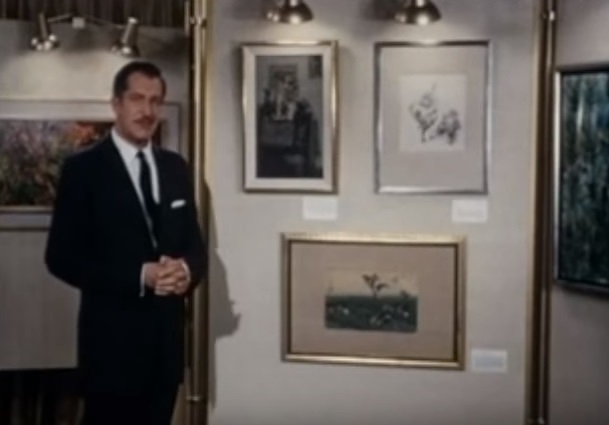
In this promotional film Sears released for its salesmen, Vincent Price explains how he was invited to participate in this project and offers a brief tour of some of the paintings that will be available in the collection. 

Thursday, March 20, 2014

The Snoop Sisters ( 1974 ) TV Series

During the early to mid-1970s, mystery programs were all the rage on prime-time television, or at least hoped to be. Between 1970 and 1978, roughly fourteen primetime mystery shows were launched and eight promptly failed ( notably the excellent Ellery Queen ). 

Nevertheless, the mild hullabaloo during the decade and the success of the NBC Sunday Mystery Movie in 1971 ( which featured different mystery movies once a week ) prompted the studio to create another mystery rotation series, The NBC Wednesday Mystery Movie. 

This series was launched in the autumn of 1971 and featured three new shows, Cool Million ( James Farentino ), Madigan ( Richard Widmark ) and Banacek. The only one of the series that managed to achieve even mild success was Banacek starring George Peppard as a suave Polish-American insurance claim bounty hunter. For the next season, three new shows were added in the "wheel" : Faraday and Company, Tenafly, and The Snoop Sisters featuring Helen Hayes and Mildred Natwick as sister sleuths. 

At the sprightly age of 72, Helen Hayes, the first lady of the American stage, was given her very own starring television series. Hayes was no stranger to the tiny tube however, from 1950 on she was a frequent guest star on theatrical shows such as Robert Montgomery Presents, Pulitzer Prize Playhouse, Omnibus, and Playhouse 90. In one television episode of the The Great Dow Hour of Mysteries she even played another mystery writer turned sleuth ( in Mary Rogers Rinehart's The Bat, 1960 ).


Teaming up with Helen Hayes was that other legend of the silver screen, Mildred Natwick, who had made some eighty film and television appearances, as well as numerous stage appearances. Natwick and Hayes had  previously played together in a 1971 TV movie entitled Do Not Fold, Spindle, or Mutilate and it is probably because of their great partnership in this film that producers Leonard Stern ( Get Smart ) and Tony Barrett ( Mod Squad ) saw the potential for a mystery series featuring the two indomitable ladies. Helen Hayes was also fresh off of her Oscar win for Airport and was justly rewarded this prime part. 

The pilot episode, A Female Instinct, aired on December 16, 1972 and introduced us to the basic premise of the series : Ernesta and Gwendolyn Snoop, two famous mystery writers, one a widow, the other a spinster, turn detective to hunt down the killer of a faded movie star. Aiding them in their investigation ( and keeping them out of trouble ) is Barney ( Art Carney ), their combination chauffeur and bodyguard, and their nephew, police lieutenant Ostrowski, played by Bert Convy. 

For an unknown reason, after this initial pilot episode, Lou Antonio replaced Art Carney as Barney. In between puzzling out the crimes they came across, they also worked on snatches of their mystery novel, with Ernesta often getting moments of creative inspiration directly at the crime scenes. 

Only four episodes were made but they were hailed by critics and fans alike as engrossing who-dunnits and the fact that it featured two mature film stars as authors/amateur detectives was years ahead of its time. Later, Angela Lansbury made this formula popular in her series Murder She Wrote. 

The Snoop Sisters boasted some great guest stars such as Paulette Goddard, Walter Pidgeon, Joan Blondell, Bill Dana, Alice Cooper, Jill Clayburgh, Bernie Casey, Kurt Kasznar, Victor Buono, Steve Allen, Roddy McDowall, George Maharis, Greg Morris, and Vincent Price ( in one of the best episodes of the series - Black Day for Bluebeard ). 

In spite of being nominated for three primetime Emmys ( Mildred Natwick won for Best Lead Actress in a Limited Series ), the show was cancelled before completing its first season. Its lackluster storylines were disappointing considering the talented script writers involved. Had the series been made by that dynamic duo Levison & Link, it would have certainly been a smashing sleuthing success and would have earned its place as one of the best mystery television programs of the 1970s.


Episodes


Corpse and Robbers ( Dec.19, 1973 )

Ernesta is surprised to get phone calls from an old friend, especially since he has been dead for many years. 

Fear is a Free Throw ( Jan.29, 1974 )

After a basketball player is poisoned by an antacid tablet given to him by Gwendolyn Snoop, she is accused of attempted murder. 

The Devil Made Me Do It ( March 5, 1974 )

During a murder investigation, the sisters uncover a satanist cult. 

Black Day for Bluebeard ( March 19, 1974 )

A washed-up horror movie icon is suspected of murdering his wealthy wife for the inheritance. 

This post is our contribution to the Big Stars of the Small Screen blogathon hosted by Aurora of How Sweet It Was. Be sure to check out all the other great writings on the major stars who found a home in the television set. 

Saturday, October 19, 2013

Nugget Reviews - 6

With Halloween fast approaching this edition of the Nugget Reviews will focus on great films to watch on Halloween night - films that even the timid would find thoroughly enjoyable. There are no fool's gold hidden among these gems...Enjoy! 


The Ghost Breakers ( 1940 ) 18k


Larry Lawrence, his quaking manservant and an heiress investigate the mysterious happenings at a castle in Cuba after they get threatening voodoo warnings to keep away from the property. Bob Hope, Paulette Goddard, Willie Best, Paul Lukas, Richard Carlson, Anthony Quinn. Paramount Pictures. Directed by George Marshall.

After the success of "The Cat and the Canary", Bob Hope and Paulette Goddard were teamed up once again to solve a mystery, this time as a radio broadcaster and an heiress who investigate the voodoo hoodoo at Castillo Maldito, an island property she inherited off of Cuba. Undoubtedly a step up from "The Cat and the Canary", "The Ghost Breakers" is one of Hope's best. He delivers rapid-fire quips such as "I'm in great shape for the shape I'm in" while still having time to woo Goddard.

                  ___________________________________________________________


The Bat ( 1959 ) 14k


A mystery writer and her companion rent a rambling mansion in the country for the summer, little knowing that their landlord has been killed and a masked murderer known as "The Bat" is on the premises searching for hidden treasure. Agnes Moorehead, Vincent Price, Gavin Gordon, Lenita Lane, John Sutton,  Allied Artists. Directed by Crane Wilbur.

"The Bat", a remake of "The Bat Whispers" ( 1931 ) was based on Mary Roberts Rinehart's famous mystery novel which was one of the first to popularize the "mansion filled with guests and hidden money" premise. The film contains some great sets, interesting suspects and more twists and turns than there are secret passages in the mansion. Although the acting gets to be downright corny at times, Agnes Moorehead and Vincent Price are always pros and make this film a treat to watch, even if the plot does elude you. Heck, we've seen it over fifty times already and have not tired of it!

                  ___________________________________________________________


The Ghost and Mr. Chicken ( 1966 ) 14k


Luther Heggs, a timid typesetter boasts that he can spend the night in the Old Simmons Mansion where it is rumored that the ghost of Nickolas Simmons still resides. He becomes the town hero for doing so but then finds a libel suit thrown at him when he prints what he saw that fateful night. Don Knotts, Joan Staley, Dick Sargant, Liam Redmond, Philip Ober. Universal Pictures. Directed by Alan Rafkin. 

Ephraim Simmons murdered his wife in cold blood and then played the organ before killing himself; the keys are still stained with blood, and could never be cleaned off, even after using Bon-Ami...or so the rumor goes. It takes a man with spunk, like Luther, to get to the bottom of the real story. A sprightly ghost theme by Vic Mizzy ( based on Mr.Ghost Goes to Town ) permeate this homespun comedy gem filled with great one-liners, great atmosphere, great Mayberry character actors, and one of Don Knotts greatest nerve-rattled performances. 'Atta boy, Don Knotts! 

                  ___________________________________________________________


House of Fear ( 1945 ) 14k


Sherlock Holmes and Dr.Watson travel to the countryside of Scotland to investigate the murders of two members of the Good Comrades Club, members who were forewarned of their death before their bodies were mutilated beyond recognition. Basil Rathbone, Nigel Bruce, Aubrey Mather, Dennis Hoey, Paul Cavanagh.Universal Pictures. Directed by Roy William Neill. 

The eighth film in the Universal Sherlock Holmes series and one of the most memorable due to its unique criminal plot. A house on the cliff, a private club, footprints in the sand and a dark stormy night, what more could one ask for in a Sherlock Holmes feature? Dr. Watson gets the spotlight turned on him in many scenes and Nigel Bruce gets to mumble and sputter exclamations to great effect. Alas, parts of the movie drag on but overall its quite a pip.

                  ___________________________________________________________


Hold that Ghost! ( 1941 ) 18k 


Two gas station attendants inherit an old roadside inn, but find that a gangster's dirty millions are hidden in the house and his con-men cohorts are no about to let it fall into the hands of two boobs. Bud Abbott, Lou Costello, Evelyn Ankers, Joan Davis, Richard Carlson, Shemp Howard. Universal Pictures. Directed by Arthur Lubin. 

Abbott and Costello's slapstick humor do not appeal to all audiences, but this is one film that even the most ardent A&C loathers will find hard not to like. Evelyn Ankers, Hollywood's top scream queen of the 1940s, adds great sweetheart support as does comedian Joan Davis. Her tango with Lou Costello is one of the highlights of this haunted house flick and we can only imagine how audiences screamed throughout the film - screams of laughter that is.

Monday, July 29, 2013

Busy Bodies - Promoting Castle's Camp

Consult your doctor! Bring your seatbelts! See it with someone with warm hands! 

If you were to ask any child in the 1960s if they would want to see a William Castle film over the weekend, you'd hear a resounding "Hurrah!" in response. Every loyal follower of cheap horror schlock such as The Little Shop of Horrors, The Crawling Eye, or The Brain that Wouldn't Die, knew who William Castle was. Heck, he was a household name. Even non-horror buffs were familiar with the King of Camp. What made this man so famous? It surely wasn't the quality of his films. It was showmanship. That's right, when it came to promoting films, he knew what the public loved ....sensationalism. Castle delivered exactly what you came to see...spine-tingling squirm-in-your-seats awkward horror ( or a lot of laughs, depending on your taste ). 

Macabre was William Castle's first film offering as an independent producer. After directing several dozen b-films for Columbia Pictures, he decided to be a man and venture out as an independent creator. 


It all began while watching Diabolique one rainy night with his wife Ellen. Castle was amazed at how many young people were standing in line, in the pouring rain, to watch a movie that will scare their pants off. Charged with the creative fuel of a good idea surging in his blood, he went on a search for a story that would surpass Diabolique in fright. He found that story...it was called "The Marble Forest" . He pitched it to several studios but none thought the movie would sell, and so Castle hocked his house, and with $90,000 in his pocket, became his own producer. 

The newly retitled Macabre was filmed in 12 days and looked to be equally as frightening as Diabolique, only it lacked one thing...a promotional gimmick. Then the idea hit Castle one night - an insurance policy! With nurses on standby and a hearst parked outside, audience members entered theatres with pen in hand ready to sign a Lloyds of London insurance policy guaranteeing that William Castle will pay the beneficiary that they name $1,000 in case they die of fright while watching the film ( hardly likely ). A small clause also read "I understand that if I have a known heart or nervous condition the One Thousand Dollars is not payable". It's always good to protect oneself. 


Macabre netted over $5,000,000 nationwide - a phenomenal return for such a small investment. The success of the picture also ingrained in Castle's mind a philosophy he always believed....showmanship is pure gold when it comes to the film industry. 


For his next film, House on Haunted Hill ( 1959 ) , he used one of the oldest promotional techniques in
the industry : a big name actor. Vincent Price to be precise. There isn't anything quite like a big name to draw audience members to theatres, but just in case certain kiddies weren't familiar with the legendary thespian, Castle concocted Emergo. It was promoted as "the new wonder where thrills fly right into the audience". It was really a lighted plastic skeleton that swooped down on the audience via a wire when the skeleton appeared onscreen. The effect was pretty good and the audience loved the trick, but most theatres disabled it after a few weeks...too many local hooligans would shoot rocks at it with their slingshots. Sometimes skeletons produce that effect.

House on Haunted Hill was a fun thriller and boasted a wonderful cast of characters. Aside from Vincent Price, it starred Richard Long, Alan Marshall, Elisha Cook and Carolyn Craig. The noted gossip columnist Louella Parsons hailed the film as being "more frightening than a graveyard on a cold, wet night". ( We didn't realize she frequented graveyards at night. )  


Vincent Price and William Castle teamed up again for this next picture, The Tingler ( 1959 ) . This remains Castle's most memorable movie...not so much for the film itself but for its publicity stunt - Percepto. Posters and trailers guaranteed that "the Tingler would break loose while you were in the audience". That is, providing you visited a theatre that purchased the Tingler kit in advance. Unsuspected audiences scarcely realized that Tinglers had to be purchased via mail-order. Each Percepto kit included 100 vibrato motors, a timing device and a 12-page installation manual. If Ol' Gus, the janitor, didn't read the instructions correctly, the "Tingler" just wouldn't visit your theatre.   


What exactly was Percepto? Electric buzzers installed in the bottom of the seats. 

Unfortunately, William Castle did not think about giving out rubber Tinglers to audience members as they exited. We would of much rather went home with a souvenir than a tingle down our spines. 

One of the most entertaining publicity gimmicks William Castle utilized was Illusion-O for his 1960 classic, 13 Ghosts. Audience members received supernatural viewers and could sit, with mouth agape, to perceive exctoplasmic ghosts whiz by them....in COLOR. Oooohhhh. Basically, Illusion-O was a piece of cardboard with thin pieces of colored cellophane attached as "lens". By looking through the red plastic the ghosts appeared on screen. For the faint at heart, a peep through the blue filter magically made them disappear. 


Dr. Plato Zorba developed his very own pair of glasses that enabled him to penetrate the supernatural world and hence, communicate with them on a face to face level, so what better way for the audience to participate then by offering them their very own supernatural viewers? Of course, at home these ghost glasses didn't seem to work as well when trying to see the spirit of Uncle Henry in the old barn out back. 

"13 Times the Thrills, 13 Times the Screams, 13 Times the Fun!"

13 Ghosts was heavily promoted through billboards, television spots, and news articles. William Castle also selected thirteen youngsters to dress as ghouls and travel up and down Hollywood Avenue on an elaborately decorated ghost float. They waved signs which read "Vote for Castle..the only candidate with a ghost of a chance" ( this was during the Kennedy/Nixon presidential campaigns ) while a recording of Castle's voice boomed through a megaphone, "Do you believe in ghosts?". 


Do you have a yellow streak down you back? Then don't walk out of Homicidal ( 1961 ) or you'll be labeled a coward! Just before the ending to Homicidal, a truly strange picture, a timer would appear onscreen announcing the "Fright Break"...while the clock ticked away you could sneak out of your seats with your little yellow "coward's only" certificate and receive a full refund. 


In small print, the certificate reads, "To protect patrons of tender years from the psychological dangers of being labeled a coward, this money-back guarantee applies only to members of the audience 15 years of age and over" . For some reason, I imagine that alot of youngsters in groups took advantage of this gimmick to save their money for an ice cream shake after the flick. 

For those who felt they wanted a little control over the ending of a film, attending Mr. Sardonicus ( 1961 ) enabled them to wield their voters right and decide whether the titled Mister received his come-uppance or not . The Punishment Poll allowed members of the audience to vote by raising glow-in-the-dark cards with a thumbs up or a thumbs down. Who stood behind the screen to count the votes, I'm sure I don't know. 


An alternate "happy" mercy ending to the movie may have been filmed, but no audience ever offered Mr. Sardonicus mercy and hence, it was never screened. We live in such an unsympathetic age. 

Mr. Sardonicus boasted some beautiful poster art of the grinning money-grabbing villian as well as this neat trailer, hosted by William Castle, whose facial expressions reminds me of a cross between Don Ameche and Ed Wynn in this trailer. 


Another film which featured take-home freebies was Zotz! ( 1962 ) . This film told the story of a school professor who finds a magical coin which, when used with the magic words, lets him "pause" movement or give pain to those he aimed his finger at ( no, not that finger! ). "Magical coins" were issued to loyal patrons and, while we're not sure what they did, they sure do look neato! 

Here's a coin that we found on Etsy, someone converted it into a kitchen magnet. Just imagine all that magical power sticking on your refrigerator, just waiting for the right person to come by and say the magic words.  

William Castle's films were selling themselves perfectly well without the help of gimmicks and promo stunts, and so after Zotz , they began to wind down. However, one interesting pre-release gimmick Castle used was in 1963's 13 Frightened Girls. In a worldwide contest, young girls from thirteen different countries were selected to be chosen as the students who appear in the film. Here is one of the girls from Sweden : 


Straight-Jacket ( 1965 ) didn't have much a promotional gimmick at all and quite frankly, didn't need one. Afterall, it featured Joan Crawford. She had recently created a sensation as Blanche in Robert Aldrich's has-been classic Whatever Happened to Baby Jane?. Joan Crawford seemed enthusiastic to be back in the spotlight again, even if it was for star billing in a horror film. To promote Straight-Jacket, Ms. Crawford smeared greasepaint on her face and went off on a national tour, visiting Lowes theatres and fan clubs across the nation, happily advertising the fact that she portrays a psychotic ax-murderer. The higher they climb, the lower they fall. 


Audience members in theatres received their very own little cardboard axes so they could practice their hacking technique on friends, neighbors, and enemies at home. We weren't able to find any photos of how these axes looked like, which makes us come to the conclusion that they must be a rare bit of memorabilia indeed! 


"Fate Dials the Number...Terror Answers the Phone!" 

Joan Crawford was back again as Amy Nelson, the girlfriend of Steve Marak ( John Ireland ), who recently did a Norman Bates and energetically stabbed his wife to death in the shower in I Saw What You Did ( 1965 ). Joan Crawford's character is a bit more sympathetic here and we, as the audience, are moved to pity. ( More so for that fact that an actress once so famous could play such a cheesy role...but that's another story in itself ). 

Posters advertising I Saw What You Did featured in bold letters the upcoming phenomena Uxoricide but obviously no one wanted to see a gimmick that sounded like a laundry detergent, so theatre chains didn't even bother installing them. What was Uxoricide? Seatbelts. You didn't follow that? We didn't either. 


And lastly - scraping the bottle of the barrel here - was The Night Walker ( 1965 ). Once again, the really big publicity drawing feature to this film was the fact that it starred Robert Taylor and Barbara Stanwyck, two big name actors who were once Hollywood's golden couple. Taylor up and left Stanwyck after twelve years of marriage ( for various reasons ) and this was their first teaming on screen in over 28 years. He plays a man out to kill her. Shouldn't it of been the other way around? 

This great poster advertises everything that we did not see in the film - as posters are apt to do. That fierce looking creature is certainly something we wouldn't want to meet in our dreams. Castle botched it up again when it came to the giveaways and didn't provide little glass eyeballs for his motion picture attendees. There was a freebie however...a paper sheet called a "Dream Interpreter". We couldn't quite figure out how it worked so if anyone remembers or still owns one of these please let us in on the secret. 


Oh, noooo!

We're not done yet! We got our very own special treat for those members of the audience who were patient enough to wade through our writing...an extra-special deluxe photo gallery insert! 

Let's take a peek at William Castle....


BEHIND THE SCREAMS!


William Castle and Mrs. Slydes on the set of House on Haunted Hill

Castle with an unknown man and an unknown head on the set of Straight-Jacket
The Master of Macabre hamming it up with some fan club members
Cary Grant, Joan Crawford, and John Ireland
Castle and Price practicing with ghouls
Castle with Mia Farrow on the set of Rosemary's Baby
Diane Baker, Joan Crawford and the Maestro
He's keeping his eye on you!
Some happy fan members get Castle's autograph
Castle enjoying a stroll down in the audience
William Castle ( Apr. 24, 1914 - May 31, 1977 ) 

This post, and The Films of William Castle, are our contributions to the fabulous William Castle Blogathon being hosted by The Last Drive-In and GoreGirl's Dungeon.  You can see a complete line-up of blogs participating in this event here.