Showing posts with label Horse Racing. Show all posts

Saturday, May 7, 2022

Classic Horse Racing Comedies

It's that time of year...the grass is growing green, the magnolias are in bloom - and the horses are racing! Look at 'em go! 

A Mother's Day Weekend tradition, the 148th Kentucky Derby once again takes place this evening so why not get in the spirit of this classic American tradition by watching some horse racing films? In a previous post, we've shared our top picks of the 1940s and 1950s, but this time around we are going to stick with the funnies. Betting on the horses can be frustrating but it also makes great fodder for comedy. Here are our winning sillies about fillies: 

Three Men on a Horse ( 1936 ) - Frank McHugh stars as a meek salesman who has an uncanny ability to pick horses. For that skill alone, a group of gamblers decides that he's a man worth kidnapping. Joan Blondell and Guy Kibbee also star in this Mervyn LeRoy film. 

A Day at the Races ( 1937 ) - This certainly ranks as one of the wildest comedies about the track - and who best to star in it than a trio of real-life horse betters : The Marx Brothers! In this classic Groucho plays a veterinarian posing as a doctor who, with the help of a misfit racehorse, tries to save a New York sanitarium from bankruptcy. 

Straight Place and Show ( 1938 ) - If you thought A Day at the Races was zany, then check out the Ritz Brothers. Their comedy routines weren't as rollicking as the Marx Brothers, but it is still a good rule not to eat peanuts while you watch. In this picture, they take up jobs as wrestlers to raise money to help a young man train his first racehorse. 

Scattergood Rides High ( 1942 ) - Guy Kibbee starred in a whole slew of Scattergood films during the 1940s, so naturally the small-town philosopher ended up eventually visiting a horse farm. Jed Prouty and Dorothy Moore also star in this 4th entry in the series. 

It Ain't Hay ( 1943 ) - Bud Abbott and Lou Costello often used their own material, but on occasion they resorted to an old script, which was the case with this film. Princess O'Hara ( 1935 ) was a Jean Parker/Chester Morris comedy that perfectly suited the hijinks of the Universal boys. Lou plays a street vendor who finds his nag has been replaced with a thoroughbred. In no time at all, he is off to the tracks!

So You Want to Play the Horses ( 1946 ) - This one isn't a feature film, but a gem of a short film that can't be passed up while we are mentioning horse racing comedies. George O'Hanlon made an excellent series of "So You Want to...." comedy shorts featuring his Joe McDoakes character, and this one covers the ins and outs of the betting game.  

The Fabulous Suzanne ( 1946 ) - This amusing Republic quickie features a young Barbara Britton ( best remembered for playing the scatter-brained Mrs. Brown in the television series My Favorite Martian ) as a waitress with a surefire "system" for winning at the racetrack. Otto Kruger and Rudy Vallee also star.

Easy Come, Easy Go ( 1947 ) - Also known as Easily Seen, Easily Forgotten.....but while you watch it is fun. This Sonny Tufts comedy features one of the largest Irish casts in any film - Barry Fitzgerald, Arthur Shields, Frank McHugh, and Allen Jenkins to name just a few. Frank Faylan and Diana Lynn also star.
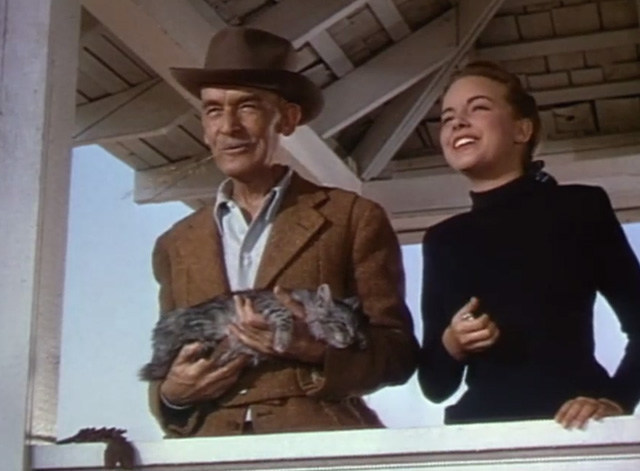
The Return of October ( 1948 ) - This is a silly but engaging family comedy about a trainer ( James Gleason ) who loved horses so much that he swore he would come back to life as a horse. His niece ( Terry Moore ) believes he did just that and Professor Bassett ( Glenn Ford ) finds her to be an excellent subject for his upcoming thesis.

Sorrowful Jones ( 1949 ) - Sorrowful Jones may sound like the name of a horse, but it is really Bob Hope's character, who is a cheap bookie who is stuck playing nursemaid to a little girl after a man leaves her as a marker for a bet. Lucille Ball also stars in this comedy and the twosome of Hope and Ball were reunited in three more films, including Fancy Pants just a year later.

Francis Goes to the Races ( 1951 )
- Francis may be a mule, but he enjoys a good race just like any horse. Here, Francis gives Peter ( Donald O'Connor ) some hot insider tips "straight from the horse's mouth" that come in handy when Peter attempts to help his gal ( Piper Laurie ) and her grandfather repay debts they owe to a racketeer.

Money from Home ( 1953 ) - If Abbott and Costello can make a racing picture, so can Martin and Lewis. This one has veternarian Virgil ( Jerry Lewis ) donning a jockey outfit and racing to the finish on an underdog, much to the surprise of Dean Martin, Mara Corday and Pat Crowley.

The March Hare ( 1956 ) - This colorful British comedy is set in Ireland and stars Cyril Cusack as a drink-loving trainer who whispers a "magic word", obtained from the fairy queen, to his horse before each big race. A sideline romance between Terence Morgan and Peggy Cummins, and a slew of great British character actors ( Martita Hunt, Wilfred Hyde White ), make this a gem.

Friday, June 1, 2018

Sea Bird II at The Derby ( 1965 )

Tomorrow will take place the 234th running of The Derby at Epsom Downs and to help you get into the mood for enjoying that race we have unearthed here a clip from the 1965 Derby ( pronounced "Darby" ) in which "Sea Bird II" made his historic victory run. 
"Sea Bird II" was a chestnut colored French thoroughbred who many consider to be the greatest racehorse of the 20th century. In this particular race, he gives a magnificent performance easily passing "I Say" - the favorite to win - by two lengths. Pat Glennon, an Australian, was Sea Bird's jockey for this race. 

This 6-minutes long British Pathé clip gives us a glimpse of the atmosphere at the race and also shows Queen Elizabeth, Prince Philip, Princess Margaret, and other royal personages in attendance.

Ready to see them charge? Simply click on the link below. 

https://www.youtube.com/watch?v=1pHi8SZFwzw

Other similar British Pathé clips: 

The Derby ( 1959 ) - 3:49 min

The Derby ( 1962 ) - 6:06 min

The Derby ( 1968 ) - 4:01 min

Friday, May 6, 2016

Horse Racing Films of the 1940s and 1950s

And they're off! Flying around the first bend is Seabiscuit, followed by The March Hare, with Riding High scrambling into third position. And what's this? National Velvet is trailing behind by nearly a furlong! She'll have a long way to catch up if she wants to win. 

With the Kentucky Derby, the most popular horse race in the U.S classics, coming up this Saturday, what better way to get into the hoof of the moment then by watching some winning horse racing films. Can't think of any good ones off the top of your head? Well then, you've come to the right place.

Below we lined up some of the finest racing flicks of the 1940s and 1950s, and ranked them based on their track performance. Select a title you are familiar with, or gamble on a long shot...it may just be a winner! Across the leaderboard you'll find : 

IN THE MONEY 


Win - National Velvet ( 1945 ) - The timeless Enid Bagnold classic comes to vivid life in this Technicolor MGM adaption starring Elizabeth Taylor, Mickey Rooney, Donald Crisp and Anne Revere. It's all about the story of a young girl determined to get her "Pi" into the Nationals and to win at that. This is the Triple Crown winner of racing pictures. 

Place - The Story of Seabiscuit ( 1949 ) - A "thorough"ly entertaining fictional account of the life and times of the great Seabiscuit prior to his winning the Triple Crown in 1937. Actual footage of Seabiscuit's win at the Kentucky Derby top off the grand finale. Shirley Temple, Lon McCallister and Barry Fitzgerald star. 

Show - Boots Malone ( 1952 ) - This is the horse-racing picture for true horse-racing fans. Boots Malone captures life at the track the way it really was. William Holden plays a cynical agent for a young jockey who wheels and deals with everyone and everything to get what he wants ( yes, this is Holden being Sefton at the racetrack ). An unexpected ending just adds to the splendor of this entertaining film. 

THOROUGHBREDS 


Riding High ( 1950 ) - Bing Crosby stars in this remake of Broadway Bill ( 1934 ), directed by Frank Capra. Crosby lends more of a laid-back vigor to the part of the determined horse trainer who bet everything on his beloved horse winning the Kentucky Derby. Coleen Gray and Charles Bickford co-star. 

The March Hare ( 1956 ) - This colorful British comedy is set in Ireland and stars Cyril Cusack as a drink-loving trainer who whispers a "magic word", obtained from the fairy queen, to his horse before each big race. A sideline romance between Terence Morgan and Peggy Cummins, and a slew of great British character actors ( Martita Hunt, Wilfred Hyde White ), make this a gem. 

My Brother Talks to Horses ( 1947 ) - What a trainer would give for an inside tip direct from the horse's mouth! Peter Lawford counts himself fortunate to have a little brother who not only knows what horses talk about, but can converse with them, too. MGM's popular child actor Butch Jenkins stars as the pint-sized horse whisperer.

The Return of October ( 1948 ) - Uncle Will ( James Gleason ) loved horses to death, so its no wonder that after he died he was reincarnated as a horse....at least that's what his niece Terry ( Terry Moore ) claims, and it's up to Professor Bassett ( Glenn Ford ) to disclaim her theory to the court when she is tried for insanity. The Return of October has a charm about it that is hard to resist, especially since that Irish charmer himself, Albert Sharpe, also stars in the film. 
The Red Stallion ( 1947 ) - A young man ( Ted Donaldson ) finds an orphaned colt in the woods and trains him to race in a big derby hoping to raise enough money to pay off his grandmother's ( Jane Darwell ) ranch debts. This is one of those routine family films to come out of an independent studio but it's very entertaining and boasts a strong cast. 


MAIDEN RACERS


Glory ( 1955 ) - Margaret O'Brien and Walter Brennan star in this story of a young woman yearning to win a big race with her philly "Glory". This coming-of-age film was made as an attempt to launch Margaret O'Brien's adult career, but it never took off. Lawrence Welk's lovely Champagne lady Norma Zimmer dubs O'Brien's singing voice for her three musical numbers. 

Sorrowful Jones ( 1949 ) - Sorrowful Jones is not a winning horse, but a cheap bookie ( Bob Hope ) who finds himself playing nursemaid to a little girl after a man leaves her as a marker for a bet. This comedy united Lucille Ball and Bob Hope onscreen for the first time. They became fast friends and played together many times afterwards. 

It Ain't Hay ( 1943 ) - Bud Abbott and Lou Costello star in this comedy remake of Princess O'Hara ( 1935 ) in which a street vendor finds his nag has been replaced with a thoroughbred no less!

Thunderhead - Son of Flicka ( 1945 ) - This charming Technicolor picture is a sequel to the popular My Friend Flicka ( 1943 ) and also stars Roddy McDowall. Now the English lad is training Flicka's son to become a race horse. 

Derby Day ( 1952 ) - Instead of focusing on the famous race at Ascot, this film turns the spotlight on the people attending the race, namely three different groups who each find their lives turned around on Derby Day. Anna Neagle and Michael Wilding teamed up for the sixth and last time in this highly entertaining drama. 

Blue Grass of Kentucky ( 1950 ) - This Monogram quickie tells the story of Blue Grass, a "secretly" bred horse of the finest stock who is entered to win at the Kentucky Derby despite his owners doubts of his racing ability. Bill Williams, Frank Morgan, and Jane Nigh star in this Kentucky drama. 

Pride of the Blue Grass ( 1954 ) - The 1950s saw a host of horse-racing remakes, and this time around Allied Artists brought back Pride of the Blue Grass ( 1939 ) in "thrilling color". Since an Irishman is a prerequisite for any great horse picture, Barry Fitzgerald's brother Arthur Shields was tossed in for good luck. 

Boy from Indiana ( 1950 ) - Lon McCallister had a difficult time growing from juvenile parts into manly roles due to his short stature. Leading men are not often shorter than their leading ladies, and so he was often cast opposite short women and playing the part of.....a jockey! In this film, Lon ditches the harness racing equipment to raise a colt who becomes champion racer Texas Dandy ( played by JoJo ). 


RABBITS

Scattergood Rides High ( 1942 )  - A boy nurses his favorite horse, Starlight, back to health to win the Governor's Race and save his father's business. Guy Kibbee and Jed Prouty are the only "name" actors in this budget family drama from Pyramid Productions.

The Rainbow Jacket ( 1954 ) - For a jockey, being banned from the track can be the worst thing that can happen to you, especially when horse racing is in your blood like it is in Tyler's ( Edward Underdown ). To satisfy his longing to be back in the saddle, he trains a young lad to be a champion jockey just like he was. 

Sporting Blood ( 1940 )  - Louis B. Mayer often claimed that if you have a good story, film it again...and again. This remake of Sporting Blood came but nine years after the original film and stars Robert Young as the young man who sets out to spite a fellow stable owner by marrying his daughter ( Maureen O'Sullivan ). Hardly sporting, old bean. 

Easy Come, Easy Go ( 1947 ) - No, it's not the Elvis musical....it's the Sonny Tufts comedy-drama set at the tracks. This film goes on record as featuring the largest cast of Irish descendants ( until The Quiet Man was made ). If one good Irishman makes a racing picture, then why not through in 12...or 20? Barry Fitzgerald, Arthur Shields, Frank McHugh, Allen Jenkins, Frank Faylan and Diana Lynn are just some of the cast. 

The Fabulous Suzanne ( 1946 ) - This amusing Republic quickie features a young Barbara Britton ( best remembered for playing the scatter-brained Mrs. Brown in the television series My Favorite Martian ) as a waitress with a surefire "system" for winning at the racetrack. Otto Kruger and Rudy Vallee also star. 

That Gang of Mine ( 1940 ) - Horse racing was a major sport in the 1940s. So much so, that even the East Side Kids made a film about it. Muggs ( Leo Gorcey ) finds his dream of becoming a jockey about to come true when he meets up with an old man who has a champion race horse. 

ALSO- ELIGIBLE : 

So You Want to Play the Horses ( 1946 ) - Joe McDoakes couldn't stay away from the race track either, and thought he would share some betting tips with his viewers in this amusing short film. 

Sunday, June 7, 2015

Bing Crosby's Wild and Carefree Days

For our latest addition to the Movie Magazine Article Collection, we have unearthed this very entertaining article from a great issue...the December 1935 edition of Modern Screen magazine. In addition to this juicy write-up, other articles in this issue included "Women with Careers Should Be Shot!" Says Bette Davis; Mary Carlisle's Tips on Catching a Beau; The True Story Behind Loretta Young's Illness; and a contest from Ruby Keeler ( one of the prizes is a Buffeteer Toaster Service Set...hot diggity! ). We've included some of the ads in this post, just to spice it up a bit. 

Obviously Ms.Walker disapproves of Der Bingle's flippant attitude in life, although we wonder how much of this is really true. This article paints a different picture than the ones told about Crosby in his later years and his children's strict upbringing.

To read the article in its full context click here, otherwise read on dear reader, read on. 

Success a la Crosby

By Helen Louise Walker

Most successful actors have had some definite ambition, some goal, some plan of life. Circumstances or their own limitations may have frustrated them, altering their courses sometimes, but they have known, if not where they were going, at least where they wanted to go. But Bing Crosby's career seems to have just happened to him, like measles. He has broken every copy book maxim for success and neither his growing maturity nor professional eminence seem to have improved him one bit. He is, if anything, growing worse! 


You doubtless know the story of how, at an early age, he set out from Spokane for Los Angeles to try to get a job pounding his beloved drum . . . and how he ran out of money before he arrived and had to sell the drum. So there he was, broke and drum-less. But a job caught up with him anyhow . . . and that's the way things have always gone for Bing. 

As for his present business and professional methods ... well, he recently sold his Toluca Lake place to Al Jolson as a home for Ruby Keeler's mother. He promised to vacate the property by the first of October. But he didn't because, he averred, he couldn't find another house big enough to accommodate two careers, three young sons, a brace of nurses and the sizable staff of servants he maintains. 

At this writing the Crosby family is, to all intents and purposes, homeless. They are living in Ruby Keeler's mother's house and, I must say, Mrs. Keeler is being pretty nice about it. But what if she should decide to turn them out into the California climate at this point? The evenings have been right chilly. . . . And what does Bing mean he can't find a house which is "large enough" when I have heard a dozen film luminaries wailing lately that they couldn't find buyers for their dwellings because those dwellings were too spacious? I know where there is a very pretty hotel for sale, too. 

One doesn't know whether to cry, "Oh come now, Bing! Be your age!" or to hope that, for his own sake, he will keep on being the irresponsible playboy until he is eighty. Maybe it's partly that quality in him which makes you and you and you . . . and me ... enjoy him so much on the screen. There is something attractive, to all of us plodding folk, about the fellow who breaks all the sober rules and still comes out on top. 

Years ago he obtained a release from his contract with Paul Whiteman because of a sudden whim to remain in Los Angeles when the Whiteman orchestra was going east. He refused several promising radio offers for the same reason. Then suddenly he became panicky, thought he was getting nowhere and couldn't imagine why. In his frantic search for advice, he signed with numbers of shrewd gentlemen, who volunteered to manage him for a percentage of his potential salary. When he decided, at last, to accept the radio offer which was to bring him sudden fame and fortune, he found himself thirty-five thousand dollars in debt for advice which he had not taken. 

His own account of that episode is characteristic. "My brother, Everett, took charge of me then and the first thing he did was to pay off the thirty-five thousand dollars. With this off my mind, I decided to go fishing. I forgot to tell anybody about that." 

One wonders whether Brother Ev was able to dismiss that transaction so lightly from his mind, since it was his thirty-five thousand dollars which had gone to pay for the unused advice. Three days later Bing walked into Brother Ev's office to find that worthy fit to be tied. He had accepted a pretty spectacular offer for Bing from an Eastern broadcasting company . . . and then he hadn't been able to find Bing! 

Brother Ev must have his troubles, even today. Bing dislikes to go to the studio unless he is actually working on a picture and one gathers that he goes rather grudgingly even then. One of the executives of his studio wished to see him on important business and Bing, notified of this fact, sent the executive an invitation to play golf. The "conference" resulted in a pleasant golf game but an unsatisfactory (to the busy executive) interview which sent that gentleman back to his office in something of a pet. (An executive in a pet is really something to contemplate. I saw one once and I've been a little jumpy ever since.) But Bing won whatever point he was trying to make, so there you are.

He won his initial success playing traps with an orchestra, his later success singing and his latest, combining singing with acting. Every rising actor I have talked to in the past two years has expounded to me about how one must work hard, study, strive, struggle, learn and grow . . . lots of things like that. It all sounds so grim. But Bing, who is one of the most highly paid singers in the country, never had a voice lesson in his life and can't read a note of music. He scarcely knows the names of the instruments which accompany him. 

Having proved to his employers' satisfaction and that of the public that he can act passably well, he doesn't mind telling you that he never had an elocution lesson in his life, never read a: volume of Shakespeare and has seen very few plays. He doesn't waste time studying in his spare moments. He plays golf, goes fishing or fusses 'round his racing stables. 

Other actors diet, exercise, and equip elaborate gymnasiums to keep their figures fit, their tummies under control. Steam baths, massage, tossing heavy balls about . . . all an uncomfortable and strenuous part of pursuing their careers. 

A year or so ago Bing began to take on weight in a really alarming fashion. His employers were agitated. His brothers were agitated. Critics raised concerted eyebrows and opined that here, unless something pretty drastic was done about it at once, was the beginning of the end of the Crosby career. Whereupon the imperturbable Bing, declining to take any steps at all about this growing front of his, strolled to the studio, excess weight and all, and made his most successful picture to date, Mississippi. There is no use in anyone's getting into a lather over a guy like that!


Years ago, doctors told him that he had a growth in his throat which should certainly be removed at once. Bing didn't like the idea of having any snipping done about his tonsils and declined firmly to permit anything of the sort. Now, eminent specialists tell him that it is that very same little growth which has given him his special and individual style of singing. His chief capital! 

No wonder he indulges his whims and behaves like a spoiled child upon occasion. Recently he had Mae West's pet cameraman, Carl Struss, on his picture, Two for Tonight. The company was a bit behind schedule and had not finished when it came time for Mae to start her new opus, Klondike Lou. Mae wanted her cameraman. Bing, apparently, decided that he liked to be "photographed pretty" too, so he declined to relinquish Mr. Struss. There was considerable tartness apparent on the Paramount lot while production on Mae's picture was delayed until she, at last, consented to content herself with George Clemens, Mr. Struss' assistant. Meanwhile Mae lost her leading man. Owing to the delay in starting, we understand, it was necessary to recall Victor McLaglen to the Fox lot to prepare for Professional Soldier. Bing, of course, was completely within his rights . . . but, dear me! We do expect him to be a handsome so-and-so in the forthcoming picture! 

Recently he notified the studio that he would like to be free of all picture assignments while the horse races are in progress at the Santa Anita track. If any assignments come up, however, one imagines that Brother Ev will take steps about that! 


When he planned the house at Toluca Lake, he called an architect. "What type of house do you want, Mr. Crosby?" he was asked. 

"Oh, I don't know. Just a house, comfortable and big enough for my family." 
 "No choice of period or style, or expense?" gasped the architect. 
 "My brother will tell you how much I can spend on it and I'll leave the rest to you." 

The architect had never encountered so delightful a client before, nor had the interior decorator, who followed him and received a similar carte blanche order. The results, one must say, did credit to both architect and decorator, and Bing, in his easy way, has enjoyed the whole thing very much. It's really a pleasant way to live, when you think of it! 


He has consistently broken Hollywood's most inviolable copy book maxim, which says that, in order to succeed, you must cultivate important people who may advance you by their favor. Bing does little entertaining. He has a few cronies with whom he likes to play cards, frolic or sing. None of them is likely to "advance" him. He will NOT make public appearances at which he must wear evening clothes, be gaped at or sign autographs. Despite his long experience as a public figure, he is really inherently shy. He used to have to do those things to earn his living. He doesn't have to any more . . . so he goes fishing. 

He sulks and becomes downright pettish if anyone or anything interferes with his whims or his convenience. He was arrested a day or two ago for driving forty-two miles an hour in a twenty mile zone on a Hollywood thoroughfare. The arresting officer found a revolver in his car and Bing had left his gun permit at home. So the cop trundled him off to the station to explain these matters. 

"It's a pity," Bing complained afterward, "a downright pity that I can't just drive down the street without some officer picking on me!" 

Well, there you are. You and I drive our careful twenty miles an hour, smile prettily at the big shots, eat our spinach, remember that haste makes waste and that the only way to succeed at your job is to work, study, struggle and strive. And where do we get? And where is Bing? 

I was a little impatient with Bing when I began to write this piece . . . but now, I dunno. I think I'll sleep until noon tomorrow, thumb my nose at the first cop I see and maybe at the first important producer. Maybe even at Will Hays  I'll let you know what happens ... if I live through it!

Movie Magazine Articles, our newest series, will feature articles like these reprinted for our reader's entertainment. Links to the original sources are available within the body of the text. In the future, simply search "Movie Magazine Articles" to find more posts in this series or click on the tag below.Enjoy! 

Friday, May 3, 2013

The Triple Crown Winner

And they're off! Coming around the first bend is Lucretia's Child, in the lead by a body length with The Fat Lady Sings, Gone With the Wind, Dunkin' Dixie and I'm Gonna Get You following closely behind. Now Lucretia's Child and Dunkin' Dixie are neck to neck..and here comes the home stretch...aaaand Seabiscuit is the winner!! ( Darn. I bet two bits on Dunkin' Dixie ).


With the Kentucky Derby, the most popular horse race in the U.S classics, coming up this Saturday what better way to get into the hoof of the moment then by watching some winning horse racing films. Can't think of any good ones off the top of your head? Well then, you've come to the right place.  

Below we have a line-up of some of the finest racing flicks you'll ever come across ( pre-1965 of course ). Look over the contenders while they are in the paddock, read the plots, weigh the odds, use your gut instinct and then place your bets, for on Saturday they race! Okay, not really "race"...but they are going to be compared head to head. Select the film you think will be the Triple Crown Winner, the grand chawhee of them all, to be announced right after the Kentucky Derby. 

( Good luck trying to find a bookie who will place your bet. )  

THE LEADERBOARD 

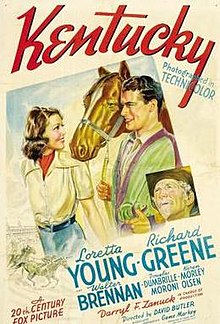
Kentucky ( 1938 ) - Loretta Young and Richard Greene star in this Southernized modern version of Romeo and Juliet set amidst the bluegrass country of Kentucky. With a strong supporting cast included Best Supporting Actor Walter Brennan, vivid Technicolor, and a fine roster of thoroughbreds racing their hearts out, this is a winner for sure. Odds : 3-1

Boots Malone ( 1952 ) - This is the horse-racing picture for true horse-racing fans. "Boots Malone" captures life at the track the way it really is. William Holden plays a cynical agent for a young jockey who wheels and deals with everyone and everything to get what he wants ( yes, this is Holden being Sefton at the racetrack ). An unexpected ending just adds to the splendor of this great film. Odds 2-1


Pride of the Bluegrass ( 1939 ) - This Warner Brothers programmer tells the story of Elmer Gantry ( "Gantry the Great" ) a blind stallion who gallops his way to glory in the Grand National. James McCallion, Edith Fellows and Granville Bates star. Odds 7-1


National Velvet ( 1945 ) - The timeless Enid Bagnold classic comes to vivid life in this Technicolor MGM adaption starring Elizabeth Taylor, Mickey Rooney, Donald Crisp and Anne Revere. It's all about the story of a young girl determined to get her "Pi" into the Nationals and to win at that. Odds 2-1 

Broadway Bill ( 1934 ) - Frank Capra's classic story of a businessman whose passion for his horse leads him to forsake all to pursue his dream of entering the Kentucky Derby despite the odds being against him. Capra later remade his hit in 1953 as "Riding High" with Bing Crosby as our devoted horse fan. Warner Baxter, Myrna Loy and Clarence Muse star. Odds 2-1 


Sporting Blood ( 1931 ) - This early talkie follows the saga of Tommy Boy, a young colt who begins life with such promise and then falls into the wayward path of drugs ( he was doped into it! ) until a young woman ( Madge Evans ) decides to help him back on victory's path. Clark Gable and Ernest Torrence also star in this film which includes actual Churchill Downs racing footage. Odds 4-1

The Story of Seabiscuit ( 1949 ) - A "thorough"ly entertaining fictional account of the life and times of the great Seabiscuit prior to his winning the Triple Crown in 1937. Actual footage of Seabiscuit's win at the Kentucky Derby top off the grand finale. Shirley Temple, Lon McCallister and Barry Fitzgerald star. Odds 3-1 

Glory ( 1955 ) - Margaret O'Brien and Walter Brennan star in this story of a young woman yearning to win a big race with her philly "Glory". This coming-of-age film was made as an attempt to launch Margaret O'Brien's adult career, but it never took off. Lawrence Welk's lovely Champagne lady Norma Zimmer dubs O'Brien's singing voice for her three musical numbers. Odds 5-1 


Blue Grass of Kentucky ( 1950 ) - This Monogram quicky tells the story of Blue Grass, a "secretly" bred horse of the finest stock who is entered to win at the Kentucky Derby despite his owners doubts of his racing ability. Bill Williams, Frank Morgan, and Jane Nigh in this Kentucky drama. Odds 5-1.

Thoroughbreds Don't Cry ( 1937 ) - A young English lad and a cockey jockey set their hearts on winning the Kentucky Derby and no difficulties are too large for them to surmount. Mickey Rooney, Ron Sinclair and Judy Garland star in this light but enjoyable jaunt into the derby. Odds 4-1 


THE TRIPLE CROWN WINNER 


National Velvet!  This thundering winner of 2 Academy Awards ( and three more nominations ) justly deserves the flowered wreath of glory bestowed around its neck. Whilst "National Velvet" is not at all a Kentucky Derby themed film - the Grand Nationals is a "steeplechase" run - there can be no doubt that it captures in its 123 min. run time everything that a horse owner and jockey have ever felt about entering a race. 


" Do you think a race like this is run by luck? " 
" No, by knowing the Pi can win and telling him so! " 

A young girl's faith and trust in the horse she loves and her single-minded determination to win the Grand Nationals allows her to capture her dream. 

Originally a vehicle for Katherine Hepburn, Paramount sold the rights to the Enid Bagnold best-seller in 1941 to MGM studios, whence Pandro Berman took loving care of it and produced this gem of a film.