Showing posts with label Movie Magazine Articles. Show all posts

Wednesday, June 14, 2023

What Leading Men Have Taught Madge Evans

One of the most sought-after leading ladies is Madge Evans. Although only twenty-five years old, she is really a “veteran” since she appeared on the screen at the age of six.

“Most of my knowledge of acting,” says Madge, “has been taught me by men. I believe that every masculine star with whom I have worked has contributed something to my training.”

Madge mentioned Ramon Novarro first. She made two pictures with him. Impossible Lover and Son of India.

“Ramon taught me more about charm than any other man. He taught me that with charm and grace any scene can be made effective.”

She said that during the production of Impossible Lover, she questioned the probability of a certain sequence, and suggested a change that was not agreeable with the director.

“Then Ramon told me a secret. ‘Play it,’ he said, ‘as if it were the most important scene in the world. Put everything you have into it. Tell yourself it’s the most beautiful piece of drama ever written, and act it accordingly.’

“Well,” said Madge, “I did, and it became the brightest sequence in the picture.”

She has been Robert Montgomery’s leading woman in three pictures — Lovers Courageous, Hell Below, and Fugitive Lovers.

“I learned much about the light touch from Bob,” Madge said. “It is natural with him. He employs it with suavity and grace.”

Madge cited an instance. When Lovers Courageous was being filmed she said she was afraid that parts of the story were too sentimental.

“But Bob’s acting circumvented this,” she said. “At just the right time, he would make a gesture or a funny little expression which would lighten the emotional burden and distract the audience.”

Otto Kruger’s chief charm for Madge is his voice. They played together in Beauty for Sale. Madge believes Kruger has more romantic appeal in his voice than any other man on the screen.

“The thrilling quality of his voice almost hypnotizes one into submission. In a love scene, when you’re in a man’s arms, you can’t be thrilled by the expression on his face or the light in his eyes — because you can’t see them. Your head is probably buried in his shoulder. But you can hear! And to hear Kruger’s voice is hearing the voice of all emotion.”

Madge named James Cagney next as a contributor to her dramatic education.

“Jim is a master at the art of pantomime. From him, I learned the use of my hands for expression. Jim has developed the art to such an extent that words sometimes seem superfluous.”

There is one thing which all these stars have, but which Lowell Sherman, in Madge’s opinion, has more of — the art of timing.

“At least, I learned it from him,” she said, “when we made The Greeks Had a Word For It. There were some excruciatingly funny lines in the picture, but on seeing the rushes each day I noticed that Lowell had somehow timed his lines so that laughter would never break in on dialogue.

“Yes, these men are fine actors,” she concluded, “and I shall never cease being grateful to them for what they taught me.”

The above article originally appeared in the 1934 issue of Film-Lovers Annual, published by Dean and Son, Ltd. Click here to read this article in its original context. 

Saturday, October 9, 2021

Clifton Webb's Bachelor Abode

In the 1950s there was a great film magazine called Film Show that released an annual book filled with articles written by the stars themselves or as they so aptly subtitled it "The Stars Tell Their Own Stories". Whether or not the actors really did write these articles does not matter because they are very entertaining to read regardless. One which we will share with you below is by Clifton Webb who decided to tell his fans a little bit about his "bachelor abode". This one does indeed seem to be written with the haughtiness/snobbery you would expect from Mr. Belvedere or Waldo Lydecker. 

____________________________________

When I first arrived in Hollywood to make Laura all I had was a solitary suitcase in my hand. With me were my mother and Earnest, my French poodle. 20th Century-Fox had persuaded me to sign a contract. They liked a test they had made of me for a part in Laura. Otto Preminger, who had seen me in "Blithe Spirit" when it played in Los Angeles, had suggested the test. While he was finishing the script of Laura I was still on the road tour of "Blithe Spirit". Word reached me that I was needed at 20th to begin work on Laura. 

Spring floods sweeping the Middle West disarranged all train schedules, and in the upset my six trunkfuls of wardrobe were lost en route. They caught up with me later, but in the meantime we settled in the house I had leased from Constance Bennett. It had twenty-two rooms, a tennis court, and a swimming pool. 

When I decided to settle in Hollywood, I bought my own place - a Spanish-style home [ Author's note: This house was located at 1005 Rexford Drive and was once owned by Grace Moore. Webb claimed it was haunted by her but we'll cover that story in another post ]. Eventually, instead of building a new house, I set about changing the architecture and some of the interior. What I have achieved is rather a mystery as far as style goes - perhaps it has some relation to Georgian, but it is just what I wanted as bachelor quarters. A new house could hardly have cost more. However, I think I have managed to make my home the setting for a civilized life. 

Clifton Webb's House - Image Courtesy of the Los Angeles Public Library
During my travels I acquired paintings that have interested several museum directors who have seen them. One, a painting of me as a youngster of thirteen, always attracts attention - not because I was the subject matter; it happens to be signed by the late George Bellows whose work is now coveted by collectors. In my collection, I have the works of artists who were more or less obscure when I bought their paintings. For instance there are examples of Fabrizzio Caricci, Buffet, Stumpfig, Pagliacci. I value highly several paintings by Bakst. Don't think I'm posing as a man of rare judgment, but I do feel there is real satisfaction in recognizing merit in the work of an unknown. I will admit, too, it is cheaper - much; to acquire the work of a popular and established artist takes money - lots of it. 

Portrait of Clifton Webb by George Bellows
My bachelor adobe is presided over by Maybelle - with charm; she's my invaluable friend - my mother. Around us are pieces of furniture and treasures gathered from various trips to Europe. Many things too, have come from friends. Some have interesting histories or recall pleasurable associations. For instance, beneath the Bellows painting of me is a marble-topped bench which I brought from my New York apartment which the late Lady Mendly, when she was Elsie de Wolf, helped me furnish. In those days she was a well-known interior decorator. 

On the bench are three vases, treasured because they were once the property of my very good friend Syre Maugham, a woman of great taste who was at one time the wife of Somerset Maugham. 

Many friends ask about a rather odd little chair with short legs that stands in the hall outside the living room. It's a Sixteenth-Century prie-dieu. It came from Hier, France, and those who have a knowledge of antiques have often tried to get it away from me. 

My most treasured possessions are the dining room table and chairs which I first had in a home in London while playing in the theatre there. The dining room is Georgian with a chandelier of crystal - it is elaborate and I like it. 

In the living room are overstuffed chairs covered with chintz to give an informal air, and a green sofa. I'm not dedicated to antiques or period furniture -in this room, there is a touch of California; in front of the sofa stands a long teak coffee table I designed myself. 

At times I wonder why I should have such a large house for just the two of us - or I should say four, Razor and Baci share it with us  - they are two lovable French poodles ( Earnest has departed ). But, through my years in the theatre and films, I have gathered many things and I like to have them around. Many are housed in the playroom which opens onto the swimming pool. There is a fire chief's helmet given to me by Philadelphia's Poor Richard's Club. The Lamb's Club in New York sent me a baton used by the late John Philip Sousa. The walls are hung with autographed photos of many stage and screen stars. 

Those who know me only by the type of role I play might not recit me with having much sentiment. I'm willing to admit I'm not a hundred percent the sophisticate. I'm a fellow who loves a home and garden - I am especially fond of camellias. I enjoy digging, pruning, and the hundred and one things that have to be done. It might be disappointing to some who visualize me only as a dapper man-about-town as my pictures would have you believe. At home, I'm just someone who has fallen for the dolce far niente life of Hollywood. 

The above article was reprinted from the 1952 issue of The New Film Show Annual.

Saturday, August 14, 2021

Just Like the Saint! - Roger Moore Off Screen

He's six foot two, fair-haired, and fabulously handsome. He's one of the world's best-dressed men and he's tough. He drives a racy, 100 mile-an-hour-plus sports car and travels internationally. He's outside the law, but he always gets his man - and his girl. He's The Saint. The man who plays him on the TV screen is of course Roger Moore. And all the things The Saint is you can say Roger Moore is - well practically all the things. 

Roger, born in London, travels the world. He tends to regard Rome as his home. But once it was California that was home to him. 

In his early days, Roger mainly played French parts and, thorough in everything he does, he went to France to learn the language and customs. He now speaks perfect French, German, and Italian - as does The Saint, who adds Portuguese and Russian to his list of languages! 

The Saint, created by Leslie Charteris 30 years ago, has always been a favourite with Roger Moore. 

"I feel I've known him, admired him, and understood him all my life," he says. Before he landed the role, he was so keen to play the part that he tried to buy the TV rights of The Saint books - all 110 of them! 

Roger began acting when he was 16. His first part after training at the Royal Academy of Dramatic Art was as a gendarme. He says: "I was stuck under a gendarme's hat and my parents who came to see the show didn't recognize me!"

After that, nearly all his roles were in costume. In repertory it was all tennis shorts and big brass hats. In Hollywood - and films - he wore "long wigs, tin armour, more helmets, tropical gear, long hair and beards, togas, more armour and army rig."

On TV there was the Ivanhoe series with chain mail and lots of lusty sword-play; The Alaskans series which called for parkas and furs; and the Maverick series in which he wore the fancy and elegant suitings of Beau. 

Now the clothes Roger needs for his part as Simon Templar, the Saint, he supplies from his own extensive and expensive wardrobe. "It's nice to know the socks I choose in the morning can stay on all day," he says. 

Roger is the tenth actor to play The Saint, though the first on TV. The other nine were Louis Hayward, George Sanders, Hugh Sinclair, Felix Marten - in French films only, Edgar Varrier - on American radio, Tom Conway, Vincent Price, Brian Aherne and Barry Sullivan. 

Looking back on his career so far, Roger Moore says, "I don't think I've really done anything I can be proud of. The worst part in the world is a hero. In reality, heroes are highly improbable - they always win. I think I would enjoy acting more if I played villains. They are more meaty roles, even if they are often smaller. And they are much nearer life as it really is."

Roger has plans to start a company for independent film productions. "The days of the big studios are numbered," he says. "TV has taken over but there is still scope for good films. I'd like to make some."

As The Saint, Roger tries to show that everyone - including Simon Templar - is human. "I try to be as real and honest as possible," he says. "That is why The Saint TV series has changed from the normal cops-and-robbers style of thing. I am trying to show a man who though almost a superman at times is very much a human being in reality."

However, for the moment, the role of the Saint - the man with all the time in the world on his hands- keeps Roger Moore pretty busy. He doesn't even get much chance for a social life. 

Still, Roger - son of a London policeman - seems to get a mighty big kick out of whatever he's doing, wherever he happens to be. 

Just like The Saint, in fact! 

This article originally appeared in STAR T.V. and Film Annual 1967 published by Odhams Books Ltd. Movie Magazine Articles, another one of our ongoing series, feature articles like this reprinted for our reader's entertainment. Click here to find more posts in this series!

Note: The article neglected to point out that Roger also had a hand in directing many of The Saint episodes. And it is interesting that Roger Moore thought he had not done any roles that he could be proud of, for after The Saint his career really took off and he had some smashing good parts. 

Thursday, June 17, 2021

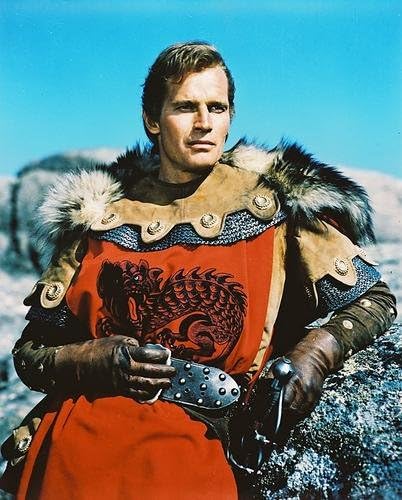
Charlton Heston - Mister Epic

His close friends call him "Chuck". But to filmgoers all over the world he is known as Charlton Heston, a six-foot two-inch giant of a man and the star of such mighty epics as The Greatest Show on Earth, The Ten Commandments, Ben-Hur, and El-Cid. 

Heston was recently asked why it was that he always appeared in big-budget films. "It's a matter of faces," he smiled. "I guess I just have to face the fact that I have a thousand-year-old face. I seldom get the chance to wear a modern-day suit. I spend most of my life in a toga.

"But I am worming my way back into the 20th century. I made a movie in Italy early this year titled The Pigeon That Took Rome. I'm playing the part of a U.S. Navy spy sent to the Eternal City in advance of its liberation by Allied Forces during the last war. Then after this, I really came up to the present day with a part in Diamond Head which we made in Hawaii. Then it was back to Madrid to start work on 55 Days at Peking with Ava Gardner and David Niven. It's the story of the Boxer Uprising in 1900, guess I'm heading back to those biblical days again," he laughed. 

Does he enjoy working on large-scale pictures?

"Yes, I do very much," he said. "But believe me they're hard work. I sweated out nine months working on Ben-Hur. It was a tough assignment. One of the most exacting roles I've ever played. I had to be 100% fit all the time. But I feel we came up with a worthwhile picture. It was all worth it."

Charlton is an actor who believes in almost living with the character he portrays. 

"I often take the character home with me after I've finished a day's shooting, " he says. I'm moody when I get home. But if my family are with me, they understand what has brought on the mood. It takes me a couple of hours to become Charlton Heston again. Any actor worth his salt tries to believe in the events which he is trying to portray. In fact, while I was working on The Ten Commandments in the part of Moses, I actually felt at times that I had become Moses. Before I started work on the picture I read through twenty-two volumes on the life of Mose. It was a fascinating experience. I always believe in conducting thorough research on the characters I'm asked to play. I like to get underneath their skins, discover what kind of person they really are."

Heston himself is a man of many controversial opinions. He speaks his mind whenever he wants to. Once he criticized a number of leading feminine Hollywood stars. "Some of them," he said "are very unprofessional in their attitude. They don't care very much about what they're doing. They're too disenchanted by the movie star bit and tend to regard it as a social engagement. The industry has created its own monsters and they're all feminine."

In Charlton Heston, Hollywood has created an actor of great talent, an actor who is admired and respected throughout the entire industry. 

This article originally appeared in the 1962 edition of Film Show Annual. Movie Magazine Articles, another one of our ongoing series, feature articles like this reprinted for our reader's entertainment. Click here to find more posts in this series!

Sunday, April 11, 2021

Mary Brian - It's Hard to Grow Up in Hollywood

Mary Brian was one of the most beautiful actresses of the 1930s. She often played charming ingenues in college-themed romances, but it seems these roles were not her cup of tea. Evelyn Warmoll shares with us in this 1938 article from Hollywood magazine, that Mary Brian was looking for more dramatic "grown-up" roles while Hollywood while trying to keep her young and innocent: 

While most movie stars are sadly bemoaning the fact that they are growing old all too fast on the screen, Mary Brian, fresh from a season of personal appearances, is back in Hollywood to try again to gain recognition as a grown up, mature, young woman. 

Mary has been Hollywood's perpetual "little girl" for ten years. She's frankly tired of it. She wants to prove to producers and a loyal following of movie fans that she has outgrown co-eds and fairy princesses and younger sisters. She wants to play dramatic feminine leads. She wants to emote. She wants to be recognized as a dramatic actress. She is tired of playing pretty young things who flit hither and thither and seldom have a dominant scene in the story which goes on around them. 

It doesn't seem so very long ago that Paramount announced that it was starting a worldwide search for a novice to play the title role of its silent production, Peter Pan. Mary Brian, just out from Texas, was at the Los Angeles Paramount theatre — dancing in the chorus — when Albert Kaufman, brother-in-law of Adolphe Zukor, saw her, talked with her and sent her out to the Paramount lot for a test for Peter Pan. Mary trembled as she made the test for it was her first movie experience, but the next day director Herbert Brenon phoned to say that a contract awaited her — not for Peter Pan but for "Wendy." When she stepped out of the dancing lineup and became Wendy, she began a series of young girl parts which lasted throughout her six and a half years as a Paramount contract player. 

She was pretty much the successor to Mary Pickford and Mary Miles Minter as Hollywood's sweetheart. No film debutante was more sought after for party lists than Mary. "The sweetest kid in Hollywood" she was called off-screen as well as on. No college picture was quite complete without Mary Brian as the fair young co-ed who turned the heads of the gridiron heroes, and finally arrived at her big romantic scene either in the booth of some campus ice cream parlor or under the ever-present sheltering oak in front of the girls' dormitory. 

When she wasn't decorating college pictures, romantic dramas of Civil war days claimed her for doll-like crinoline girls who made exquisite pictures of Mason-Dixon beauty, but never had much opportunity to lead the parade when the dramatic scenes began. 

When the talkies came in Mary Brian began intensive training for more dramatic and dominant roles. She tucked her collection of sunbonnets and middie blouses gently but firmly in the garage trunk, pinned up the curls that once hung on the back of her neck, and tried every way she knew to "grow up" in a hurry. Other diminutive girls had been given dramatic roles — Helen Hayes, Sylvia Sydney, Elizabeth Bergner, dozens of small girls had dominated dramatic pictures. While Mary made no comparisons, she yearned for just one chance to show what she could do. But to Hollywood she was still the "young sister type." 

Finally, Walter Huston's The Virginian gave her a deviation from her usual cast assignment and The Front Page offered broader opportunities as did The Royal Family but whenever a college picture was being cast the first name on every casting director's tongue was "Mary Brian." 

As often as she could afford to, Mary shook her pretty head and announced that she had her mind set on more dramatic parts. During one of the waits between pictures, Ken Murray induced her to resume stage work and to return to her dancing (which Hollywood never thought of at all). For a year Mary alternated between Broadway, road shows and pictures that offered her at least some hope of outgrowing the "little sister" roles. 

Her personal appearances were huge successes and she found that her fans were just as eager for her to grow up as she was. When fans saw her dance in local theatres they wrote letters by the score to variolas Hollywood producers asking them to make Mary Brian a dancing screen star. 

When the co-ed and little sister offers continued unbroken Mary Brian went to London for a British picture and one day Hollywood was startled to hear that "little Mary" was the star of the 1935 Chariot's Revue and "going over like a house afire." 

After an extended London season Mary returned to Hollywood and played a "heavy" in Spendthrift merely to get away from the girlish type of role previously given her. This was followed by two independent pictures which offered more or less straight dramatic leads and other personal appearances in which she was supported by a dancing trio, Gordon, Read and King and also by Arena and Hines. 

A few months ago Mary came back to Hollywood again in search of mature roles and was fairly successful in Three Married Men and Killer at Large but the recent summer season found her at the head of the casting office lists for co-ed roles in a half dozen football pictures and she began to wonder what she could do to create a new "1938 model Mary Brian." 

"I'm afraid you just can't grow up in Hollywood," says Mary. "I enjoy playing girlish parts but I'm crossing my fingers and hoping that the day soon comes when I can play a dominant, dramatic part and show them that Wendy has grown up. I don't care whether I play a vamp, a society girl or a French apache; I just want a chance to assume a role that has some depth and determination." 

Mary Brian lives with her mother near Toluca Lake, a few miles north of the Hollywood studio where she began her screen career. At least once each year she is reported "this-a and that-a" about some currently popular young screen Lochinvar but isn't taking romance too seriously. After playing more than 50 girlish featured leads in as many feature films Mary seems far more anxious to play a dramatic role on the screen than take a demure walk to the altar in a real life romance.

This article was taken from a February 1938 issue of Hollywood magazine. You can view the scans of this article, as well as the entire issue, via the Internet Archive here. To find more stories like this, check out the other posts in our series - Movie Magazine Articles. Enjoy!

Saturday, December 8, 2018

The Ten Richest Women in Movies in 1938

Hollywood's ten richest women aren't as rich as they might be, but they are probably richer than they're going to be. Uncle Sam's income-tax arm is getting no shorter, and by the time next March roars in the Government's "take" will deflate huge salaries of movie queens like a pinprick deflates a rubber balloon.

So with our "We have a war to win—" program gaining acceleration, our tax-collection agencies are going "all out" in efforts to keep the Government's sinking fund from disappearing. Hollywood and the movie industry. synonymous with six-figured pay-checks, is the garden spot for the enlarged appetite of the income-tax giant.

And no line is drawn on sex. A beautiful, talented actress when stopped by a traffic officer might let loose of her "charm" and wind up with a pair of ducats to the policemen's ball instead of a date in court. But when the income-tax bugaboo hovers about, the beauty, the talent, and the celluloid wiles of the actress only give her the willies! She thinks her ship has come in, and it has, only the Government holds first, second and third mortgages on it.
Hollywood's ten richest women, all of whom can describe Henry Morgenthau, Jr. (in many ways), know the spelling of the Secretary of the Treasury's name quite well. In return, Morgenthau knows that, based on salaries earned in 1938. Hollywood's "top ten" actresses would be: Claudette Colbert, who grossed nearly $427,000 that year; Irene Dunne, receiver of about $405,000; Joan Crawford, about $305,000; Norma Shearer, a cool, even $300,000; Greta Garbo, alone with $270,000; Ginger Rogers, nearly $208,000; Loretta Young, about $181,000; Deanna Durbin, an even $174,000; Bette Davis, over $143,000; and Myrna Loy. slightly over $140,000.

These salaries all sound like a pretty fair load of country bucks, but even then Uncle Sam's arm was reaching deep into the actresses coffers. Now, with a new income-tax scale about to become a law, digging is going to be deeper.

Assuming the new tax contemplated becomes a law and assuming the salaried person in each case is married, the following are tax totals on high-bracket figures as computed by the Joint Committee of Internal Revenue of the Congress. (These figures are only approximate, but they present a clear picture of what Hollywood's ten richest women are up against under this new tax set-up.)

Tax on a $100,000 income, joint return, would be $53,000, on a separate return, $41,700. On a $250,000 income, joint return would be $159,000, separate, $143,000. On a $300,000 income, joint return would be $202,250, separate $180,000.

Missing from this dollar parade are Shirley Temple, recently absent from pictures, but who still will pay plenty under the new deal tax; Marlene Dietrich for her $130,000; Merle Oberon at $139,000, Jean Arthur, Alice Faye, Barbara Stanwyck, Joan Bennett, others. Despite their less pretentious salaries, the Government will get a lot of "national defense" out of their contributions. Remember! On $100,000, under usual exemptions, the Government will get close to fifty percent of a star's salary! — L. R.
Gadzooks! Nearly 50% of a star's salary....and this at the $100,000 tier.  According to the Federal Income Tax brackets of 1941, it was 76% due for taxes on earnings over $400,000.

Just to put in perspective what these actresses were raking in: $1 in 1938 was about the equivalent of $18 today. So you'll have to multiply each salary by 18 to find out what their incomes were that year....I'll do the first one for you: Colbert made $7,644,784 that year and probably paid over to $3,600,000 in taxes alone. Yikes! Current rates state that for earnings over $426,700.00, you'll pay 39.6% plus $123,916.25, so had Colbert earned her $7 mill today she would be paying $3,100,000. 


Movie Magazine Articles, another one of our ongoing series, feature articles like this reprinted for our reader's entertainment. Click here to view the original article online, which is dated Sept. 26, 1941. In the future, simply search "Movie Magazine Articles" to find more posts in this series or click on the tag below. Enjoy!

Sunday, May 13, 2018

Famous Stars and Their Mothers

They are just mother's boys and girls grown tall! 

Believe it or not, Hollywood stars have a few things in common with regular folk like us.....for example, they have mothers, too! At least, that is what this photo-spread from the Mother's Day week issue of Movie-Radio Guide would have us believe. But honestly, if it weren't for the captions, the resemblance between some of these stars of the 1930s/1940s and their maters may have gone unnoticed ( not that one would expect Cesar Romero's mother to share his trademark moustache ). 

We'd like to thank the Old Time Radio Researcher's Group for making so many great movie and radio magazines available to the public....and we'd also like to wish a Happy Mother's Day to all of our readers! 

Eleanor Powell of the twinkling feet and mother Blanche ( above ) always spend the day together. 
Cesar Romero with his mother Maria ( right ) taking time to chat with another beloved mater of the screen, Lela Rogers, star Ginger's mom. 
Formal party is what the irrepressible Mickey Rooney stages for Mother Nell on the great day! Inset: Homey describes Mother's Day in the Darnell family. Linda is getting some fine points on baking from Mom.

Mary Livingston and daughter Joanie have much in common besides the matching red, white, and blue jumpers they are wearing. One of those common interests is story-book time at the Benny's.

Every day is Mother's Day for Titian-haired Greer Garson, for she and her mother, Mrs. Nina S. Garson, are inseparable pals. Instead of making the rounds with some dashing screen hero when on a recent New York trip, Greer's constant companion was her mom. They are seen here at the Stork Club.
Mother of Lucille Manners, soprano star of "Cities Service Concert" ( Fri. NBC ) is herself musically accomplished and was Lucille's first teacher. Kate Smith's grandmother ( pictured ) as well as her mother, is a good pal to the CBS singer. Mrs. Benjamin Hanby is modern, too, and travels by air.
Betty Winkler transferred her dramatic activity from Chicago to New York and took her mother along. Betty stars in "Abie's Irish Rose". 
First grown-up luncheon date for Shirley Temple, Mother's Day, 1941, at the Brown Derby with Mrs. Gertrude Temple. 
Radio star Gracie Allen is not only one of America's favorite entertainers, she's doubly that to a couple of young Americans named Ronnie and Sandra. The two children of Gracie Allen and George Burns like their mom and dad on the air, but they like even better Gracie's reading and George's antics at home. 

Saturday, November 11, 2017

Joan Fontaine - A Rising Star

JOAN FONTAINE comes close to her famous one-picture-to-stardom Rebecca role in her currently releasing Suspicion with Cary Grant. And so, the great question of whether Miss Fontaine - or Mrs. Brian Aherne, if you prefer - was a flash in the pan is definitely settled. She's not. 

She is an actress of the first water, crystal-clear, no flaws, and far outshadowing the sister who long cast a shadow over her, Olivia de Havilland. A moving, intensely human story lies behind this fait accompli. 

A blonde, Joan has more than her share of good looks and a bright and charming spirit that has made her a favorite with all Hollywood. However, as a child in Tokyo, Joan was ill a great deal of the time. She was a lonely little girl because she did not have the strength to play when her necessary schoolwork was done. After her family had moved to San Francisco, Joan regained her health in the dry, sunlit air of Saratoga. 

Five feet three inches tall, Joan weighs 108 pounds, favors outdoor sports for exercise, specifically swimming and tennis at which she is adept. Her favorite hobbies are reading history and indulging her life-long weakness for Japanese art. 

It probably was Olivia herself who first challenged Joan to be something besides Olivia's sister. Five years ago Joan was just a stock player, a girl for whom the screen producers held little promise. Olivia had arrived and great things were in store for her. She got many of them except the part of Rebecca which little sister Joan swiped right from under her nose. Joan also won or was won by the talented English actor Brian Aherne, and between them, their mutual romance worked wonders in giving Joan new self-assurance. So inspired, Joan delivered to director Alfred Hitchcock an amazing Rebecca, dissolved the shadow of Olivia, and all the time was having gruesome bouts with hay fever (which she still has in its meanest form every year). 
Suspicion, a picturization of "Before the Fact," with Alfred Hitchcock again wielding the megaphone, is the story, most difficult to convey, of what goes on in the mind of a young wife infatuated with her swashbuckling, loving husband, who in all respects but his marital fidelity is a no-good loafer with what apparently is a tendency toward homicide for funds. It is a thrilling, chilling and superbly acted drama by Grant and particularly Miss Fontaine ... despite her hay fever ... and Olivia. -Evans Plummer

Joan Fontaine never really outshadowed her sister Olivia, but she did have a unique presence onscreen and made a number of really fine films. The above portrait of her is one of the loveliest we've ever seen. This article originally appeared in Movie-Radio Guide ( Vol. 11, No. 7 ) dated the week of November 22-28th, 1941. 

Movie Magazine Articles, another one of our ongoing series, feature articles like this reprinted for our reader's entertainment. Links to the original sources are available within the body of the text. In the future, simply search "Movie Magazine Articles" to find more posts in this series or click on the tag below. Enjoy!

Thursday, August 10, 2017

The Girl Who Takes Jean Harlow's Place

When I was assigned to interview Marjorie Woodworth, the girl Hal Roach has tabbed to take Jean Harlow's place--and the girl Harvard undergrads recently used as a target for a soft orange---I thought, "Just another hopeful. I'll bet she doesn't look any more like Harlow than my redheaded granddaughter does." 

Then I sat down to luncheon with her (chaperoned by publicity chief Jules Seltzer of the Hal Roach Studios, where's she's starring in "Broadway Limited"). I took one look, opened my mouth-and ate my words! 

Marjorie is a natural blonde with heliotrope eyes, long lashes and features not exactly like Harlow's, but close enough-and plenty good! Her figure is a little larger, proportionately, but just as trim as was La Belle Jean before her untimely death. Marjorie measures five feet five inches tall (in stocking feet); hips, thirty-four inches; bust, thirty-four; waist, twenty-four; shoe, 5-B; hat, twenty-one and one-half; weight, 117 pounds. I didn't get her phone number because Seltzer was eavesdropping and besides, her dad, Clyde Woodworth, is the city attorney of Inglewood, Calif.! That's where Marjorie was born, June 5, 1921, and reared. Funny thing about that June 5 date. It was on her nineteenth birthday last year she was signed by Roach. 

Margie Starts Harvard Riot 

About her trip east on a bid from the president of the Harvard Lampoon, she was jubilant-in spite of the orange blitz, which happened when a rival Harvard Crimson faction tried unsuccessfully to kidnap Margie from the Lampoon executives. "They were just college boys having a little fun," said the honored guest and victim. "I'm a college girl and I understand them." She had two years at the University of Southern California. 

Is the Athletic Type 

Margie's favorite sports are ice-skating, swimming and horseback riding. She eats almost anything but dotes on prime roast beef rare. After a year of preliminary training, she's still studying dramatics and voice modulation at Max Reinhardt's school between picture calls. Asked if she had ever been told before Roach discovered her that she resembled Jean Harlow, she said, "Yes, many times in high school and college. But I don't know. I only saw her once---in 'Saratoga,' I believe." That was Harlow's last film. As for Marjorie's future success, she says, "I'm having fun!" and leaves the rest to movie-goers.- E. P.


Marjorie never came near the level of success that Jean Harlow had in Hollywood. She did a number of films in the 1940s but didn't catch enough attention from the movie-goers to become a star. This article originally appeared in the June 28th, 1942 issue of Movie Radio Guide. 

Movie Magazine Articles, another one of our ongoing series, feature articles like this reprinted for our reader's entertainment. Links to the original sources are available within the body of the text. In the future, simply search "Movie Magazine Articles" to find more posts in this series or click on the tag below. Enjoy!

Saturday, June 17, 2017

Bill Bixby and Fatherhood

"Reach out for your child. Reach out and touch him, because I didn't and my father didn't. I couldn't even talk to my parents. Maybe that's why this show ( The Courtship of Eddie's Father ) is so important to me. It probably represents a lot of things I didn't have." 

Actor Bill Bixby spoke these words in a 1971 magazine interview shortly after the death of his father to coronary thrombosis. Bill, who was born Wilfred Everett Bixby III in 1934, was an only child. His father had left him during his formative years to join the Army and serve overseas, and upon his return Bill resented him greatly. A growing distance spread between them. 

During the 1960s, while he was busy starring in the popular sitcom My Favorite Martian, Bill was known throughout Hollywood as being a playboy. He was a real life bachelor who dated every gorgeous girl he met and professed that he did not care for children. So he was an odd choice to be cast as widower Tom Corbett in the 1969 series The Courtship of Eddie's Father.....and yet, the part was a blessing to him because it made him change his outlook towards marriage and children. 
"The reason this show is so important to me is because it represents a lot of things I didn't have"

Bill Bixby recognized that the series had the potential to share with television viewers what a meaningful relationship between a father and son could be like. Bill did not have that kind of relationship growing up and playing the part of Tom Corbett allowed him to be the father that he did not have. It gave him the opportunity to show what fatherhood really is all about, and for so many youngsters who tuned in to watch the series, Tom Corbett became their surrogate father.

Indeed, he was such a good dad on screen that it is amazing that he was still single while the show was being filmed. It was Brandon Cruz ( "Eddie" on the show ) who had a lot to do with this change of heart. "Make no mistake, this little boy changed my life!" The comradery he had with little buddy onscreen and off made him yearn for a son of his own. He knew that having a child would not be an answer to his own problems, but he liked the thought of focusing his constant stream of energy into the loving and caring for another human being.

In July 1971, just a month after his father passed on, he married his long-time friend Brenda Benet and, in 1974, she bore him a son, Christopher. Their marriage lasted until 1979 and, after their divorce, Benet had custody of the boy. Bill remained close to him and was adamant that his son not be allowed to watch any episodes of The Incredible Hulk, worrying that his transformation from the mild-mannered doctor into the giant green monster would give the boy nightmares. 

Both Bill and Brenda doted on Christopher, but he was a sickly child and had respiratory problems. During a camping trip to Mammoth Lakes with his mother, the six-year old came down with epiglottis and suffered cardiac arrest during an emergency tracheotomy at the hospital.

"Christopher's death was the greatest shock in my life," said Bixby years later. He rented a house on the beach after his son's death and "I never left the second floor of that house. I didn't go out onto the sand for four months." It was a shock he never fully recovered from, nor did his wife Brenda Benet, who committed suicide just one year later. 

Brandon Cruz, who named his own son Lincoln Bixby in honor of his best friend and on-screen dad, once said "Bill was such a professional, such a giving actor, and caring person that it didn't even seem like work. It seemed like I was hanging out with my best friend. It was corny, but he was so wonderful to work with, you could not pay anybody to say a bad word about Bill. He was giving to a fault, basically."

Warner Archive Instant has just released the complete series of "The Courtship of Eddie's Father". A great series to enjoy! 

Sunday, April 9, 2017

Binnie Barnes Shares Stories of Her Past

Into a cold, gray London factory, on a foggy morning, tramped a cheerless girl in a shabby hat and a rag of a dress. Under her arm she carried a lunch box, nothing more than an old pasteboard shoe box which was turned to everyday use. Going to her place at a grimy iron stamping machine, she opened the box and took from it a small picture cut from a magazine. This she fixed to her incongruous treadmill where she could see it for the long day ahead. "My eye!" remarked the girl next to her. "Don't tell me it's the Princess of Wyles?" 

"No, it's Lillian Russell. She was called The American Beauty, and I'd rather be like her than any other woman in the world." 

Into a warm, bright Hollywood room on a sunny morning breezed a joyous creature trim and smart in sky-blue pajamas. A soft hat rakishly perched upon her gold-shot hair set off her refreshing charm. She held out a friendly hand in greeting. Then she drew forth a platinum-framed photograph which she placed admiringly upon the table. "I simply can't quite make myself believe I've somehow lived to be her in the film 'Diamond Jim,' " marveled the one-time London factory girl, Binnie Barnes.

"Has it been so great a change?" 

"Look at me !" she challenged — and that wasn't hard. "Nothing could possibly be greater than changing from what I was to Lillian Russell." 

Binnie Barnes certainly had a colorful background and I couldn't help wondering why an English actress had been chosen to play an American beauty. 

"You can't be more surprised than I was," she said. "It knocked me right off my pins. You see, they cabled me to come over and play Miss Russell's chum, Edna McCauley, the fashionable dressmaker. But when I got here, they were in a jam and they grabbed me to get them out of it. They'd tested about a thousand girls for the Lillian Russell part, but although they got beauty galore, they couldn't get just what they were after. They wanted someone sympathetic." 

Binnie and Cesar Romero in "Diamond Jim" ( 1935 )

"Miss Russell was." I recalled. 

"Then you knew her!" exclaimed Binnie, wide-eyed. Explaining that I'd known Miss Russell in her Casino and Weber and Fields days, I assumed that the slender Binnie embodied the "Beauteous One" of an earlier date. 

"Yes," she replied, "when Miss Russell was at Tony Pastor's and just entering her Broadway career. She was twenty-eight." 

"And you're?" (Courage, man!) 

"Twenty-six." 

Singing with the angels, Lillian Russell, who had a way of keeping her youth out of Father Time's hands, must have raised a note of thanks. "One thing that encouraged me was a yellowed program of the bill at Tony Pastor's announcing, 'Lillian Russell in English Ballads.' As I'd sung them I felt we had something in common. And when it came to playing her I wasn't afraid of my English accent. It isn't very noticeable, is it? You know, I've been taken for an American girl ever since I went on the stage. In fact, I was billed as 'Texas Binnie Barnes' in the first thing I did, a rope-twirling act with Tex McLeod in South Africa. Nobody knew I was English, and the funny part of it was, that I myself didn't know I had a Southern accent. I'd picked it up from Tex, and thought that all Americans talked as he did. When I went back to London I couldn't get a job as an English girl. I played gangster molls in 'Innocents of Chicago' and other sweet, tender little things in which you couldn't call your life your own. And was I tough!" 

"You don't look it." 

"Thank you kindly, sir," she laughed. "But those were my bad days. I once tried an Irish accent in 'The Silver Tassie' with Charles Laughton on the London stage. It seemed odd to be with him again in 'Henry the Eighth' on the screen. But I started my movie work with Ida Lupino's father, Stanley, in short comedies. He threw pies, and had to have a girl who could take 'em. The first one that came along knocked me flat on my fanny. Far from a beauty," she pensively added, "I was called 'Pie-Face'." 

Charles Laughton and Binnie in "The Private Life of Henry VIII" ( 1933 )

"You seem to have had a varied career," I sympathetically remarked. 


"A bit of this, that and the other," she lightly replied. "I was in slapstick for years. I didn't mind, just taking my luck as it came. I'd probably never got on the stage at all if Tex McLeod hadn't happened to come into a London dance hall where I was working. It's all been surprising. But it amazed me to be given the part of Lillian Russell, for London producers had always associated me with tough parts. And I certainly never was known as a beauty. In England we have no great beauties. Of course, there was Lily Langtry in her time, but even she couldn't hold a candle to Lillian Russell. Today we have personalities, to my mind, far more important than beauty, especially on the screen." 

"Whom do you consider the most beautiful screen actress?" 

"A fine lot of trouble I'd be piling up for myself answering that!" 

"Nonsense, go ahead." 

"W-well," she hesitated, "I will say that Claudette Colbert is charming. But beauty's no good if you've no personality. English girls are much quieter than American girls, who have more push and are more sexy, but do not have more charm. But an English girl can be very dull. She is kept down by chaperons and God knows what! Life is more of a routine in England. Just as in all old countries, it goes on and on without change ; customs and habits remaining the same. Here, there is more freedom. This makes it easier for an American girl to marry. She learns an awful lot. Then there's the climate, with more opportunity for sports, which develop the body and must do the mind some good. Everything here is action. Before an Englishman does anything he thinks twice — particularly about marrying. So what can the poor girl do?" 

"But you managed it?" 

"Once — and never again. Now that I've got a husband I'm going to hang on to him. That's my main job, and I'm going back to it after making one more picture here. But I'll return to America. I never want to stay in any one place a long while. After a bit I like to pop off somewhere else. I've had a lot of experiences in different parts of the world, and they've all been swell, even when I've been out of dough. I grumble once in a while, but I'm never discontented. My one idea, ever since I was a kid, has been to keep working." 

"You mentioned driving a milk cart." 

"We had no money, so I had to do some- thing. Dad was a London policeman, and when he died he left mother and me on a tiny farm. So we went into the milk business. The hardest part of it was getting up at four in the morning. That's not gay, even for a fourteen-year-old girl. But I loved driving the horse. Snowy we called him. He got so he knew every house on the route and would stop without my saying a word or pulling a line. And that, mind you, meant sixty houses. Then there was a little coffee shop where I'd get a cup for myself and lumps of sugar for Snowy. That turned out to be our hard luck place. I was coming out of it one morning when Snowy, scared by a passing tram, started to run away. I just managed to swing myself up on the wagon, but I couldn't stop him. He tore along till he got jammed in between two trams and was so badly hurt he had to be shot." 

"Were you hurt, too?" 

For answer she pulled off her hat. Her forehead showed a white scar. 

Leslie Howard and Barnes in "The Lady is Willing' ( 1934 )

"That runaway put us out of the milk business. But as soon as I was able 'to be about again I got a job in a factory, where I tested electric light bulbs and became a first-class solderer — sealed the tin casings, you know". Next I worked in a paper bag factory. Then I pressed veins on artificial leaves — sounds silly, doesn't it? From there I went to a tobacconist's. I never did office work; for one thing, I wasn't intelligent enough." 

No? With all due respect, you can't believe her. 

"When I left a place I always got a better one," was her most intelligent reply. "I liked 'em all while I stayed. "Work was good for me," she insisted. "If I'd been brought up in cottonwool, I'd never have done anything. And it was fun having a go at one thing and another. I got to know all kinds of people. Lord, the different ones that poked their heads out of doors when I was delivering milk! That was the time, early in the morning, to see them as they really were without any frills. The things they wore and the things they said! I'll never forget one old crone who wore diamond earrings — probably slept in 'em — and a second-hand lady with the airs of a duchess. Oh, well, I dare say I thought myself pretty grand when I got that job in a dance hall! I'd wait for a customer to do a twirl with me, then slither out on the floor like Lady Vere de Vere herself." 

"After all your other jobs, what do you think of movie work?" 

"This," said the practical Binnie, "is a sissy job." 

- Written by Charles Darnton 

This article ( edited in certain places ) originally appeared in the December 1935 issue of Modern Screen magazine. 

Movie Magazine Articles, another one of our ongoing series, feature articles like this reprinted for our reader's entertainment. Links to the original sources are available within the body of the text. In the future, simply search "Movie Magazine Articles" to find more posts in this series or click on the tag below. Enjoy!