Showing posts with label Rock Hudson. Show all posts

Sunday, December 19, 2021

Wintry Westerns - 8 Classic Westerns Set in Winter

I love westerns. I don't review them nearly as often as I should but I certainly do watch plenty of them! And, at this time of year, the best westerns to watch are the Wintry Westerns....those that are set in snowy locales. Most westerns take place in dusty desert areas such as Arizona and Texas or in lush green cattle-grazing lands like Wyoming and Colorado so this is a small niche. They are great to watch on a cold winter's day with a cup of hot cocoa, especially when the snow is falling outside.

I'll share with you some of my favorites ( from the oldest to the newest ) and hopefully, you'll share some of your favorite wintry western titles as well. 

THE WILD NORTH ( 1952 ) 

Stewart Granger plays a trapper accused of murdering a man in a Canadian village. He takes refuge in the mountains but can't shake a Mountie ( Wendell Corey ) off his trail. Instead, during a fierce snowstorm, they band together to battle the forces of nature and survive in the "wild North". This is one of my favorites, not only because of the great location scenery of Idaho ( not Canada ) but because of the presence of Stewart Granger and Cyd Charisse as an Indian maiden. 

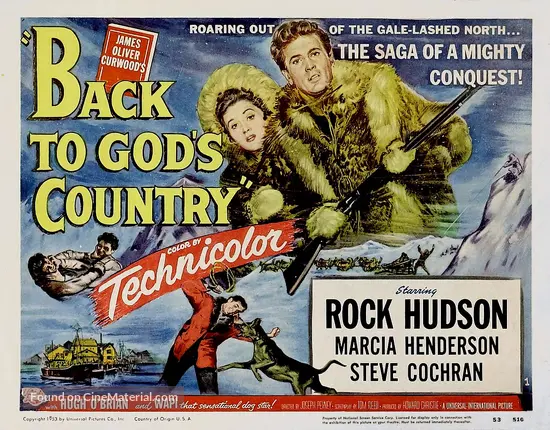
BACK TO GOD'S COUNTRY ( 1953 )

Perhaps this might not qualify as a western, but it takes place in the 1870s in snowy Alaska, so that's close enough for me. Rock Hudson plays an American sea captain who is taking a cargo of furs down to the states from Canada via dogsled. Contending with the weather is harrowing enough, but Rock also has a broken leg and two dangerous villains on his heels. 

TRACK OF THE CAT ( 1954 ) 

Robert Mitchum stars in this visually striking western as the son of a ranching family who heads out into the snow to track down a panther who is killing the family's livestock. Diana Lynn and Teresa Wright co-star and yes, that's William Hopper Jr. with a beard. Director William Wellman's son stated that his father created the picture as a "black and white film shot in color" with specific pops of color adding a beautiful splash to the overall monochromatic look. 

DAY OF THE OUTLAW ( 1959 ) 

"A day you'll never forget!" declares the poster to this Robert Ryan film. Unfortunately, I did forget most of this gritty western, but I do remember the winter landscape and Burl Ives cutting a powerful image on horseback. It's about a cattleman trying to save a small frontier town from Burl Ives and his gang of thugs. 

WILL PENNY ( 1967 ) 

This film starts off as a regular "sunny" western but about half way through we see the winter scenes. Will Penny ( Charlton Heston ) is an aging cowboy who gets a line camp job on a large cattle spread and finds that there is a woman ( Joan Hackett ) and her son already living in the cabin he is supposed to occupy by himself. He lets them stay over the winter and protects his "family" when the wicked Quint ( Donald Pleasance ) invades his home. 
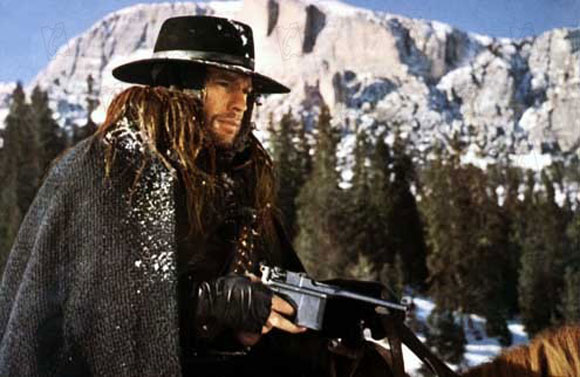
THE GREAT SILENCE ( 1968 ) 

Spaghetti westerns are one of those genres that you either love or hate. I could live without them - especially the brutal ones - but I had to include this film because it is set is a snow-covered Utah and is renowned for being one of the best spaghetti westerns ever made. It's about a mute gunfighter who takes it upon himself to defend a group of outlaws from a band of bloodthirsty bounty hunters. Jean-Louis Trintignant, a French actor who couldn't speak a word of English, starred as the mute gunslinger "Silence". 
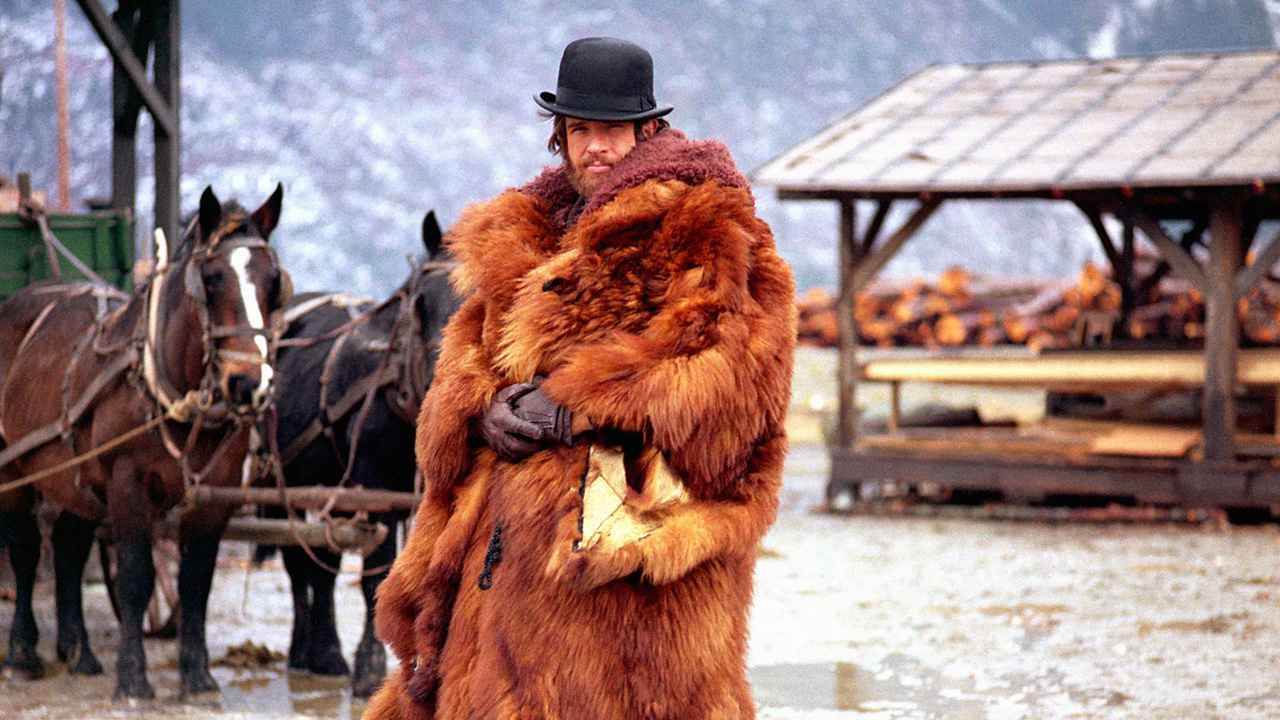
McCABE AND MRS. MILLER ( 1971 ) 

Warren Beatty and Julie Christie star as a gambler and a prostitute who become business partners in a brothel in a remote mining town. Their business trives until a major corporation comes to buy them out. This film is often cited as one of the first "anti-westerns" because it features no gunfights and no heroes but our purpose it can be classified as a western. McCabe and Mrs. Miller really captures the cold environment of winter and features some beautiful filming from director Robert Altman. 
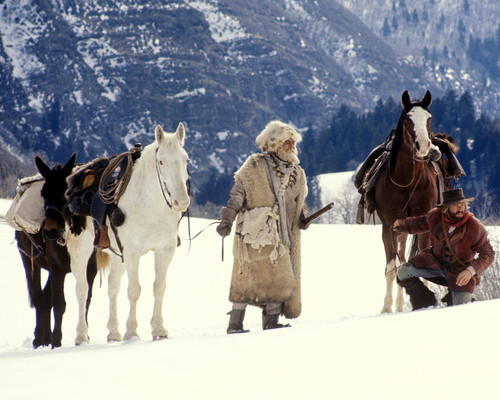
JEREMIAH JOHNSON ( 1972 )

Robert Redford stars as mountain man Jeremiah Johnson in this outdoorsman's adventure set in the beautiful hills of Utah ( and filmed on Redford's recently acquired Sundance ski area ). Johnson is a  Civil War veteran who abandons mankind and heads for the mountains of Utah to become a trapper. With the help of another grizzled mountain man ( Will Geer ), he learns to live of the land but must contend with hostile natives when he incurs the wrath of a Crow chief. 

Thursday, April 11, 2019

From the Archives: Twilight for the Gods ( 1958 )

Rock Hudson and Cyd Charisse in a scene from Twilight for the Gods ( 1958 ). Don't let the black-and-white photograph fool you, this Universal picture was filmed in eye-popping Eastman Colour. Hudson plays a boozy sea captain who must take his passengers ( including a call girl ) "out of the raging fury of wind and water" to safety. It was based on a book by Ernest K. Gann, who also wrote "The High and the Mighty" and "Fate is the Hunter", both of which were made into motion pictures. 

From the Archives is our latest series of posts where we share photos from the Silverbanks Pictures collection. Some of these may have been sold in the past, and others may still be available for purchase at our eBay store : http://stores.ebay.com/Silverbanks-Pictures

Sunday, July 15, 2018

Nugget Reviews - 25


The Private Eyes ( 1980 )   14k 


Scotland Yard detectives, Inspector Winship and Dr. Tart, are hired to investigate the death of Lord and Lady Morley at their English mansion. One by one all of their suspects die off, leaving Winship and Tart to face the real killer. Don Knotts, Tim Conway, Trisha Noble, Bernard Fox. The Private Eye Partners. Directed by Lang Elliott.

Don Knotts and Tim Conway were teamed up for the first time in Disney's 1975 comedy The Apple Dumpling Gang and really "clicked" together. Knotts, who always played the sidekick to Andy on The Andy Griffith Show, did a wonderful job of switching to the straight man and allowing Conway to take the laughs. The Private Eyes is a bit on the wacky side but it has its moments of humor, especially in the running gags throughout the film. 

___________________________________________________________

Blonde Fever ( 1944 ) 14k


A happily married couple who own a restaurant outside Reno finds their marriage on the rocks when a blonde bombshell who was hired as a waitress begins to split them apart. Mary Astor, Philip Dorn, Gloria Grahame, Marshall Thompson. Metro-Goldwyn-Mayer Pictures. Directed by Richard Whorf.

Gloria Grahame was making her film debut - along with Marshall Thompson - in this light-hearted comedy from MGM. With their performances, both of them steal the show from the pros Mary Astor and Philip Dorn. The story, which was based on a play, was tight and the film had its moments, but overall, it is quite forgettable and not up to MGM's usual standards when it comes to comedies. However, the great character actor Felix Bressart is in the movie, and his presence alone makes it worth watching!

         ___________________________________________________________


Five Little Peppers and How They Grew ( 1939 ) 14k


The wealthy Mr. King wishes to buy out the poor Pepper family's 50% share in a copper mine he owns but once he gets to know the family better and comes to love them, he changes his mind and invites them to live with him in his mansion. Edith Fellows, Charles Peck, Tommy Bond, Clarence Kolb. Columbia Pictures. Directed by Charles Barton. 

This first entry in what was to become a four-film series about Margaret Sidney's Pepper family, is very unassuming and quite entertaining. It packs in quite a bit of plot in its 58-minute runtime. There is some youthful romance between the rich Mr. King's grandson Jaspar and Polly Pepper, a good deal of drama during a family bout with measles, and innocent humor from the children's activities - especially from Dorothy Ann Seese who was quite a scene-stealer. 

___________________________________________________________

The Golden Blade ( 1953 ) Elect.


The young Harun enters Baghdad seeking information about the group of men who ransacked his tribe and murdered his father. In a quaint bazaar he purchases a magic sword and discovers that Fate has led him to aid the princess Khairuzan in order to discover the group he is after. Rock Hudson, Piper Laurie, Steven Geray, George MacReady. Universal Pictures. Directed by Nathan Juran. 

"Out of Bagdad's mystic past thunders the adventure of all ages!" So proclaims the poster to The Golden Blade. The screenwriter was banking on audiences ignorance of "Bagdad's mystic past" and decided to mix medieval and Mongolian ( ?) elements into the screenplay, making the film a pastiche of styles. Nathan Juran, an art director who would later direct the Ray Harryhausen classics The 7th Voyage of Sinbad and First Men in the Moon was just learning the ropes at this time so the film is rather bland in spots but not bad for a Sunday afternoon's viewing. 

___________________________________________________________

The Pink Jungle ( 1968 ) 14k


A photographer and his model get stranded in the South American jungle when their pilot takes off without them. There, they meet an adventurer who talks them into buying a treasure map and hunting for diamonds with him. James Garner, Eva Renzi, George Kennedy, Nigel Green. Universal Pictures. Directed by Delbert Mann.  

The Pink Jungle is one of many fun adventure films that were released in the mid-late 1960s and it plays out like an American version of That Man from Rio with non-stop action and comedy. Oddly enough, it is little known today despite its great cast and witty script. James Garner was ideal for parts like this and should have made more similarly themed films. Eva Renzi, a real fashion model, and George Kennedy were also perfect. 

Monday, May 26, 2014

Giant ( 1956 )

"Bick, you shoulda shot that fella a long time ago. Now he's too rich to kill"

Uncle Bawley's words do not fall on deaf ears, rather they echo the sentiment felt by the entire Benedict family and little do they realize that Jett Rink's solitary oil well on Reata land will launch the emergence of an industry that will change the face of Texas.

Edna Ferber's sprawling western saga of a Texan family comes to life in George Steven's 1956 film adaptation. Giant tells the story of a wealthy cattle baron, Jordan "Bick" Benedict ( Rock Hudson ) who comes to Maryland to purchase a horse from Horace Lynnton ( Paul Fix ), a socially prominent doctor. While staying at his home he meets, falls in love with and marries Lynnton's beautiful daughter Leslie ( Elizabeth Taylor ). Bick transports her from the lush green countryside of Maryland to his dusty isolated ranch called Reata, an enormous 600,000 acre cattle spread run by himself, his sister ( Mercedes MacCambridge ) and his staff of Mexican farmhands.


Once at Reata, Leslie undertakes changes that reflect her well-bred upbringing and stubbornly refuses to let Texan folkways stop her from being considerate and helpful to the Mexican people. We follow Leslie as she grows from a delicate flower from the east into a tough leathered matriarch. We follow Bick as he rises from a cattle rancher to an oil millionaire in his competition against Jett Rink ( James Dean ), a despised ranch hand who first strikes oil on Reata land. Together they build a marriage mixed with tenderness and turbulence to create a dynasty spanning three generations.


At its heart Giant is an intimate story of compromise and adjustment. Leslie learns to adapt herself to her surroundings and become a true Texan without compromising her values. She becomes such a part of the ranch that none of Bick's family, friends or neighbors could imagine what Reata would be like without her. More importantly, Bick comes to accept that life on Reata cannot remain the same as when his father ran the ranch. He comes to accept that his children want to lead lives of their own in different professions and, in the subtle finale, finds that his racial views have been completely changed.

"Honey, you don't act that way towards those people. You're a Texan now"
"Is being a Texan a state of mind? I'm still myself"

The evolving Benedict family symbolizes the state of Texas itself which was adapting and moving away from its agrarian existence. Modern ways of thinking were pushing out old-fashioned notions of bigotry, child-rearing, and woman's place in the home.

The strong-willed Leslie was the instigator to many of these changes but even more so was that substance known as black gold - oil. The oozing stinking liquid was converting humble farmers into millionaires overnight and, with their pockets bulging with more cash than they knew what to do with, they had little desire to hold onto archaic beliefs of the past. It was an exciting time and they were proud to be in the throes of new inventions, discoveries, ideas, and new modes of transportation.

When Edna Ferber's epic novel was first published in 1952 it received much criticism. Texans resented being known as racially intolerant folk and despised the character of Jett Rink. Nevertheless, the book was immensely popular and, like Ferber's previous novels, quickly caught the attention of Hollywood producers who clamored to obtain the film rights. In making her decision, Ferber chose to go with Warner Brothers because George Stevens was undertaking the project. She appreciated his love for the story and his promise to remain faithful to her novel. 


Many actors in Hollywood were eager to get a part in the film, predicting what a prestigious production it would be. For the three leading characters, Stevens considered casting Grace Kelly, William Holden and Montogomery Clift. Alan Ladd and Robert Mitchum were also under consideration for the role of Jett Rink, but Stevens chose to go with James Dean, a talented young man who was quickly making a name for himself at Warner Brothers.


The cast of Giant was primarily very youthful. Rock Hudson, only 29 at the time, was given one of his first opportunities to demonstrate his dramatic acting ability and proved to be excellent as Bick Benedict. This was a pivotal film for Elizabeth Taylor as well who, at only 23 years of age, was launched to new heights as a dramatic actress. In Giant she recreates the literary Leslie and gives her a depth which was lacking in the original novel.


Carroll Baker was making her debut film performance as Luz, the Benedict's daughter, even though she was three years older than Taylor. Dennis Hopper had a brief, but substantial role himself as Jordy, their independent-minded son.

Along with these youthful characters, Stevens cast a number of excellent seasoned supporting actors including tough-as-nails Mercedes McCambridge; the delightful Jane Withers as the Benedict's neighbor and best friend ( who had been called out of retirement for this part ); the lovable Chill Wills as Uncle Bawley, a gentle man whom Leslie particularly adores; and Paul Fix as Dr. Lynnton. Also rounding out the cast is Sal Mineo, Earl Holliman, Elsa Cardanas, Rod Taylor ( billed as Rodney Taylor ), Judith Evelyn, Carolyn Craig, and Victor Millan.

"Money isn't everything, Jett" 
"Not when you've got it"


Location shooting for Giant began on June 6, 1955 in Marfa, a small town south of Pecos, Texas, where the cast and crew spent two months filming the scenes in and around Reata. 

"It was such a happy time", Jane Withers recalled, sharing a sentiment felt by most of the cast. However, tragedy struck eight days after Dean's final scenes were shot, when the cast, assembled in the screening room at Marfa, heard that James Dean had been killed in a car crash. Warner Brothers had banned Dean from racing during the production for fear that he may injure himself while filming was progressing.

In addition to its fine script and cast, a major part of Giant's appeal lay in its magnificent score, composed by the Russian immigrant Dimitri Tiomkin, who was one of Hollywood's most talented western film composers. His score for Giant weaves strains of old Texan favorites such as The Yellow Rose of Texas with classical music ( Clair de Lune ) and heart-thumping melodies of grandeur.

George Stevens invested three years of his life into making Giant, taking no pay for his work as director, instead choosing to have part interest in the final film rights. Stevens had faith in the script, production crew, and his own directorial skill; he had profound respect for his audience and for this reason made certain that every scene was the best it could be, no matter how many retakes or different camera angles it took to get a scene just right.


"Well....after a hundred years the Benedict family is finally a success"

At one point, nearing the end of the long editing stage, George Stevens Jr. grew impatient to complete the picture. Stevens reminded him, "Just think how many man hours people will spend watching this film over the years. Don't you think it's worth a little more of our time making it a better experience for them?"

Giant was released at a unique time during the 1950s when America was at its grandest. Texas was huge and booming with energy and so was the rest of the country. When Giant premiered on Nov. 24, 1956, it earned critical acclaim and became the top grossing film in Warner Brothers history. In some theatres it played for three months straight. The film was nominated for 11 Academy Awards but went on to win only one Oscar ( for Best Director ) competing against Mike Todd's epic Around the World in 80 Days.


That extra effort that Stevens and the cast and crew put into making the film all that more special has been appreciated by audiences for nearly 60 years. In its gentle way Giant grows from an intimate portrait of two newlyweds to a film of gigantic proportions, equal to the entertainment it provides. Decades later, other sagas such as Dynasty, Dallas, and The Thorn Birds imitated Giant's scope which drew the audience into the individual characters and the family as a whole. 

The film inspires a love for the tumbleweed ridden country known as Texas, its cattle, its oil, its people, and its history. Giant makes you proud to be a Texan, whether you were born one or not, and inspired audiences around the world to share in an admiration for the state that has become so much apart of America's heritage. 

This post is our contribution to the Classic Movie Blog Association's marvelous Fabulous Films of the 1950s Blogathon. Be sure to head over to the main site to check out all the great coverage of your favorite films of the '50s. 

Friday, May 24, 2013

Howard Hawk's "Man's Favorite Sport?" ( 1964 )

If you were to watch only the credits to "Man's Favorite Sport?" you would think that the sport they are referring to is chasing women, but it is quite the contrary. Fishing. That's what this is all about. That age old pleasurable pursuit of man against fish. 

Roger Willoughby ( Rock Hudson ) is an authority on the subject. He is the best-selling author of several books on fishing and a sporting goods salesman at Abercrombie & Fitch ( the L.L. Bean of the West Coast ). Hence, PR representative Abigail Page ( Paula Prentiss ) thinks he is a natural choice for a celebrity competitor when she schemes up a publicity campaign of hosting a fishing tournament at Lake Wakapoogee lodge and campground. What a draw to the resort...men will jump at the chance to compete against pro-fisherman Roger Willoughby. Why, it's like having a chance to golf against Tiger Woods! Only problem is - Woods doesn't know how to play golf. I mean, Willoughby doesn't know how to fish. In fact, he can't even stand the sight of fish; hates the taste of them too.


When he finally shares his dark secret with Abigail she decides he will just have to learn. She's not going to pass up such great publicity.... besides, she already has a yen for him. And this is where the fun begins. In the short span of 3 days prior to the tournament, Roger has to learn how to fish, how to swim, how to set up camp, as well as make sure he puts up a good front when the competitors come pouring in. He may lose his job if his boss finds out he isn't as skilled as he thought and he may lose his fiance when she discovers just what Abigail has up her sleeve!


"Man's Favorite Sport?" was based on a short story by Pat Frank titled 'The Girl That Almost Got Away'. It was filmed in 1962 and released in theaters in early 1964. The movie was an excellent vehicle for Rock Hudson and suited his awkward comedic talent perfectly, a natural sense of comedy which he had demonstrated successfully in "Pillow Talk", "Send Me No Flowers", "Lover Come Back" and "Come September". Unlike these films however, "Man's Favorite Sport?" did not score well at the box-office. Critics were harsh - lukewarm at best - and the public did not embrace it. Perhaps it was the changing times. Or perhaps they were judging it based on Howard Hawks' past successes. 


The film boasts a peppy score by Henry Mancini ( Ann-Margret released an excellent recording of the title song as a single ) and a wonderful cast of supporting players including Maria Perschy, Charlene Holt, John McGiver, Norman Alden, Roscoe Karns, and a guest appearance by pro-fisherman Joe Kilroy, sporting a cast of his very own.  
  
Maria Perschy was an Austrian actress who could of been the next Romy Schneider but her career never took off in Hollywood. She split her time between European and American pictures and starred in a few memorable films such as "Freud", "633 Squadron" and "Five Golden Dragons". In "Man's Favorite Sport" she plays Isolde "Easy" Mueller, the owner of the Lake Wakapoogee resort and Abigail's friend.

Charlene Holt, the stunning Texan redhead who portrays Roger's fiancee "Tex", was discovered by Howard Hawks while making a Revlon lipstick commercial. She was a top model in the industry and often appeared on television elegantly pushing products of one kind or another. Hawks was grooming her for stardom and after this small part put her in two other films,"Red Line 7000" ( 1965 ) and "El Dorado" ( 1966 ), opposite John Wayne. 

John McGiver made a career of playing dazed and drunk employers with high standards. He was a character who popped up in dozens of light-hearted comedies during the 1960s, notably in "Mr.Hobbs Takes a Vacation"( 1962 ) and "Who's Minding the Store?" ( 1963 ).  


Howard Hawks liked to do the unexpected. He enjoyed filming movies that were just a little bit different, a little out of the norm. In 1963 a very assertive tomboyish business woman was not a common role to cast. He selected Paula Prentiss for this part and the role suited her to perfection.  After "Where the Boys Are" ( 1960 ) the lovely Paula Prentiss shot to stardom as one of the most delightful screwball comediennes of the 1960s and she was quickly put in a string of romantic comedies where she was teamed with Jim Hudson. She also played a supporting role in the Bob Hope comedy "Bachelor in Paradise" ( 1961 ). Most often she played engaging, outspoken women who were a bit on the flighty side. At first, Paramount refused to have Paula Prentiss in the film but Howard Hawks knew she was the right choice and moved the production over to Universal in order to secure her. After "Man's Favorite Sport?" she made a handful more comedies and then her popularity took a nose-dive. Today, her most well-remembered role is Bobbie Markowe in "The Stepford Wives" ( 1975 ). 


The first time I saw "Man's Favorite Sport" I did not think much of the movie. It seemed routine, but my father enjoyed it thoroughly because of its camping/fishing theme and colorful location shots, so we'd watch it again every couple of months and by golly, after several years of repeat viewing it has become one of my favorites. In winter, my family watch it to stir up our anticipation for summer and the camping plans we have made and in summer we take the DVD along with us on our outings. After a long day of hiking my sister and I hop into our tent and pop "Man's Favorite Sport" in our portable DVD player. Watching it takes away the fear of knowing there may be black bears lurking right outside our tent...and not the mini-bike riding species. 

There are some critics who consider Howard Hawks an avant-garde genius of a filmmaker. They analyze and take apart his films searching to discover the hidden meaning within each of his pictures. But I don't believe he put secret meanings within his films. I don't believe he made a movie - whether it be a comedy, a war film, or a western - for the masses and then hid subtle subtexts within it for the discerning to fathom. Howard Hawks was a simple man and a simple
director. He learned early in his career a valuable lesson from Sol Wurtzel ( Fox Studios production head ) ..." Make something that's entertaining! "*. And this is what he set out to do..and has accomplished in doing. Hawks was one of the few directors in Hollywood who had complete control over his films. He could make script re-writes, scene changes, casting changes, entire production changes, and not have to report to a superior. He was the boss and as such I believe he made films that he personally would enjoy most. Hawks was a man's man. He was an outdoors man at heart and loved to ride, to hunt, to ski, and to fish. 

His simple view of filming was evident in a discussion with the audience at the 1970 Chicago Film Festival :

Q: You say you are an entertainer, but the French critics in the last few years have been treating you as something more than that. Do you think they are right? 

A : ( Hawks ) Oh, I listen to them, but I get open-mouthed and wonder where they find some of the stuff that they say about me. All I'm doing is telling a story. I'm very glad that they like it, and I'm very glad that a lot of them are copying what I do, but they find things.......I work on the fact that if I like somebody and think they're attractive, I can make them attractive. If I think a thing's funny, then people laugh at it. They give me credit for an awful lot of things that I don't pay attention to at all. *


If there is any underlying theme in "Man's Favorite Sport?" it is fakery. The sets are as artificial as the sporting goods department display at Abercrombie & Fitch. They are, like Roger himself, merely for display purposes. Roger is a sham, he is not the he-man he pretends to be. He cannot fish, he cannot build a fire, and he even cries for Abigail's help when he is floundering in the water. Chief Screaming Eagle is a sham. Even the title credits are a sham. We listen to a chorus of women singing " Just let a girl appear, he'll pursue her; And run his fingers through her curls; And that's the way it's been since the world began...the favorite sport of men is girls " stressing the point that man's favorite sport is pursuing women when all through the film it is the woman who is doing the pursuing. Roger is caught in Abigail's net and is as helpless as a fish trying to escape. 


"Man's Favorite Sport?" was intended to be a tribute to Howard Hawks' own comedy masterpiece, "Bringing Up Baby" ( 1938 ) starring Cary Grant and Katherine Hepburn. He originally intended to have the two stars re-united for this fishing expedition. Hepburn declined.  Paula Prentiss was cast. Cary Grant believed he was too old for the role of a man being pursued by a younger woman, so he opted out as well. Although Rock Hudson did a great job of making the role of Roger Willoughby his own, many feel that he was trying to be a "Cary Grant" and failed miserably. 


"Man's Favorite Sport?" is certainly no "Bringing Up Baby" and does not rank along with the Rock Hudson/Doris Day comedies, but nevertheless it has it's entertaining moments and leaves you with a wonderful carefree feeling after watching it. This is one of those rare films where the plot actually gets better as the story progresses. The movie starts off rather slow but picks up momentem once Roger arrives at Lake Wakapoogee. "Man's Favorite Sport?" is innocent enough for the very young to watch and subtly entertaining for adults. Although it is quite long for a comedy ( over 2 hours runtime ) it is so colorful and amusing that the clock moves swiftly. 

* Excerpts from "Focus on Howard Hawks", edited by James McBride. Prentice-Hall, 1972.

This post is my contribution for Seetimaar- Diary of a Movie Lover's Howard Hawks Blogathon celebrating the films, life and career of this versatile director. For a complete list of participating bloggers and to read more about the films of Howard Hawks, visit the website here. 

image name image name image name image name

Wednesday, May 22, 2013

Dating Tips from Rock Hudson

Here are some "rock" solid dating tips from lover boy himself...Mr. Rock Hudson! In this modern age it is hard to find good advice on dating so we decided to see what can be learned from one of the most debonair men of the 1950s and 60s. Who said you can't learn valuable lessons on life from the movies? On screen, Rock gave alot of great tips on man's favorite sport, the pursuit of women. So let's ado with any more talk and get on to the juicy tips he gave....


Do's - 


- Drive a luxury car. And there isn't any car more luxurious than a Rolls. That was Rock's choice and it should be yours too. If you own a villa in Italy that helps alot too. Women love a room with a view. 


- Be a Texan gentleman and wear a tweed suit. A lady will overlook a gruffy beard when she meets a true gentleman, and nothing spells a gentleman like an over-sized tweed suit. 


- Learn all the latest dance moves. Is the Watusi in style? Well, you better dig that and shimmy real good. You never know when you may be called upon to show off your dance moves, so they better be impressive.


- Get into a brawl over a worthy cause. There's nothing women like more than seeing their man be the hero...even if you do wind up with your face in the salad bowl. It will make a giant man out of you. 


- Dress appropriately. It is true, styles come and go, but pink flower hats and war paint are never proper attire for everyday shopping..and if you really want to get close to the chicks you'll have to do a lot of shopping with them. 


If you follow these "dos" of dating you'll be sure to have your date pining "lover come back!" and asking for more pillow talk. You are on the road to starting a relationship that is something of value, and may even become a magnificent obsession for you. 

Don'ts - 


- Don't get your tie caught in your girlfriend's dress zipper.  Not only is it an embarrassing situation but those zippers are murder on a man's tie! 


- Don't kiss the neighborhood divorcee in the country club coat room...especially in front of your sweetheart. Sneaky is as sneaky does. 


- Don't call your date on a three-way party line. The gal on the other end may just be more interesting than your sweetheart and then where would you be?


- And lastly, when it is time for the big wedding don't escort your bride to the church in a paddy wagon. Yes, they are very safe vehicles and can be hired cheaply, but a bride wants something special. Even a poultry truck would be a better choice. 


If you don't follow these simple tips than do not be surprised if your date calls you a strange bedfellow and tells you to "Do me a very special favor and send me no flowers". Say farewell to her arms then, that love is written on the wind.