Thursday, February 20, 2014

First Men in the Moon ( 1964 )

Charles Schneer and Ray Harryhausen, two of the foremost producers of sci-fi films of the 1960s, had in 1963 recently completed their sea-faring mythology extravaganza " Jason and the Argonauts "  when they decided to embark upon a screen-telling of H.G Well's famous Victorian fantasy novel "First Men in the Moon".

Filmed in astounding "Dynamation!" the movie begins in modern times with a UN space ship rocketing to the moon. Amidst cheers on Earth for the historic moment, the very first men walk on the surface of the moon.....but lo! within steps from their rocket ship these astronauts discover a flag - a Union Jack flag.  And along with the flag, a declaration ( written on the back side of a summons for Katherine Callender ) claiming British subjects had honorably walked that solitary surface in 1899....and had claimed the moon for her majesty, Queen Victoria.


Quickly a UN investigation team is dispatched to the tiny village of Dymschurch to question Katherine Callender, but when they discover that she had since died, they seek explantations from her husband Arnold who is now living in a nursing home.
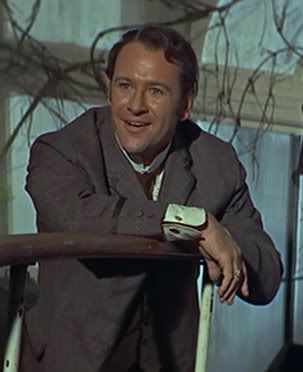
After his initial shock at seeing photographs of the flag he had helped to place on the moon, he relates the story of their voyage.....

In the secluded country village in England, Arnold Bedford ( Edward Judd ) is working ( or rather....not working ) on his play. Always looking for a new way to make some money, he becomes fascinated with the scientific substance his neighbor, an eccentric scientist named Joseph Cavor ( admirably played by Lionel Jeffries ) has recently invented....Cavorite it is called. A liquid substance it be, and it deflects the force of gravitity on any object that it is painted unto. Seeing a very lucrative business opprotunity here, Arnold talks his way into becoming partners with Cavor.
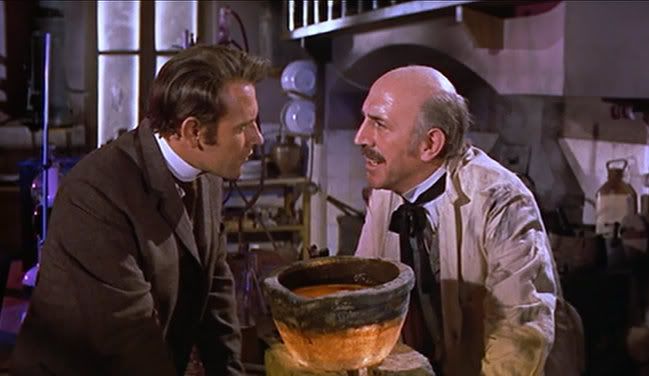

Cavor explains that his main use for Cavorite will be to apply it to the surface of a bathysphere that he has constructed in his greenhouse with the intention of flying to the moon...and of course, Arnold is astonished at this fool hardy scheme...UNTIL that is, he hears the reason why. "There be gold in them thar mountains!" Ah yes, to the depths Man would fanthom for the pursuit of wealth.

And so, in no time at all our merry duo hastily prepare for their sojourn to the Moon. Unlike the book, where Bedford and Cavor remain the only passengers on this journey, the film added a female character - Bedford's fiancee, Katherine ( Martha Hyer ) known simply as "Kate" to tag along with the boys on their ride through space. A pretty addition she is too.
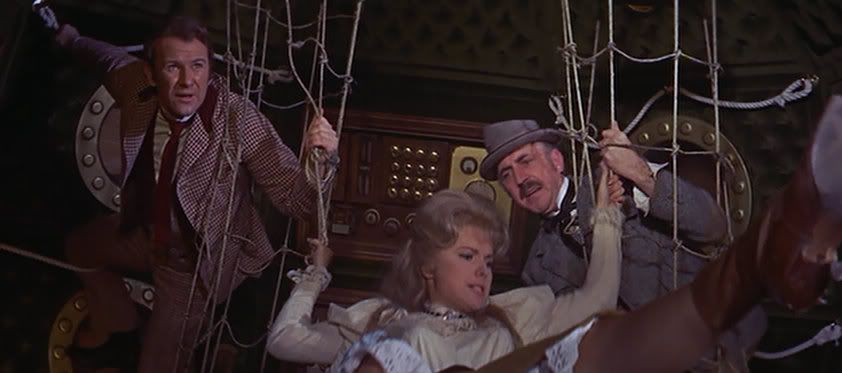
" Stop calling me Mrs. Bedford. We are not married! " ....." Not married?!... Madam ....kindly leave the room! "
Once on the moon we see the handiwork of model-maker extrodinaire Ray Harryhausen with magnificent space sequences, a gigantic brained Grand Lunar ( seated on a throne behind a veiled screen, much like the Wizard of Oz ), a caterpillar-like mooncalf, and a number of little Selenites....which are actually children in suits, so maybe that doesn't count as Harryhausen handiwork.
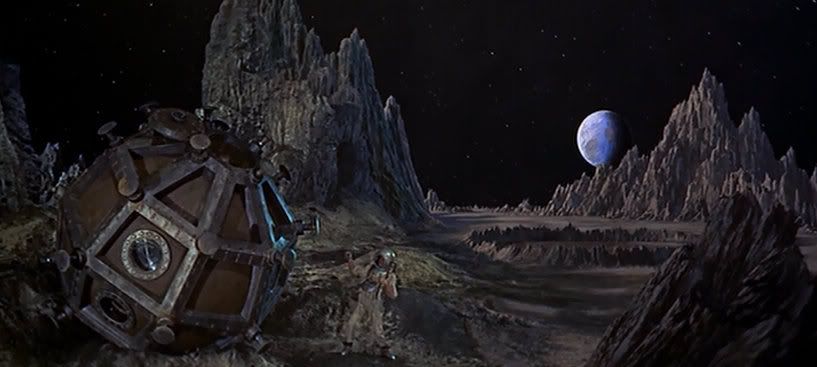


"First Men in the Moon" has always been my favorite of all of the Charles Schneer/Ray Harryhausen pictures because of the mood it evokes. There is a beautiful Victorian flavour throughout the film and the pre-moon scenes are my especially favorites ( oddly enough, these are the ones that have no special effects at all and make up about 45 minutes of the picture ).
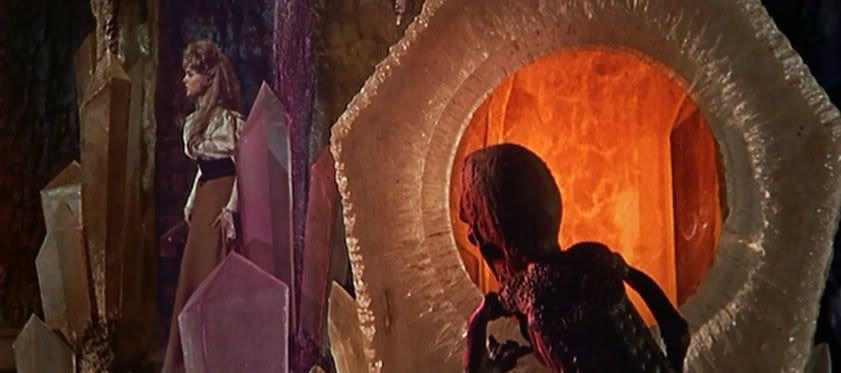

" It's....simply.....imperial "

Laurie Johnson, one of England's most renowned television and film composers at the time, wrote a haunting and atmospheric theme to "First Men in the Moon" as well as a lovely romantic ballad that can be heard softly in the background whilst our characters are at Cherry Cottage and during the greenhouse sequences. The complete soundtrack to the film has been released on audio cd but unfortunately, is quite a rare album to find today.
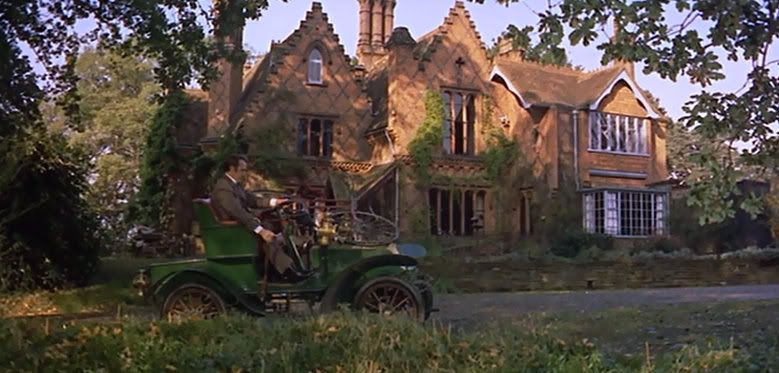

Peter Finch happened to stop by the set one day to visit his good friend, Lionel Jeffries, and found himself being used for a guest spot as the baliff who serves Kate her legal summons. Aside from his appearence there are not too many well-known character actors with the exception of Milles Malleson who does one of his characterisitc dithery/absent-minded impersonations as the church registar.

" Poor Cavor...he always did have that nasty cold "

"First Men in the Moon" takes us on a wonderful light-hearted sojourn to a Victorian era, a period when the spirit of exploration was at its peak and there were new and exciting worlds just waiting to be explored....and conquered. Some say this film drags on until the scenes when they land on the moon and see the "creatures" but I disagree. But then, that may be because I have never been much of a sci-fi film fan.

Anyway, overall the film is a delight to watch and the recent DVD release has just astounding sound and remarkable color restoration. Details you never thought to notice stand out bright and bold. It is a relaxing movie and what I like best of all about it is the carefree way our heroes go about on their expedition to the moon. They pack a few cans of sardines, a couple of chickens and are off on their way in no time at all. Where modern scientists take months and months of planning and preperation for a routine space flight, Bedford and Cavor simply put on their jackets, hop in their sphere....and enjoy the ride! What comes, comes.

Quite right.....the only way to travel.
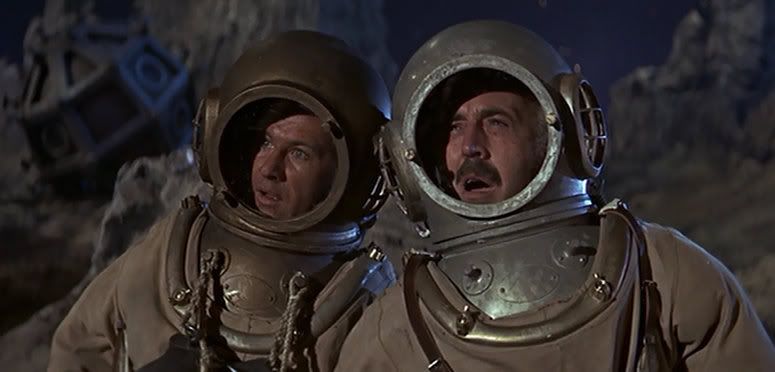
Two chumps having a jolly good time on the Moon

This post was originally published on The Absent-Minded Buccaneer blog. 

Wednesday, February 19, 2014

Nugget Reviews - 9


Daisy Kenyon ( 1947 ) 24k


A fashion illustrator loves a married lawyer but when he refuses to get a divorce she marries a returning soldier and thinks her life is perfect until the lawyer decides he wants her afterall.  Joan Crawford, Dana Andrews, Henry Fonda, Ruth Warrick. 20th Century Fox. Directed by Otto Preminger.

A golden nugget for sure! Daisy Kenyon is one of those films that if you catch a glimpse of it on late-night television you can't tear yourself away from it. Its been-filmed-a-hundred-times-before plot somehow becomes amazingly fresh in Preminger's hands. It's obviously Joan Crawford's picture but our two leading man vie for the spotlight in every scene they are in which only adds to the excellent dramatic acting. 

                _________________________________________________________


Peter Ibbetson ( 1936 ) 18k


Two childhood sweethearts become separated and meet again years later - one a rising architect, the other a Duchess. Gary Cooper, Ann Harding, Ida Lupino, Douglas Dumbrille, John Halliday, Virginia Weidler, Dickie Moore. Paramount Pictures. Directed by Henry Hathaway.

This movie started off simply superb - fantastic settings, great actors, and magnificent cinematography. We were sure it was a 24k gold nugget, but mid-way through it took a turn into the realm of mystic fantasy and became quite somber in tone. That's our only beef with it. Well...that and Gary Cooper's western accent. A beautiful and haunting film otherwise. 

                _________________________________________________________


Three Wise Fools ( 1946 ) 14k


Three men who all love the same pretty girl are given a curse by the Irishman who whisks her away. Years later, as old bachelors, her granddaughter comes to live with them and softens the old fools' hearts. Margaret O'Brien, Thomas Mitchell, Edward Arnold, Lionel Barrymore, Lewis Stone. MGM. Directed by Edward Buzzell.

Margaret O'Brien is adorable in this film with her masterly airs and her Irish brogue and we've come to appreciate Thomas Mitchell more and more with every film we see him in. Our "three wise fools" seem like they are a bit embarrassed to be in the picture and wish they were doing something else. Did Louis Mayer give them these roles for punishment perhaps? Hmmm.... Nevertheless Lionel Barrymore is delightful with his curmudgeonly manner.

                _________________________________________________________


Fiend without a Face ( 1958 ) Elctr. 


Several recent strangulation deaths in a small Canadian village have been attributed to the US Air Force bases nuclear power output but then the people SEE the real culprit behind the deaths. Marshall Thompson, Kynaston Reeves, Kim Parker, Terry Kilburn. Amalgamated Productions. Directed by Arthur Crabtree. 

Oh dear. This film was a doozy. "Fiends take form before your very eyes" reads the poster. And by golly, its right. That "fiend" you see in the poster is what you get in the flick. A brain with antennae. Obviously, this was the Brits version of The Tingler. The old professor is the real kicker in the movie....he got a basement full of neato gadgets and managed to figure out a way to make thoughts take form. Scientists the world over have not been able to do this, but this old man figured it out in his basement...with a simple headband. Terry Kilburn, an MGM child star, makes an appearance as one of the Air Force men. 

                _________________________________________________________


Stolen Hours ( 1963 ) 14k 


A jet-setting party-loving woman discovers she has a brain tumor and turns her life around before she dies. Susan Hayward, Michael Craig, Edward Judd, Diane Baker. Mirisch Corporation. Directed by Daniel M.Petrie.

Stolen Hours, also known as Summer Flight, was one of those 1960s Delbert Mann/Ross Hunter style soap operas. It was a ( rather inferior ) remake of Dark Victory starring Bette Davis ( Davis said after this film was released, "Some pictures should never be remade" ). Hayward is supposed to be a 30-year-old-something woman but looks more like the 46 year old woman that she is. Despite the mushy plot, the film boasts some great color locale shots of the coast of England and really swell art direction. 

Friday, February 14, 2014

Hollywood Home Tour - James Stewart

"Today we're going to take a short spin three blocks west of Rodeo Drive and head on over to Roxbury Drive to catch a glimpse of the beautiful English tudor home of James Stewart.....

918 North Roxbury Drive

"Coming up on the right you'll see the house. The ivy-covered home is accented with a wide lawn, long stone walk and birch trees lining the sides. James Stewart purchased this house in 1949, shortly after he married Gloria and before he began filming on Winchester '73 and Harvey. 

"The 6,300 square foot house was originally built by director King Vidor in 1928. It features a spacious entrance hall, living room, large library, dining room, kitchen, breakfast room, and five bedrooms upstairs. In the backyard a walled English garden adds a touch of privacy. 

Both Jimmy and his wife had green thumbs and enjoyed growing flowers and vegetables in their garden. Whenever they had a bountiful harvest they shared their crops with the occasional giant rabbit and with their neighbors. I do believe some of these neighbors you are quite familiar with....anyone ever hear of Lucille Ball and Desi Arnaz? How about Jack Benny? Jeanne Crain, Rosemary Clooney, the Gershwins, and that acerbic wit Oscar Levant also lived further down the street. We'll take a closer look at these homes further on in our tour folks." 

.
Up-to-date Note: During the 1970s James Stewart purchased his neighbor's property and tore down the house so that he could expand his garden. He could be seen walking his dogs along Roxbury up until his death in 1997. After his death, his house was purchased by the founder of a brokerage service who called it a "dump" and tore it down within weeks. You can view photographs of the inside of Stewart's house over at the Architectural Digest website. Obviously, Stewart had a great home and was an avid reader too.

Tuesday, February 11, 2014

Shirley Temple - A Legend Has Passed


A legend in Hollywood - Shirley Temple Black - has passed away today at the age of 85. An internationally-renowned child star, Presidential delegate, ambassador to Ghana and Czechoslovakia and co-founder of the International Federation of Multiple Sclerosis Societies, Mrs. Black made an indelible mark in the world. At the height of her popularity in the 1930s, she received more fan mail than Greta Garbo and was photographed more often than President Franklin D. Roosevelt. She was aptly nicknamed at the time "America's Little Darling" and will forever remain so. May you rest in peace!

Shirley Temple ( Apr. 23, 1928 - Feb. 10, 2014 )

Sunday, February 9, 2014

Editor - Cotton Warburton

For anyone who is a Walt Disney film fan the name "Cotton Warburton" will ring a bell, even if you can't quite recall where you have seen that name. Of course, if you never pay attention to credits ( gasp!! ) then that name will probably not be ringing any bells in your carillon. But for my sister and I, we see "Cotton Warburton" flash upon the tele at least once a week - for that's about how often we watch a Disney film. Starting in 1956, Warburton had a long career with the Walt Disney Studios as a film editor, working on 35 films in that time period. Even though he is best known for his Disney work, Warburton edited a number of films throughout the 1940s for Metro-Goldwyn-Mayer as well. Let's highlight a little of this man's work and his life : 

Irvine Eugene Warburton was born on October 8, 1911 in San Diego, California. During his high school years at San Diego High he excelled in sports and especially enjoyed track and field events, winning several championships for his running speed. When he entered USC he joined the Trojans football team and went on to become an All-American Quaterback in 1933. While Warburton was quarterback, USC had a winning streak that lasted for 27 games, a record which remained unsurpassed until 1980. 

When "Cotton", as he was nicknamed, left college in 1934 he was offered the opportunity to become a pro football player with the Chicago Bears, but declined, instead choosing to enter the film industry. Hoorah for Cotton!  

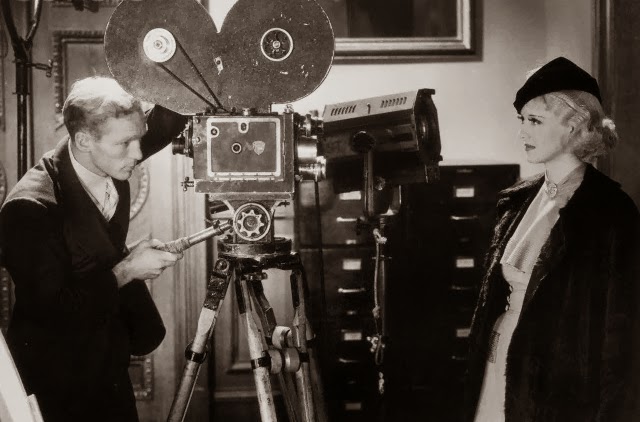
He first tried his hand at acting, appearing briefly in Big City ( 1937 ) but then decided to venture behind the camera and became a film editor. This was where he found his forte. His first film at MGM studios was a short Laurel and Hardy comedy entitled Air Raid Wardens, released in 1943. 

Comedy was the genre that Warburton began his career with and which he excelled at best. Several more "B"-comedy films followed ( Three Hearts for Julia, Up Goes Maisie, Love Laughs at Andy Hardy ) before Warburton moved up to the "A" films such as Cynthia, Neptune's Daughter, the delightful Two Weeks with Love, and Three Guys Named Mike ( 1951 ). 


Warburton continued editing for musicals and dramas into the 1950s, working on such films as Sombrero, Above and Beyond, and Skirts Ahoy! before he decided to try his hand at the new medium called television. One of his first forays in editing for the small screen was The Adventures of Ozzie and Harriet. 

The next project Warburton undertook was editing a western film for Walt Disney studios : Westward Ho the Wagons. It was a happy experience for Warburton and it led to him switching studios permanently. From 1957-1959 he edited one of Walt Disney's most popular television series, Zorro, as well as the film The Sign of Zorro...which were mainly episodes from the first season of the show spliced together to create a feature film. 


Some of Warburton's other credits in the late 1950s, early 1960s included The Absent-Minded Professor, Son of Flubber, Moon Pilot, Miracle of the White Stallions and The Misadventures of Merlin Jones ( 1964 ). 

The same year Warburton completed The Misadventures of Merlin Jones, he also worked on another project for Walt Disney...a much bigger film : Mary Poppins. It was for the creative editing in this supercalifragilisticexpialidocious musical that he was awarded the Academy Award in Best Editing during the 37th annual awards ceremony. The competition that year included Becket, Father Goose, Hush, Hush, Sweet Charlotte and the other musical favorite of the year, My Fair Lady. 


Warburton had to work closely with the animators for the Jolly Holiday sequence but it was the chimney pot sequence of Mary Poppins which was the creme-de-la-creme of Warburton's editing work. It was crisply edited and, combined with the stellar animated special effects, created a toe-tappin', eye popping entertaining musical feast. 


The entry for Wikipedia describes the job of a film editor as thus : Film editing is often referred to as the "invisible art" because when it is well-practiced, the viewer can become so engaged that he or she is not even aware of the editor's work. On its most fundamental level, film editing is the art, technique, and practice of assembling shots into a coherent sequence. The job of an editor isn’t simply to mechanically put pieces of a film together, cut off film slates or edit dialogue scenes. A film editor must creatively work with the layers of images, story, dialogue, music, pacing, as well as the actors' performances to effectively "re-imagine" and even rewrite the film to craft a cohesive whole. Editors usually play a dynamic role in the making of a film. 

We believe much of what makes a Disney film so entertaining, especially the comedies, can be attributed to Warburton's clever editing and perfect comedic timing. He never lets a shot rest on an actor's expression or on an action sequence for longer than is necessary to capture the humor or the excitement of the moment.

Take a look at this short sequence from That Darn Cat ( 1965 ) and you can see what we mean :

&bp

Some other Disney classics that Cotton Warburton edited during the late 1960s were The Happiest Millionaire, The One and Only Genuine Original Family Band, The Love Bug ( and the Herbie sequels ) as well as the amusing The Computer Wore Tennis Shoes. After Walt Disney's death in 1966, the studio was reeling from not having one leader in charge of production. A committee took over to head up the studio and the following year they decided the best project they could undertake would be to finish a film that Walt had started in the early 1960s as a back-up plan in the event that P.L. Travers would not let Mary Poppins be made - Bedknobs and Broomsticks ( 1971 ). Once again, it was Cotton Warburton who was called upon to edit the finished film. He did a marvelous job on the musical numbers ( especially With a Flair ) and the famous marching armor finale, but alas....times had changed. Bedknobs and Broomsticks suffered from major cuts upon its release and failed to be the box-office smash the studio had hoped for. Warburton's editing went unrecognized at the Academy Awards that year as well. 


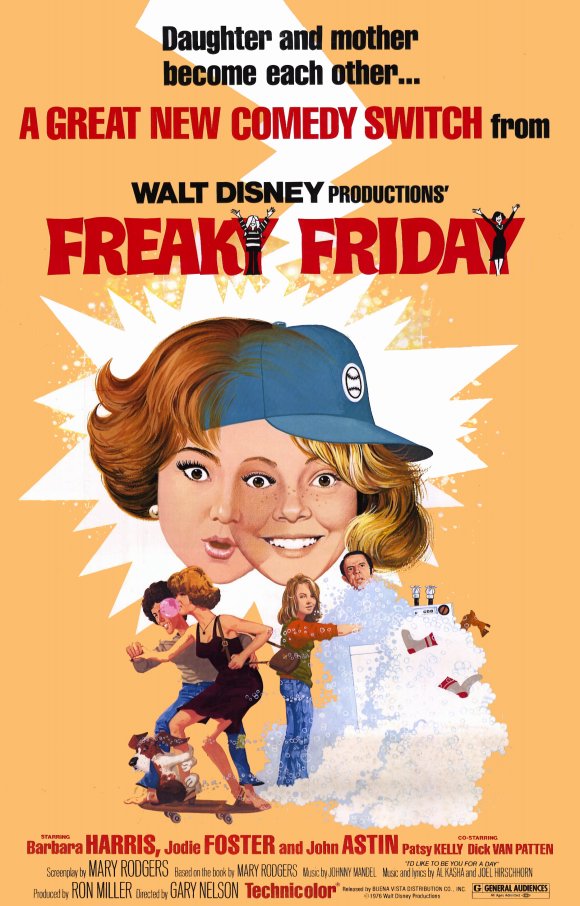
Warburton went on to edit the comedies that the Walt Disney Studios was creating throughout the early 1970s ( The Stongest Man in the World, No Deposit No Return, Freaky Friday ) and continued until his retirement in 1976. His final film was The Cat from Outer Space. Not the altogether best film to end one's career with but a fun flick nonetheless. 

Filmmaking is a collaborative form of art. No one person can make a masterpiece.  Even if a film has a marvelous cast, great cinematography, and a fine script, the whole film can fall apart in the hands of a bad editor. Each person has to be at the top of their game, and just like football...each man has an equally important position. Cotton Warburton played football like a pro and he brought his game-face into every film project he worked on as well, making sure he wasn't the man who would foul up the game with a "tumble". In our book Warburton was a true All-American Editor.

This post is apart of the 31 Days of Oscar ( Feb. 1- March 1 ) blogathon hosted by Paula's Cinema Club, Once Upon a Screen, and Outspoken and Freckled. Be sure to check out all of the other great entries in this blogathon!

Friday, February 7, 2014

The Impossibly Difficult Name That Movie Game


A mysterious woman hiding in the bushes and a happy hiker.....this is a key scene in a engrossing dramatic film. Can you guess which film? Give it a try and if you want some more picture puzzles, check out our past Impossibly Difficult Name that Movie game posts. Most of them have not been solved yet!

If you are not familiar with the rules to The Impossibly Difficult Name that Movie game or the prize, just click here. 

Good luck guessing! 

GAME OVER. 

Congratulations on Phyl, who correctly guessed the film "The Unguarded Hour" ( 1936 )!

Sunday, February 2, 2014

Set Design - Suez ( 1938 )

My sister and I began watching Suez ( 1938 ) last week. For those not familiar with the movie it's a so-called "biopic" on the life of French diplomat, Ferdinand de Lesseps, who dreamed of building a canal to connect the Mediterranean and Red Seas. We had never seen the film before, but once the credits began rolling we knew we were in for a good picture judging from the talent involved ( Tyrone Power, Loretta Young, Annabella, Joseph Schildkraut, Leon Ames, Henry Stephenson, Nigel Bruce, Darryl F. Zanuck production, Philip Dunne screenplay, Alan Dwan direction, etc ). 

However, ten minutes into the film, we knew we weren't in for just a good picture, but a great picture! Was it the cinematography that grabbed us? Nope. Was it the elaborate costumes? No, although they were lovely. Was it the quality in acting? No... we didn't expect bad acting. IT WAS THE SETS. 

Within these 10 minutes the audience is shown three different humongous sets - that of a tennis arena, the foyer and the ballroom of Napoleon's palace. Simply breathtaking. And this was only the beginning, for throughout the film there are over 17 different sets. 


Suez begins with a young Ferdinand de Lesseps ( Tyrone Power ) giving his friend the vicomte Rene de Latour ( Joseph Schildkraut ) a whallop during a rousing game of tennis in an elaborate recreation of an authentic indoor tennis arena of the period. The game being played out was a mixture of our modern tennis and racquetball (and one that looks more exciting than both ). Loretta Young, as Countess Eugenie de Montijo, is cheering on her sweetheart Fernidad, when she is espied by the President of France, Louis Napoleon ( played with particular malice by Leon Ames ).


At a state ball which our principal players are invited to, a fortune teller predicts that Eugenie will have a troubled but great life and wear a crown, while de Lesseps will spend his life digging ditches. Prophetic words. Napoleon's displeasure with de Lesseps presence in Paris quickly gets him an assignment to Egypt to assist his father, the French consul. While there he is inspired with the dream of building a canal to bridge the two great seas and makes it his life's ambition despite the personal costs involved. 


Darryl F. Zanuck's historical spectacle, Suez, was given a two million dollar budget when production began in the spring of 1938. Obviously, the sets and special effects ( Suez boasts two excellent disaster sequences - a rock slide and a sand storm ) were given the most prominent chunk of the budget pie, with costumes coming in a close third. 


Fox was currently indulging in a series of historical films which depicted characters loosely based on real people ( The House of Rothchild, Clive of India, Lloyds of London ) and several which included big-budget disaster sequences ( San Francisco, In Old Chicago ). When Suez was released it received unfavorable reviews from the critics because of the liberties it took with historical facts, but regardless of the dissing from the critics the public adored the film and it easily earned back its investment in box-office receipts the very same year. Most of the heirs to Ferdinand de Lesseps approved of the fictionalized depiction of their father, save for one of his sons who sued Zanuck for libel. As Allen Dwan, the director of the film, once said "We gave him a romance with Eugenie, and [he] objected to it, so [he] took us to court. And the court told [him] that this picture did so much honor to France that no matter what [he thought], the case must be discarded, and they threw it out of court".


Ronald Colman was screenwriter Philip Dunne's original choice for the part of de Lesseps, who would have been splendid in this role. Nevertheless, Tyrone Power plays de Lesseps with great conviction even though he couldn't resemble the real de Lesseps with ten pounds of makeup on, and was much too young for the part. Midway through the film a touch of grey on the sides of his head was supposed to give us the impression that he aged 40 years. 

Loretta Young was not pleased at being usurped as the reigning star of the picture by the French beauty, Annabella. She knew her role was mainly a piece of set-dressing and so she decided to be the most glamorously dressed woman in any scene in the film. Working with her costume designer, Royer, her skirts grew to enormous size when filming began. In one particular scene her hoop-skirts were so large that the set builders had to widen the doorways to make room for her entrance. 


The responsibility of designing the sets was shared by two great artisans, Bernard Herzbrun and Rudolph Sternard, both of whom had created beautiful sets in two other Tyrone Power epics - Alexanders Ragtime Band ( 1937 ) and In Old Chicago ( 1937 ). 

Rudolph Sternad ( 1906-1963 ) worked in Hollywood as an art director, and later a production designer, starting in 1936. He designed sets for The Rose of Washington Square, The More the Merrier and High Noon, which began an association with Stanley Kramer that lasted for twenty films including The Caine Mutiny, Judgement at Nurenberg, Inherit the Wind and It's a Mad, Mad, Mad, Mad World. Although he was nominated for three Academy Awards, he never won. 


Bernard Herzbrun ( 1891-1964 ) created sets for over 270 films, which included several Shirley Temple films, Harvey, Creature from the Black Lagoon, and Magnificent Obsession, between 1930-1955. Herzbrun was nominated for an Academy Award for his work on Alexander's Ragtime Band, and it was this recognition which earned him the assignment to create the sets for Suez. 

Herzbrun helped create designs for 42 films in 1938 alone. It was an extremely busy year for him and yet you can tell what a fastidious man he was by the details in Suez's sets. Alexander's Ragtime Band would end up being the only nomination Herzbrun ever received, for surprisingly, he was snubbed at the Oscars in 1938! 


While Suez was nominated for three Academy Awards ( Best Cinematography, Best Sound Recording, Original Score ) its set design was not included which must have been one of the greatest oversights in the history of art direction. But....to be fair...Suez was up against stiff competition that year. The eleven nominees included The Adventures of Tom Sawyer ( Lyle Wheeler ), Carefree ( Van Nest Polglase ), If I Were King ( Hans Drier ), Marie Antoinette ( Cedric Gibbons ), Herzbrun's own Alexander's Ragtime Band and the winner that year - The Adventures of Robin Hood, featuring sets created by Carl J. Weyl.

Even though Suez was not historically accurate, it remains an entertaining and thrilling spectacle; a film which features fine acting, beautiful music, stellar special effects, and most of all, magnificent sets which transported its audience back to Napoleon's Europe during the mid-1800s.

This post is apart of the 31 Days of Oscar ( Feb. 1- March 1 ) blogathon hosted by Paula's Cinema Club, Once Upon a Screen, and Outspoken and Freckled. Be sure to check out all of the other great entries in this blogathon!