Showing posts with label Mickey Rooney. Show all posts

Friday, June 9, 2023

From the Archives: The Adventures of Huckleberry Finn ( 1939 )


Mickey Rooney as Huck Finn poses with a "mess of fish" in this still photo from MGM's adaptation of Mark Twain's The Adventures of Huckleberry Finn ( 1939 ). Jackie Moran played the character of Huck a year earlier in The Adventures of Tom Sawyer. 

From the Archives is our latest series of posts where we share photos from the Silverbanks Pictures collection. Some of these may have been sold in the past, and others may still be available for purchase at our eBay store : http://stores.ebay.com/Silverbanks-Pictures

Saturday, July 11, 2020

Magic Couples of Metro-Goldwyn-Mayer

Movies have always reflected the hopes and dreams of the public, especially in terms of romance. Since almost every movie genre - from mysteries to swashbucklers, from war to love stories - features a leading man and a woman, it is not surprising that thousands of different screen couples exist on film. Only a relatively few couples created real magic, and of these, a surprising number worked for MGM.

At the studio with "more stars than there are in heaven," Louis B. Mayer and Irving Thalberg acted as divine matchmakers. If a couple proved successful in a film, it was likely they would be recast as a team, especially if they were both under contract to MGM. Thalberg, for example, noticed a chemistry between Joan Crawford and Clark Gable when they co-starred for the first time in Dance, Fools, Dance ( 1931 ). He set the story department to finding scripts that would suit the two actors. Subsequently, Crawford and Gable made eight films together, in most of which she played the working girl who rose to fame and glamour, and he was the rugged he-man who loved her. Judy Garland and Mickey Rooney, the perennial happy-go-lucky teenagers, co-starred in nine MGM movies. And Myrna Loy and William Powell, the quintessential happily married couple of the forties, made thirteen films together in as many years. 

What made a great screen couple? The answer is as difficult to determine as it is to explain what makes a relationship work in real life. Like all great lovers, screen couples exude mystery and wonder. "We're inevitable, " John Gilbert tells Greta Garbo in Queen Christina ( 1934 ), "Don't you feel it?" She does and so do we. Great lovers always seem inevitable, part kismet, and part coincidence. 

Casting two actors together creates a third entity, a single ideal. And no movie studio in the world paired couples together with as much frequency as MGM. In some cases, screen couples served to perpetuate a series, such as Johnny Weissmuller and Maureen O'Sullivan in the Tarzan films, or Lew Ayres and Laraine Day in a succession of Dr. Kildare episodes. But the great MGM screen couples came to symbolize a singular aspect of romance: Greta Garbo and John Gilbert ( Temptation ); Clark Gable and Jean Harlow ( Lust ); Joan Crawford and Clark Gable ( Glamour ); Myrna Loy and William Powell ( Sophistication ); Jeanette MacDonald and Nelson Eddy ( Sentimental Love ); Judy Garland and Mickey Rooney ( Good, Clean Fun ); Greer Garson and Walter Pidgeon ( Enduring Love ); Spencer Tracy and Katharine Hepburn ( Mutual Admiration ). 

Perhaps the popularity of these couples can be attributed to moviegoers' longing for the romantic ideals these costars projected on the screen. Certainly, their popularity also was a reflection of the times. Jeanette MacDonald and Nelson Eddy sang sentimental arias to each other, lavishly adorned in period costumes, while the world suffered through the Great Depression. Their love was always chaste and their relationship was as idealized as someone like Louis B. Mayer couple imagine. In Mrs. Miniver ( 1942 ), Greer Garson and Walter Pidgeon stoically endured the hardships of World War II. ( Winston Churchill said that the movie did more for the war effort than a fleet of destroyers ). But the common bond and the lasting appeal of the majority of screen couples from this era also had to do with equality of the sexes. 
We may think of the liberated woman as a phenomenon of the seventies, but just look at the female characters of the thirties and forties. They were women who stood up to their men; Women who could wisecrack, work, even fight, if necessary, for the things they wanted and for the men they loved. They were equal partners in solving a crime, running a business, singing duets, or dancing on Broadway. These women held their own with men in the bedroom, the boardroom, and even the barroom, when necessary. In a classic scene from The Thin Man ( 1934 ), Myrna Loy discovers that William Powell has consumed six martinis, and tells the waiter, "....bring me five more martinis, Leo, and line they right up here."

These women matched their men, drink for drink, or any other way, and the men loved them for it. 

The influence of MGM's screen couples continues today on late-night television and in video rental stores, where these movies of yesteryear are still popular, reinforcing the fantasies created by Hollywood's most powerful dream machine. Obviously, we still want to believe that, in real life, Loy and Powell or Garson and Pidgeon stay happily married for decades. "Ah! Sweet mystery of life, " as Jeanette MacDonald and Nelson Eddy would croon. And the mystery was this: Why can't real life work like the movies?

- Peter Hay

The above article was an excerpt from "MGM: When the Lion Roars", written by Peter Hay and published by Turner Publishing Inc ( 1991 ). 

Saturday, November 23, 2019

Arabian Adventure ( 1979 )

If you are looking for a fun 1970s adventure film set in Arabia, then here is a title to keep in mind: Arabian Adventure. Director Kevin Connor and producer John Dark, who made such corny classics as The Land That Time Forgot ( 1974 ), At the Earth's Core ( 1976 ), and Warlords of Atlantis ( 1978 ) turned from the Edgar Rice Burrough's themed adventure films to try his hand at an Arabian fantasy....and the result was pretty good. 

Variety dubbed Arabian Adventure "Star Wars with flying carpets" when it was released in November 21, 1979. It doesn't have any humanoids or loyal wookies like Chewbacca, but the film does bear a slight resemblance to George Lucas' space epic in its black and white portrayal of evil and goodness. 

Christopher Lee stars as Alquazar, an evil caliph who rules the Arabian kingdom of Jadur. Like most wicked rulers, he desires to be the most powerful man in all the world. In order to do this, he needs to obtain the Rose of Elil which can only be retrieved by someone who is pure and honest. When the handsome Prince Hasan ( Oliver Tobias ) comes to Jadur to woo Alquazar's stepdaughter Princess Zuleira ( Emma Samms ), Alquazar seizes his opportunity and sends the prince on the journey to capture the rose in his place. He agrees to give him the princess's hand in marriage if his expedition is successful but, in order to guarantee that the rose will be returned to him, Alquazar sends his backstabbing henchman, the bubbling Khasim ( Milo O'Shea ) on the journey with Prince Hasan. Also tagging along is Majeed ( Puneet Sira ), a beggar orphan boy, and his pet monkey. Once they reach Elili, they must battle with a genie, a valley of fire-breathing "dragons", and a swamp filled with groping hands before they can capture the rose. 
The script, written by Brian Hayles ( Warlords of Atlantis ), is a motley blend of Eastern fantasy tales. "These Eastern tales abound with lovely excursions into pure fantasy," John Dark exclaimed in a 1979 interview for Starlog magazine. "It was a very beautiful period and a very beautiful territory. We hope to recreate, in our story, the exciting architecture and costumes, as well as some exciting special effects, like an army of flying carpets. It's an amalgam of a lot of stories, a lot of lore, magic mirrors, wicked spells, benign and evil jinnees and one or two very special ideas of our own."

Kevin Connor assembled a fantastic cast for Arabian Adventure. Christopher Lee is delightful as the evil caliph. As Lee himself described his character, "Very small children can go to see it and they'll have a lot of fun - they won't feel threatened by my evil nature because they'll know I'm going to be done in by the film's end."
Oliver Tobias, a Swiss stage actor, is the handsome prince, rather sullen but a good fighter; and Emma Samms, the lovely English actress, was making her film debut as the princess. But it is Puneet Sira who steals the show as the orphan Majeed. Like Sabu's character in Alexander Korda's The Thief of Bagdad ( 1940 ), it is Majeed who often comes to the aid of the prince and proves himself to be the real hero in the end. 

Arabian Adventure also features some great cameo appearances: Peter Cushing as the imprisoned old ruler of Jadur; Mickey Rooney as a befuddled machinist; and Capucine as a beautiful genie who resides in a gemstone. 

Most of Kevin Connor's films tend to feature a number of warring creatures and a hero who has to spend a lot of time trying to make his escape from these creatures. Arabian Adventure differs in that it has very few creatures, even though the script gave many opportunities to include them. Instead, Prince Hasan and Majeed must contend with Alquazar's sword-wielding Arab henchmen, robotic dragons that guard the volcano where the rose is kept, and an ungrateful genie ( also taken from The Thief of Bagdad ). 

The film is clearly aimed at a younger audience, and while it is entertaining, it could have had more elements that would appeal to adults. The adventure to retrieve the Rose of Elil also could have been more exciting. But all in all, it is a fun Saturday afternoon flick that will probably send a child's imagination wild with fantasies of flying carpets, evil caliphs, genies, and endangered princesses. 

Saturday, November 17, 2018

Pete's Dragon ( 1977 )

"Boo-Bop-BopBop-Bop, I love you, too!" 

Good ol' Elliott. He is exactly the kind of companion any child would wish to have. Strong, clever, amusing, cuddly, fun to be with, and he has the ability to make himself invisible when asked ( how many friends do you know who will disappear for you? ). Elliott's best quality is undoubtedly who he is - a dragon. Friends come in all shapes and sizes, and Elliott is just about the best shape and size of any dragon you can imagine. He is of the jolly-green-giant variety. 

How does one get a friend such as Elliott? Well, as his pal Pete explains, "nobody owns Elliott, he just sort of goes to those who need him". Truly need him. Pete ( Sean Marshall ) was such a boy. He was an orphan who was purchased by the nasty Gogan family to be used as an extra hand on their farm. He ran away one night and came to the town of Passamaquoddy where he met Nora ( Helen Reddy ) and her father Lampie ( Mickey Rooney ), who operate the lighthouse in the seaside village. Pete wants to belong to someone - and someplace - and he feels like Nora and Passamaquoddy are where he belongs. Only, the Gogans are anxious to get the full value of the $50 they paid for Pete and have come to bring him home. 

"That boy is our legal property, same as the family cow!"
Pete's Dragon was based on an original short-story by Seton I. Miller, who was famous for penning the screenplays to some of Errol Flynn's best films of the 1930s and 1940s ( The Adventures of Robin Hood, The Dawn Patrol, The Sea Hawk ). Walt Disney had purchased the rights to his unpublished work in the 1950s with the intention of adapting it for television. It sat on a shelf until S.S Field fleshed out the idea and Malcolm Marmorstein ( Dark Shadows ) typed out the screenplay in 1977. 

Walt Disney Studios always had a flair for creating entertaining musicals suitable for children of all ages and Pete's Dragon certainly combines all the elements you would hope to find in a family fantasy film: a touch of magic, a dastardly yet highly amusing villain by the name of Doctor Terminus ( Jim Dale ), quaint settings, a beautiful feminine lead, and a dash of romance - in the form of a long-lost sea captain.

Surprisingly, Pete's Dragon was made at a time when the studio was floundering. Animated films, which Walt Disney had always been known for, were no longer popular in the theatres and even family-based entertainment such as this story, was viewed as being passé. The studio was going through its dark ages for sure, so it is a wonder that Pete's Dragon was such a success at the box-office, raking in nearly four times its $10 million budget. 

"Life is lollipops and raindrops with the one you love, Someone you can always be with, Argue and agree with....climb the highest tree with..."

The film benefits from a great cast which includes the old legend of Hollywood, Mickey Rooney, along with Red Buttons and Shelley Winters ( as Mrs. Gogan ). Helen Reddy, who hailed from Australia, was a singer who had made an international hit with the Grammy award-winning song "I Am Woman". She had a brief appearance in Airport 1975 ( as Sister Ruth ) before she was offered the lead in Pete's Dragon. Reddy had a natural talent for acting and this should have been the start of a long acting career but, unfortunately, that never came about. 
Sean Marshall, who portrayed Pete, had a few roles in films and television shows prior to Pete's Dragon. After this film, he was a regular on two short-lived television series, The Fitzpatricks, and The MacKenzies of Paradise Cove, and then retired from film. Jim Dale was marvelous as Dr. Terminus. He began acting in the British Carry-On film series from the 1960s and made a few more Disney films after Pete before focusing his talent on voice-recordings, being especially famous for reading the Harry Potter books for audio release. Also in the cast was Jim Backus, Gary Morgan, Charlie Callas, Charles Tyner, and Jane Kean. 

Pete's Dragon boasts an engaging Oscar-nominated musical score, conducted by Disney great Irwin Kostal. For once, the famous Sherman Brothers could not be credited with writing the music to this film, even though Joel Hirschhorn and Al Kasha's songs featured some equally clever lyrics. "Candle on the Water" and "It's Not Easy" are two of the most memorable tunes. 
Pete's Dragon does run rather long and could have benefited from a few well-placed editing cuts, but on the whole, it's a colorful film with some very entertaining brazzle-dazzle moments. 

Sunday, May 13, 2018

Famous Stars and Their Mothers

They are just mother's boys and girls grown tall! 

Believe it or not, Hollywood stars have a few things in common with regular folk like us.....for example, they have mothers, too! At least, that is what this photo-spread from the Mother's Day week issue of Movie-Radio Guide would have us believe. But honestly, if it weren't for the captions, the resemblance between some of these stars of the 1930s/1940s and their maters may have gone unnoticed ( not that one would expect Cesar Romero's mother to share his trademark moustache ). 

We'd like to thank the Old Time Radio Researcher's Group for making so many great movie and radio magazines available to the public....and we'd also like to wish a Happy Mother's Day to all of our readers! 

Eleanor Powell of the twinkling feet and mother Blanche ( above ) always spend the day together. 
Cesar Romero with his mother Maria ( right ) taking time to chat with another beloved mater of the screen, Lela Rogers, star Ginger's mom. 
Formal party is what the irrepressible Mickey Rooney stages for Mother Nell on the great day! Inset: Homey describes Mother's Day in the Darnell family. Linda is getting some fine points on baking from Mom.

Mary Livingston and daughter Joanie have much in common besides the matching red, white, and blue jumpers they are wearing. One of those common interests is story-book time at the Benny's.

Every day is Mother's Day for Titian-haired Greer Garson, for she and her mother, Mrs. Nina S. Garson, are inseparable pals. Instead of making the rounds with some dashing screen hero when on a recent New York trip, Greer's constant companion was her mom. They are seen here at the Stork Club.
Mother of Lucille Manners, soprano star of "Cities Service Concert" ( Fri. NBC ) is herself musically accomplished and was Lucille's first teacher. Kate Smith's grandmother ( pictured ) as well as her mother, is a good pal to the CBS singer. Mrs. Benjamin Hanby is modern, too, and travels by air.
Betty Winkler transferred her dramatic activity from Chicago to New York and took her mother along. Betty stars in "Abie's Irish Rose". 
First grown-up luncheon date for Shirley Temple, Mother's Day, 1941, at the Brown Derby with Mrs. Gertrude Temple. 
Radio star Gracie Allen is not only one of America's favorite entertainers, she's doubly that to a couple of young Americans named Ronnie and Sandra. The two children of Gracie Allen and George Burns like their mom and dad on the air, but they like even better Gracie's reading and George's antics at home. 

Monday, June 16, 2014

On the Homefront : MGM and the War Effort

Sunlight streams through the shattered roof of a country church. There are empty places in the pews where, only a few weeks earlier, parishioners had sat - the local stationmaster, a choirboy, the young daughter-in-law of a much loved family. They are gone now, dead from the bullets or the bombs of an enemy they didn't know, in a war they hardly understood. 

Framed by the wreckage of his church, the vicar delivers a ringing sermon : "Why, in all conscience, should these be the ones to suffer? I shall tell you why! Because this is not only a war of soldiers in uniform. It is a war of the people - of all people - and it must be fought not only on the battlefield but in the cities and in the villages, in the factories and on the farms, in the home and in the heart of every man, woman, and child who loves freedom...This is a people's war! It is our war! We are the fighters! " 

The camera pans upward, through the sundered roof of the church.  "Onward Christian Soldiers" rises on the soundtrack as British fighter places - like a gathering flock of graceful birds - wing overhead, toward the enemy. 

So ends Mrs. Miniver, MGM's most popular and award-winning film of World War II. Moviegoers around the world thrilled to it, and with good cause. MGM was at its best during the war years, making movies to build the morale of fighting men and women, and the families awaiting their return. 


It was a time of pure patriotism, the fan club, the screen magazine, and the star system. MGM's male stars traded costumes for khaki and marched off to war. Clark Gable, James Stewart, Robert Taylor, Gene Kelly, Jackie Cooper, Stewart Granger, Van Heflin, Robert Montogomery, and Robert Sterling all served in the armed services. 

Other stars of both sexes went overseas to perform in USO shows; some washed dishes, served food, or danced with lonely GIs in the Hollywood Canteen. And still others traveled around the United States,  selling war by the thousands, sometimes quite creatively. MGM, for instance, conducted a "Tanks for Yanks" campaign that featured Johnny Sheffield, the "Boy" in the Tarzan series, touring the country and speaking, from the turret of a tank, about "A Boy's Place in America". 

In another promotion, MGM conducted a contest in several cities to pick seven girls who were "...doing the most to promote the war effort on the homefront". Their prizes were corsages and dinner with seven sailors, all paid for by MGM. 

Meanwhile, back at the studio, the sound stages busily produced war-related short subjects, such as National Defense, a documentary honoring all of the Rosie the Riveters and Max the Mechanics in the country. One of Pete Smith's lighthearted short subjects, Victory Vittles, advised home-front housewives to make do with leftovers, while an intriguing series on the medieval prophet Nostradamus revealed his provocative predictions for the advent and end of the war. Don't Talk and Mr. Blabbermouth warned home-front warriors about the consequences of rumor-mongering and spilling war secrets to unsuspected spies. 

For the young and the young-of-heart, the studio's cartoon department penned, among others, The Blitz Wolf, in which Adolf the cartoon wolf, who bore a "striking resemblance to Adolph the Phewrer" was ultimately defeated by the three little pigs of Pigmania - once they abandoned isolationism and fought together for the common good. 


Still, MGM's most effective weapons were its stirring home-front feature films. "Motion pictures are of the utmost importance to....build up mroale", said General Dwight Eisenhower in 1942, "...feature productions bring home their country vividly to the memories of soldiers. Let's have more motion pictures!" An MGM obliged, with multi-star musical extravaganzas such as Thousands Cheer ( 1943 ), Family musicals such as Meet Me in St. Louis ( 1944 ), comedies such as Swing Shift Maisie ( 1943 ), and, most movingly, tributes to the family values the Allied forces were fighting to defend. 

MGM's Mrs. Miniver gently dissolved class distinctions in England and celebrated the enduring power of the family - itself a miniature world at peace. Its American counterpart was The Human Comedy ( 1943 ), William Saroyan's semi-autobiographical story about the Macauley family of Ithaca, California. In his own, spun-glass way, Saroyan created a town and a family with whom practically every American could identify and sympathize. 

The Macauleys are poor in terms of money but affluent in the abundant, boundless love they have for each other. Since his father is dead and brother Marcus ( Van Johnson ) is in the army, young Homer Macauley ( Mickey Rooney ) works at a postal telegraph office to support the family. At the beginning of the film, Homer is a boy; by its end, the war has made him a man, as it has the American soldiers overseas. The telegraph office where he works receives and delivers wires from the War Department announcing the deaths of sons on the battlefield. Inevitably, it receives the news of the death of Homer's brother Marcus. As Homer tries desperately to cope with his terrible loss, the voices of Marcus and his father - like the vicar's words in Mrs. Miniver - comfort him, and the theater audience, too : "You are what we're fighting the war for. You are what we have left behind - to live the hopes we only dreamed ". 

This post is an excerpt from Peter Hay's excellent book on the history of Metro-Goldwyn-Mayer studios, "MGM: When the Lion Roars" published by Turner Publishing in 1991. For those who have not yet read it, it is the authoritative book on the studio and a truly delightful read, packed with over 700 photographs from the MGM's golden era. 

Saturday, May 10, 2014

Hot Off the Presses!


Oh boy, oh boy, oh boy!!.....Mickey and Judy just got the news and are ready to share it live coast-to-coast : Silver Scenes WILL BE HOSTING THE MGM BLOGATHON this summer. Hot diggity doooo! Tune in back here on Monday to read more about this breaking news. 

Wednesday, May 7, 2014

Nugget Reviews - 11

Another eclectic mix of films, with a generous sprinkling of Brit comedies thrown in :


Blue Murder at St. Trinians ( 1957 ) 14k


The girls of St. Trinians steal their way into winning a UNSECO contest in order to get a free bus trip throughout Europe. One of the girl's fathers, wanted for a diamond robbery, sneaks along as the new "headmistress", while Policewoman Ruby Gates tails them closely. Lionel Jeffries, Terry-Thomas, George Cole, Joyce Grenfell, Lloyd Lamble. Alastair Sim. John Harvel Productions. Directed by Frank Launder.

An entertaining episode in the St. Trinian's series...although it bears a very misleading title. We didn't see any murder in the whole film. Aside from the diamond robbery the biggest crime was the editor cutting out many of Joyce Grenfell's scenes. Or at least it seems like some of them were cut out. Terry-Thomas is marvelous as Captain Ricketts, the manager of a rickety bus line; Jeffries makes a surprisingly good headmistress; but disappointingly Sim only returns to bookend the film in two brief scenes. Overall, a bumpy beginning leads into a fun romp with the naughty gals of St. Trinians.  

              ________________________________________________________


Judge Hardy and Son ( 1939  ) 14k


Andy gets himself into debt anticipating that he will win the $50 prize in a school essay contest, but finds that his debts amount to very little when Mother Hardy gets ill. Meanwhile, Judge Hardy searches for the lost daughter of a poor Russian couple. Mickey Rooney, Lewis Stone, Ann Rutherford, Martha O'Driscoll, Maria Ospenkaya. Metro-Goldwyn-Mayer Studios. Directed by George B. Seitz.

"Andy Dandy" gets himself into a mess of money and girl trouble in this eighth installment in the Hardy series. Unlike the previous films, Judge Hardy and Son takes on a solemn mood mid-way through when Mrs. Hardy comes near dying. By the end of the film though, Andy's back to his cavalier ways and is whoop-whooping with joy when he gets to take Polly to the Fourth of July fireworks show.

                 ________________________________________________________


Good Morning Boys! ( 1937 ) Elct.


A schoolteacher takes his students to Paris and wind up capturing a gang of art thieves who plan on stealing a famous painting at the Louvre museum. Will Hay, Martita Hunt, Graham Moffet, Lilli Palmer, Peter Gawthorne. Gainsborough Pictures. Directed by Marcel Varnel.

Will Hay may have been a big comedian in England but after seeing this film I understand where American and British humor differ. There were some moments of amusement in the scenes themselves but Will Hay did not provide many laughs. I'd take Frankie Howerd over Hay any ol' day. And speaking of Frankie Howerd....

                ________________________________________________________


The Runaway Bus ( 1954 ) 14k


An airport bus gets lost in the fog en route to Blackbush and discovers that a master criminal known as The Banker is hiding on board, with several million pounds in stolen bullion stashed in the boot of the bus. Frankie Howerd, Margaret Rutherford, Petula Clark, Terence Alexander, George Coulouris. Val Guest Productions. Directed by Val Guest. 

It's a lesser known comedy from Val Guest but nevertheless boasts a great Brit cast and a nice little Hitchcockian twist at the end. Great rainy day viewing, and it's nice to see Pet Clark in her post-kiddie-flick-pre-Downtown era. But good luck trying to find a clean copy of the movie.....you'll have to do a lot of squinting to see the actors through the fog. Blimey! 

________________________________________________________


Charlie Chan at the Racetrack ( 1936 ) 14k


Charlie Chan takes a sea cruise to the mainland to uncover the murderer of a famous horse breeder. Warner Oland, Keye Luke, Helen Wood, Gavin Muir, Thomas Beck, Alan Dinehart.  20th Century Fox. Directed by H. Bruce Humberstone.

This is the twelfth of sixteen Charlie Chan films that Warner Oland made and we think it's one of the best. There are a lot of really good "Chan" moments in the film as well as some great verbal play between him and number one son, Lee. A slew of Chan regulars have brief roles; there is the swell setting at the track and on board the ship; and the usual suspense thrown in among the comedy ( Chan even gets shot in the leg on this voyage! ).

Saturday, September 7, 2013

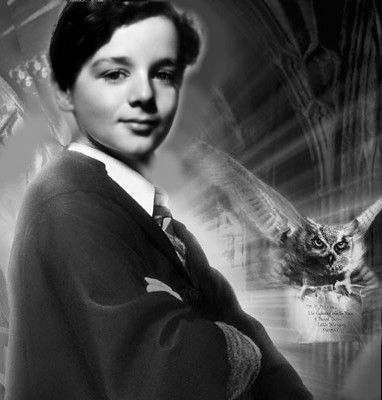
The Original Harry Potter ( 1938 )

Ever wonder what the original Harry Potter series was like? We certainly did; and so in the spirit of the upcoming Great Imaginary Film Blogathon, we thought we'd share our review of the first film in the original Harry Potter series... and get this, he wasn't called Harry!  

Henry Potter ( 1938 ) 
aka School for Sorcerers  ( UK title )

Studio : MGM Pictures. 

Directed by Victor Fleming. 

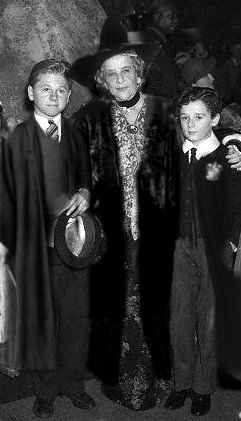
Cast : Freddie Bartholomew ( Henry Potter ), Mickey Rooney ( Richard "Dodge" Woolsey  ), Joan Mortimer ( Lucille Griffith ), Jackie Cooper ( Dunkin Balfrey ), Basil Rathbone ( Snafferal Snake ), Harry Davenport ( Headmaster Humbledore ), Louis Hayward ( Professor Quinttin ), May Robson ( Headmistress Margaret McDonagall ), Wallace Beery ( Rupert Haggin, Groundskeeper ),  Lennox Pawle ( Mr. Wanderers ). 


The Story : 

The film takes place in 1876 London, and opens with a young orphan, Henry Potter, being sold to rather dubious foster folk who agree to provide him food and lodging provided he work in exchange. One day, while running an errand to the meat shop in town, he happens to pass by Wanderers Magic Shop, a shop he has not seen before even though he just passed the storefront on his way to town. Mr. Wanderers beckons him in and tells him he has been expecting young Henry. 


His face was not pasted on. We kid you not!

He informs Henry that he is a little warlock - quite a famous one at that, having survived an attack from the villainous Lord Valdimere as a baby. He then equips Henry with a basic entry-level witch kit complete with cape, a wand and a magic spell book and sends him off into the streets..which have been magically transformed to Dungeon Alley, a hidden wizardry avenue filled with students preparing for the fall semester of school. Henry boards the train at Queen's Station which takes him to Higgens School of Witchcraft, where he has been invited to attend. 


Henry Potter and Dunkin Balfrey


Once at school Henry meets Dodge Woolsey and Lucy Griffith, two chums he will remain lifelong friends with..as well as Dunkin Balfrey, at first a schoolhouse rival, but then a good friend. He also finds Headmaster Humbledore to be a trusted ally and mentor. Humbledore reveals to Henry details about his birth and the death of his parents that he was unaware of before and warns him against Lord Valdimere, who may return to harm him. Sinister events at the school make Henry suspect that one of his professors is aiding Valdimere in his desire to kill him. It will take a pure heart, a good knowledge of witchcraft, and the help of his friends for Henry to overcome the evil Valdimere. 

The adorable May Robson as Headmistress MacDonagall

The Review : 

Although it falls into the routine "Tom Brown's Schooldays" formula upon occasion, overall the movie is quite enjoyable and it was a great introduction to a series that ran for over six years. Freddie Bartholomew and Mickey Rooney are a great duo ( they made five other films together in addition to the Henry Potter films ) and Joan Mortimer provided good sweetheart-support as little Lucille Griffith. Joan Mortimer would be busy in the early 1940s as she juggled between doing the Henry Potter series in addition to the Henry Aldrich series with Jimmy Lydon. She must of loved working with Henrys!

Unfortunately, Freddie Bartholomew was pigeon-holed into playing English school-boy roles ever since his appearance in David Copperfield in 1935. Bartholomew was fourteen years old when the Potter series began and by the time the fourth film in the series was filmed he was edging near twenty. Because of his growing age the studio execs decided to cancel the series...much to the disappointment of its loyal followers. 


One of the most notable performances in Henry Potter is from villain-extraordinaire Basil Rathbone. Little Henry has his eye on him from the start and it's no wonder...you never know whether to trust Snake or not. 

Basil Rathbone was famous in the 1930s for playing villains in such notable films as Captain Blood, Kind Lady, and The Adventures of Robin Hood ( filmed the same year ). However, in the late 1930s he would star in what would become his most famous role, that of Sherlock Holmes, in a string of classic films released by Universal. 

MGM was generally not inclined to film stories dealing with witchcraft, however since Henry Potter focused on the predicaments of three school age children, Louis B. Mayer felt that youngsters would relate to the trials and tribulations they must go through in spite of its underlying theme. And with three of the studio's top child actors in the lead roles, it was sure not to miss! 

Henry Potter was released on Sept. 18, 1938 and ranked in above-average at the box-office. Most of the film was shot in the sound stages at MGM and on the backlot where Dungeon Alley and the Higgins School of Witchcraft were constructed with MGM's usual stamp of set design brilliancy. 

Later releases included : 

Henry Potter's Secret ( 1940 ) 

Henry Potter Fights Back ( 1942 ) 

Henry Potter and the Black Bird ( 1944 ) 


The quality of the original films remained throughout but with much of the cast evolving as the series progressed it was difficult to match the enchantment of the original. Overall, its a series well worth checking out! 

For more information, or if you would like to participate in the Great Imaginary Film Blogathon click here.

Thursday, May 9, 2013

It's Spring Fever Time!


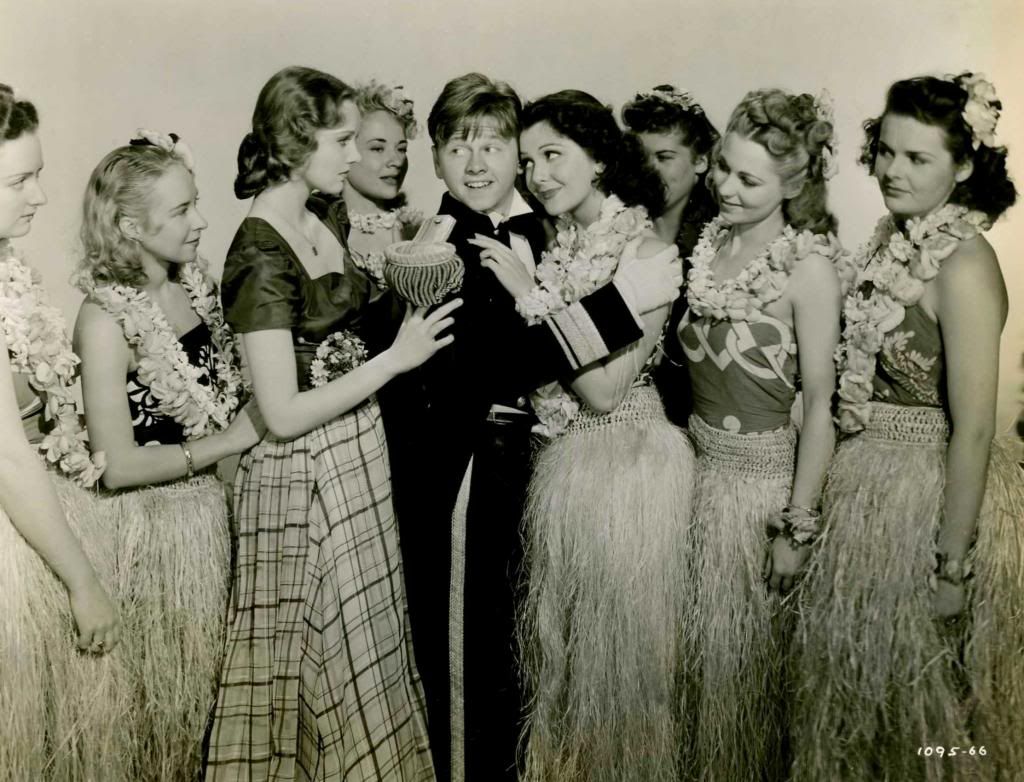
Andy Hardy is certainly enjoying spring with his band of hula honeys in this still from "Andy Hardy Gets Spring Fever" ( 1939 ) starring Mickey Rooney, Ann Rutherford and Helen Gilbert.