Showing posts with label British Imperialism. Show all posts

Tuesday, April 21, 2026

Rewind Review: The Admirable Crichton (1957)

Lewis Gilbert's version of The Admirable Crichton is a handsome adaptation of one of J.M Barrie's most popular plays which, although often referred to as a "satire", was more than likely Barrie's way of disguising his gentle assault on the British class system. It's also a rather unabashed look at the utter helplessness the uppercrust have when they are thrust in a commonplace situation or, in this case, an un-commonplace situation. 


Lord Loam (Cecil Parker) is the father of three young women, each about to be betrothed. Loam is a just man - one of those easily swayed lords of the English realm. He fancies that he desires equality as much as the average working class gent... and he does, to a point. In fact, it is his embarrassing "servant's tea party" that leads him to embark on a yachting voyage to the South Seas, along with his daughters, their suitors and the ship's staff. 

When a spot of inclement weather frightens the crew into bailing, the passengers are left floating in a lifeboat in the mid-Pacific to fend for themselves. Thankfully, their unflappable manservant Crichton (Kenneth More) and a servant girl (Diane Cilento) are dunked overboard with them.... and it is Crichton who turns out to be their savior with his resourcefulness when they are marooned on a deserted island. As the toffs accustom themselves to island life they find a new social order emerging. The tables are reversed as Crichton becomes the lord of the land and they the servants; but when a passing ship comes to their rescue, Crichton must decide if they are to remain islanders or each return to their previous status. 


The Admirable Crichton, released as Paradise Lagoon stateside, was the first color adaptation of Barrie's beloved 1902 play, but not the first filming. There was G.B Samuelson's 1918 silent version, Cecil B.DeMille's lengthy 1919 retelling (Male and Female starring Gloria Swanson) and Paramount's Yankeefied take on the story, We're Not Dressing, released in 1934 and starring Bing Crosby and Miriam Hopkins. 

Lewis Gilbert displays a masterful hand at putting the shipwreck satire to film and Wilkie Cooper obviously delighted in photographing the island paradise, which the play could only suggest. His sumptuous Technicolor photography gave reason enough for Brits to leave their flats to see the film. 

The rich blue waters of Bermuda subbed for the unnamed South Seas island and a couple of well-placed artificial palms added to its appeal. The island sets are quite clever and were a precursor to the familiar bamboo sets of Gilligan's Island during the 1960s. 


It is really Britain's everyman, Kenneth More, however, who steals the show and makes this his own film. More isn't ones ideal image of a heartthrob that three gals would be pining over, but on a deserted island he takes on the appeal of a hero and his good points do indeed shine through. 

The always lovely Sally Ann Howes portrays the beautiful Mary, eldest daughter of the Loams, who finds she has lost her heart to her butler. Sally Ann Howes always seems to be running along a beach, but this time, alas, she is not singing "Truly Scrumptious". Cecil Parker is marvelous as Lord Loam; Diane Cilento (Mrs. Sean Connery at the time) plays the cockney Eliza, not unlike Eliza Dolittle; and Martita Hunt, Jack Watling, Peter Graves, Gerald Harper, Mercy Haystead, and Miranda Connell round out the cast. 

The Admirable Crichton is a very entertaining and underrated little gem that has been cast adrift by the critics. It is hard to imagine watching this story unfold within the confines of a stage. It certainly was a tale meant to be filmed in Technicolor. 


Although Barrie attempted to write a comical study of the folly of civilization's class system, he left The Admirable Crichton without a moral. What comes through in this film however, is that the poor class have as much, if not more snobbery, than the rich. It is Mary who desires to remain on the island married to Crichton and living the blissful life of a pair of castaways but Crichton is stubbornly proud of his "position" and fails to conceive how the daughter of his employer can love him for himself when the setting is changed. In short, he behaves like an utter ass. 

Friday, April 29, 2016

The Four Feathers ( 1939 )

Every generation of the Favershams have had a military hero, but even as a boy Harry Faversham thought war futile and did not wish to follow in his illustrious family's footsteps. As his father explained to a comrade, "I send him to the best army school in England, spend half my time telling him about his famous ancestors and what do you think? I found him this morning reading poetry.... Shelley of all people!"   

As Harry (John Clements) matured, his viewpoint of war did not alter, but not wishing to displease his father, he enters the British Army. However, while saying goodbye to his fiancee Ethne (June Duprez), he reconsiders his decision and on the eve of the day his company is to leave to join Kitchener's army in Sudan, he resigns his commission. Harry feels that his future with Ethne and living a peaceful life in England is more important than fighting a hopeless battle in the desert.  
 
"The futility of this idiotic Egyptian adventure and the madness of it all, the ghastly waste of time that we can never have again!"  

His commanding officer is very displeased with him, as are his three boyhood friends who each send him a white feather, symbolizing cowardice. This does not affect him so much as does hearing his sweetheart agree with them:   

"You were not born free Harry, and nor was I. We were born into a tradition, a code which we must obey even if we do not believe in it.....and we must obey because the pride and happiness of everyone around us depends upon our obedience."


Filled with angry passion, he plucks off a white feather from her fan and adds them to the group, making four feathers. He secretly vows to prove his courage to Ethne, his companions ...and himself. The way he goes about this is above and beyond the call of duty. This is where the romance ends and the adventure begins.

During the late 1930s many British Imperialism-themed adventure spectacles were released, but Alexander Korda's The Four Feathers (1939) - is by far the best.


Filmed on location in the Middle East in glorious Technicolor, we follow Harry on various escapades throughout Egypt, climaxing in a battle at Obdurman, before we return to England for the "showdown". For a film that's not even two full hours in length, it manages to squeeze in quite a bit of story and a lot of excitement, as well as a tender sub-romance involving Captain John Durrance (Ralph Richardson), one of Harry's friends, and Ethne. 

The beloved character actor C. Aubrey Smith plays one of his usual bombastic gentleman roles, that of Ethne's father, a retired general who likes to recount a tale of his bravery in battle using the fruit and nuts from the dinner table.

"Now the Crimean ...... war was war in those days, and men were men!"   


The Four Feathers was released on DVD several years ago ( in an excellent Blu-Ray Criterion edition ), but has since become quite rare. Most of Korda's films haven't even had a DVD release, so it's a wonder that this version was even printed. 

With spectacular filming, breathtaking color, a sweeping Miklos Rozsa score, thrilling battle scenes (that have cropped up again as clips in many other films), and excellent cast performances, this is a real gem. The story is not a new one, however. 

"The Four Feathers" was originally a novel written by A.E.W. Mason in 1902 and its first screen-telling was made in 1915. It was remade in 1929 with the dashing Richard Arlen, Fay Wray, Clive Brook, and William Powell. 


After the blockbuster Korda version, it was made yet again in 1955 by RKO (inferiorly) as Storm Over the Nile starring Anthony Steele, Lawrence Harvey and Ian Carmichael. Ah, but who wants to stop at four versions? In 1977, The Four Feathers was aired as a made-for-TV film starring Beau Bridges, Robert Powell, Jane Seymour and Simon Ward. More recently, in 2002, it was filmed yet again with Heath Ledger, Wes Bentley, and Kate Hudson in the starring roles. 

Unless you have a passion for comparison, don't even bother with these other versions, because, to this day, Korda's 1939 The Four Feathers remains the crown-jewel of them all. 

Sunday, November 16, 2014

North West Frontier ( 1959 )

Flame Over India ( released in Britain as North West Frontier ) is a suspenseful epic about smuggling a boy prince out of India's northwestern province to safety in Kalapur after his father, the Rajah, is killed in a massive Islamic uprising. 

English army officer Captain Scott ( the marvelous Kenneth More ) is given last-minute orders to this effect and is left to use his own resources to bring the boy out in safety. Being a loyal soldier, Scott is willing to lay his life on the line before letting any harm come to the young prince and gets a few chances to prove his loyalty to the crown. Most of the English population of the area fled prior to the uprising and only the Governor ( Wilfred Hyde-White ), his wife ( Ursula Jeans ), the prince's American governess ( Lauren Bacall ), a Dutch/Indian news reporter ( Herbert Lom ) and a French gun dealer ( I.S. Johar ) remain, all of whom ask for Captain Scott's assistance in their flight for safety. 

Leaving by horse cannot be considered because of the numerous snipers hiding in the hills, and most of the trains have already left days ago ( filled to the brim and flowing over with Indians ), so unfortunately the only means of train transportation left at his disposal is a decrepit old steam locomotive - Victoria, the Empress of India. Gupta, the engineer of the locomotive has great faith in "his fine lady", and assures the Captain that Victoria will be suitable for the mission.


 "Alright, Victoria is old, I confess that. But she has experience, sahib. And when she has experience, what can go wrong?!" 

What can go wrong indeed! Our cast of characters venture forth on a 300-mile journey through rebel-held territory in the rickety old engine and to add to the danger, they find that an enemy agent is among them - one who is bent on purposely endangering the prince!!

What appealed to me most about this film the first time I saw it was its fine cast ( who can pass up a good Kenneth More film? ), its imperialism era setting and the wonderful plot. When the picture was released in the UK, More received top billing for his performance as the Captain. However, for the US release, he got bumped down to second billing in place of Lauren Bacall. 

At first, Bacall appears to be out of place as the governess, but her performance grows on you as the film progresses. She is excellent as usual and perfectly suited as the head-strong American woman who likes to speak her mind, and who slowly falls in love with the storybook correct Captain Scott. 

North West Frontier is a highly under-rated adventure film and this may be due to it rarely being aired on television. If it had a broader audience it would surely become a favorite with many. Its duel titles does not help matters ( the alternately spelled Northwest Frontier becomes a third title in the mess ).


Filmed in Technicolor on location in India and Spain, the movie plunges into the fray of danger and excitement from the start and although the "enemy" is pretty obvious to discover, Northwest Frontier is filled with many other suspenseful moments throughout its 129 minute run time. 

For those with that inner spirit of adventure, come aboard the Empress of India on a daring ( and dangerous ) journey through the Northwest Frontier and you can be sure you'll not to be disappointed! It's a Boys Own adventure come to glorious life in film. 


This post is our contribution to The British Empire in Film Blogathon being hosted by Phantom Empires and The Stalking Moon. Be sure to check out their sites for a jolly good list of imperial posts! 

Thursday, November 13, 2014

Kim ( 1950 )

1885 Lahore, India: 

Colonel Creighton, head of the British-India Secret Service receives a report that the Russians are planning an attack on India via the Khyber Pass…where and when they plan on attacking is unknown. With the help of “Red Beard” Mahbub Ali, their top agent who disguises himself as a horse trader; the “Fat Man”; and an orphan English boy named Kim, they try to uncover the Russian’s plan before it is too late. 

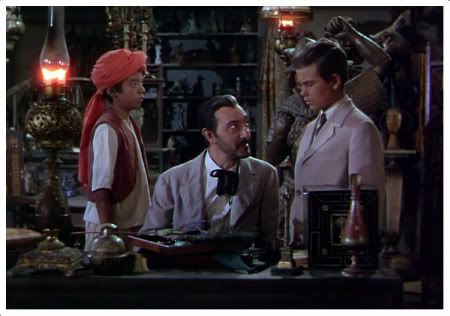
Rudyard Kipling’s thrilling adventure novel “Kim” was brought to the screen in 1950 in brilliant eye-popping Technicolor and boasted a splendid cast with Errol Flynn as the magnificent Red Beard, Cecil Kellaway as the Fat Man, Paul Lukas as the Holy Man ( a Tibetan monk with an unusually strong Austrian accent ), and Dean Stockwell as our boy-hero Kim - a young English lad who learns how difficult it can be to play to spy for the Great Game, especially when he learns that he must forsake his scavenging ways and don the manners of his own people.

"You belong with your own people. A true man, like a true horse, runs with his own breed"


Kipling's novel was based on real-life spying methods during the era of the Great Game. This was the familiar term for the rivalry the British Empire had with Russia for gaining territory ( and supremacy ) in Central Asia. The "game" began in 1813 and continued on for nearly 100 years. In 1885, the year that Kim was set in, the two powers nearly declared war on each other when Russia seized Afghan territory near Panjdeh.

Filmed on location in Rajasthan and Utter Pradash, India ( as well as Lone Pines, California ), the movie gives us a grand tour of India and how it may have looked during the Age of Imperialism, when British troops paraded on grounds outside city walls and wily dangerous characters lurked in dark corners of crowded sadaks. 


The rights to Rudyard Kipling's popular adventure novel were purchased by Metro-Goldwyn-Mayer in the mid-1930s with the intention of casting Freddie Bartholomew in the title role. For unknown reasons, this project was abandoned and not taken up again until the late 1940s.

During this time, Errol Flynn was loaned to MGM from Warner Brothers for two pictures. The first one was That Forsyte Woman where, opposite Greer Garson, he was cast as the unloved Soames Forsythe. His second feature was a choice between King Soloman's Mines or Kim. Both were to be filmed on location. Errol opted for India over Africa and the lead role of Allan Quartermain in King Solomon's Mines was turned over to English actor Stewart Granger...in a very enjoyable version of the story too, if I say so meself. 


Kim is a wonderful adventure film as well – enjoyable for all ages – but alas, it fails to be a truly memorable film, mainly due to its heavy reliance on voice-over narration rather than pictures and dialogue. However, when there is dialogue, it is spoken right from the pages of Kipling’s novel and pleasantly plays on the ears in lyrical fashion.

" You should believe only your eyes…and not the voices of others."

" This is a child’s game, Mr. Luzor "

" It is part of a Great Game ". 

Sir Robert Baden-Powell, the famous British Army scout and founder of the Boy Scout movement, would of fully approved of the lessons this film teaches…..key lessons on observation and judging character; always being aware of one's surroundings and being prepared.


Dean Stockwell is particularly noteworthy as the English sahib living life as an Indian boy. Devoted to his Holy Man, Kim acts as his chelah ( a servant to a monk ) while travelling across India with him in quest of the sacred River of the Arrow. Begging on the streets, climbing across rooftops, cursing passerby's, and donning a dark tan, he is an unlikely suspect to his enemies and hence...becomes a master player of the Great Game.

This post is our contribution to The British Empire in Film Blogathon being hosted by The Stalking Moon and Phantom Empires. It's a ripping good event covering all the grand and glorious films set in the age of Imperialism. Be sure to check it out!