"Dive! Dive!"
Film producer/director Irwin Allen let audiences dive deep into the waters of adventure with Voyage of the Bottom of the Sea, his second of three feature films that he made at 20th Century Fox studios in the early 1960s. Prior to gaining a reputation as "The Master of Disaster" because of his disaster-themed films of the 1970s, Allen tried his hand at writing, producing and directing adventure pictures. His first production for Fox - Lost World (1960) - was co-written by Charles Bennett and its success at the box-office led to the two men collaborating on another Jules Vernes-like story. They took some inspiration from "20,000 Leagues Under the Sea" and created a clever story about a modern era atomic submarine
Walter Pidgeon stars as the cigar-chomping Admiral Nelson, inventor and commander of the newly built atomic sub Seaview. The Seaview is on diving trials in the Arctic Ocean when they discover boulder-size pieces of ice crashing into the sea around them. They surface and find that temperatures are over 100 degrees and the sky is aflame. A meteor shower had pierced the Van Allen radiation belt and caused it to catch on fire. Admiral Nelson and his right-hand man, Commodore Emery (Peter Lorre) believe that the Earth can be saved from burn-up if a missile were to be shot into the Van Allen belt to create an explosion. According to their calculations, this missile can only be launched from the Mariana Islands, and so the Seaview races to the south to reach the islands before the entire world burns.
Along for the ride is Dr. Susan Hiller (Joan Fontaine), a psychologist who is studying crews for their reaction to stress, Vice-Admiral B.J. Crawford (John Litel), and Congressman Parker (Howard McNear). The voyage progresses smoothly until doubts begin to arise in the mind of Captain Lee Crane (Robert Sterling) as to whether the admiral is making a sound and safe decision. Lt. Connors (Barbara Eden) has complete faith in the admiral but cannot explain the unusual happenings onboard the Seaview... acts of sabotage that appear to be of Admiral Nelson's doing.
Voyage to the Bottom of the Sea is a fun adventure flick packed with action. The race-against-time element makes the story exciting enough, but Allen threw in a touch of mystery with the added story of the saboteur. There are also two octopus attacks and a great mine-field sequence.
The Van Allen radiation belts had only recently been discovered when Irwin Allen began writing Voyage to the Bottom of the Sea, and so much about them was still unknown. The idea of the Van Allen belt catching on fire was later proven to be impossible, but at the time, it probably sent shivers down audiences thinking about it being an actual possibility.
Even though most of the film takes place within the confines of the Seaview, the film never feels stagebound. The sets, created by Herman Blumenthal, were very imaginative (they were later reused for the television series). The Seaview itself is an especially good design.
Irwin Allen plunged $1.5 million dollars into the making of Voyage to the Bottom of the Sea and it paid off handsomely. Critics gave the picture mixed reviews but audiences loved it and the movie raked in over $8 million dollars.
Teen singing-sensation Frankie Avalon helped to lure in the young female audience. His part was not very dramatic and, surprisingly, he didn't sing in the film but you can hear his voice crooning the opening credits.
Also in the cast was Michael Ansara (who fell in love with and married Eden after making the movie), Regis Toomey, Henry Daniell, Skip Ward and Mark Slade.
Showing posts with label Rewind Review. Show all posts
Monday, August 10, 2026
Saturday, July 25, 2026
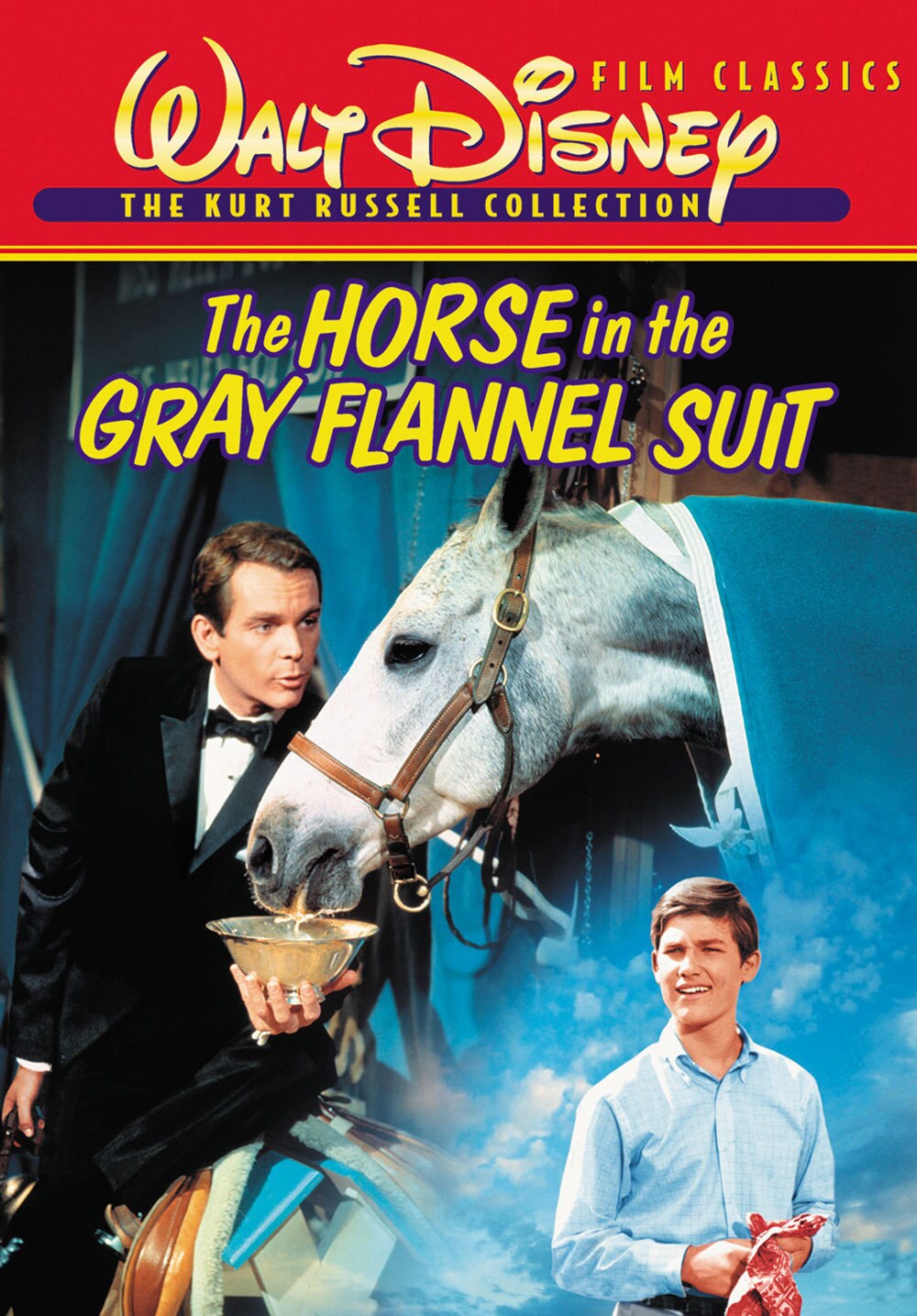
Rewind Review: The Horse in the Gray Flannel Suit (1968)
The Horse in the Gray Flannel Suit really has no bearing on horse racing but rather covers an event in the equestrian world that has seldom been depicted in the motion pictures - horse jumping.
Advertising executive Frederick Bolton (Dean Jones) finds he is up to his neck in bills and in stress. His daughter Helen (Ellen Janov) desperately wants a horse - which he cannot afford - and his boss wants him to dream up a winning advertising campaign for a prestigious pill company "Aspercel" by tomorrow - or else, lose his job.
After hours scheming up campaign angles, a bolt of inspiration hits him and he finds it may just be a solution that will please both his boss and his daughter: enter a horse named Aspercel in horse jumping competitions across America. What better way to instill in the minds of the social elite the tongue-tripping name of Aspercel and receive headline coverage nationwide?

The Horse in the Gray Flannel Suit was based on the novel "The Year of the Horse" by Eric Hatch, who was an author and screenwriter best known for My Man Godfrey and Topper. The film was originally planned to be released as The Year of the Horse, but instead, the publicity department decided to pun the popular 1956 Gregory Peck film The Man in the Gray Flannel Suit, which also dealt with the world of advertising.
Dean Jones' comedic skill in the short-lived television series "Ensign Pulver"(1963), had caught the eye of Walt Disney and when the series was canceled he was cast as the handsome cat-chasing FBI agent in That Darn Cat (1965). Jones has come to be known for his family man roles of the 1970s, but in the 1960s he was usually cast as a bachelor or a childless husband. In this film, he portrays a widower, whom we imagine has not been on a date since his wife's passing. Like most of his roles, he plays Fred with a lot of harried gestures and frequent bursts of nervous laughter.
Ellen Janov was performing at a club in Palm Springs singing when she was spotted by a Disney exec and screen-tested for the role of Helen Bolton. She was fifteen years old at the time of filming and this was the only picture she ever made. Later, she recorded a few songs released through Capitol Records before becoming a primal therapist in Los Angeles. She died tragically at the age of 22 in a house fire.
" For $2,000 I'd jump a few fences myself "
The lovely Diane Baker was making her first - and only - appearance in a Walt Disney production as Suzie "S.J" Clemens, Helen's riding instructor. Suzanne Pleshette could have easily played her role as well, but it is nice to see Baker in this part. The riding habit suits her.
Kurt Russell, who was soon to become one of Disney's biggest stars, had a supporting role as Helen's boyfriend Ronnie, while Morey Amsterdam provided comic relief as Fred's co-worker Charlie. Lloyd Bochner, Fred Clark, Alan Hewitt and Lurene Tuttle rounded out the cast.
The star of the film "Aspercel" was really Albarado, a dapple grey jumper who practically steals every scene he is in from the principal actors. In certain scenes, he was doubled by Sir Winston and Could Be, but don't ask us which scenes those were.
The beautiful Bolton estate and other location scenes were filmed on Disney's 900 acre Golden Oak ranch near Newhall, California.
Kurt Russell, who was soon to become one of Disney's biggest stars, had a supporting role as Helen's boyfriend Ronnie, while Morey Amsterdam provided comic relief as Fred's co-worker Charlie. Lloyd Bochner, Fred Clark, Alan Hewitt and Lurene Tuttle rounded out the cast.
The star of the film "Aspercel" was really Albarado, a dapple grey jumper who practically steals every scene he is in from the principal actors. In certain scenes, he was doubled by Sir Winston and Could Be, but don't ask us which scenes those were.
The beautiful Bolton estate and other location scenes were filmed on Disney's 900 acre Golden Oak ranch near Newhall, California.
The Horse in the Gray Flannel Suit was the first film to be marketed with "Walt Disney Productions Presents" after Walt's death in 1966. It was released on December 20, 1968, along with the short, Winnie the Pooh and the Blustery Day, but alas, the film was not the big success it was hoped to be. It brought in only $3.3 million dollars (half of what The Ugly Dachshund fetched).
"Aspercel, Aspercel...take one pill it'll make you well. If you're dead....your dead."
The Horse in the Gray Flannel Suit doesn't have the belly-laugh comedy of some of the better Disney films and, in spite of its marketing, isn't really a comedy at all. Aside from some amusing scenes of Dean Jones riding Aspercel bareback, it is more of a warm domestic drama. Like The Happiest Millionaire, it seems as though the Disney studios were experimenting with trying to capture an older audience. The film gently delves into a variety of different sub-surface topics such as gender equalities and single-parent child-raising all the while keeping the audience entertained and amused with its central theme - horses.
One of the more important dramatic aspects of the story plot, however, is the psychological trauma of children who support their family. Unbeknownst to Fred, his eagerness to make his publicity plan work puts a lot of untold pressure on the shoulders of his daughter. Helen feels that she is homely and that boys do not like her. Her equestrian skill is the only substance for her self-confidence, but she finds she doesn't enjoy riding as much when she discovers that it is her medals that will either keep or break her father's position. When Fred shamefully realizes this it dawns on him that he has been valuing his job more than his family and quickly makes amends to change that.
The Horse in the Gray Flannel Suit is a personal favorite of ours because of its "feel good" quality. Like most Disney films, it leaves you with a sense of satisfaction after watching it. The film is colorful, features talented performers, an entertaining plot and - most amazing of all -actually does focus on what you would expect to see in it based on its title: horse jumping. The twenty-five-minute finale will make any horse lovers heart thump, with actual footage from the Washington D.C International Horse Show spliced in between sequences. Overall it's a tally-ho-ho show!
Tuesday, April 21, 2026
Rewind Review: The Admirable Crichton (1957)
Lewis Gilbert's version of The Admirable Crichton is a handsome adaptation of one of J.M Barrie's most popular plays which, although often referred to as a "satire", was more than likely Barrie's way of disguising his gentle assault on the British class system. It's also a rather unabashed look at the utter helplessness the uppercrust have when they are thrust in a commonplace situation or, in this case, an un-commonplace situation.
Lord Loam (Cecil Parker) is the father of three young women, each about to be betrothed. Loam is a just man - one of those easily swayed lords of the English realm. He fancies that he desires equality as much as the average working class gent... and he does, to a point. In fact, it is his embarrassing "servant's tea party" that leads him to embark on a yachting voyage to the South Seas, along with his daughters, their suitors and the ship's staff.
When a spot of inclement weather frightens the crew into bailing, the passengers are left floating in a lifeboat in the mid-Pacific to fend for themselves. Thankfully, their unflappable manservant Crichton (Kenneth More) and a servant girl (Diane Cilento) are dunked overboard with them.... and it is Crichton who turns out to be their savior with his resourcefulness when they are marooned on a deserted island. As the toffs accustom themselves to island life they find a new social order emerging. The tables are reversed as Crichton becomes the lord of the land and they the servants; but when a passing ship comes to their rescue, Crichton must decide if they are to remain islanders or each return to their previous status.
The Admirable Crichton, released as Paradise Lagoon stateside, was the first color adaptation of Barrie's beloved 1902 play, but not the first filming. There was G.B Samuelson's 1918 silent version, Cecil B.DeMille's lengthy 1919 retelling (Male and Female starring Gloria Swanson) and Paramount's Yankeefied take on the story, We're Not Dressing, released in 1934 and starring Bing Crosby and Miriam Hopkins.
Lewis Gilbert displays a masterful hand at putting the shipwreck satire to film and Wilkie Cooper obviously delighted in photographing the island paradise, which the play could only suggest. His sumptuous Technicolor photography gave reason enough for Brits to leave their flats to see the film.
The rich blue waters of Bermuda subbed for the unnamed South Seas island and a couple of well-placed artificial palms added to its appeal. The island sets are quite clever and were a precursor to the familiar bamboo sets of Gilligan's Island during the 1960s.
The always lovely Sally Ann Howes portrays the beautiful Mary, eldest daughter of the Loams, who finds she has lost her heart to her butler. Sally Ann Howes always seems to be running along a beach, but this time, alas, she is not singing "Truly Scrumptious". Cecil Parker is marvelous as Lord Loam; Diane Cilento (Mrs. Sean Connery at the time) plays the cockney Eliza, not unlike Eliza Dolittle; and Martita Hunt, Jack Watling, Peter Graves, Gerald Harper, Mercy Haystead, and Miranda Connell round out the cast.
The Admirable Crichton is a very entertaining and underrated little gem that has been cast adrift by the critics. It is hard to imagine watching this story unfold within the confines of a stage. It certainly was a tale meant to be filmed in Technicolor.
Although Barrie attempted to write a comical study of the folly of civilization's class system, he left The Admirable Crichton without a moral. What comes through in this film however, is that the poor class have as much, if not more snobbery, than the rich. It is Mary who desires to remain on the island married to Crichton and living the blissful life of a pair of castaways but Crichton is stubbornly proud of his "position" and fails to conceive how the daughter of his employer can love him for himself when the setting is changed. In short, he behaves like an utter ass.
Thursday, October 10, 2024
Rewind Review: The Witch's Tale Radio Series (1931-1938)
"Draw up to the fire and gaze into the embers as I tell you a hearty tale that will boil your blood..."
Old Nancy the witch knew how to tell a good ghost yarn. At over 107 years old ( and aging fast ) she certainly had plenty of years to practice her art of story-telling. Each week, for seven years, she gathered her listeners close to her via radio waves and cackled tales of mystery and horror to send chills running up their spine.
The old "Witch of Salem", as she was affectionately called, played host of The Witch's Hour, one of New York's most beloved horror programs, between May 21, 1931 and June 13, 1938 on WOR, the Mutual Radio Network. The series was created by Alonzo Deen Cole who not only wrote and directed each episode but also provided the sounds of Old Nancy's cat Satan. His wife Marie O'Flynn also took part acting in many of the episodes as the female lead.
Originally stage-actress Adelaine Fitz-Allen voiced old Nancy but after she passed on at the age of 79 she was replaced by 13-year old Miriam Wolfe....who did just as good a job!
What made The Witch's Hour so engrossing was the clever story lines and the quality of the programs. Each episode was well-acted and utilized convincing sound effects that gave the series its extra dose of creepiness.
Unfortunately, only about 50 episodes of the program still exist today since many of the original recordings, which were performed live during broadcast, were destroyed by Cole in 1961. All of the surviving episodes could be heard at the Relic Radio website or through Old Time Radio.
Old Nancy the witch knew how to tell a good ghost yarn. At over 107 years old ( and aging fast ) she certainly had plenty of years to practice her art of story-telling. Each week, for seven years, she gathered her listeners close to her via radio waves and cackled tales of mystery and horror to send chills running up their spine.
The old "Witch of Salem", as she was affectionately called, played host of The Witch's Hour, one of New York's most beloved horror programs, between May 21, 1931 and June 13, 1938 on WOR, the Mutual Radio Network. The series was created by Alonzo Deen Cole who not only wrote and directed each episode but also provided the sounds of Old Nancy's cat Satan. His wife Marie O'Flynn also took part acting in many of the episodes as the female lead.
Originally stage-actress Adelaine Fitz-Allen voiced old Nancy but after she passed on at the age of 79 she was replaced by 13-year old Miriam Wolfe....who did just as good a job!
What made The Witch's Hour so engrossing was the clever story lines and the quality of the programs. Each episode was well-acted and utilized convincing sound effects that gave the series its extra dose of creepiness.
Unfortunately, only about 50 episodes of the program still exist today since many of the original recordings, which were performed live during broadcast, were destroyed by Cole in 1961. All of the surviving episodes could be heard at the Relic Radio website or through Old Time Radio.
Since today is Halloween and tonight is the witching hour, be sure to tune into some of these programs, and for a sample, here for your listening pleasure are....
The Haunted Crossroads ( 1933 )
An invisible woman has stabbed a policeman in the back at an isolated crossroads. A stabbing like this has happened before, and will soon happen again.
Graveyard Mansion ( 1934 )
Two brothers inherit a suspicious old house in Louisiana and meet a beautiful woman who's been dead for one hundred years! Are there vampires within the mansion? A ghost perhaps?
The Wonderful Bottle ( 1934 )
A couple of young American lads in Argentina meet an old Spaniard who sells them a magic bottle that grants its owners every wish. That bottle was made by the devil and anyone who owns it must get rid of it before he dies or he will burn in hell’s fire forever!
The Devil Mask ( 1935 )
A wife is concerned about her husband's disrespect of African ways and so asks a witch doctor to boom on the drums a ceremonial chant to keep the devil away during the trip back to England.
The Priest of Sekhet ( 1936 )
A young British archaeologist becomes trapped in an ancient tomb, along with a dead priest from ancient Egypt. After his rescue, the archaeologist undergoes a strange change of character.
FIVE EERIE CLASSICS
The Haunted Crossroads ( 1933 )
An invisible woman has stabbed a policeman in the back at an isolated crossroads. A stabbing like this has happened before, and will soon happen again.
Graveyard Mansion ( 1934 )
Two brothers inherit a suspicious old house in Louisiana and meet a beautiful woman who's been dead for one hundred years! Are there vampires within the mansion? A ghost perhaps?
The Wonderful Bottle ( 1934 )
A couple of young American lads in Argentina meet an old Spaniard who sells them a magic bottle that grants its owners every wish. That bottle was made by the devil and anyone who owns it must get rid of it before he dies or he will burn in hell’s fire forever!
The Devil Mask ( 1935 )
A wife is concerned about her husband's disrespect of African ways and so asks a witch doctor to boom on the drums a ceremonial chant to keep the devil away during the trip back to England.
The Priest of Sekhet ( 1936 )
A young British archaeologist becomes trapped in an ancient tomb, along with a dead priest from ancient Egypt. After his rescue, the archaeologist undergoes a strange change of character.
This is a Rewind Review post dating from Halloween 2016.
Subscribe to:
Posts (Atom)