Showing posts with label Myrna Loy. Show all posts

Saturday, July 11, 2020

Magic Couples of Metro-Goldwyn-Mayer

Movies have always reflected the hopes and dreams of the public, especially in terms of romance. Since almost every movie genre - from mysteries to swashbucklers, from war to love stories - features a leading man and a woman, it is not surprising that thousands of different screen couples exist on film. Only a relatively few couples created real magic, and of these, a surprising number worked for MGM.

At the studio with "more stars than there are in heaven," Louis B. Mayer and Irving Thalberg acted as divine matchmakers. If a couple proved successful in a film, it was likely they would be recast as a team, especially if they were both under contract to MGM. Thalberg, for example, noticed a chemistry between Joan Crawford and Clark Gable when they co-starred for the first time in Dance, Fools, Dance ( 1931 ). He set the story department to finding scripts that would suit the two actors. Subsequently, Crawford and Gable made eight films together, in most of which she played the working girl who rose to fame and glamour, and he was the rugged he-man who loved her. Judy Garland and Mickey Rooney, the perennial happy-go-lucky teenagers, co-starred in nine MGM movies. And Myrna Loy and William Powell, the quintessential happily married couple of the forties, made thirteen films together in as many years. 

What made a great screen couple? The answer is as difficult to determine as it is to explain what makes a relationship work in real life. Like all great lovers, screen couples exude mystery and wonder. "We're inevitable, " John Gilbert tells Greta Garbo in Queen Christina ( 1934 ), "Don't you feel it?" She does and so do we. Great lovers always seem inevitable, part kismet, and part coincidence. 

Casting two actors together creates a third entity, a single ideal. And no movie studio in the world paired couples together with as much frequency as MGM. In some cases, screen couples served to perpetuate a series, such as Johnny Weissmuller and Maureen O'Sullivan in the Tarzan films, or Lew Ayres and Laraine Day in a succession of Dr. Kildare episodes. But the great MGM screen couples came to symbolize a singular aspect of romance: Greta Garbo and John Gilbert ( Temptation ); Clark Gable and Jean Harlow ( Lust ); Joan Crawford and Clark Gable ( Glamour ); Myrna Loy and William Powell ( Sophistication ); Jeanette MacDonald and Nelson Eddy ( Sentimental Love ); Judy Garland and Mickey Rooney ( Good, Clean Fun ); Greer Garson and Walter Pidgeon ( Enduring Love ); Spencer Tracy and Katharine Hepburn ( Mutual Admiration ). 

Perhaps the popularity of these couples can be attributed to moviegoers' longing for the romantic ideals these costars projected on the screen. Certainly, their popularity also was a reflection of the times. Jeanette MacDonald and Nelson Eddy sang sentimental arias to each other, lavishly adorned in period costumes, while the world suffered through the Great Depression. Their love was always chaste and their relationship was as idealized as someone like Louis B. Mayer couple imagine. In Mrs. Miniver ( 1942 ), Greer Garson and Walter Pidgeon stoically endured the hardships of World War II. ( Winston Churchill said that the movie did more for the war effort than a fleet of destroyers ). But the common bond and the lasting appeal of the majority of screen couples from this era also had to do with equality of the sexes. 
We may think of the liberated woman as a phenomenon of the seventies, but just look at the female characters of the thirties and forties. They were women who stood up to their men; Women who could wisecrack, work, even fight, if necessary, for the things they wanted and for the men they loved. They were equal partners in solving a crime, running a business, singing duets, or dancing on Broadway. These women held their own with men in the bedroom, the boardroom, and even the barroom, when necessary. In a classic scene from The Thin Man ( 1934 ), Myrna Loy discovers that William Powell has consumed six martinis, and tells the waiter, "....bring me five more martinis, Leo, and line they right up here."

These women matched their men, drink for drink, or any other way, and the men loved them for it. 

The influence of MGM's screen couples continues today on late-night television and in video rental stores, where these movies of yesteryear are still popular, reinforcing the fantasies created by Hollywood's most powerful dream machine. Obviously, we still want to believe that, in real life, Loy and Powell or Garson and Pidgeon stay happily married for decades. "Ah! Sweet mystery of life, " as Jeanette MacDonald and Nelson Eddy would croon. And the mystery was this: Why can't real life work like the movies?

- Peter Hay

The above article was an excerpt from "MGM: When the Lion Roars", written by Peter Hay and published by Turner Publishing Inc ( 1991 ). 

Saturday, October 17, 2015

Midnight Lace - Sheer Entertainment

In Ross Hunter's tense 1960 thriller Midnight Lace, effervescent musical star Doris Day becomes the pawn in a cat-and-mouse game when a sadistic man harasses her over the telephone. Tormented by an eerie voice who promises to kill her before the month is out, she is unable to convince anyone that a stalker even exists, let alone figure out who is behind these menacing calls.

Who would want to kill our heroine and why? That's the question viewers are asked to answer and when the film reaches its nail-biting conclusion, the audience is asked to keep the secret mum so that friends can have the fun of solving it themselves, too.

Doris Day is charming as Kit Preston with Rex Harrison as her dashing husband Tony, head of the respected Preston Mining Company. The couple share an elegant London townhouse, designed in a modern taste by Alexander Golitzen and Robert Clatworthy, which overlooks posh Grosvenor Square. 

The action begins right away on Kit's way home one day from shopping, when a sinister voice calls out to her in a thick London fog:

"Mrs. Preston. Over here. So close I can reach out my hands on your throat."

"Who are you? What do you want?"

"You'll know when the time comes Mrs. Preston, just before I kill you..."

Understandably frightened, Kit is told that her experience could be that of a prankster and she finds comfort the next day after seeing Lord Horatio Nelson's statue doused in bubble gum pink paint, a result of hooligans running amok in the previous day's "pea-souper", as Tony so aptly puts it.


Kit's peace of mind doesn't rest long after she receives a call, phrased much like the threat in the park and just as terrifying. The couple turns to England's esteemed Scotland Yard for professional help lead by Inspector Byrnes, played most convincingly by dapper English character actor John Williams. Byrnes explores all angles to the case, even questioning Kit's sanity. Perhaps she is making up her assailant as a means to garner attention from her frequently absent husband. 

Just when Tony's worries about his wife begin to increase, company accountant Daniel Graham ( Richard Ney ) uncovers a major discrepancy in the account books leading Tony to believe that a member of his staff has embezzled nearly one million British pounds! Could it be Daniel, himself? Or is it company treasurer and close friend Charles Manning ( Herbert Marshall )? He has been losing a lot of money at the horse races lately... Rounding out the cast is attractive Natasha Parry as Kit's dear friend Peggy, Myrna Loy as her sociable and sophisticated Aunt Bee, and Roddy McDowall.


Based on a 1961 two-act play by Janet Green entitled "Matilda Shouted Fire", Ivan Goff and Ben Roberts's witty script included an innocent flirtation between Kit and construction crew foreman Brian Younger ( John Gavin ). His crew is hard at work at a site next to the Preston's townhouse building and he keeps a careful watch over her after a series of unfortunate accidents occur, such as when a darkly-dressed man appears at Kit's doorway soon after another threatening phone call.

"Sometimes I think the Blitz left us with more derelict minds than derelict buildings"
                                                                                   Inspector Byrnes

Director David Miller did a fine job giving "Midnight Lace" a Hitchcock flavor. It chugs along at a nice clip and provides a clever twist at the finale when all is revealed. Talented cinematographer Russell Metty, famous for his work on classics like Bringing Up Baby ( 1937 ), Written on the Wind ( 1956 ), and Touch of Evil ( 1958 ), paints a rich picture in Eastmancolor which also serves to showcase Irene's chic gowns and dress suits worn by Doris. A champion of costume design, Irene was nominated for an Academy Award for Midnight Lace, but Arlington Valles snagged home the award that year for his creations in Spartacus

Doris's real-life husband Martin Melcher, and fellow producer Ross Hunter, had Universal release the film in October 1960 in New York City, though not in London as one would expect with regards to the story's setting. Hunter made his mark in crafting lush Technicolor dramas during the 1950s and 1960s, usually casting Doris, Lana Turner, or Jane Wyman in the lead role. He took a risk making a suspense, but it proved to be a wise move.

The film suited Doris well, allowing her to express her dramatic chops and it was appropriate for her legions of fans. Though one may not consider Universal's Midnight Lace in the same league as the studio's earlier horror classics, it has just the right blend of mystery and glamour to make it a satisfying flick to watch on a Friday night.

Just be sure you don't pick up the phone if it starts to ring...you never know who might be on the other end.

This post is my ( Diana ) contribution to the Universal Blogathon being hosted by yours truly, Silver Scenes. Be sure to check out all of the great posts covering Universal's most memorable classics from the 1910s-1960s.

Monday, November 4, 2013

School Bells Ringing, Children Swinging


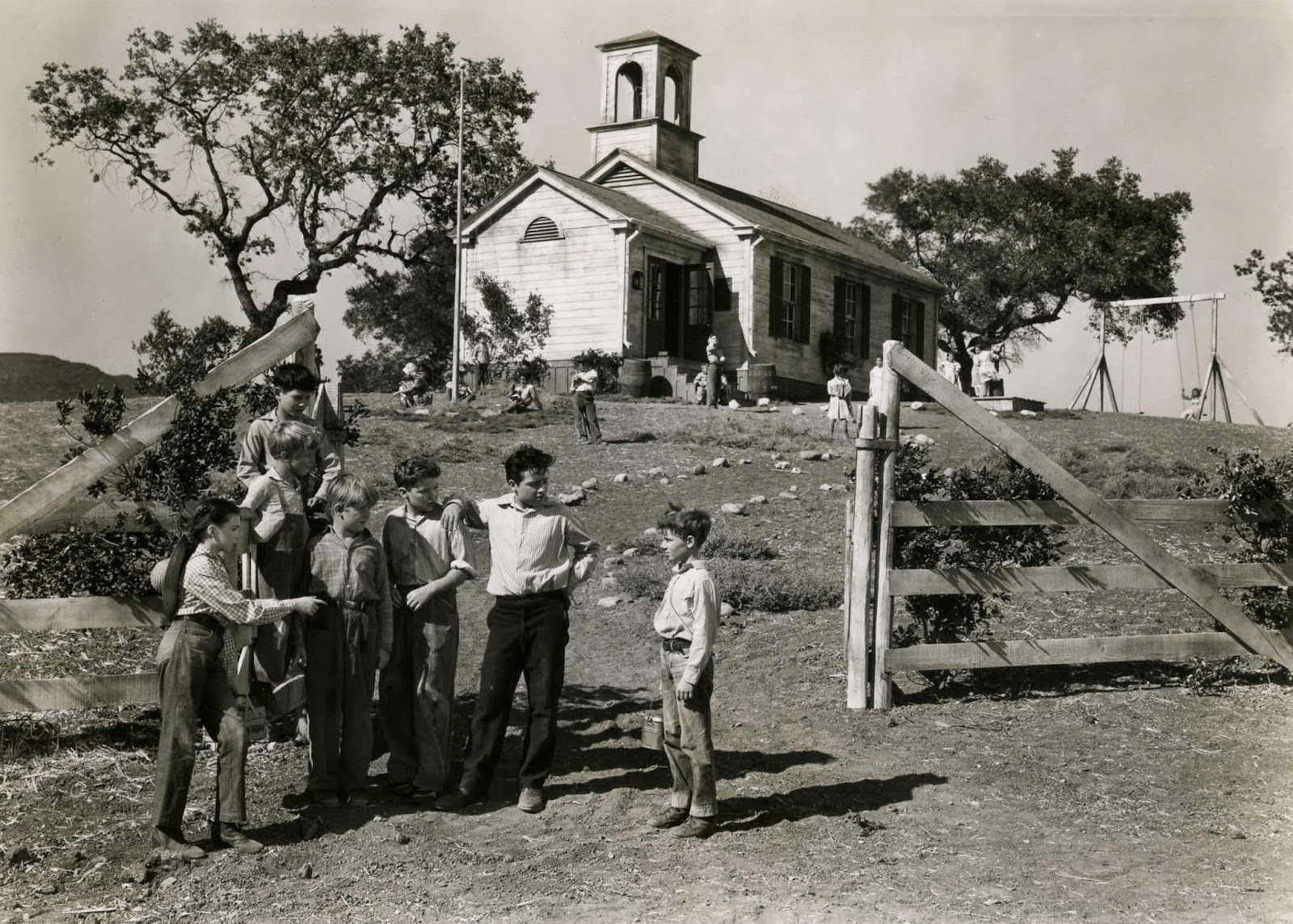
Boy meets horse, boy loses horse, boy miraculously gets horse back - stories like these were endlessly cropping up in films of the late 1940s. "National Velvet" and "My Friend Flicka" started a chain reaction that continued on until the early 1950s. Most of these follow-ups were just average productions, but The Red Pony ( 1949 ) was a stand out. Beautiful Technicolor and big name drawing actors like Robert Mitchum and Myrna Loy helped draw the adult crowd to this pleasing family film. A young Peter Miles plays Tom Tiflin, the pony's proud papa, and here we see him getting a teasing from his fellow schoolmates. He probably should run to teacher for help, but won't, since she is played by the inimitable Margaret Hamilton. 

Sunday, September 22, 2013

Libeled Lady ( 1936 ) - A Behind-the-Scenes Look

Every ace reporter wants a good story, one that is ripe with human interest and a fair amount of juice. But a really good reporter avoids the pulp. Sometimes, in the haste of chasing a scoop they squeeze a lemon and then they find the aftertaste to be quite bitter. Warren Haggerty ( Spencer Tracy ) did just that. As editor of the New York Evening Star, he printed a statement that heiress Connie Allenbury ( Myrna Loy ) was a marriage-breaker, cause enough for her to sue him for libel - $5,000,000 worth! 

Frantic, Haggerty schemes up a plan to prove his statement true. He nabs an out-of-work reporter ( William Powell ) to marry his own fiancee Gladys ( Jean Harlow ), and then orders him to compromise Ms. Allenbury. Enter an indignant Gladys who will then publicly sue Connie Allenbury for husband-stealing. Good plan, providing all runs well. 

All does NOT go well, however. Hence, the film takes a rollicking good turn into the realm of comedic mayhem. 


Libeled Lady is based on an original story by William Sullivan, a former newspaper reporter himself. Its premise revolves around a newspaper editor's worse nightmare - a libel suit. But, like most editors will attest, ingenuity comes to the rescue in moments of crisis, and Warren Haggerty will do anything to avoid that suit and save his job. 


The film is a briskly paced and highly amusing comedy which gives each of its stars plenty of room to sparkle and shine. It features some of MGM's top talent in their best form. Jean Harlow began her rise to stardom through screwball comedies and her return to the genre, after some more diverse roles in Riffraff ( 1935 ), Wife vs. Secretary ( 1936 ), and Suzy ( 1936 ), was welcomed with open arms by the public. Libeled Lady secured her standing as one of MGM's top female stars. She went on to make two more films before her untimely death at the age of 26.


Interestingly enough, Harlow originally balked at playing the part of Gladys. She wanted the role of Connie Allenbury in order to have scenes with her off-screen fiancee, William Powell. The MGM boss, Louis B. Mayer, shook his head at the suggestion ( he insisted the Powell/Loy teaming was what the public wanted ), and by the end of the film Harlow admitted that she enjoyed playing Gladys and the role was perfect for her. Even though she didn't get to spend many scenes together with Powell, they did spend time with each other in between scenes. As Frank Miller* writes, 

" She often visited the set when he was filming his scenes with Loy. One of those times, while she was waiting for Powell to finish a scene so they could go to dinner, director Jack Conway realized that he was one extra short for a big scene. Rather than let them postpone shooting - the casting office was already closed for the night - Harlow put on a black wig and joined the rest of the extras, a return to the work she had done when she first arrived in Hollywood ". 


Rosalind Russell was originally selected for the role of the heiress, but after the success of Powell and Loy's teaming in The Great Ziegfeld, it was decided that Myrna Loy would be more suitable. Libeled Lady marked the fifth of their fourteen films together. 

Another star that was replaced prior to the film's shooting was Lionel Barrymore for the part of Mr. Allenbury. Walter Connolly took over and played it with flair.


Location scenes for the famous fishing sequence were filmed in the high Sierras of California. The beautiful set design of the Allenbury's fishing cottage was another wonderful creation from MGM's supervising art director, Cedric Gibbons, who was busy that year working on Romeo and Juliet and The Great Ziegfeld for the studio as well. 

Libeled Lady was advertised as being MGM's first all-star film since Dinner at Eight ( 1933 ). It was directed by one of MGM's most dependable directors, Jack Conway, and was an immense hit at the box-office, earning $2.7 million in sales and even picked up an Oscar nod for Best Picture. 


Unlike most romantic comedies today, Libeled Lady had a perfect balance of star punch. It subtly refused to shine the spotlight on any one person and let it rest on all of them instead. It is truly a sophisticated slapstick par excellence. We have not seen the movie in over ten years and yet the one feature we do recall about the movie is it was funny...for that to remain memorable is a testament to how amusing the film must really be.

Some may say that a libel suit is no laughing matter...but Libeled Lady proves that statement wrong. It can be a laughing matter indeed! 

This post is our contribution to the Journalism in Classic Film blogathon covering newspaper men and women in classic films, hosted by Comet Over Hollywood and Lindsay's Movie Musings. Be sure to check out all the other great posts in this blogathon! 

* for TCMdb