Showing posts with label Joan Crawford. Show all posts

Saturday, November 29, 2025

The Shining Hour (1938)

MGM films are easily distinguished by their production values, which were top in the industry. If you turn the TV on midway through an MGM movie, you are likely to know it is an MGM movie just by the quality of the set design, the music, the costumes, the cinematography, and of course the "big name" actors. 

The Shining Hour had all of the above - except for a quality script. Unfortunately, this brought the whole film down to a Columbia "B" movie status. As entertaining as the film was, the plot seemed so absurd mid-way through that it turned into a comedy - at least for the two of us watching it. We had a grand laugh! But I doubt this was the intention of Keith Winter's original stage play. 

The story around The Shining Hour is a simple love triangle turned into a rectangle. Henry Linden (Melyn Douglas) comes from a socially prominent Wisconsin farming family. On a trip to New York City, he falls in love with dancer Olivia Riley (Joan Crawford) and asks her to marry him. Henry's brother David (Robert Young) reads about their engagement in the newspaper and flies to New York City hoping to stop the "impossible" marriage. He hadn't met Olivia yet, but he already knew she didn't belong in the Linden family. Hrumph! David questions her integrity so she slaps him in the face and marries Henry. 

When the newlyweds arrive at the grand Linden estate, they are greeted by David and his wife Judy (Margaret Sullavan) but not by Hannah (Fay Bainter), Henry and David's sister, because she, too, was against the "impossible" marriage. These Lindens are making a bad impression as wealthy country snobs. 

Judy takes to Olivia instantly and the two become fast friends and Olivia tries her best to become one of the proud Lindens.... in fact, she fits like a glove. Hannah begins to tolerate her and all seems to be going well until David suddenly has a change of heart and falls in love with Olivia! She tries to resist his charm but he continues to pursue her, even during the party when Henry and Olivia are celebrating the completion of their big new beautiful house. Judy suspects as much but Henry is blissfully unaware of any complications until Olivia begs him to take her away on a long honeymoon - that very night.

This seems to be the crutch of the problem with the Lindens. They greet one another during the day like they never slept together the night before. All of their romantic entanglements seem like they are being played out at a college campus and not one of them is really married. Throughout the second half of the film, Olivia repeatedly says she is "no good" and does not deserve the love of Henry since she never really loved him when she married him, however, it is Olivia that is making the only effort to being a loving spouse. Henry continually leaves her alone as though he were a travelling salesman... as a gentleman farmer what could he possibly be doing on a farm so late at night? David is even more aloof towards Judy. He wears dinner whites in the evening and riding clothes during the day so, unlike Henry, I doubt he works on the farm and yet he barely talks to Judy. 

Sadly, Hannah is the worst of the lot. Towards the end of the film, she goes into a jealous rage and burns Henry's new house down. Director Frank Borzage captures this scene well and we see Fay Bainter dressed in black, her hair all tussled, and laughing like a mad woman. The next scene, Henry and David still have ash on their face from putting out the fire and Hannah is back to being primly dressed and calmly serving them a cup of coffee. It is these abrupt transitions that no doubt led critic Bosley Crowther to calling the film "a hackneyed story of a definitely inferior grade."

The hackneyed transitions could have been fixed if the runtime was just a bit longer. The Shining Hour is only 76 minutes long and that seems much too short for such a dramatic script - even the Andy Hardy films ran over 80 minutes! Audiences thought little of the film as well and MGM ended up swallowing a loss of over $137,000. Joan Crawford had suggested the play as a property worth buying so Louis B. Mayer was probably cross with her. 

After reading this review you may be thinking "Is this film even worth watching?" and the answer to that is, yes, definitely! Joan Crawford and Melvyn Douglas are wonderful in the movie, it's a top-notch production (except for the preposterous story), the Cedric Gibbons sets are gorgeous, the setting is scenic, you'll get to see Joan Crawford dance, and the ending is amusing, so why not watch it? 

Saturday, December 25, 2021

Happy Holidays!

Merry Christmas to all our readers! 

We want to wish all of you a very jolly Christmas day and here's hoping 2022 will be a year filled with happiness, good health, and prosperity for you! 

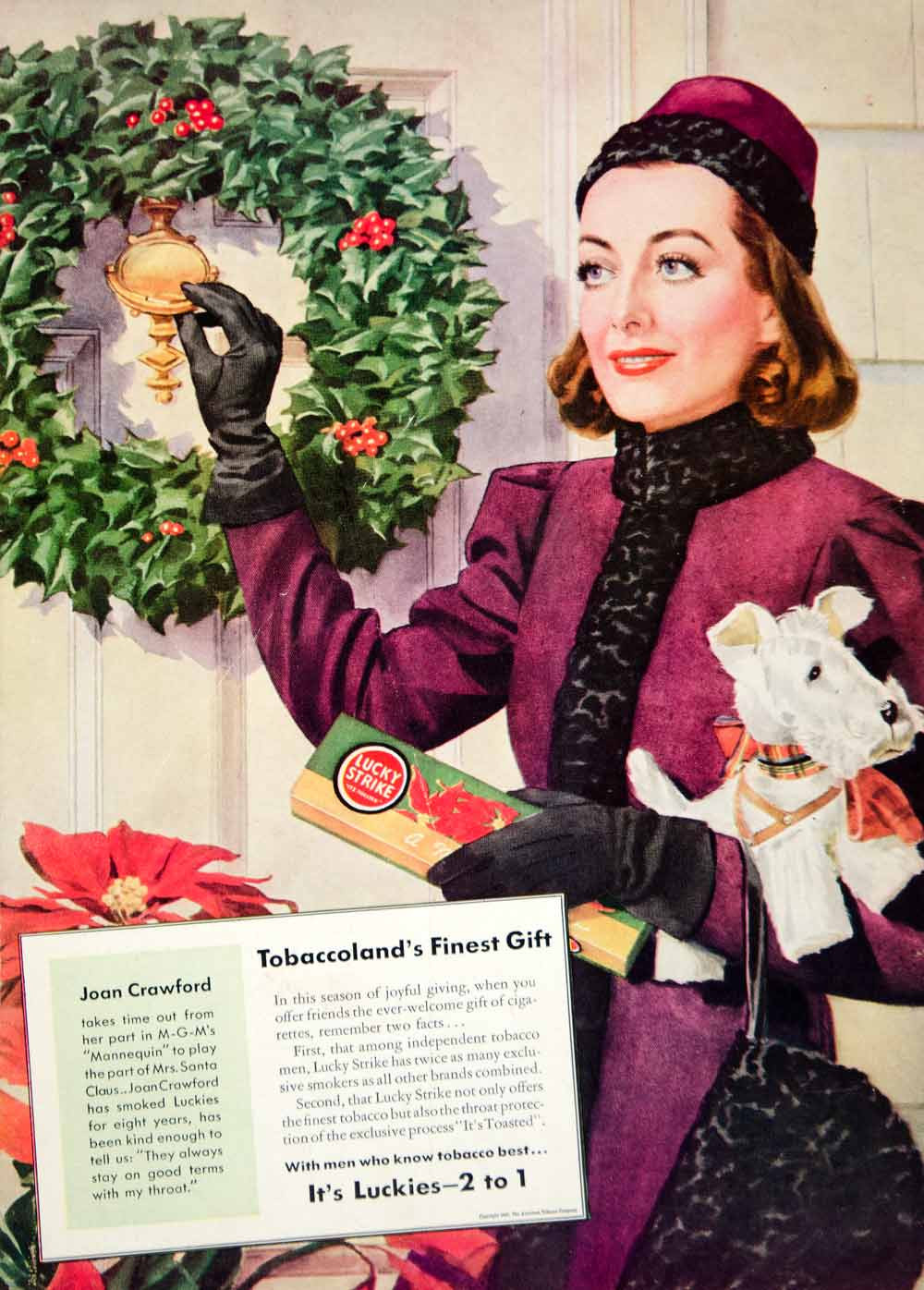
Make sure you have a box of Lucky Strikes in your house because Joan Crawford just may stop by for Christmas dinner! 

Saturday, July 11, 2020

Magic Couples of Metro-Goldwyn-Mayer

Movies have always reflected the hopes and dreams of the public, especially in terms of romance. Since almost every movie genre - from mysteries to swashbucklers, from war to love stories - features a leading man and a woman, it is not surprising that thousands of different screen couples exist on film. Only a relatively few couples created real magic, and of these, a surprising number worked for MGM.

At the studio with "more stars than there are in heaven," Louis B. Mayer and Irving Thalberg acted as divine matchmakers. If a couple proved successful in a film, it was likely they would be recast as a team, especially if they were both under contract to MGM. Thalberg, for example, noticed a chemistry between Joan Crawford and Clark Gable when they co-starred for the first time in Dance, Fools, Dance ( 1931 ). He set the story department to finding scripts that would suit the two actors. Subsequently, Crawford and Gable made eight films together, in most of which she played the working girl who rose to fame and glamour, and he was the rugged he-man who loved her. Judy Garland and Mickey Rooney, the perennial happy-go-lucky teenagers, co-starred in nine MGM movies. And Myrna Loy and William Powell, the quintessential happily married couple of the forties, made thirteen films together in as many years. 

What made a great screen couple? The answer is as difficult to determine as it is to explain what makes a relationship work in real life. Like all great lovers, screen couples exude mystery and wonder. "We're inevitable, " John Gilbert tells Greta Garbo in Queen Christina ( 1934 ), "Don't you feel it?" She does and so do we. Great lovers always seem inevitable, part kismet, and part coincidence. 

Casting two actors together creates a third entity, a single ideal. And no movie studio in the world paired couples together with as much frequency as MGM. In some cases, screen couples served to perpetuate a series, such as Johnny Weissmuller and Maureen O'Sullivan in the Tarzan films, or Lew Ayres and Laraine Day in a succession of Dr. Kildare episodes. But the great MGM screen couples came to symbolize a singular aspect of romance: Greta Garbo and John Gilbert ( Temptation ); Clark Gable and Jean Harlow ( Lust ); Joan Crawford and Clark Gable ( Glamour ); Myrna Loy and William Powell ( Sophistication ); Jeanette MacDonald and Nelson Eddy ( Sentimental Love ); Judy Garland and Mickey Rooney ( Good, Clean Fun ); Greer Garson and Walter Pidgeon ( Enduring Love ); Spencer Tracy and Katharine Hepburn ( Mutual Admiration ). 

Perhaps the popularity of these couples can be attributed to moviegoers' longing for the romantic ideals these costars projected on the screen. Certainly, their popularity also was a reflection of the times. Jeanette MacDonald and Nelson Eddy sang sentimental arias to each other, lavishly adorned in period costumes, while the world suffered through the Great Depression. Their love was always chaste and their relationship was as idealized as someone like Louis B. Mayer couple imagine. In Mrs. Miniver ( 1942 ), Greer Garson and Walter Pidgeon stoically endured the hardships of World War II. ( Winston Churchill said that the movie did more for the war effort than a fleet of destroyers ). But the common bond and the lasting appeal of the majority of screen couples from this era also had to do with equality of the sexes. 
We may think of the liberated woman as a phenomenon of the seventies, but just look at the female characters of the thirties and forties. They were women who stood up to their men; Women who could wisecrack, work, even fight, if necessary, for the things they wanted and for the men they loved. They were equal partners in solving a crime, running a business, singing duets, or dancing on Broadway. These women held their own with men in the bedroom, the boardroom, and even the barroom, when necessary. In a classic scene from The Thin Man ( 1934 ), Myrna Loy discovers that William Powell has consumed six martinis, and tells the waiter, "....bring me five more martinis, Leo, and line they right up here."

These women matched their men, drink for drink, or any other way, and the men loved them for it. 

The influence of MGM's screen couples continues today on late-night television and in video rental stores, where these movies of yesteryear are still popular, reinforcing the fantasies created by Hollywood's most powerful dream machine. Obviously, we still want to believe that, in real life, Loy and Powell or Garson and Pidgeon stay happily married for decades. "Ah! Sweet mystery of life, " as Jeanette MacDonald and Nelson Eddy would croon. And the mystery was this: Why can't real life work like the movies?

- Peter Hay

The above article was an excerpt from "MGM: When the Lion Roars", written by Peter Hay and published by Turner Publishing Inc ( 1991 ). 

Saturday, September 22, 2018

Johnny Guitar ( 1954 )

Joan Crawford in a western? If that sounds incredulous, Ms.Crawford must have thought so, too, because it was not until 1954 that she starred in her first spurs-and-guns picture - Johnny Guitar. Unlike Barbara Stanwyck, Joan seemed out of place in the desert locale sporting jeans - but she gave it a good try. 
Crawford stars as Vienna, a saloon/casino owner who owns a good chunk of territory in a wind-swept Arizona cattle town and wants the railroad to put in a new stop in town thereby carrying tourists to her gambling lair. Emma Small ( Mercedes McCambridge ) has recently brewed a potful of poison in her heart against Vienna because Vienna stole her sweetheart, the Dancin' Kid ( Scott Brady ), away from her and now is dead set against her notions of securing a railroad stop. 

The Dancin' Kid isn't the noblest citizen in town. He and his cronies ( Ernest Borgnine, Ben Cooper, Royal Dano ) are constantly being blamed for robbing stage-coaches. In truth, they are mining ore from a hidden silver vein. But when the vein runs dry, the Dancin' Kid sees no harm in robbing the town bank - owned by none other than Emma Small. Emma is certain that Vienna is behind the robbery, so it is a good thing that Vienna hired her former lover, Johnny Guitar ( Sterling Haydn ), for protection. 

Johnny Guitar grossed more than $2.5 million when it opened in theatres in January 1955, in spite of primarily negative reviews from critics. It is an unusual western from director Nicholas Ray ( They Live by Night, Rebel Without a Cause ), playing out like a western-noir with a lot of tough-talking drama. The film is slow to start with way too much pretentious dialogue taking place within the confines of Vienna's saloon but, once the picture moves out-of-doors, the story begins to unfold and it is pure entertainment from there on. 

Mercedes McCambridge gives a powerful performance of an embittered woman who is sharpening her claws readying herself for the chance to accuse Vienna of "aiding and abetting" criminals, a hanging charge. In two fantastic showdowns, they butt heads in a war of glares, scathing remarks, and guns. 
McCambridge was not the first choice to play Emma Small. Crawford, who owned the film rights to the novel "Johnny Guitar" by Roy Chanslor, had wanted either Bette Davis or Barbara Stanwyck for the role but both actresses were too expensive. McCambridge adds such a bite to the character that neither Davis or Stanwyck could have given. 

Actually, the entire cast is glove-fit for their roles...with the exception of Joan Crawford. It is good to see Scott Brady in a semi-villainous role. Sterling Haydn gives his usual gruff performance as Johnny Guitar. The remainder of the cast is made up of familiar western character actors: Ward Bond has a great part as big man John McIvers, Frank Fergusen plays the town marshall, and John Carradine and Rhys Williams are friends of Vienna's.
Johnny Guitar was filmed in TruColor and the color cinematography is beautiful. Costume designer Sheila O'Brien made excellent use of her fashion color palette bedecking Crawford in bright solid colors that stand out among the muted old western town surroundings. In one scene, Vienna is dressed in a gown of white that seems to symbolize her virtuous innocence among the black-clothed posse that has come to hound her.

This particular scene emphasizes what many modern reviewers consider is what Johnny Guitar is really about - a visual commentary on the House of Un-American Activities communist scare which was taking place at that time. In Hollywood, so many actors - including Sterling Haydn - were pressured into naming fellow thespians whom they believed to be communists. Vienna has no personal grievance against the Dancin' Kid and his men but, when little Turkey, one of his gang, is captured in her house, it seems to prove her allegiance to him. The posse threatens Turkey to admit that Vienna is one of the group. Denial means death. A tough choice for the poor kid to make....as it was for those who testified against their friends during the communist trials. 
Peggy Lee gives a sultry performance of the title song near the end of the film, which, if you had felt like turning off your television mid-way through Johnny Guitar, would have made you regret it. It is one of the best western endings that I have seen in years. 

Sunday, May 7, 2017

TV/Movie Set - When Ladies Meet ( 1941 )

Back in the studio-system days of Hollywood, if a film turned out to be successful at the box-office, within a decade you can be sure that a remake would be filmed. Why chance a new script when you have a winner on hand? Metro-Goldwyn-Mayer loved digging out old scripts and re-working them for their current stars. One such production was When Ladies Meet ( 1941 ), a re-telling of the 1933 comedy starring Ann Harding. 

MGM gathered together a few of their biggest talents, surrounded them with a top-notch production crew, and updated the script a bit to add some modern pizzazz to the old war-horse. What resulted was good box-office. Hey, it's a formula! 

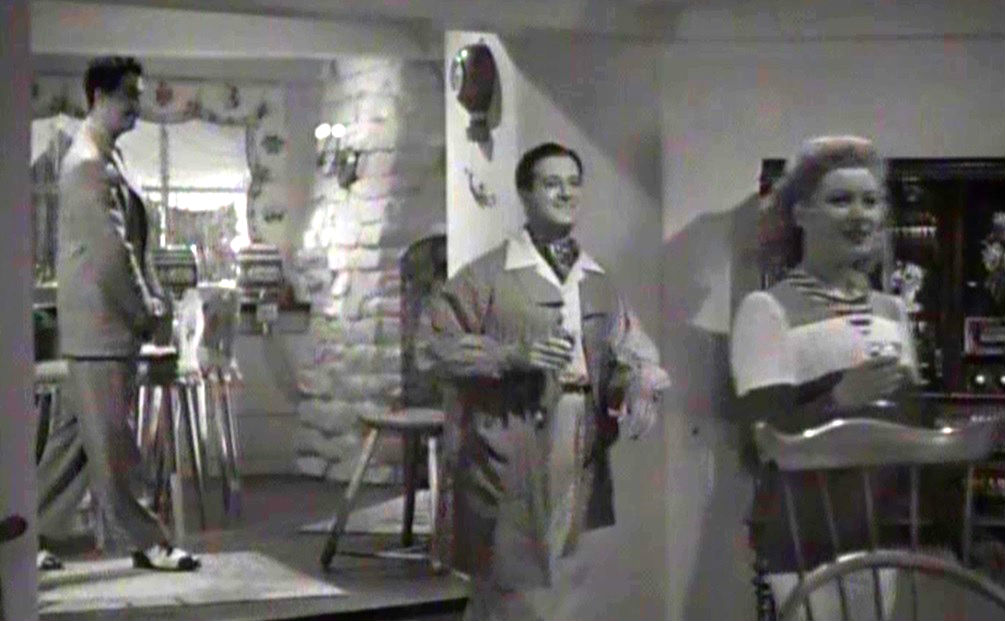
Having not seen the original I can only comment on this remake and say that it is quite an entertaining bit of fluff. But even more impressive then the wonderful cast ( Greer Garson, Joan Crawford, Robert Taylor, Herbert Marshall, and Spring Byington ) was the set design....particularly the house of Bridget Drake, portrayed by Byington. Like most of her roles, she plays a rather dizzy woman ( but obviously not dumb since she is living in such a beautiful home ). Her boyfriend Walter converted an old water-wheel into the extravagant country retreat and, on one afternoon, she finds herself saddled with some old friends staying for the night : author Mary Howard ( Crawford ) who hopes to have a rendezvous there with her publisher/lover Mr. Woodruff ( Herbert Marshall ); Jimmy ( Taylor ) who comes to follow Mary; and Mrs. Woodruff ( Garson ) who arrives not knowing that she will be meeting her husband's mistress. 

The things that go on in seemingly respectable country homes!.....Tsk, tsk, tsk. 

This lovely timber-framed Connecticut-style farmhouse boasted hardwood floors, beamed ceilings, thick white stone walls, and plenty of fireplaces to keep the guests cozy on rainy nights. It just so happened to be a rainy night when Robert Taylor and Greer Garson arrive unexpectedly. 

THE EXTERIOR

The Backyard - Or is it the front? Believe it or not that "pond" is the swimming pool, which Joan Crawford just splashed into from her perch atop a rustic swing. 
The Front Drive - The driveway skirts around the pool. We are never shown the garage but there certainly is one, and it is probably where the servants quarters are, too. 

THE INTERIOR

Dizzy Bridget was so proud of Walter's handiwork she gave the characters a tour of her house and, since she conducted it so well, we will just follow in her footsteps and make some remarks as we pass by these beautiful rooms. 
The Living Room - One of the best features of a traditional "Connecticut" style home is the sunken-living room. While it is open to the bar/kitchen and the staircases, the off-setting depth of the living space gives the room a warmer cozier feel and adds contrast.
The wrap-around sofa reminds me of the interior of a ski lodge. That's a model ship hanging on the wall. There are a number of them throughout the house. Walter must have shared a common interest in yachting with Claire Woodruff. 
When it's raining cats and dogs outside, sit beside the piano and sing a duet. At least, that is what Claire and Mary decide to do. After they find out they share a love for the same man, they no longer have much to sing about. 
Time for Drinks! - The merry foursome now head off towards the bar, which is actually the conversation room of the house, for this is where the inside of the "wheel" is kept. The water-wheel, that is. Look how thick the supporting beams are! This house is built to withstand a Blitz. 
The Bar - Another sloppy screenshot pastiche. If you want to see a larger image simply click on the photo...but be warned, the images only get blurrier the larger they are viewed. 
To the Dining Room! - After Walter's signature cocktails have been downed, he precedes to show them the dining room, tastefully furnished in Early American style. 
The Dining Room - Straight out of the 1941 Ethan Allen catalog. 

UPSTAIRS INTERIOR

The Upstairs Hall - Bridget now ushers her female guests to the upstairs guest rooms. There are four bedrooms in the main-room and supposedly two additional rooms above the barn. Bridget and Walter have separate bedrooms....she claims. 
Guest Bedroom #1 - Mrs. Woodruff is shown her cozy corners. Bridget plays the perfect hostess and even offers her a new toothbrush and nightgown ( why can't we be invited to Bridgie's place? )
Guest Bedroom #2 - Mary's chamber is much larger and there seems to be a flower theme going on here. 
Look how wide the doors are! Marvelous. 
The Barn Loft Guestroom - Finally, the barn loft, where Jimmy gets to bed for the night. He wonders why he can't stay in the main room, insisting that he has been "housebroken". 

THE TALENTS BEHIND THE SCREEN

The art direction of When Ladies Meet can be attributed to that artistic genius of MGM - Cedric Gibbons - whom you will find on the credits of over 1000 films. Almost all of his sets were decorated by Edwin Willis, who naturally did this film as well. When you have two talented individuals like these fellows working together you are bound to see some great house designs up on the silver screen, and, for me, Bridget's house in When Ladies Meet ranks as one of the best "country retreats" to be seen. 


This post is our contribution to The Favorite Film and TV Homes Blogathon being hosted by Phyllis Loves Classic Movies and Love Letters to Old Hollywood. Simply click on the links above to read more posts about fabulous house sets from the golden age of Hollywood. 

Thursday, December 3, 2015

Winter Sports in Films of the 1930s and 1940s

Whether you were born in a warm climate or the heart of the Arctic itself, the appeal of winter sports is undeniable. The crisp cold air, the thrill of the high-speeds, the beauty of the surrounding scenery capped off with the enjoyment of warming up with a cup of hot cocoa while sitting beside a roaring fire is one of the best pleasures to be had in winter. And if you are lucky enough to have a roasted sweet-potato near by, grab it. 

However, if there are palm trees blowing gently in the breeze outside your window, or so much snow has fallen that you can't shovel your way out of the house, then the next best thing to participating in winter sports is watching others romp in the snow. 


So grab a cola, find some pretty brunettes ( or a Jerry Colonna ) to sit beside and enjoy some good old-fashioned winter fun courtesy of Hollywood's dream factory. 

SKATING

All of the popular stars of the 1930s and 1940s strapped on a pair of skates and hit the ice ( sometimes the hard way ) for at least one film. Sonja Henie, the most famous ice skater of the 1930s starred in ten productions for 20th Century Fox during her reign as the studio's ice queen. You can see her twirl in dizzying circles in One in a Million ( 1936 ), Happy Landing ( 1938 ), Second Fiddle ( 1939 ) and Wintertime ( 1943 ) where she starred opposite such glamour boys as Don Ameche and Cesar Romero.

Don't go expecting any triple-salchows however. While Sonja was the top in her field in her day ( she won three Olympic gold medals ), ten-year old skaters can outdo her moves these days. The Norwegian gal with the dimples had charm and that made up for a large part of her star appeal. Incidentally, the "ice" that she skated on was primarily frozen milk. On black and white film, water did not give off the milky white texture that the studios wanted so they mixed some cow's milk into it to give it a shine. 

The Ice Follies, which began in 1936 and toured around the world, were all the rage in the 1930s and, of course, when something is the rage Hollywood is bound to make a film about it. Joan Crawford was pushed onto the ice along with James Stewart and Lew Ayres ( playing a drunk again ) in The Ice Follies of 1939. The movie has its entertaining moments ( including a sparkling Technicolor finale with Roy and Eddie Shipstad, the founders of the Ice Follies, doing some of the skating routines ) but it crashed at the box office. 


That didn't stop Republic from releasing another Follies-themed film just two years later : Ice-Capades starring James Ellison. He looked good on ice, and so did Clark Gable and Jean Harlow when they attempted to glide without falling in Wife Vs. Secretary ( 1936 ). 

Bette Davis tried skating, too, but she fell on her rump in The Man Who Came to Dinner ( 1942 ). If you want to learn how to showoff on skates like Joseph Cotten did in The Farmer's Daughter ( 1946 ), then it's best to watch a tutorial first. Mickey Mouse gives viewers some points in On Ice ( 1935 ). 


Of course, having a partner to support you helps - just look at how much fun Loretta Young had with Cary Grant in The Bishop's Wife ( 1947 ). 


SKIING 

If you don't care for the graceful art of figure skating then how about experiencing the thrill of cold air rushing against your face as you head down the slopes on a pair of skis? We're cross-country ski enthusiasts ourselves, so instead of risking our necks on the mountainside we prefer to watch our favorite stars hit the slopes...by standing in front of a backdrop screen. 


One of our all-time favorite actors - Melvyn Douglas - could often be found playing in the artificial snow. Claudette Colbert met him on the slopes at St. Moritz in I Met Him in Paris ( 1937 ) and Mary Astor stumbled down the hill with him in And So They Were Married ( 1936 ). 

Greta Garbo also found him in the snowbanks in Idaho in Two-Faced Woman ( 1941 ). Barbara Stanwyck went to Lake Arrowhead to look for Melvyn but all she found was George Brent in My Reputation ( 1946 ). It cost her her reputation too. 

That's what happens when you don't know how to ski, you end up bumping into fellows you didn't plan on meeting. If that is a common problem then it's best to learn the fundamentals of skiing. Goofy demonstrates proper technique in The Art of Skiing ( 1941 ) with comical results. It makes you want to consider buying life insurance. 

The Alps were the ideal place and definitely the "in" place to ski during the 1930s. European socialites would go sloping on the mountains for amusement just as American society went slumming in the cities. 

Even members of royalty like Prince Rudolph ( Tyrone Power ) went to Switzerland to enjoy the fresh mountain air and the excitement of downhill skiing. It was his only form of relaxation, poor boy. Not only did he manage to get a few days of skiing into his busy schedule but he met another winter sports enthusiast ( Sonja Henie ) whom he fell in love with in Thin Ice ( 1937 ). Robert Young found romance with Florence Eldridge on the Alpine slopes as well in Paradise for Three ( 1938 ).

Most Americans could not afford to travel to the Alps, so they opted to head to the most famous ski resort of the West - Sun Valley, Idaho. 

Not only was the snow perfect for skiing but you could find Sonja Henie there too ( she certainly got around ). In Sun Valley Serenade ( 1941 ) she played a Norwegian refugee showing off her skiing and skating talent to the band manager at a Sun Valley resort - who just happened to be played by John Payne, another actor who looked great in cold-climate pictures. 

Bud Abbott and Lou Costello caught ski-fever when they headed out to Sun Valley for Hit the Ice ( 1943 ). They tried dog-sledding but found out that rolling like a snowball gets you down a hill faster! 

American society enjoyed the fun to be had in Sun Valley too. Gene Tierney played an heiress who meets a swell looking guy ( Tyrone Power ) at a resort in That Wonderful Urge ( 1948 ). Alright, he turned out to be a reporter, but heiresses can't expect everything to be perfect. 

Well, there you have it folks....these are just a few film suggestions to get you off of your couch and out of the house where you can enjoy the brisk cool air and the pleasure to be found in winter sports. 

See you on the slopes!
This post is our contribution to the Winter Sports Blogathon being hosted by Le Mot du Cinephiliaque . Be sure to head on over there to read more posts on films that featured your favorite winter sports.


Sunday, June 1, 2014

Above Suspicion ( 1943 )

"My love is like a red, red rose...." 

MGM journeys into the realm of espionage with Above Suspicion (1943), a witty jaunt into spy-laden pre-World War II Europe. 
Fred MacMurray plays Richard Myles, an Oxford college professor, who is happily ready to embark on a Continental honeymoon with his bride Frances (Joan Crawford). Before they depart however, a former colleague of his, now with the foreign office, asks the couple if they would do a favor to him, and jolly ol' England, by inquiring into the whereabouts of a scientist who has disappeared within the confines of the Fuhrer's Vaterland. He holds the secret plans to the Nazi's latest diabolical invention - underwater magnetic mines. As honeymooners they would be considered above suspicion and could look into the matter discreetly. Or so they are told. Ach du lieber!...before they can utter "uberraschung" they are caught up in a web of intrigue that leads them from Paris to the pine-laden Alpine forests of Innsbruck. 


Above Suspicion, based on the novel by Helen MacInnes, is an easy-to-follow and briskly paced thriller with some rattling good moments of excitement. Its purely escapist plot is given credibility through its deft handling by director Richard Thorpe (Night Must Fall, Ivanhoe) and its stellar cast. The film plays out along the lines of Desperate Journey with grand morale-boosting elements but very little plausibility.....but perhaps that's what makes both of these pictures so entertaining. Above Suspicion was released at the height of World War II, a time when so many American and British citizens were eager to make an active contribution to corking up the war for good. 

"Darling, the less you know, or appear to know, the better"

At one time or another we're all drawn in by the allure of being a spy; deciphering codes, staking out suspicious bookshop fronts, wearing disguises, hiding out in secluded chalets and, of course, capturing public enemies. Richard and Frances are no different, and Frances is especially thrilled to help the British secret service but, unlike his wife, Richard realizes the danger ahead. En route, our American heroes stumble upon cryptic clues, all the while being spied on with peering abnormality by dubious faces and sundry characters. Their only key to unmasking friends from foes lies within the lyrics to Robert Burns eighteenth century melody. 

In addition to our leading cast, Above Suspicion features some excellent character support from Basil Rathbone, Felix Bressart, Reginald Owen, Richard Ainley, Bruce Lester and Sara Haden. Conrad Veidt is especially appealing in his role as Herr Seidel, one of the Brit's loyal allies within Germany. Veidt was often pigeon-holed as villains and it is a pleasant change of face to see him play this underground hero. Veidt died of a massive stroke shortly after filming commenced and Hollywood lost one of its most talented actors because of his passing. His entertaining dance floor sequence is a highlight of the film. 


Fred MacMurray was making a departure from his recent Claudette Colbert comedy teamings to take a dramatic turn and this role suits him quite well. Incidentally, Colbert would have made an excellent Frances had Crawford declined the part. 


Joan Crawford had been loyal to Metro-Goldwyn-Mayer since they gave her her start in 1925. She made seventeen films with the studio but by the early 1940s her star-status was beginning to wane and fresh faces like Lana Turner, Hedy Lamarr, and Greer Garson were receiving all of the choice scripts. Eager to showcase her acting ability, Crawford accepted a lower salary and switched to the less prestigious Warner Brothers studio after the completion of Above Suspicion. Within one year she was up for the Academy Award for Best Actress for her portrayal in Mildred Pierce.

Within Above Suspicion are hidden elements of Hitchcock-like suspense, featuring a labyrinth of twists and turns, car chases, and an assassination attempt at an opera, a scene taken right out of The Man Who Knew Too Much (1934). Overall, the film is like a tasty strudel filled with chunks of drama, comedy and action, all enfolded within thin layers of plot to make up a taut 90-minute thriller.


This post is our contribution to the super-sneaky Snoopathon hosted by Movies Silently. Be sure to check out all the great posts about the nefarious spies, agents, and Mata Hari's that appeared in films from 1920-1965.