Sunday, April 11, 2021

Mary Brian - It's Hard to Grow Up in Hollywood

Mary Brian was one of the most beautiful actresses of the 1930s. She often played charming ingenues in college-themed romances, but it seems these roles were not her cup of tea. Evelyn Warmoll shares with us in this 1938 article from Hollywood magazine, that Mary Brian was looking for more dramatic "grown-up" roles while Hollywood while trying to keep her young and innocent: 

While most movie stars are sadly bemoaning the fact that they are growing old all too fast on the screen, Mary Brian, fresh from a season of personal appearances, is back in Hollywood to try again to gain recognition as a grown up, mature, young woman. 

Mary has been Hollywood's perpetual "little girl" for ten years. She's frankly tired of it. She wants to prove to producers and a loyal following of movie fans that she has outgrown co-eds and fairy princesses and younger sisters. She wants to play dramatic feminine leads. She wants to emote. She wants to be recognized as a dramatic actress. She is tired of playing pretty young things who flit hither and thither and seldom have a dominant scene in the story which goes on around them. 

It doesn't seem so very long ago that Paramount announced that it was starting a worldwide search for a novice to play the title role of its silent production, Peter Pan. Mary Brian, just out from Texas, was at the Los Angeles Paramount theatre — dancing in the chorus — when Albert Kaufman, brother-in-law of Adolphe Zukor, saw her, talked with her and sent her out to the Paramount lot for a test for Peter Pan. Mary trembled as she made the test for it was her first movie experience, but the next day director Herbert Brenon phoned to say that a contract awaited her — not for Peter Pan but for "Wendy." When she stepped out of the dancing lineup and became Wendy, she began a series of young girl parts which lasted throughout her six and a half years as a Paramount contract player. 

She was pretty much the successor to Mary Pickford and Mary Miles Minter as Hollywood's sweetheart. No film debutante was more sought after for party lists than Mary. "The sweetest kid in Hollywood" she was called off-screen as well as on. No college picture was quite complete without Mary Brian as the fair young co-ed who turned the heads of the gridiron heroes, and finally arrived at her big romantic scene either in the booth of some campus ice cream parlor or under the ever-present sheltering oak in front of the girls' dormitory. 

When she wasn't decorating college pictures, romantic dramas of Civil war days claimed her for doll-like crinoline girls who made exquisite pictures of Mason-Dixon beauty, but never had much opportunity to lead the parade when the dramatic scenes began. 

When the talkies came in Mary Brian began intensive training for more dramatic and dominant roles. She tucked her collection of sunbonnets and middie blouses gently but firmly in the garage trunk, pinned up the curls that once hung on the back of her neck, and tried every way she knew to "grow up" in a hurry. Other diminutive girls had been given dramatic roles — Helen Hayes, Sylvia Sydney, Elizabeth Bergner, dozens of small girls had dominated dramatic pictures. While Mary made no comparisons, she yearned for just one chance to show what she could do. But to Hollywood she was still the "young sister type." 

Finally, Walter Huston's The Virginian gave her a deviation from her usual cast assignment and The Front Page offered broader opportunities as did The Royal Family but whenever a college picture was being cast the first name on every casting director's tongue was "Mary Brian." 

As often as she could afford to, Mary shook her pretty head and announced that she had her mind set on more dramatic parts. During one of the waits between pictures, Ken Murray induced her to resume stage work and to return to her dancing (which Hollywood never thought of at all). For a year Mary alternated between Broadway, road shows and pictures that offered her at least some hope of outgrowing the "little sister" roles. 

Her personal appearances were huge successes and she found that her fans were just as eager for her to grow up as she was. When fans saw her dance in local theatres they wrote letters by the score to variolas Hollywood producers asking them to make Mary Brian a dancing screen star. 

When the co-ed and little sister offers continued unbroken Mary Brian went to London for a British picture and one day Hollywood was startled to hear that "little Mary" was the star of the 1935 Chariot's Revue and "going over like a house afire." 

After an extended London season Mary returned to Hollywood and played a "heavy" in Spendthrift merely to get away from the girlish type of role previously given her. This was followed by two independent pictures which offered more or less straight dramatic leads and other personal appearances in which she was supported by a dancing trio, Gordon, Read and King and also by Arena and Hines. 

A few months ago Mary came back to Hollywood again in search of mature roles and was fairly successful in Three Married Men and Killer at Large but the recent summer season found her at the head of the casting office lists for co-ed roles in a half dozen football pictures and she began to wonder what she could do to create a new "1938 model Mary Brian." 

"I'm afraid you just can't grow up in Hollywood," says Mary. "I enjoy playing girlish parts but I'm crossing my fingers and hoping that the day soon comes when I can play a dominant, dramatic part and show them that Wendy has grown up. I don't care whether I play a vamp, a society girl or a French apache; I just want a chance to assume a role that has some depth and determination." 

Mary Brian lives with her mother near Toluca Lake, a few miles north of the Hollywood studio where she began her screen career. At least once each year she is reported "this-a and that-a" about some currently popular young screen Lochinvar but isn't taking romance too seriously. After playing more than 50 girlish featured leads in as many feature films Mary seems far more anxious to play a dramatic role on the screen than take a demure walk to the altar in a real life romance.

This article was taken from a February 1938 issue of Hollywood magazine. You can view the scans of this article, as well as the entire issue, via the Internet Archive hereTo find more stories like this, check out the other posts in our series - Movie Magazine Articles. Enjoy!

Friday, April 9, 2021

From the Archives: April Love ( 1957 )

 
Shirley Jones is about to enjoy a kiss from Pat Boone in this scene from April Love ( 1957 ), a delightful musical remake of the 1944 film Home in Indiana. It was a big hit at the box office and the title song was nominated for an Academy Award. It is also one of Pat Boone's personal favorites, "the kind of movie I wish I could have made 20 more of".

From the Archives is our latest series of posts where we share photos from the Silverbanks Pictures collection. Some of these may have been sold in the past, and others may still be available for purchase at our eBay store : http://stores.ebay.com/Silverbanks-Pictures

Friday, March 26, 2021

The Bishop Murder Case ( 1930 )

Before Basil Rathbone donned the deerstalker to play Sherlock Holmes in 14 films, he portrayed the dapper sleuth Philo Vance in The Bishop Murder Case ( 1930 ), Metro-Goldwyn-Mayer's first film to feature S.S. Van Dine's famous detective hero. 

Paramount Pictures brought novelist Dine's character to the screen in two successful pictures starring William Powell ( The Canary Murder Case and The Greene Murder Case ) so Metro quickly purchased the rights to his latest novel "The Bishop Murder Case" to film their own version with Rathbone portraying the urbane amateur detective. 

In this story, a fiendish murderer is on the loose at Professor Dillard's estate and he is using Mother Goose nursery rhymes as his motif. Excerpts from the rhymes are being left as clues with the murderer cryptically signing his notes "The B.I.S.H.O.P".

Basil Rathbone did a fine portrayal of Philo Vance and the familiar air of superiority that he gave to Sherlock Holmes could be seen in Philo's character as well. Leila Hyams played the leading lady, the pretty young niece to Professor Dillard. Also in the cast was Roland Young, Delmer Daves, Carroll Nye, Alec B. Francis, and George F. Marion. Clarence Geldert played John Markham, the New York County District Attorney who, like Lestrade, often needed Vance's helping hand to solve the murder. 

While The Bishop Murder Case has a great plot, the production seems dated by comparision to other mystery films of the 1930s. It was released in 1930, just when many of the major studios were transitioning from silent to sound pictures, and the film was issued as both a silent picture and as an "All-Talking!" feature. It seems more like a silent film with long pauses on the character's faces as if the audience had to "read" the lines from their expressions. In many scenes, the microphone is not positioned near the actor speaking, so their voice sounds faded. The staging is also more reminiscent of silent films. It's amazing how much films advanced just within five years! Especially at Metro-Goldwyn-Mayer where they often utilized the latest technology. 

Nevertheless, if you want a good mystery and need your fill of Philo - or just want to see Basil playing detective - then The Bishop Murder Case is worth a look-see. 

Thursday, March 25, 2021

The Impossibly Difficult Name that Movie Game


Something is happening on The Cyclone Racer, but what is it? One woman is obviously pointing it out. But what that something is is not so obvious. Time to put your thinking caps on and see if you can remember which film this screenshot came from!

As always, if you are not familiar with the rules of the game or the prize, simply click here.

GAME OVER. 

Congratulations to The Tactful Typist for correctly identifying this scene as coming from "Half-Angel" ( 1951 ) starring Loretta Young and Joseph Cotten. In this scene, the two of them are telling a policeman that they left the rollercoaster cart running without an operator. 

Saturday, March 20, 2021

I Love Lucy - Lucy's Night in Town

 A Shroud of Thoughts is hosting the 7th Annual Favourite TV Show Episode Blogathon and I thought I would undertake the impossible and choose an episode from the beloved 1950s sitcom I Love Lucy. This comedy classic ran for six seasons and then switched to an hour-long format where twelve additional episodes were made. Every episode was so well-written, it is difficult enough trying to pick a favorite season, let alone a single episode! 

Lucy's Night in Town is a real winner however, not just because it is fun to watch but because within its 25-minute runtime it encapsulates the formula that the show is famous for: Lucy gets herself into trouble with Ricky, she then tries to get herself out of trouble, she gets herself deeper into trouble, and finally, she gets Ricky, Fred, and Ethel into trouble with her and they all end up with nothing! 

In Lucy's Night in Town, the Ricardos are living in a sprawling ranch in Connecticut that they purchased after moving away from their apartment in New York City. The Mertzes later come out to join them and move into the guesthouse on the property but, in this episode, they were still living in New York. 

Ricky and Lucy have four tickets for a sold-out show - The Most Happy Fella - and Lucy is excited about going into the city again after spending weeks in the country. Ricky and Fred plan to meet Lucy and Ethel at a restaurant just before going to the theater. They bought the tickets six months prior and since tickets are impossible to get, Ricky warns Lucy repeatedly "not to forget the tickets!"


With this kind of buildup, the audience knows that Lucy is going to forget the tickets...but surprisingly, she does not. Instead, as she and Ethel are about to order their dinner at the restaurant she realizes that the tickets are for the matinee performance. They missed it completely! Lucy says "Well, at least I didn't lose them. You have to admit that"...."Well bully for you!", Ethel replies. So Lucy's mental gears quickly spin into action and she tells Ethel to stall while they eat. You can only stall so long, but Lucy is desperate! Here begins a great scene with Lucy and Ethel eating as slow as they can while Ricky and Fred are gulping their dinners down. 

"What are you doin'? Would you please tell me what you are doin'?" - Ricky

"Chewing" - Lucy

"Well swallow it now and chew it later. We're in a hurry." - Ricky

Once Lucy realizes the jig is up she confesses that the tickets are no good. They head to the theater to see if they can get some last-minute tickets for a cancellation and are in luck when a couple turns in their tickets for box seats - but there are only two tickets. They decide that the girls will see the first half and the boys will see the second. So Lucy and Ethel go first and when intermission time comes Lucy realizes that the two seats behind them were empty the entire time. Lucy decides to sneak back after intermission, but Ethel objects. 

"Do you know anyone who's missed the whole first act and still wants to see the show?" - Lucy

"Sure, Ricky and Fred!" - Ethel

Of course, the couple who bought the seats shows up but, instead of leaving to wait in the lobby, Lucy and Ethel simply push Ricky and Fred aside and try to sit two people in one chair! Things really get funny when Lucy knocks down Ethel's purse into the audience below....the purse that Fred just hid $500 in!

Surprise! The couple wants their seats. 

Lucy's Night in Town aired on March 25, 1957. It was part of the 6th season, a season that was full of great episodes like Lucy and the Loving Cup, Lucy and Superman, Lucy Raises Chickens and Building a Barbeque. This episode was always a favorite of mine because of its extra witty script and because it mixed the new country setting with the old city setting. Joseph Kearns, best known for playing Mr. Wilson on Dennis the Menace, has a great spot as a fussy theater manager. We also get to hear some wonderful Frank Loesser songs from The Most Happy Fella in the background and Lucy and Ethel's reaction to them are perfect. 

At the theater, Ricky asks, "I wonder what the show is about anyway." Fred responds, "Well, I can tell you one thing - the guy is not married." "How can you tell?"..."Look at the title!" Fred says pointing to the poster marked The Most Happy Fella. 


Interestingly, Desi Arnaz and Lucille Ball helped to finance the original production of The Most Happy Fella on Broadway and it turned out to be a smashing success running for 14 months straight. This was a clever way to promote their own investment. 

Lucy's Night in Town is just one of many favorite I Love Lucy episodes. What are your favorites? 

Friday, March 19, 2021

Movie Magazines & Memorabilia: TV Radio Mirror

Today we are launching a new series featuring short reviews of vintage movie magazines, books, and other memorabilia. My sister and I have been dealers in the movie memorabilia industry for nearly ten years now and we have discovered a lot of great magazines and other periodicals that are chock full of great articles, photos, film reviews, and interesting tidbits so we'd like to share these with our readers in the hopes that you will hunt for some of these periodicals yourself. We'll post some photos ( captured from eBay or our own collection ), a little background info about the magazine, and a summarization of its regular contents. 

Let's start off now with one of our favorites - TV-Radio Mirror magazine. This was a great magazine! It was an American magazine that was released monthly and every issue features wonderful articles about the radio and television stars that were popular at the time. Like most movie magazines, the pages were packed with on-the-set photos, "at home" snapshots, interviews, gossip, and a few full-color spreads. 

TV-Radio Mirror featured some great covers with Burns & Allen, Ozzie and Harriet, or the Lennon Sisters and other members of the Lawrence Welk Show often garnering the most coverage. The magazine was originally titled Radio Mirror, then Radio-TV Mirror, and later in the 1950s as television became more popular, it was changed to TV-Radio Mirror. It was launched in 1933 and ran all the way to 1977. 

We like this magazine the best because the quality of the articles is better than most and much more entertaining. Many of the articles were supposedly written by the stars themselves. For example, Barbara Eden told her fans how she fell in love with Michael Ansara, Ed Byrnes revealed the type of woman he was looking for in a wife, and Shirley Boone told the story of how she and Pat arrived in Hollywood. Whether these stories were true or not doesn't matter much, they are fun to read!

Regular features included interviews, reviews of the latest films, a station guide to radio programs and television shows, and a listing of great "old" movies playing on television. Like most magazines of the time, TV-Radio Mirror also issued an Annual that summed up the year in radio and television. If you come across one of these at a flea market/antique fair, grab it...they are worth it!

If you want to read full issues of TV Radio Mirror, check out the World Radio History website. This site has all issues of Radio Mirror from November 1933-December 1958. To see more reviews of movie magazines and other memorabilia in the future, simply click on the banner on the right-side column. 

Sunday, March 14, 2021

Mysterious Island ( 1961 )

A world beyond imagination! Adventure beyond belief! 

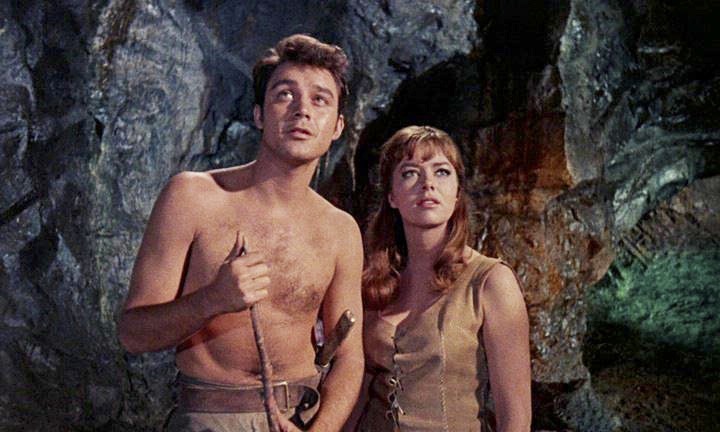
A band of Union Army prisoners, a Confederate soldier, and a journalist escape in a hot air balloon during the Civil War and are carried off by a storm to an uncharted island populated with giant creatures. This same storm blows in two ladies who were the only survivors of a shipwreck. They band together to survive, staving off giant chickens, bees and pirates before making an attempt to escape the island with the aid of Captain Nemo. 

Jules Verne's 1874 novel "Mysterious Island" was used as a basis for this marvelous adventure film. Special effects maestro Ray Harryhausen teamed up with producer Charles Schneer for the sixth time to create this dandy fantasy film that Time magazine declared would "thrill the geewillikers out of anyone!"

It does indeed! Mysterious Island combines a great cast with a fine script, a fantastic Bernard Herrmann score, and great special effects, making it a winner all-around. Even though it was released by Columbia Pictures, it is a British-made production with a primarily English cast playing Civil War soldiers. Michael Craig heads the cast as Captain Cyrus Harding. He quickly takes command when the balloon party lands on the island. Harding is your quintessential cookie-cutter captain who does things by the book. Even though he seems like the kind of character who would be given a love-interest, he remains single the entire film. 

Gary Merrill is excellent as Mr. Spilitt, an engaging journalist who enjoys jesting with Lady Fairchild, one of the shipwrecked ladies, played by the impeccably British Joan Greenwood. Percy Herbert plays a tough-talking Confederate, Dan Jackson is the loyal strongman Corporal Neb and, to draw in the teenage crowd, Michael Callan plays a young soldier who overcomes his cowardice when he attempts to rescue his new sweetheart, the miniskirt clad Elena Fairchild ( Beth Rogan ). 

Let's not forget Captain Nemo.....Herbert Lom plays the famous inventor. He adds a bit more gruffness to the character than James Mason did in Twenty Thousand Leagues Under the Sea ( 1954 ). A dash of humor and more showmanship would have given greater interest to his character, but he was in keeping with Verne's description so we're not complaining. 

Mysterious Island was shot at Shepperton Studios, England, and on location in Sa Conca Bay, Spain. Unlike some of Harryhausen's other films, this picture uses a number of matte shots and they really help to create the storybook-like setting of the island. Check out the site Matte Shot to see more screenshots of the mattes used in the film. 

Harryhausen must have had a ball creating the miniatures for Mysterious Island. He made a fantastic model of the Nautilus, a truly frightening giant bee, a giant baby chicken, man-eating crab, and an octopus. It took him months to film these creatures in stop-motion, moving each armature a little bit at a time until the scene played out just right. 

Impressive as these creatures are, my favorite of his creations was the miniature air balloon. As you can see from this behind-the-scenes photo, this miniature was not as tiny as you would think. The soldiers make their escape in the balloon during a heavy storm and Harryhausen had to create this setting within the confines of Shepperton Studios. It is amazing to see the balloon tossed about in the storm over the ocean, forgetting that there was no storm or ocean in reality!


Mysterious Island premiered in the theatres Christmas Week 1961 and was a huge box-office success. It played to packed theaters worldwide and the film received glowing reviews critically as well. It is currently available for viewing on DVD and in an excellent newly restored blu-ray edition from Powerhouse packed with special features.