Thursday, October 29, 2015

The Universal Pictures Blogathon : The Guests Arrive


I bid you velcome! 

Let me introduce myself, I am Count Dracula. It brings me great pleasure to be your host on this celebration of vone of the great film studios - a personal favorite of mine - Universal Pictures. Ah yes, it was my home for many many years. The Metzinger Sisters have so kindly asked that I be your guide and I am more than happy to walk amongst the living once again. 

My guests, please remove your hats and hang up your coats, and step this way....the party vill be taking place in many different rooms so do not be alarmed if you must leave the safety of the main parlor. Igor will be most pleased to show you the way.


We are going to have a vonderful celebration. Alas, the anniversary cake has long since molded but I do have some eye of newt and blood cocktails as an aperitif. 

Now please, sit, read, and be merry... What music we will make together! 

Ah, here is our first guest-of-honor.....


A Person in the Dark tells us how Charlie has her doubts about her uncle in Shadow of a Doubt ( 1943 ). She believes she has found a worm in her rose. How delightful! They are most delicious creatures. 


There are stranger cults than blood-suckers....Cinemaven's Essays from the Couch shares with us the flesh-piercing Cult of the Cobra ( 1957 ). As a boy in the old country I learned to beware of snakes. 


Love Letters to Old Hollywood gives us an entertaining look at Lady on a Train ( 1945 ) one of Deanna Durbin's best Universal films. My children, if it vere not for the lovely Ms. Durbin, I, Count Dracula, very well may have been forgotten by now! 


Diana Metzinger ( Silver Scenes ) tells us how Doris Day deals vith a telephone stalker in Midnight Lace ( 1960 ). I vould simply bite the cord but then ve all handle stress differently.


Now here is an old friend indeed! Frankenstein teams up vith my dear companion, the Volf Man in the 1943 classic Frankenstein Meets the Wolf Man ( Monster, behave yourself! ) Cinemaven's Essays from the Couch returns to tell us the story of this film. 


Another crony of mine, Boris Karloff, had a spine-tingling television series of his very own. The Last Drive-In shares with us the thrills to be had when viewing Thriller ( 1960-1962 ).


Sometimes They Go Till Eleven demonstrates the troubles that tiny folk have to contend vith in his look at the sci-fi classic The Incredible Shrinking Man ( 1957 ). Why, even having a bite of cheese could be a snap....or a trap!

Children of the night, if at any time you feel lost, please let me direct you to the main parlor : 

The Universal Pictures Blogathon - List of Guests

You will find all of the guests-of-honor assembled here by the stroke of midnight on Halloween. If they do not show up by then, well....we'll just have to fly out and fetch them! 


Day Two : The Universal Pictures Blogathon - The Monster Bash

Wednesday, October 28, 2015

Beau Geste ( 1926 )

In 1926 Percival Christopher Wren's best-selling novel "Beau Geste" was brought to the screen in a thrilling silent adaptation by John Russell and Herbert Brenon. It was a film that inspired director William Wellman and launched numerous remakes ( including Wellman's own 1939 version of Beau Geste ).  

Ronald Colman, Neil Hamilton and Ralph Forbes star in the lead roles of three English brothers who join the Foreign Legion after one of them is accused of stealing a family jewel known as "The Blue Water". They find that becoming real soldiers is a far cry from the game of soldiers they played in their youth, especially with a bestial sergeant ( Noah Berry ) and a greasy rat ( William Powell ) in their company. 

Beau Geste could be called a war film, but it would be better to classify it as a mystery, for director Herbert Brenon established a riddle of events within the first fifteen minutes that draws audiences into discovering what the remaining story has to tell. Unlike most mysteries, it unravels its narrative working backwards to a solution.


Beau Geste begins with a troop of Foreign Legion soldiers marching towards a fort announcing their coming and receiving no response from the trumpeteer within. When the leader of the troop, Major de Beaujolais, investigates closer he finds that all of the soldiers standing guard around the fort are corpses, leaning with their guns pointed outwards in readiness for an attack. He asks for a volunteer to climb the walls and open the gates from within, but this man too disappears and so the Major scales the walls himself and finds the dead body of the commander clasping a letter in his hand...a letter addressed to Scotland Yard, confessing a crime that he had committed. The major returns to his soldiers outside of the gate but within a few minutes turns to find that the fort is going up in flames. A bonfire of corpses standing alone in the desert. What could it all mean? 

Paramount united with its rival, Famous Players, to bring Beau Geste to the screen, releasing it in the autumn of 1926. Critics at the time thought the film would have only a mediocre run, underestimating audiences ability to endure an "epic length" film ( 120 minutes ). Little did they realize that within twenty years this would become a standard running time. Beau Geste quickly became Paramount's biggest hit of the year and one of the greatest box-office successes of the entire decade. 

Some of the era's most popular stars worked together to make the film such a roaring success....Ronald Colman, who was being groomed as a rival to Rudolph Valentino, the legendary actor Neil Hamilton, William Powell, Ralph Forbes, Victor McLagen, Alice Joyce ( as the boys mother ), and Mary Brian as their love interest. 

Norman Trevor receives the choicest role as Major de Beaujolais, the man who first discovers the mysterious Citadel of the Dead with its legions of dead soldiers standing guard. As Sergeant LeJaune, Noah Berry demonstrates a glorious slice of ham in a performance which would have earned him an Academy Award had the awards been established at that time. 

Beau Geste is silent cinema at its best, combining elements of adventure, mystery and romance in one tight production and we highly recommend it as an introductory film for those who have not yet had a taste of silent cinema. 

This post is our contribution to The Silent Cinema Blogathon being hosted by In the Good Old Days of Classic Hollywood and running from Oct. 27 - Oct. 29, 2015. Be sure to check out all the great articles on your silent film favorites.

Saturday, October 24, 2015

Chitty Chitty Bang Bang ( 1968 ) - The Story of the Motorcar

The Classic Movie Blog Association is currently hosting the Planes, Trains and Automobiles blogathon from Oct. 19-24th and we decided to take a behind-the-scenes look at one of the most iconic movie cars ever built - Chitty. 

In 1967, Albert "Cubby" Broccoli assembled a stellar cast and crew to film Ian Fleming's children's story "Chitty Chitty Bang Bang" in a grand musical version that would rival any film Walt Disney Studios could make. The book was originally a three-volume series written by Fleming in 1964 for his son Caspar and told the story of an eccentric inventor, Caractacus Potts, who rebuilds an old racing car for his children. As the family drives the car around town they begin to find that it is a magical car, capable of flying and floating. 

Roald Dahl was hired by Broccoli to write the screenplay to the film and he weaved elements of Fleming's book into a marvelous fantasy story centering around Potts, the motor-car, and Baron Bomburst, a mad German who wants to steal the car for his own collection. 

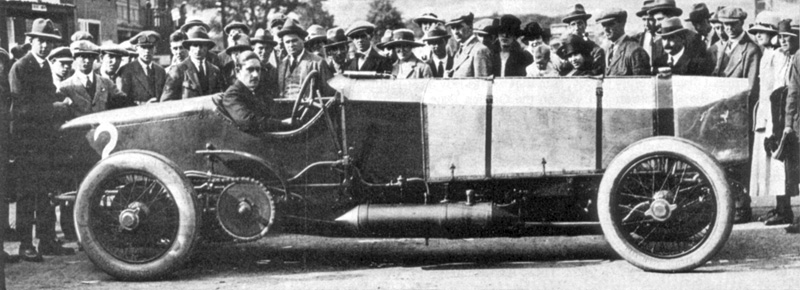
Count Zborowski's Chitty 1 in 1921
Chitty is undoubtably the star-attraction in the film, even though it boasted a splendid cast including Dick Van Dyke, Sally Ann Howes, Lionel Jeffries, Gert Frobe, James Robertson Justice, Benny Hill, Robert Helpmann, Anna Quayle and Adrian Hall and Heather Ripley as Potts two children. Fleming took his inspiration from a series of aero-engined racing cars built by Count Louis Zborowski in the early 1920s which was nicknamed Chitty Bang Bang . The name of the car was coined by the sound the airplane engine makes as it starts and runs. Zborowsi built four different Chittys in his lifetime but the Chitty 1 was his most famous model. Built with a 23-liter 6-cylinder Maybach aero-engine it nearly reached 120mph on one occasion. Eventually the car was purchased by Arthur Conan Doyle's sons. 


In the film, Jeremy and Jemima discover that their favorite "playcar" at Mr. Coggin's junk yard is going to be sent to the fiery furnace as scrap metal, and so they rush home to plead with their father to purchase the car instead. Mr. Potts is a poor inventor, but after Lord Scrumptious buys his invention of whistling treats for dogs, he gleefully returns home with Chitty in tow. And then for two days he hides himself in the garage rebuilding the motor car using scrap material found around the house. What results is a magnificent testament to what an eccentric inventor can create with a little bit of ingenuity and a heap of skill. 

Chitty Chitty Bang Bang's production designer Ken Adams ( Goldfinger, Dr. Strangelove ) worked with British cartoonist Frederick Rowland Emmett to create a new look for Chitty, a marvelous design that combined elements of a ship with a flying machine. 


Seven different Chittys were built for the film including one fully functional road-going model with UK registration GEN 11. Alan Mann Racing in Hertfordshire built this car and fitted it with a Ford 3000 V6 engine. Dick Van Dyke claimed that the motor car "was a little difficult to maneuver, with the turning radius of a battleship". Nevertheless it turned hundreds of heads in whichever village it traveled through. 

Pierre Picton with his GEN 11
After the movie was completed, Pierre Picton, Dick Van Dyke's stand-in driver for the film, purchased two Chittys, auctioning one in the 1970s and keeping another, which he drove to numerous charity races up until 2011, when he decided to have that one also auctioned. At one point, Michael Jackson desired to purchase the car, but Picton refused, wishing to have Chitty remain in Britain. Director Sir Peter Jackson purchased the car for $805,000 and currently plans to use it for charity drives. 

The remaining Chittys were constructed as props for the various scenes requiring transformations. One Chitty was built with wings, another with the hovercraft attachment; there is a smaller road-going version and an engine-less model for trailer use, as well as the "junk" model which the children initially discovered. 


Most of these were later equipped with engines and used to promote the film worldwide. Two of these Chittys are in Florida today. One resides at the Denzer Car Museum in North Miami, another is owned by a private collector. The National Motor Museum in Beauleiu, UK also houses one of these models. 

In addition, many fans of the Chitty Chitty Bang Bang built their own versions of the beloved motor car, many of them being exact replicas. So there are plenty of Chittys across the world!


To conclude our look at this fine four-fendered friend, here are a few specifications to give you a start so that too could construct your own Chitty: 

Length : 17' 7" 
Height : 6' 3" 
Width : 5' 9" 
Maximum Speed : 100 mph
Features : 

  • Ejector seat with parachute
  • Built-in Chittyfied GPS
  • Hovercraft capabilities
  • Flies for hours without supervision

Be sure to head on over to the Classic Movie Blog Association's website to read more reviews of your favorite films featuring planes, trains and automobiles. Thanks for stopping by!


Wednesday, October 21, 2015

Vincent Price and the Sears Art Collection

In the mid-century, fine art was something the general public could not easily find in a department store, even though chains such as J.C.Penney, May Company and Sears Roebuck & Co. stocked home appliances, furnishings and other decor. But on October 6, 1962, Sears remedied this oversight with the launch of The Vincent Price Collection of Fine Art exhibit and sale that took place in one of their stores in Denver, Colorado. 

When it comes to art, the Price is right
Sears had long been eager to offer fine art to its customers and as far back as 1895 had attempted to do so, offering oil paintings at affordable prices - 90 cents and up. During the Depression having a "tasteful" home was a low priority for many and so the fine art department of Sears received very little attention. However, good taste is never out of style and by the 1950s, the directors at Sears realized there was a large market for fine art once again. 

In 1962, George Struthers, vice-president in charge of merchandise at Sears, approached Vincent Price with an invitation to become the buyer for a new fine arts department Sears was launching. It was well-known at the time that Price was an avid art collector. In 1957, he and his wife Mary Grant donated ninety pieces from their private collection to establish the Vincent Price Art Museum at East Los Angeles College, which is still in existence today. 

Price always liked the idea of bringing the fine arts to the broad American public and was excited with being presented the opportunity to do it with one of the largest department chains in the States. 


He was asked simply to make a collection that would appeal to all kinds of people; people who had never seen art before, and to connoisseurs who were aware of great art. Price was given carte blanche to purchase the fine art needed for the collection and each and every piece Sears would back up with their famous money-back guarantee.
"I feel that an awful number of people suffer under two misapprehensions about art. Number One is that it is not available to them, and Number Two, that it may cost too much money....[Therefore my goal] was to correct these misapprehensions and to tell people that art is not for one class of people; economic class or educated class, but art belongs to everyone" 
                                                                                                      Vincent Price 
Within three months, Price collected nearly 2000 works of art - paintings, etchings, drawings, prints, etc. The initial exhibit included original works from the great masters - Rembrandt, Chagall, Picasso, Dali, Whistler and more - as well as some of the best contemporary artists at the time. The works ranged in price from $10 to $3000, plus Sears customers could purchase items on an installment plan basis for as little as $5 down and $5 a month. 

The Vincent Price Art Collection was an instant success and so many pictures were snatched up the first day of its exhibit that an additional shipment had to be flown in lest the walls become bare the next day. The fine art collection was then offered at ten additional Sears stores before expanding nationwide to all of the stores. By the late 1960s, the price of the quality of the art that Price was willing to put his name behind had inflated beyond the range of Sears shoppers and in 1971 the program ended. Within those nine years, over 50,000 pieces of art were passed into American homes and offices. 

In addition to providing affordable fine art for its customers, the Sears Vincent Price Gallery of Fine Art opened its doors in Chicago in 1966 to provide an audience for less well-known young artists. 


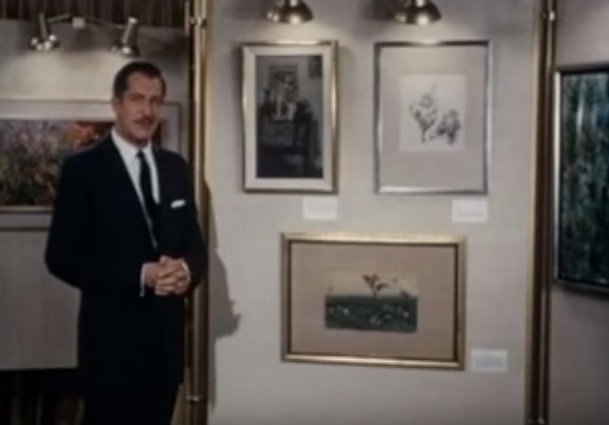
In this promotional film Sears released for its salesmen, Vincent Price explains how he was invited to participate in this project and offers a brief tour of some of the paintings that will be available in the collection. 

Saturday, October 17, 2015

Midnight Lace - Sheer Entertainment

In Ross Hunter's tense 1960 thriller Midnight Lace, effervescent musical star Doris Day becomes the pawn in a cat-and-mouse game when a sadistic man harasses her over the telephone. Tormented by an eerie voice who promises to kill her before the month is out, she is unable to convince anyone that a stalker even exists, let alone figure out who is behind these menacing calls.

Who would want to kill our heroine and why? That's the question viewers are asked to answer and when the film reaches its nail-biting conclusion, the audience is asked to keep the secret mum so that friends can have the fun of solving it themselves, too.

Doris Day is charming as Kit Preston with Rex Harrison as her dashing husband Tony, head of the respected Preston Mining Company. The couple share an elegant London townhouse, designed in a modern taste by Alexander Golitzen and Robert Clatworthy, which overlooks posh Grosvenor Square. 

The action begins right away on Kit's way home one day from shopping, when a sinister voice calls out to her in a thick London fog:

"Mrs. Preston. Over here. So close I can reach out my hands on your throat."

"Who are you? What do you want?"

"You'll know when the time comes Mrs. Preston, just before I kill you..."

Understandably frightened, Kit is told that her experience could be that of a prankster and she finds comfort the next day after seeing Lord Horatio Nelson's statue doused in bubble gum pink paint, a result of hooligans running amok in the previous day's "pea-souper", as Tony so aptly puts it.


Kit's peace of mind doesn't rest long after she receives a call, phrased much like the threat in the park and just as terrifying. The couple turns to England's esteemed Scotland Yard for professional help lead by Inspector Byrnes, played most convincingly by dapper English character actor John Williams. Byrnes explores all angles to the case, even questioning Kit's sanity. Perhaps she is making up her assailant as a means to garner attention from her frequently absent husband. 

Just when Tony's worries about his wife begin to increase, company accountant Daniel Graham ( Richard Ney ) uncovers a major discrepancy in the account books leading Tony to believe that a member of his staff has embezzled nearly one million British pounds! Could it be Daniel, himself? Or is it company treasurer and close friend Charles Manning ( Herbert Marshall )? He has been losing a lot of money at the horse races lately... Rounding out the cast is attractive Natasha Parry as Kit's dear friend Peggy, Myrna Loy as her sociable and sophisticated Aunt Bee, and Roddy McDowall.


Based on a 1961 two-act play by Janet Green entitled "Matilda Shouted Fire", Ivan Goff and Ben Roberts's witty script included an innocent flirtation between Kit and construction crew foreman Brian Younger ( John Gavin ). His crew is hard at work at a site next to the Preston's townhouse building and he keeps a careful watch over her after a series of unfortunate accidents occur, such as when a darkly-dressed man appears at Kit's doorway soon after another threatening phone call.

"Sometimes I think the Blitz left us with more derelict minds than derelict buildings"
                                                                                   Inspector Byrnes

Director David Miller did a fine job giving "Midnight Lace" a Hitchcock flavor. It chugs along at a nice clip and provides a clever twist at the finale when all is revealed. Talented cinematographer Russell Metty, famous for his work on classics like Bringing Up Baby ( 1937 ), Written on the Wind ( 1956 ), and Touch of Evil ( 1958 ), paints a rich picture in Eastmancolor which also serves to showcase Irene's chic gowns and dress suits worn by Doris. A champion of costume design, Irene was nominated for an Academy Award for Midnight Lace, but Arlington Valles snagged home the award that year for his creations in Spartacus

Doris's real-life husband Martin Melcher, and fellow producer Ross Hunter, had Universal release the film in October 1960 in New York City, though not in London as one would expect with regards to the story's setting. Hunter made his mark in crafting lush Technicolor dramas during the 1950s and 1960s, usually casting Doris, Lana Turner, or Jane Wyman in the lead role. He took a risk making a suspense, but it proved to be a wise move.

The film suited Doris well, allowing her to express her dramatic chops and it was appropriate for her legions of fans. Though one may not consider Universal's Midnight Lace in the same league as the studio's earlier horror classics, it has just the right blend of mystery and glamour to make it a satisfying flick to watch on a Friday night.

Just be sure you don't pick up the phone if it starts to ring...you never know who might be on the other end.

This post is my ( Diana ) contribution to the Universal Blogathon being hosted by yours truly, Silver Scenes. Be sure to check out all of the great posts covering Universal's most memorable classics from the 1910s-1960s.

Thursday, October 15, 2015

The Dawn Patrol ( 1938 )

They roared through the dawn...with death on their wings!

Yes indeedee, rip-roaring action abounds in The Dawn Patrol. Where Errol Flynn walks, how can adventure help but follow? 

It's 1915. In central France the 39th Aerial Squadron of the British Royal Flying Corps is losing men like flies to enemy fire. Major Brand's ( Basil Rathbone ) nerves are shattered as he receives orders each day to send mere boys to the skies to face their death.


Amateur aviators fresh out of school, all eager to soar into the heavens to shoot down a Gerry, come to the squadron regularly. Naive, and blindly brave, they boast of what they'd do if they receive their flying orders. But the "old hands" Captain Courtney and Lt. Scott ( Errol Flynn, David Niven ) know better. It's no easy game. With a well-trained enemy on your tail at every moment it's a face-off to the death. 

They eye Major Brand with hatred burning in their hearts, knowing any one of these boys might be sent next, and without sufficient aerial combat experience what chance had they of surviving? They blame him for sending them to the slaughterhouse of the skies. 

"You know what this place is? It's a slaughterhouse, and I'm the butcher!" 
                                                                                                                Major Brand 


Brand realizes this too, and hates himself even though he is simply doing his duty. However, when Brand gets promoted to wing commander, and Courtney gets selected as his replacement, Courtney finds what it feels like to be in the Major's boots : very dirty. And those who were once his friends, are now giving him the evil eye as well. 

The Dawn Patrol was released in 1938 to critical acclaim for it's strong focus on the men who fought the hawk-like battles in the air. John Monk Saunder's Oscar-winning original story was first put to film in 1930 by director Howard Hawks, featuring Richard Barthelmess and Douglas Fairbanks Jr. in the lead roles. Hawks captured some outstanding aerial footage of dogfight scenes and many of these shots were reused in the 1938 remake, interspersed with scenes of Flynn in the pilot seat. 


The aerial scenes were not entirely old footage - Warner Brothers Studios reconditioned nearly two dozen vintage Nieuport and Fokker bi-planes which were used for additional dogfight footage as well as close-up scenes at the headquarters. The famous stunt flier Douglas "Wrong Way" Corrigan was asked to fly some of these Nieuports but Corrigan wanted $100,000 to appear in the film. That was one stunt where he did indeed go the wrong way - the studio was not willing to pay such an amount and nixed him from the production. 

Basil Rathbone is excellent as Major Brand, and Errol Flynn is as powerful and charismatic as ever as Captain Courtney. Flynn thoroughly enjoyed working with friends and the comradery between him and David Niven seen on film was true to life - Niven was one of his best chums. Keep a sharp eye out for Rodion Rathbone, Basil's son, who was making his film debut as "Russell" one of the inexperienced fliers. 


The Dawn Patrol remains one of Flynn's most memorable pictures and it's message of the senseless brutality of war packs a punch over a half century later. Commanding officers of the armed forces today go through the same agony when they must carry out orders from "higher up" knowing the steep price it costs on human lives...lives they personally know. 

Film critic Llewellyn Miller made an accurate prediction in his 1938 review of The Dawn Patrol

"A few...a very few pictures are timeless in their appeal. A very few pictures may be revived year after year without seeming quaint or out-dated or downright silly. The Dawn Patrol is one of the very few films which will survive this year and next and as many years to come as there are people who remember wars. I wish it might be included in every course in American history in every school in the land. I hope that it is revived every year, so long as bullets are being cast and battleships are being made, because, like every great war film that the motion picture industry has produced, it says 'Where is the glory, where is the great adventure, where is there anything but criminal waste in such insanity?'" 

This post is our contribution to Classic Movie Blog Association's Planes, Trains, and Automobiles Blogathon running from Oct. 19 - Oct. 24th. Be sure to head on over to CMBA's blog to find links to all the great articles on your favorite modes of transportation.

Tuesday, October 13, 2015

The Impossibly Difficult Name that Movie Game


A creepy-looking man seated at a desk. With Halloween fast approaching, we thought this was a great screenshot. You know you've seen the film, but let's see how good those mental gears are at turning out a title! 

As always, if you are unfamiliar with the rules to the game or the prize, click here.

GAME OVER. 

Congratulations to Damsbo for correctly identifying Fritz Lieber in this scene from "Cry of the Werewolf" ( 1944 ) starring Nina Foch and Stephen Crane.