Friday, November 15, 2013

The Wolf Man ( 1941 )

"Even a man who is pure in heart and says his prayers at night, may become a wolf when the wolf bane blooms and the autumn moon is bright"

Larry Talbot may not have been a man “pure in heart” but he was a man who certainly didn’t expect to be turned into a howling beast when the wolf bane bloomed. Who does for that matter? Poor guy. He was just a luckless lump who happened to be in the wrong place at the wrong time. 

After 18 years spent abroad in America, Larry Talbot returns to his ancestral home in Llanwelly, Wales, only to find that a dangerous date with destiny awaits him. 

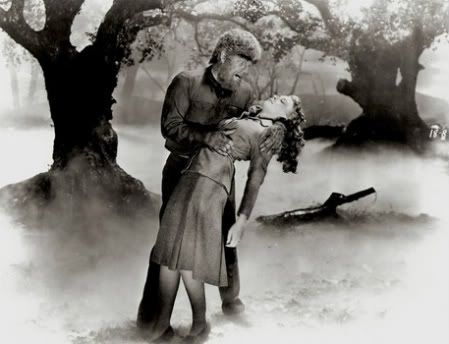
While escorting his sweetheart, the lovely Evelyn Ankers, through a gypsy encampment, he hears the scream of her friend Jenny in the woods, runs to rescue her from a wolf….and gets bitten in the process!

With his newly purchased silver handled wolf-carved cane, he had bludgeoned the wolf to death during the struggle. But lo! the next morning he finds his wound has disappeared and the police are questioning him about the death of Bela (played by the inimitable legend of horror, Bela Lugosi) …..the gypsy he had supposedly mistaken for a wolf. 


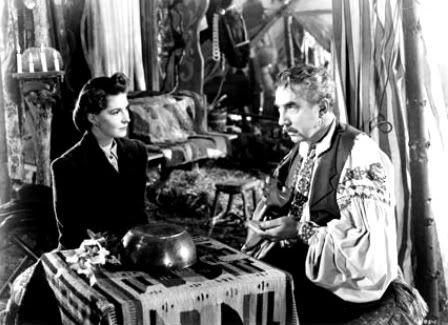
To make matters worse, Bela’s mother (Maria Ospenskaya) tells Larry that he will become a wolf as well. But, being our everyday all-American disbelieving film hero, he promptly disregards the wise old gypsy’s warning and the protective charm she gives him, a foolish act that leads him straight into danger. Oh dear, won’t these guys ever learn? 

Filming on The Wolf Man began just before Halloween 1941. It was completed and released in December and went on to become one of the top grossing pictures of the year. 


Dick Foran, a popular B film and cowboy star, was originally intended for the role of Larry Talbot but was replaced one week prior to filming. A good thing too, for Lon Chaney Jr. was very fond and proud of the Wolf Man character and made a career of playing him. He welcomed the opportunity of starring in the many sequels such as Frankenstein Meets the Wolf Man, House of Frankenstein, House of Dracula and the really horrifying classic, Abbott and Costello Meet Frankenstein. 

When Lon Chaney Jr., the son of the famous "Man of a Thousands Faces" Lon Chaney Sr, was offered the lead role in The Wolf Man, he was not yet known for being a horror film actor. He had enjoyed success on stage in Steinbeck's Of Mice and Men and had appeared in the film adaptation in 1939. Chaney was up for the lead in Universal's remake of The Phantom of the Opera in 1940, but alas..it was his Wolf Man father, Claude Rains who won that choice part. Instead, Chaney starred in Man Made Monster (1941) and director George Waggner was so pleased with his performance that he quickly plopped him into his next picture, The Wolf Man. A legendary horror icon was born! 

Although he played an innocent victim of circumstances on screen, off-screen Chaney was quite a hooligan. He had vandalized studio property one day while drunk and, as punishment, Waggner assigned his star dressing room to Ankers. After spending grueling hours having Jack Pierce apply yak hair and a rubber schnozz to him every morning, and then wait another 45 minutes after shooting to have it removed, Chaney was upset at having his dressing room taken. He had a fondness for playing practical jokes and Ankers quickly became the prime recipient of them. He enjoyed sneaking up on her in full makeup and scaring her. One incident, however, was not Chaney's fault....a 600 pound bear which was used in an eliminated sequence, escaped one afternoon from its trainer and chased Ms.Ankers up a ladder. 

Evelyn Ankers - who played Larry's gal Gwenn Conliffe in the film - was known as the “Scream Queen” of the 1940s and was very busy that decade making horror films such as The Ghost of Frankenstein, Son of Dracula, and The Invisible Man’s Revenge. She also starred in a couple entries in the popular Universal Sherlock Holmes film series: The Pearl of Death and Sherlock Holmes and the Voice of Terror. 


The Wolf Man was not the first film to feature hairy lycanthropes. Six years earlier Universal had made The Werewolf of London starring Henry Hull as a botanist who receives that notorious wolf bite while hunting for a rare flower in the mountains of Tibet. 

This film did not gross much at the box-office, so Universal so they gave it another try and in 1941 the viewing public was much more gullible and embraced The Wolf Man. It was released just days after the attack on Pearl Harbor so it proved to be escapism at its finest. To this day it remains a classic and justly so; with its smothering foggy atmosphere, superb supporting cast (including Claude Rains, Ralph Bellamy, Warren William and Patric Knowles), and excellent set design it leaves a lasting impression. So much so that when the autumn moon is bright, our thoughts naturally turn to the Wolf Man of the night.


This post is our contribution to The Chaney Blogathon, a celebration of father-and-son and the memorable ( and forgettable ) films that they made. The Last Drive-In and Movies Silently have teamed up to host this event, so don't linger around here...head on over to either of their blogs to view a complete schedule of posts!

Thursday, November 14, 2013

Hollywood Home Tour - Warner Baxter

We're off on another bus tour again! This time the Silver Scenes bus is taking us past the beautiful Tudor estate of that delectably debonair actor Warner Baxter. With his rugged masculine face Ohio-born Baxter became a star in the early 1920s in silent pictures such as The Great Gatsby and...

"Hold on a minute gals! Who's conducting this tour?"


688 Nimes Road, Bel-Air

Oh gosh, that's right....sorry Al. Go right ahead, we'll just head back in the kitchen and make some more chicken sandwiches for the passengers. 

"As the girls were saying, Baxter became a Hollywood star during the silent era, but once the soundies came he catapulted into mega-stardom. He played the Cisco Kid in In Old Arizona ( 1928 ) which became his most famous early, talking role. He earned an Oscar for this too, making him the first American to win a Best Actor award. Baxter then went on to make such hits as 42nd Street ( 1933 ), Broadway Bill ( 1934 ) and Kidnapped ( 1938 ). He reached his peak in popularity in the mid-1930s and was the highest paid actor in Hollywood at that time, earning $284,000 a year. 

"It was during this time that Warner Baxter and his wife, Winifred, moved from their lodgings at 138 S. Beachwood Drive into this beautiful Tudor estate in Bel-Air. You can see it coming up on your right folks, just over the hill. 

"Look at those lovely lush gardens...Warner Baxter was one of the first actors allowed to build in Bel-Air and in 1932, construction began on this magnificent home. Baxter, inspired by early spook films, added a network of secret panels so you could play hide-and-seek throughout the house. And what a place to hide! At 16,000 square feet, it was one of the largest homes built by any Hollywood star. The estate included 18 bathrooms, seven kitchens and well over forty bedrooms ( no one took the time - or effort - to count them all ). Some of the closets alone are bigger than most people's living rooms. 

At the time the house had a beautiful view of the Pacific Ocean, but recent tree plantings are beginning to obscure it. Baxter was a quite a tinkler when he was not acting and surely he must have had a room set aside as a workshop where he could invent. One of his inventions is in constant use today...a radio device that permits emergency crews to change a traffic signal from over two blocks away. 

"During the 1940s, when Baxter began to drift into B-films and The Crime Doctor series, his family downsized to a comfortable estate at 911 North Roxbury Drive.

"Warner Baxter died on May 7, 1951 at the age of 62, after suffering from a bout of pneumonia."


Update: Today this lovely home no longer stands, having been replaced by a modern glass and concrete structure. Jack Ryan purchased the property in late 1962 and turned the house into, what the Daytona Beach News, dubbed "The greatest glittering pad in Bel-Air". Ryan had made his fortune in doll designs...anyone heard of Barbie doll? Just down the street is Kirkeby estate where The Beverly Hillbillies  were filmed and Elizabeth Montgomery, who later starred in the popular television series Bewitched, purchased Baxter's Roxbury Drive residence in the mid-1960s. 

Monday, November 11, 2013

Interview with the Authors of "Also Starring : Forty Biographical Essays on the Greatest Characters Actors"

Once Upon a Screen, Outspoken and Freckled and Paula's Cinema Club have teamed up to once again bring us the annual What a Character! blogathon. With all the excitement generated over the celebration of these marvelous unsung talents we thought we would spotlight an excellent book on the subject : Also Starring: 40 Biographical Essays on the Greatest Characters of Hollywood's Golden Era. This is the definitive guide to character actors, featuring insightful peeks into the lives of forty of the greatest characters of the silver screen. Each actor is profiled in depth with illustrations and filmographies and are introduced with clever taglines, such as "Jolly Jowls" S.Z Sakall, "The Gentleman's Gentleman" Eric Blore, "Steam in her Kettle" Marjorie Main, and "The Eccentric Harridan" Elsa Lanchester. It's definitely a book the ultimate film fan would include in their movie library, covering the character actors we all love, from the famous to the obscure. The authors, Sara and Cynthia Brideson, graciously took the time to answer some of our questions about this book and character actors in general : 

This is the first book that you and your sister have collaborated on, could you tell us why you chose to spotlight Hollywood character actors?

Sara: I chose to write about character actors because I feel that they were often more talented than the leading actors. Sometimes the lead characters are not nearly as interesting as the side ones. For example, in You Can't Take it With You, Spring Byington, as the eccentric mother who writes nonsensical plays, was even more interesting than Jean Arthur, who played the main, more 'normal' character. Almost every classic movie has an example of this. I wanted our book to proved how interesting the supporting actors were even if their names are not well remembered. 

Cindy: I agree with everything Sara said, though I had an added impetus to write this book. As a child I was very interested in Glinda from The Wizard of Oz and it caused me to be near tears that no libraries had any substantial literature about Billie Burke, the actress who portrayed the good witch. Sara was really into Judy Garland, who has had much written about her. I wrote the book almost as if it were a gift to myself as a seven year old child; maybe there's some other oddball kid out there today who is as interested in learning abut Billie Burke or another character actors who will find joy in Sara's and my book. We certainly hope so. 


“Also Starring” features many rare and interesting trivia on the actors, was researching this information difficult?

Researching the information for the book was quite easy for some actors but incredibly difficult for others. Using Google news archives, we were able to find a lot about certain character actors, namely Eve Arden, Spring Byington, Agnes Moorehead, and Roland Young. We were very excited whenever we discovered that an actor had written an autobiography. We especially enjoyed S.Z. Sakall's memoir and Shelley Winters'. The actors who we could find virtually nothing about were Henry Travers and Virginia O'Brien. It took much digging to find enough to go on for an essay about them, but we managed to find some interviews and newspaper articles that illuminated their characters enough to give an idea of what they were like. We feel lucky to live in an age where newspaper archives are so accessible. It's certainly easier than poring over microfilm for hours!


You must have also unearthed a lot of great trivia and behind-the-scenes tidbits about these character actors, could you share one of your favorite anecdotes with us?

Billie Burke was an extreme animal lover, though sometimes her efforts to make animals feel comfortable did not end well. Once in the goldfish pond in her garden, she poured warm water into it to keep the fish warm. The next morning the fish had all died. Billie was understandably heartbroken. Elsa Lanchester was quite a bohemian in her youth. She actually posed nude for painters in London! It is rumored that Hattie McDaniel took marijuana. One of her co-stars claimed they smelt smoke coming from her car between breaks from filming. Claude Rains demanded he always be in the foreground of a scene when with Ingrid Bergman in Notorious, so no one would be able to see she was taller than he was. Eddie Rochester Anderson was not included in his longtime co-star, Jack Benny's, will. Most people thought this was terrible, but Eddie never said a word against Benny. 

Character actors are often overshadowed by the big name Hollywood actors, despite their wide and varied career and their acting abilities. While you were conducting your research, which actor’s career stood out to you as being the most impressive and which talent do you believe to be the most forgotten today?

All of the actors had impressive careers. Many of them began as leading actors on Broadway before they went to Hollywood, like Lewis Stone, Fay Bainter, and Billie Burke. However, we feel Agnes Moorehead had the most impressive career. she began at the New York Academy of Performing Arts, then went with Orson Welles' Mercury Theatre Group, and then became a huge success in radio, film, and TV. She mastered every medium. She also was nominated for more than one Oscar as well as Emmy awards. The most forgotten actors in our book are probably Virginia O'Brien and Jules Munshin. Both of them were specialty performers, but they were in some of the essential classic films, thus making it all the more vexing that they are forgotten. Jules Munshin is best known for his part as one of the three sailors in On the Town and Virginia O'Brien is best known for playing Judy Garland's friend in The Harvey Girls. We hope our book will make people want to discover the films of these forgotten actors. 

What distinguishes a character actor from a supporting player, such as Tony Randall or Gig Young?

A supporting player vs. a character actor has many different variations. We included both supporting players and character actors in our book. Supporting players, like Claude Rains, Shelley Winters, and Joan Blondell, are usually more well known and can even have a strong fan base. Their characters are usually "the third star" in the credits and they play a more integral part in the plot line. Character actors are often those actors who have 100 credits to their name but are still not well known. H.B. Warner, Eric Blore, and Beulah Bondi are among these. They make a huge impression on the audience, nevertheless. Character actors are usually more quirky than supporting players and their parts are much smaller. 

Like John Barrymore's agent told him in Dinner at Eight when convincing him to take a character part: "Audiences keep waiting for you to come back, and you never do!" That's how a character part is-- too short and it always leaves the audience wanting more. 


Many character actors found themselves typecast in certain roles, do you think they regretted this?

Some actors regretted being typecast while others did not mind at all. Hattie McDaniel, for example, did not mind playing a servant or a maid. Though many of her peers thought taking such roles was degrading she said: "I'd rather play a maid than be one." Agnes Moorehead often wished she could get more glamorous roles rather than ones in which she played women older and homelier than she really was. Billie Burke was regretful she did not get to tackle more dramatic roles, but in her autobiography she expressed that she did not wish to complain about her roles as "bird-witted women" because such parts kept a roof over her head. It was most difficult for actors who had started as leading men and women on Broadway to accept their typecast roles than it was for people who had started as character actors. For the most part,the actors accepted their typecast roles gracefully. 

Whom do you consider to be your favorite character actor?

Sara: My favorite character actor is probably Edward Everett Horton. He was always such a nervous wreck in his movies and made the most comical expressions. He really stole the show from Fred Astaire and Ginger Rogers in the films in which he co-starred with them. He was a really neat person off screen too, which is a bonus! My favorite character actress is Fay Bainter because she was so moving on scene but could take a comical turn a minute later. One of my best memories from junior high was having her nephew as my history teacher. He brought in the Oscar she won for Jezebel and let me hold it. It was heavier than it looks!

Cindy: Of course my favorite character actress is Billie Burke! She's so hilarious because half the time the ladies she portrays do not know they're being funny. Her most well-rounded performance is probably in Dinner at Eight; here, she has a chance to be both comedic and dramatic. For a character actor, I guess I'd have to say Ray Bolger. He was so much more than just the Scarecrow in The Wizard of Oz. He saved many a film from being mediocre through his wit, hilarious, rubber-faced expressions, and mind boggling dancing skills ( I'm thinking specifically of a lackluster biopic on ballerina Marilynn Miller, 'Look For the Silver Lining.' ). I'd suggest watching him The Harvey Girls and Rosalie to see his best comedic skills.


Recently you completed a book about impresario Florenz Ziegfeld, could you tell us about this and some of your other upcoming projects.

Our next book is called "Ziegfeld and His Follies: A Flamboyant History of the Life, Loves, Work, and Legacy of Broadway's Greatest Producer, Florenz Ziegfeld, Jr." We've been working on this book in one form or the other since we were eight years old. Because Ziegfeld was married to Billie Burke, we immediately became interested in his life. The film The Great Ziegfeld is a good introduction to Ziegfeld's larger than life productions, but it does not capture the real Ziegfeld who was decidedly more private and serious than William Powell's portrayal made him out to be. Powell basically plays Nick Charles playing Florenz Ziegfeld in the film! We are also working on a book about classic stars and authors and their cats. It's amazing how many felinephiles there were (Billie Burke and Joan Blondell included!) The Ziegfeld book is currently under consideration of the University of Kentucky Press. We're keeping our fingers crossed that it will be accepted!

Also Starring: 40 Biographical Essays on the Greatest Character Actors from the Golden Age of Hollywood  by Sara and Cynthia Brideson is available to purchase in paperback, Kindle and Nook editions at Amazon, Barnes and Noble, and through the publisher, BearManor Media. 

Sunday, November 10, 2013

Lionel Jeffries - What a Character! Blogathon

Lionel Jeffries was one of the most delightful and unique character actors to ever grace the British cinema. Bald, bewhiskered and bumbling he was an instantly recognizable actor in over 100 films, and however brief his appearances he was always an asset in comedies, thrillers, and dramas alike. Whether he be Grandpa Potts in Chitty Chitty Bang Bang or the inventor Cavor in First Men in the Moon, Jeffries excelled at playing charming crackpots and inquisitive and spirited characters.

Unlike Terry-Thomas who exaggerated toothy eccentrics for comic effect, Jeffries portrayed peculiar personas in a compelling and queer manner which made them strangely believable. His characterizations were of people that you might find and meet one day. Lionel Jeffries brought an element of reality to every character he portrayed. 

"I was constantly rewriting the words of the characters I was given to bring them a comic humanity. Most of the people I played were caught in desperation. In their hearts they knew they were failures - but they would never admit it, even to themselves."

Jeffries was born on June 10, 1926 in Forest Hill, London. As a boy he attended Queen Elizabeth Grammer School in Wimborne Minster, Dorset while his parents worked in a mission in London's East End with the Salvation Army. 


At the age of 19, he received a commission in the Oxford and Buckinghamshire Light Infantry, serving first in Burma, where he worked for the Rangoon radio station and later with the Royal West African Frontier Force where he rose to the rank of captain in 1945. After the war he trained at the Royal Academy of Dramatic Arts, where one short year later he won the Kendel award for his acting and writing. He felt out of place at the Academy however, being the only bald student among the bunch. He had lost all of his hair before the age of 20! Perhaps the war had that bad of an effect on his head. 

"Of course I was upset. Tried a toupee once, but it looked like a dead moth on a boiled egg". 

Upon completing his schooling in the early 1950s he quickly embraced the film medium and plunged into a series of roles in some memorable British comedies and spy thrillers in spite of being told by his agent that he was too young for character parts and not good-looking enough for leading man roles. His baldness certainly put him at a disadvantage but he took his egghead and used it to his advantage instead. 

One of his first film roles was a small part in Hitchcock's marvelous little thriller, Stage Fright ( 1950 ). Roles in Windfall and The Black Rider followed but then he hit a rough patch and as his agent predicted, parts were hard to come by and few and far in between. In 1953 he turned to stage and appeared in the Westminster Theatre production of Carrington VC with Alec Clunes. Stage was not his cup of tea and although he did a few more productions he quickly stepped out of the stage scene and was not behind the floodlights again until 1984, when he played Horace Vandergelder in Hello Dolly! at the Prince of Wales theatre in London. 


One day, in early 1955, he attended the cast audition for The Colditz Story and with holes in his shoes he walked away with the third lead to Eric Portman and John Mills. From then on he was always in demand for his quirky characterizations, often playing an officious policeman or bungling crook in these early roles. Some of his most memorable parts of the 1950s included the inquisitive reporter in The Quatermass Xperiment, Gelignite Joe, the diamond robber in Blue Murder at St. Trinians, Major Proudfoot in Law and Order, and a prison officer in The Two-Way Stretch, a Peter Sellars comedy. Jeffries also appeared in a number of dramas and crime films including the suspenseful Vicious Circle with John Mills, Hour of Decision and Man in the Sky with the always competent Jack Hawkins. 


It was in the 1960s, however, that Lionel Jeffries reached his comedic peak, first with his role of a priest in the wacky Bob Hope spy flick, Call Me Bwana, then as key suspect Captain Rhumstone in Murder Ahoy, and lastly in one of my all-time favorite roles, as the highly-strung Professor Cavor in the delightful Charles Schneer/Ray Harryhausen adaptation of H.G Wells' First Men in the Moon featuring Edward Judd and Martha Hyer. Here, Jeffries plays a reclusive scientist who invented a paste that combats gravity and, not wanting to dilly-dally with simple everyday uses, intends to launch a sphere into space on a voyage to the moon. 

Jules Verne's Rocket to the Moon was another film that featured Lionel Jeffries in a similiar role, but that same year he starred in one of his most memorable films - Chitty Chitty Bang Bang. Jeffries gladly accepted the role of Grandpa Potts, Caractacus' travel-loving father, even though he was in fact six months younger than Dick Van Dyke. 


Jeffries thoroughly enjoyed playing in wholesome children's films such as Chitty. He believed there were more wise children than wise adults and wanted to see entertainment geared towards children that adults could enjoy as well. In an era when society was bombarded with images of sex and violence Lionel Jeffries stood out for his gentler sensibilities. He was a devoted Catholic and deplored permissivism. Unlike alot of Hollywood marriages, Jeffries remained married to one woman, former actress Eileen Walsh, for over 59 years ( until his death ), with whom he had one son and two daughters. One day, his eight-year old daughter Martha came to him with a book she was reading - Edith Nesbit's delightful classic "The Railway Children" - and told her father "I think this would make a good film". Papa agreed and he promptly purchased a short option on the film rights for £300. 


He wrote a script that retained all of the charm of Nesbit's book and took it to Bryan Forbes, then head of Elstree Studios, to get his opinion of it. Jeffries and his wife had met Forbes at Richmond Hill, home of Sir John Mills, where they often socialized with the Oliviers, the Nivens, and the Attenboroughs.  Jeffries confined to Forbes that he "secretly harbored a longing to direct the film" himself. The Railway Children was indeed Jeffries first experience behind the camera as a director and it was a smash hit. The film, featuring Bernard Cribbins, Jenny Agutter, and Dinah Sheridan remains a cult classic in Britain, being shown year after year at Christmas Time. 


On the wake of its success, Jeffries was inspired to direct some more children's films but continually hit a stone wall when it came time to finding a producer. They were indifferent at best, and he came to the conclusion that "No one wants family entertainment anymore. They want explicit sex". Nevertheless he did find backers to several more productions, The Amazing Mr. Blunden ( 1972 ), Baxter! ( 1973 ), Wobbling Free ( 1977 ) and, his final film as a director, The Water Babies ( 1978 ). 


Throughout the 1980s and 1990s, Lionel Jeffries turned to television, a medium which he had originally shunned years before because of its inferior production values. An appearance in the drama Cream in My Coffee altered his opinion and launched a belated career on the tiny tube. He had guest appearances in Inspector Morse, The Collectors, Lovejoy and portrayed grandpas in Rich, Tea and Sympathy and Woof!.

For years Lionel Jeffries was playing characters older than himself because of his premature baldness, but in these later roles, his age had finally caught up with his missing hair! Lionel Jeffries passed away on February 18, 2010 after several years of suffering from declining health ailments. He was 83 years old.

This post is our contribution to the What a Character! blogathon, a celebration of some of the most talented actors in Hollywood, the beloved "character actors". Don't miss visiting Once Upon a Screen or Paula's Cinema Club to view a complete schedule and find links to great posts on nearly fifty other great character actors. 

Thursday, November 7, 2013

Dame May Whitty - What a Character! Blogathon


Dame May Whitty was a delightful character actress of numerous first-class productions of the late 1930s and 1940s. Typically playing a distinguished aunt, mother, grandmother, or dowager, her presence brought an authentic English air to any film....possibly even more so than Gladys Cooper. Proud, gentle, kindly, and altogether charming, she was indeed the ideal symbol of British dignity. 

Dame May Whitty was born on June 19, 1865 in Liverpool, England, the daughter of a newspaper journalist/editor. Her first encounter with the world of acting was in a stage production of The Mountain Sylph at the court theatre in Liverpool. She was sixteen years old and danced in the chorus. Within a year, she made her London stage debut and quickly became a seasoned performer. By the turn of the century she was well-known on both sides of the Atlantic. 

In 1918, she was created a Dame Commander of the British Empire ( being the first actress to receive that honor ) for her philanthropic services with the Red Cross during The Great War. Always willing to serve a good cause, she displayed her selfless service again by helping out for the war effort during World War II. She also appeared in Forever and a Day and Stage Door Canteen, both made to boost morale and the sales of war bonds. Even upon her death her will requested that rather then giving flowers at her funeral the money should be used to send CARE packages to England. 


Whitty was busy across the pond and on Broadway during the 1920s and 30s, and it was in 1932 that she was offered the co-starring role in Emlyn William's new play, "Night Must Fall." Reluctant at first to accept the role of the wheel-chair bound, chocolate-loving old lady who is beguiled by a psychopathic killer, it was to become one of her best performances. The show was a great success in England, and she reprised the role on Broadway and once again in 1937 for the MGM film of the same name opposite Robert Montgomery. At the tender age of 72 she made her Hollywood film debut. Her first experience in front of the cameras was a happy one, one which she enjoyed immensely. However, there was one sequence she had trepidation over - toward the end of the film, Whitty had to play a two-and-a-half-minute scene of rising tension, culminating in hysteria. She suggested to director Richard Thorpe that she do a run-through, just to show him what she had done in the play and then he could tell her what to do for the camera. But he didn't...he simply shot the scene as it was, unbroken and unaltered, in a single take. This earned her the title of "One-take Whitty". 

It was a magnificent performance altogether and she received an Academy Award nomination as Best Supporting Actress. Thus began a wonderful career as a supporting actress in many fine productions for MGM and other studios. 


In 1937, she played the medium in MGM's The Thirteenth Chair and the next year starred in her most memorable role, that of charming old Miss Froy, an espionage agent who mysteriously disappears onboard a train while returning home to England, in Alfred Hitchcock's The Lady Vanishes

In 1940, Dame May was asked if she thought of retiring, 

"Quit? Only the aged and infirm quit, and I am neither. So long as I can do my bit, I'll keep right on doing it." 


In the early 1940s, she reached the peak of her film productivity and played in a number of fine films for MGM and other studios...in Raffles ( 1940 ) she played the Lady Kitty Melrose whose diamonds are stolen by the renowned Amateur Cracksman; in Suspicion ( 1941 ) she played Joan Fontaine's mother, and in Mrs.Miniver ( 1942 ) she was Lady Beldon, the perennial winner of the town's annual rose competition, and aunt to Teresa Wright. 

In this film Whitty demonstrated her flair for portraying characters with multiple facets of emotion. In the beginning of Mrs. Miniver we see Lady Beldon engaging with various characters in conversation and freely donating her blunt opinions to each of them. Whitty had a masterful way of unloading carefully timed barbs in such a direct manner while retaining her cuddly lovable cantankerous self. It is as the film progresses however that her depth of character is revealed. Lady Beldon is a crusty coconut, hard and bristly on the outside and sweet and milky within, and one by one the layers of her shell are peeled away to reveal this inner nature...first, by the kindly Mrs. Miniver, and then by the brutal circumstances of war. This performance earned May Whitty her second Academy Award nomination. 


For a change from her more usual high-society roles, she played the down-to-earth Dolly ( her real-life husband Ben Webster played her spouse in the film ) in Lassie Come Home; she was the elderly villager of Penny Green in If Winter Comes ; and in The White Cliffs of Dover ( 1944 ) she played the lovable governess Nanny. Gaslight saw her returning to her prestigious roles, this time as Ingrid Bergman's garrulous neighbor on Thorton Square. 


In the thriller My Name is Julia Ross Whitty had an usually biting role as the wealthy mother who tries to convince secretary Nina Foch that she was her son's wife, and in Green Dolphin Street she did a complete reversal and magically transformed herself in the wise Mother Superior for Donna Reed. 

In 1947 her husband of 55 years, Ben Webster, passed away. Dame May Whitty made the films The Sign of the Ram ( with Susan Peters ) and The Return of October that year but had to be replaced by Lucille Watson in Julia Misbehaves due to illness. 

On May 29, 1948 she died at the age of 82. Many of Hollywood's British colony friends attended the funeral including C.Aubrey Smith, Edmund Gwenn, Herbert Marshall, Brian Aherne and Boris Karloff. 

Her daughter Margaret Webster was a famous actress herself as well as a notable stage producer and director and in 1969 she wrote an autobiography, "The Same Only Different", covering both her and her mother's careers.


This post is our contribution to the What a Character! blogathon, a celebration of some of the most talented actors in Hollywood, the beloved "character actors". Don't miss visiting Once Upon a Screen or Paula's Cinema Club to view a complete schedule and find links to great posts on nearly fifty other great character actors. 

Tuesday, November 5, 2013

The Quatermass Report - Part Two

In our continuing look at the influential Quatermass series of the mid-century we turn the spotlight onto Nigel Kneale's final serial of the 1950s - Quatermass and the Pit, as well as the final episode, simply entitled Quatermass from 1979. Part One is available to read here. 


QUATERMASS AND THE PIT

Andre Morrell, who had been the original choice for the role of Professor Quatermass when Kneale first conceived of the character in 1953, had finally consented to portray the now-famous bow-tied Brit. This third installment, released in 1958, combined the same elements of the previous series - an alien invasion through human takeover and a time-ticking race on Quatermass' part to stop this - but in a new and completely absorbing way. In fact, Quatermass and the Pit is one of the best of the series. 

"The last adventure, which I called Quatermass and the Pit, went way past the concerns of the time and into an ancient and diabolical race memory," said Kneale in an interview in 1996. "It sought to explain man's savagery and intolerance by way of imagines that had been throbbing away in the human brain since it first developed. Racial unrest, violence and purges were certainly with us in the 1950s, and I tried to speculate on where they first came from."


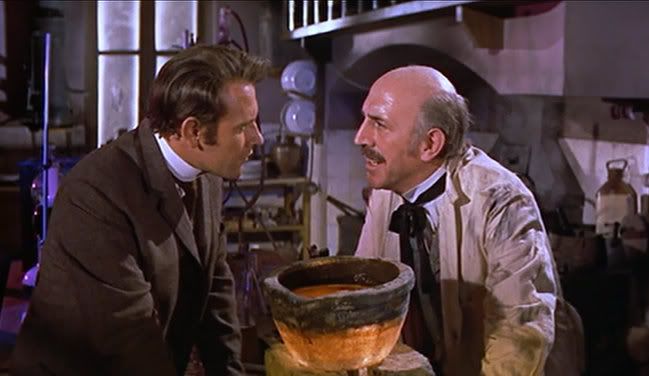
During routine engineering work at Hobbs' End underground station ( "Hob" is a folk name for Satan ), a group of bones and half complete skeletons of ape men are discovered, apparently drastically predating the era that scientists had established for those creatures. Later, an unusual metal container is unearthed. The authorities, led by the unimaginative Colonel Breen ( Julian Glover ), believe it to be an unexploded bomb left over from WW2, but when Professor Quatermass arrives on the scene, he proves otherwise. The contents inside reveal to him a discovery which shatters the accepted theory of Darwin's evolution and offers a dire warning for the future of mankind. 


Kneale ambitiously attempted to rationalize the nature of both supernatural hauntings and human concepts of the devil and, surprisingly, he translated those ideas into a convincing and plausible, if improbable, script. 

Quatermass and the Pit was broadcast in December 1958 and received much acclaim from television critics, with several reviewers praising Morell for having given the definitive portrayal of Professor Quatermass. Cic Linder, Anthony Bushnell, and John Stratton rounded out the great cast. 


As with the previous two serials, Hammer purchased the film rights to these monumental Pit episodes, however, partly due to the declining box-office receipts of Quatermass 2, Kneale's refusal to tolerate a drunken Donlevy once again, and Columbia disinterest in the series ( Hammer had recently struck a distribution deal with Columbia Pictures ), it was not brought to the big screen until February 16, 1968.

Instead, Hammer plunged into another film adaptation of a Kneale teleplay - this time of "The Creature" ( 1955 ), which they retitled The Abominable Snowman

Roy Ward Baker undertook the directorial responsibilities when Quatermass and the Pit was put into production in February 1967. Baker had directed a number of fine films during the 1950s, notably The October Man and A Night to Remember, but several recent failures made him turn to television, directing episodes of such popular crime-fighting series like The Saint and The Avengers. 


Kenneth More was Baker's original choice for the part of Quatermass, but eventually he selected Andrew Keir to replace Morell, who had turned down the chance to play the role again. This was a stroke of good fortune, for Keir brought an excellent steely determination to his characterization of the professor as well as injecting a very human fragility and vulnerability. 

James Donald adds great support to Keir, and Barbara Shelley, one of Hammer's most popular and prolific leading ladies, is excellent as fellow scientist, Barbara Judd. Quatermass and the Pit ( also known as Five Million Years to Earth ) was her final film for the studio. There are a swarm of delectable British character actors to enjoy as well, including Peter Copley, Bryan Marshall and Edwin Richfield.

Hammer's home base, the Associated British Studios in Elstree, Borehamwood did not allow for enough space to film and so the project was relocated to the MGM Borehamwood studios where no other film was being shot at the time, giving the crew - and especially the production designers - ample space to work with, which they utilized in creating the enormous Underground station and excavation settings. 


QUATERMASS 1979 

After Quatermass and the Pit, Hammer approached Kneale about the possibility of writing another script for a film follow-up but that idea never came to fruitation. Instead, Professor Quatermass made his final television appearance in the four-part 1979 Thames Television serial release, simply entitled Quatermass. Alas, it was a serial that should not have been made. In the mid 1960s, Nigel Kneale had written a dreary and depressing tale of the future state of London - and much of the world - where young people have formed violent gangs and attack bystanders without provocation while bands of hippies worship the ancient energies and dance around archaic stone monuments waiting to be transported by aliens into a faraway world. 


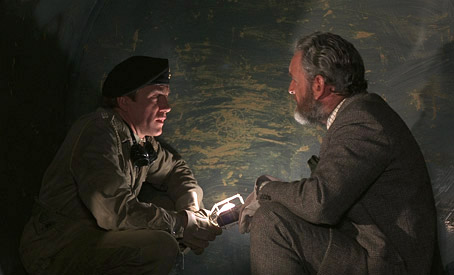
Quatermass was not put into production until late 1978, when these peace, love and hate incidents seemed oddly irrelevant.  What's worse, Professor Quatermass is no longer an optimistic man of science, but has warped into a bitter and discouraged old man. He has long been retired, living in retreat in the Scottish Highlands. His sole purpose in coming to London is to search for his missing teenage granddaughter. After a recent space mission goes horribly wrong, right before the public's eyes on live television, a young astronomer ( Simon MacCorkindale ) and Quatermass search to find the answers to this occurrence and other unusual happenings.

The series, and even the 100-minute feature film release The Quatermass Conclusion, progress along cumbersomely and convey a bleak dystopian setting, a far cry from the 1950s post-war Britain of the previous serials.

Whereas Kneale's original series were genre-defining and ground-breaking, this Quatermass lacks energy and quite frankly, fizzles out before it has a chance to begin. Not even John Mills' superb acting ability could inject new life into the character. 


THE QUATERMASS EXPERIMENT 2005

BBC Four attempted to revive Professor Quatermass for the younger generation 
in 2005, when they mounted a remake of the original Quatermass Experiment, this time with a much more youthful Jason Flemyng portraying the now tie-less Professor. More recently, Simon Oakes, the current CEO of Hammer Films has announced plans to dip into the archives and remake several of Hammer's post popular films, including the inimitable Quatermass.

The BBC Quatermass serials of yor did not rely on special effects but rather on interesting characters, good dialogue and an intelligent story, elements seen far too rarely in modern science fiction films, which hopefully will be remedied if a remake is undertaken. 

To this day Nigel Kneale's creation of Quatermass, and the serials that showcased this character, remain one of the BBC's finest achievements and influenced numerous science-fiction series including Doctor Who and Sapphire and Steele. 

Be sure to check out the Quatermass films available on DVD, as well as The Quatermass Film Music Collection. 

Monday, November 4, 2013

School Bells Ringing, Children Swinging


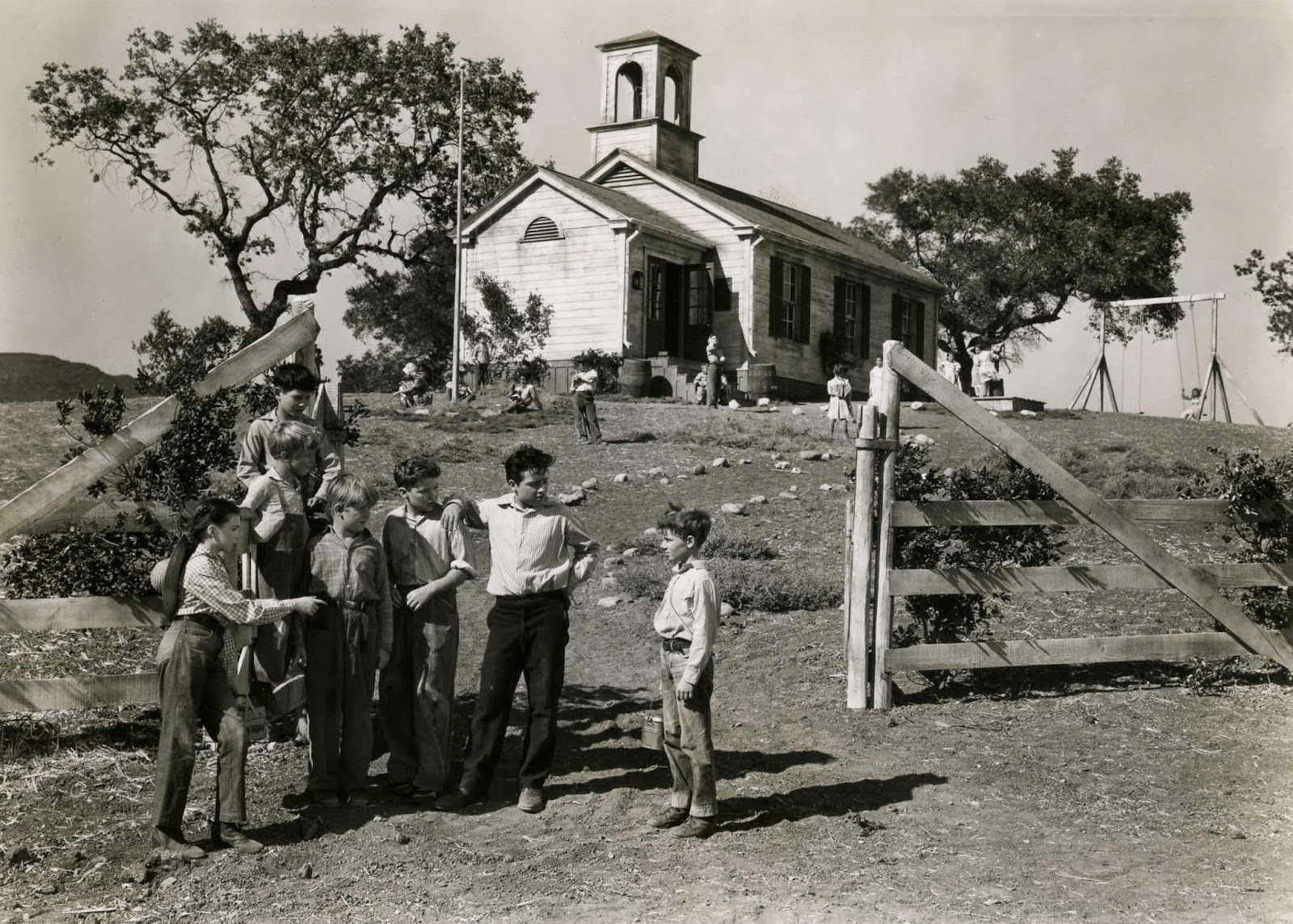
Boy meets horse, boy loses horse, boy miraculously gets horse back - stories like these were endlessly cropping up in films of the late 1940s. "National Velvet" and "My Friend Flicka" started a chain reaction that continued on until the early 1950s. Most of these follow-ups were just average productions, but The Red Pony ( 1949 ) was a stand out. Beautiful Technicolor and big name drawing actors like Robert Mitchum and Myrna Loy helped draw the adult crowd to this pleasing family film. A young Peter Miles plays Tom Tiflin, the pony's proud papa, and here we see him getting a teasing from his fellow schoolmates. He probably should run to teacher for help, but won't, since she is played by the inimitable Margaret Hamilton.