Friday, June 20, 2014

Hollywood Home Tour - Clark Gable

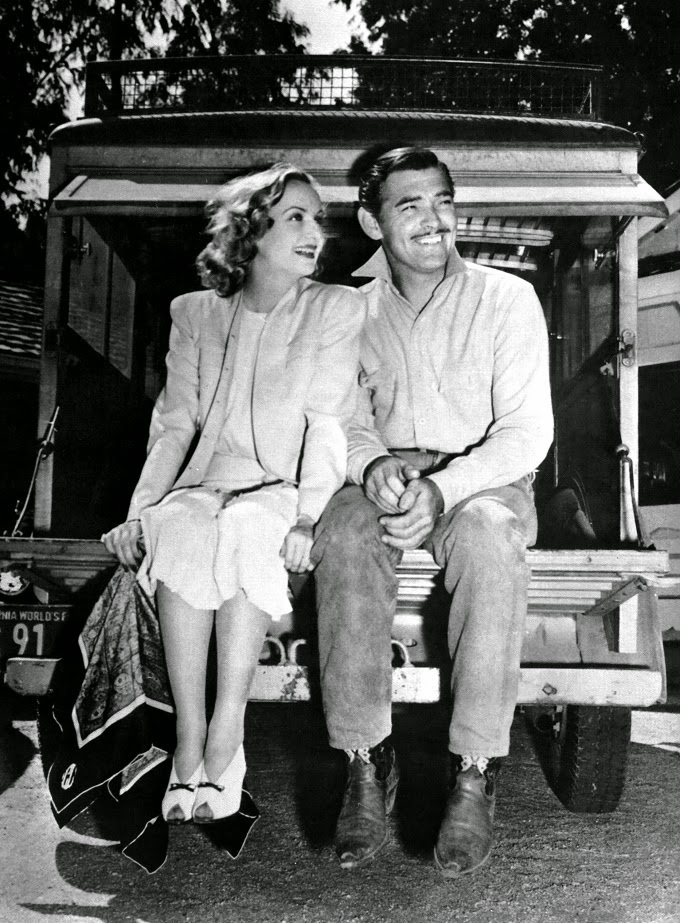
"Here we come to one of the most famous of movie star homes - the ranch shared by Clark Gable and his wife Carole Lombard from 1939 -1942.... 


4525 Petitt Street, Encino

"The spacious nine-room white brick and wood ranch was nicknamed "The House of Two Gables" when the couple moved in. While Gable was off making Gone With the Wind, Lombard had the interior completely re-done in a beautiful Early American style, renovating two of the first-floor bedrooms into an office for Gable and a room to showcase his ever-growing firearm collection. Outside on the grounds were citrus groves, fields of oats and alfalfa, stables, a hen house, cow barn, and a pig-less pigsty. I'll pull up to the curb here, so you folks can get a better look at the place."

"Did Gable actually farm the property?" 

"Yes, he really did enjoy being on the ranch and especially loved to give reporters the grand tour of his mini-farm - it was 20 acres - often posing for photos on his tractor or milking cows for them. It was a peaceful respite away from the hustle of Hollywood for him"

"The house was the former residence of director Raoul Walsh. Clark Gable and Carole Lombard had previously visited the home and were admirers of the property, so when they got wind that it was up for sale in the fall of 1938, Carole put up $50,000 to purchase it. In March of 1939 the couple were married and moved in shortly after...however, this was only to be a temporary residence. The lovebirds were planning on starting a cattle ranch and were looking to purchase a large piece of land either in Arizona or Wyoming. Carole Lombard's death in an airplane crash put an abrupt end to their dream plans and, brokenhearted, Gable put the Encino ranch up for sale, not bearing to stay there any longer. A good friend of his, Al Menseco, convinced him to change his mind and while Gable was fighting overseas during WWII, he had the ranch kept running by a few house servants and a caretaker. After the war, the King again put it up on the market and pulled it off shortly thereafter. Gable currently lives on the ranch with his fifth wife, Kay Spreckles Gable. "

Up-to-date Note : In 1973, his wife Kay sold the ranch and it was subdivided into a housing development called Gable estates. Today, the house still stands although it sits on less than an acre of property. Click here to view images of the interior of the home at this great Carole Lombard website.

Monday, June 16, 2014

On the Homefront : MGM and the War Effort

Sunlight streams through the shattered roof of a country church. There are empty places in the pews where, only a few weeks earlier, parishioners had sat - the local stationmaster, a choirboy, the young daughter-in-law of a much loved family. They are gone now, dead from the bullets or the bombs of an enemy they didn't know, in a war they hardly understood. 

Framed by the wreckage of his church, the vicar delivers a ringing sermon : "Why, in all conscience, should these be the ones to suffer? I shall tell you why! Because this is not only a war of soldiers in uniform. It is a war of the people - of all people - and it must be fought not only on the battlefield but in the cities and in the villages, in the factories and on the farms, in the home and in the heart of every man, woman, and child who loves freedom...This is a people's war! It is our war! We are the fighters! " 

The camera pans upward, through the sundered roof of the church.  "Onward Christian Soldiers" rises on the soundtrack as British fighter places - like a gathering flock of graceful birds - wing overhead, toward the enemy. 

So ends Mrs. Miniver, MGM's most popular and award-winning film of World War II. Moviegoers around the world thrilled to it, and with good cause. MGM was at its best during the war years, making movies to build the morale of fighting men and women, and the families awaiting their return. 


It was a time of pure patriotism, the fan club, the screen magazine, and the star system. MGM's male stars traded costumes for khaki and marched off to war. Clark Gable, James Stewart, Robert Taylor, Gene Kelly, Jackie Cooper, Stewart Granger, Van Heflin, Robert Montogomery, and Robert Sterling all served in the armed services. 

Other stars of both sexes went overseas to perform in USO shows; some washed dishes, served food, or danced with lonely GIs in the Hollywood Canteen. And still others traveled around the United States,  selling war by the thousands, sometimes quite creatively. MGM, for instance, conducted a "Tanks for Yanks" campaign that featured Johnny Sheffield, the "Boy" in the Tarzan series, touring the country and speaking, from the turret of a tank, about "A Boy's Place in America". 

In another promotion, MGM conducted a contest in several cities to pick seven girls who were "...doing the most to promote the war effort on the homefront". Their prizes were corsages and dinner with seven sailors, all paid for by MGM. 

Meanwhile, back at the studio, the sound stages busily produced war-related short subjects, such as National Defense, a documentary honoring all of the Rosie the Riveters and Max the Mechanics in the country. One of Pete Smith's lighthearted short subjects, Victory Vittles, advised home-front housewives to make do with leftovers, while an intriguing series on the medieval prophet Nostradamus revealed his provocative predictions for the advent and end of the war. Don't Talk and Mr. Blabbermouth warned home-front warriors about the consequences of rumor-mongering and spilling war secrets to unsuspected spies. 

For the young and the young-of-heart, the studio's cartoon department penned, among others, The Blitz Wolf, in which Adolf the cartoon wolf, who bore a "striking resemblance to Adolph the Phewrer" was ultimately defeated by the three little pigs of Pigmania - once they abandoned isolationism and fought together for the common good. 


Still, MGM's most effective weapons were its stirring home-front feature films. "Motion pictures are of the utmost importance to....build up mroale", said General Dwight Eisenhower in 1942, "...feature productions bring home their country vividly to the memories of soldiers. Let's have more motion pictures!" An MGM obliged, with multi-star musical extravaganzas such as Thousands Cheer ( 1943 ), Family musicals such as Meet Me in St. Louis ( 1944 ), comedies such as Swing Shift Maisie ( 1943 ), and, most movingly, tributes to the family values the Allied forces were fighting to defend. 

MGM's Mrs. Miniver gently dissolved class distinctions in England and celebrated the enduring power of the family - itself a miniature world at peace. Its American counterpart was The Human Comedy ( 1943 ), William Saroyan's semi-autobiographical story about the Macauley family of Ithaca, California. In his own, spun-glass way, Saroyan created a town and a family with whom practically every American could identify and sympathize. 

The Macauleys are poor in terms of money but affluent in the abundant, boundless love they have for each other. Since his father is dead and brother Marcus ( Van Johnson ) is in the army, young Homer Macauley ( Mickey Rooney ) works at a postal telegraph office to support the family. At the beginning of the film, Homer is a boy; by its end, the war has made him a man, as it has the American soldiers overseas. The telegraph office where he works receives and delivers wires from the War Department announcing the deaths of sons on the battlefield. Inevitably, it receives the news of the death of Homer's brother Marcus. As Homer tries desperately to cope with his terrible loss, the voices of Marcus and his father - like the vicar's words in Mrs. Miniver - comfort him, and the theater audience, too : "You are what we're fighting the war for. You are what we have left behind - to live the hopes we only dreamed ". 

This post is an excerpt from Peter Hay's excellent book on the history of Metro-Goldwyn-Mayer studios, "MGM: When the Lion Roars" published by Turner Publishing in 1991. For those who have not yet read it, it is the authoritative book on the studio and a truly delightful read, packed with over 700 photographs from the MGM's golden era. 

Friday, June 13, 2014

The MGM Blogathon : The Master List

The big day is about to arrive! In two weeks the MGM blogathon will be making its grand entrance. 

READ all about the big stars! 
            READ all about the big films! 
                        SEE all the big pictures .....

from the biggest studio in Hollywood, Metro-Goldwyn-Mayer. Are you thinking BIG yet? 

Our celebration of the 90th anniversary of MGM will be taking place from June 26-29th. We have had a fantastic response from bloggers wanting to participate in this epic event and have gathered together the posts and participants so far in a Master List, organized by date. 


June 26th


June 27th


The Asphalt Jungle ( 1950 ) - Ramblings of a Cinephile
Katharine Hepburn and Louis B. Mayer - The Great Katharine Hepburn
Mutiny on the Bounty ( 1936 )  - Classic Film Freak

June 28th

He Who Gets Slapped ( 1924 ) - Nitrate Diva
Ben-Hur ( 1925 )  and Ben-Hur ( 1959 ) - Phantom Empires

June 29th


If you are not happy with your scheduled post date, then just let us know and we'll shuffle them all around! 

Monday, June 9, 2014

TV/Movie Set: The Parent Trap Ranch

It's that time of year again....when summer begins to peak its head around the corner then our brains start to buzz with new ideas. One of them you're seeing right now : a new series featuring the houses, apartments, cabins and cottages from our favorite movies and television shows. We're not to going to limit it to just our favorites though, we'd love to hear your suggestions on houses we should feature in the new future. 

Actually, this idea isn't all that new. Diana and I have been huge fans of architecture ever since we were kindergarten age, when we use to draw out plans for our dream house, vacation cabin, tree-house or that ideal ice cream stand. Today, we're still sketching house plans whenever an idea crops up ( usually in the middle of the night ) or, more frequently, when we see a perfect house on screen. Instead of hoarding all these designs to ourselves, we just decided to share them! O you lucky people you. 

Over the weekend we were watching The Parent Trap ( 1961 ) and so we picked it to be our very first house in the series. And what a house it is. 

In order to put the place in perspective, it's always best to see a floor plan. Here's my sloppy sketch of the place along with a few mistakes thrown in. If anyone knows where we can get a hold of the original set design plans, let us know! 


Before we get started on the picture tour, I'd like to give special mention to Julia who runs the very entertaining blog Hooked on Houses. She took most of these fab screenshots and - since we're lazy - we snitched them ( don't shake your head just yet, her website stated that people are more than welcome to borrow her images ). Anyway, she has a great selection of TV/Movie houses in her own series, with some classics scattered among the lot, but I think she stopped posting and so we're taking up where she left off...only with Silver Scenes you'll see strictly classic film sets and nothing else. 

Let's get together now and start the tour:  

THE EXTERIOR


Walt Disney's The Parent Trap tells the story of twin sisters, separated at birth, who meet accidentally at summer camp and decide to switch places in order to meet the parent they've never seen before and reunite them both. 


The lovable Hayley Mills plays duel roles in the part of Sharon/Susan, with Maureen O'Hara and Brian Keith playing their divorced parents, Maggie and Mitch. 


The film opens up with the girls at Camp Inch where they first discover that they are the spitting image of each other. Later this summer we'll post images of the cabin that they share, as well as the Boston house that Sharon lives in, but for now we want to focus strictly on the ranch that Susan's dad, Mitch, owns. 

THE ENTRANCE FOYER


Mitch's house is decorated in this beautiful old Spanish missionary style with lots of interior stonework, heavy wood furniture, ornate carvings, and stained glass windows. The entrance door features beautiful decorative wood engravings, especially on the front side. 

THE LIVING ROOM


Once inside, this massive living room greets you. Just get a load of the fireplace on the far left side of the room. Two sets of french doors lead out to the courtyard while the steps take you to the upstairs bedrooms. 


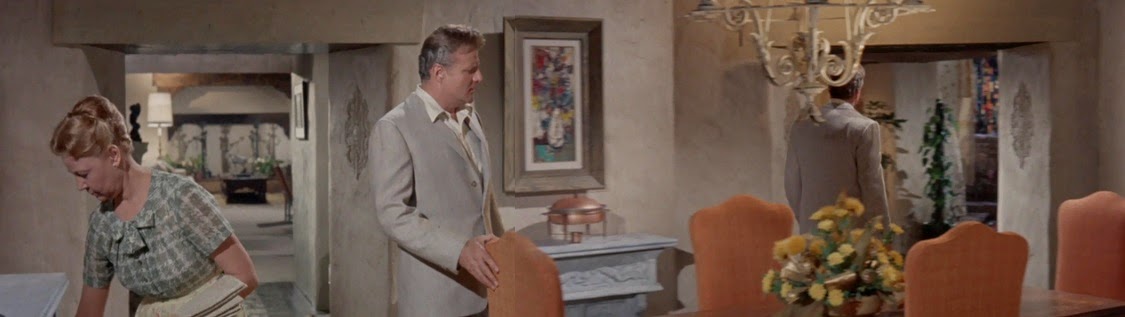
We couldn't figure out where Hecky and Verbena live but it's probably in that separate section of the house just past the thru-way. You can see it in the top shot behind the white Thunderbird. If you were to take a right turn when you enter through the front door, you'd be in a short hallway that leads to the dining room. We pasted two screenshots together so a broader view could be seen. 


Mitch was wondering where his dinner was, when he was told that he will be eating out in the courtyard for a change. Nice as the courtyard is, it wasn't prepared for a dining table and so the gals got Hecky to move one in for them while they set up their "Let's Get Together" routine to entertain their parents. 

THE COURTYARD


If we grew up in this house I'd be throwing pennies down that old well every day making wishes on the future. Although with a life like Sharon had there really wouldn't be many wishes for a better future to make.... 


....unless you wanted a sister and a mother of course. And Maureen O'Hara makes one stunning mother! Here she is making her grand entrance to the courtyard and finds the set-up as amusing as Mitch does. We weren't able to figure out where that backdoor leads to, so we'll leave that up to your imagination. 


Let's take a look at the courtyard in these daytime shots before we move on to the upstairs bedroom. It looks like there is a little stone man with his legs crossed in the background. One thing this house certainly doesn't have a shortage of is flora and stonework.


The art directors who created the fantastic sets of The Parent Trap were Disney legend Carroll Clark ( stay tuned for a re-post about this talented man ) and Robert Clatworthy. Send Me No Flowers, Lover Come Back, That Touch of Mink, Psycho and Midnight Lace were just a few of the films that Robert Clatworthy was the art director on. 


Set decorators, Emile Kuri and Hal Gausman deserve as much credit for creating such a wonderful atmosphere with their decor. The second sheet of our floor plan features the upstairs rooms. Since most of the film took place in the lower level, we weren't able to take note of all of the bedrooms. Sharon and Susan shared a bed, so there must have been only one guest room but I would have loved to see Mitch's bedroom.

THE BEDROOMS


The entire Evers residence has this nice subtle light-tone color palette that carries over from the interior decor popular in the late 1950s. Parts of the house also foreshadow the style of the late 1960s, particularly the yellow glass windows in the living room. You just got to love those wide doors and hallways in this shot of Mitch's dressing room, and look at those horse watercolors. 


Walk through that doorway on the right and you'll end up right smack in the middle of Cleopatra's spa, complete with golden dolphin faucet handles. This bathroom connects with Sharon's bedroom, but oddly enough we see Maureen O'Hara using the bathroom instead. Her guest room did not have a one? Odd, for a ranch this size. But then again, that was probably just so the audience could enjoy that little scene where Mitch finds Maggie's bra hanging on the shower stall and thinks it belongs to Sharon. 


Maureen O'Hara was 41 years old when she made The Parent Trap, one year older than Brian Keith, but you'd never guess it from the way she looks. Maureen is one of the few actresses that really reached her prime ( as Miss Broooodie would say ) in her 40s. 


Here is Sharon looking inquiringly at her dad. This bedroom scheme reminds me of a great set from another Hayley Mills film, The Moon-Spinners ( 1964 ), with it's blue walls and thick white trim ( all stucco ). 


That's about all we get to see of the upstairs except for this brief scene of Verbena putting away the laundry. Anybody want to take a guess at what kind of room that back one could be? A dressing room? Guest room?

Anyway...now the piece de resistance...the kitchen! 

THE KITCHEN


This is one posh kitchen. The stonework is what really makes it stand out. That door in the back looks like it leads to the courtyard but actually it opens to a passageway ( carport? ) which enters into the courtyard. 


And see those great windows that look out to the wishing well? Well..they're not windows. They are just wooden frames. The summers in California are so warm, who needs windows? But in winter, I imagine they would put in the glass panes. 
_______________________________________________

The Parent Trap features several beautiful sets, but the Evers ranch is the best of them all. To this day, the Disney Archives still receive requests for the blueprints to the house, with other asking for directions to the house so they could see it in person. In truth however, there never was an Evers ranch. 

The exterior of the house was just a shell. The exterior walls and roof were erected on the Golden Oak ranch, a large piece of property that Walt Disney owned in Placerita Canyon Road, in Santa Clarita Valley. The interior was all constructed on sound stages, which is hard to believe considering all the "sunlight" that streams in. 

Well, that about wraps up our first TV/Movie Set post. Hope you enjoyed it and stay tuned for more to come! 

Tuesday, June 3, 2014

The Saint ( 1962-1969 )

"Templar...Simon Templar." 

The world was a safer place when the Saint was there to quench the evil desires of the wicked foes scattered across the planet. Simon Templar aka "The Saint" came to the rescue of any poor soul in need, be they wealthy or penniless....provided there was a pretty face nearby. Zipping around in his sporty Volvo P1800, this modern Robin Hood came to aid in the fight for truth, justice and the British way. Via film clips and painted backdrops the Saint traveled all over the world for this cause. From the pearly oceans of Japan to the revolutionary countries of Eastern Europe, Simon would be found taking the law into his own hands and rattling the nerves of the most confident of criminals. 

Roger Moore was "The Saint" for seven years on ITC's hour-long mystery/spy thriller series, becoming a veritable tiny-tele James Bond in the course of the decade. 


The Saint has its profound moments of sleep-inducing splendor and is overall quite charming and strangely addictive. Alongside The Avengers this saintly series was the longest running show of its genre in British television's history. Undoubtedly a testament to Roger Moore's appealing persona and the show's snappy dialogue.


HOW SAINTS ARE BORN

Simon Templar, part gentleman thief/part detective, first appeared in Leslie Charteris' 1928 novel "Meet the Tiger". This story was a commercial success when it was first published and convinced Charteris to stick to writing Saint stories from then on. For over 100 novels, he placed his man in the frays of danger, but Simon Templar ( S.T. for the Saint ) was always prepared to fight the ungodly, whether they be drug runners, gangsters, arms dealers or Nazis. 

In 1936 Leslie Charteris sold RKO the idea of obtaining the screen rights to his hallowed hero, and the studio successfully thrust him into a series of B-grade films, some being of note, others being mediocre. Louis Hayward was the first actor to portray Simon Templar in The Saint in New York, released in 1938. He promptly dropped out of the series after this stupendous start and then the venerable George Sanders took over for five more films before he too stepped down and left the crime-fighting to Hugh Sinclair for the final two films. 


By 1944 the series was washed up and NBC snatched the opportunity to send The Saint into saintly syndication nationwide on its own radio program. Illustrious actors such as Brian Aherne, Edgar Barrier, Tom Conway, Vincent Price and Barry Sullivan all got their chance to play Simon Templar during the show's 6 year run. 

WHEN THE SAINT COMES MARCHING IN...

"I want you to meet the most fantastic man...this is Simon Templar"

When The Saint launched in Britain on ITV on October 4, 1962, it bore little resemblance to the RKO films of the 1940s and instead created a look of its own, a stylish identity that later shows were to emulate, namely the more entertaining The Baron and the benumbingly boring Man in a Suitcase. 

Edwin Astley's jazzy high-pitched opening theme lured audiences into watching each episode every week, but his skill in composing did not extend to penning action-centered filler music and the strength of the series rested solely on Roger Moore's capable shoulders. 

"A buccaneer in the suits of Savile Row, amused, cool, debonair, with hell-for-leather blue eyes and a saintly smile..." these were the words that Charteris used to describe his favorite character. In spite of the fact that Roger Moore fit his description down to the hair root, the author was not all too pleased with the television incarnation of The Saint. This changed overtime however and eventually Charteris became good friends with the producer of the series, Robert S. Baker.

Roger Moore made Simon Templar all his own and embodied his graces of being a sociable, well-tailored gentleman, subtly strong, and always ready to aid a damsel-in-distress. He is not your macho Rambo, bulging with muscles and spiteful vengeance...rather, he's a dandy. But don't underestimate his sophisticated appearance, the Saint would never shirk a fight in the cause of justice. He's just the kind of guy who would look in the mirror and fix his hair afterwards. 

MORE THAN MOORE

Moore could have easily performed in every episode single-handed and still made it entertaining, but instead the producers surrounded him with great guest stars, notably a slew of English character actors who made their livelihood by appearing in shows like The Saint, Danger Man, The Avengers, and The Prisoner simultaneously. Any British TV fan would instantly recognize the likes of Peter Wyngarde, Andrew Sachs, George Murcell, Derek Farr, Kate O'Mara, and Allan Cuthbertson.

The Saint also featured a number of cast members who later went on to befriend or aid in the annihilation of London's sole protector, 007. Julian Glover, Shirley Eaton, Burt Kwouk, Lois Maxwell, David Hedison, Valerie Leon, Paul Stassino, and Honor Blackman were just some of the actors who appeared on The Saint first. 

Templar was quite a ladies man and it's fairly easy to presume that men were the great audience judging from the amount of feminine acquaintances and dalliances Simon had with the ladies. He had a preference for blondes but eventually would settle for any gal with a shapely figure and a pleasing personality. Some of his single-episode sweethearts included Jean Marsh, Samantha Eggar, Barbara Shelley, Quinn O' Hara, Suzan Farmer, and Sylvia Syms. Good taste Templar.


INSURED AND BONDED 

Rarely did Templar resort to using a pistol, preferring the age old art of fisticuffs instead, and like the Saint, Roger Moore hardly ever relied on having stuntmen do his dirty work, preferring to handle the stunts himself. The press loved to emphasis this and thoroughly touted Moore's hand in attempting the dare-devil driving, incredible falls and long leaps that he jumped. The insurance companies were not so thrilled however. Mid-way through the series' run, they insisted that Moore allow the stuntmen to handle more of his feats and have the cameramen cut to close-ups of their leading man in the studio instead. 


One hundred and eighteen episodes of solving mysteries, and later capturing spies, and it was time for the Saint to take a permanent vacation. On February 9, 1969 the series wrapped up production with the final episode, "The World Beater". After seven years of being Simon Templar, Roger Moore was not quite ready to break the habit. Instead he teamed up with Tony Curtis for another ITC mystery/spy thriller, The Persuaders ( 1971-1972 ) in which he played Lord Brett Sinclair, a character not unlike Simon Templar. This series only lasted for one season and then Moore finally accepted the opportunity to don the James Bond persona, which he did for seven films, starting with Live and Let Die ( 1973 ). 

SIMON SAYS...AGAIN

The Saint was not ready to be laid to rest however, and reawakened in 1978 to spread his wings once again in The Return of the Saint, an ITC production starring Ian Ogilvy. Replacing Templar's beloved Volvo was a sporty new Jaguar XJS. Unlike the original series, this Saint actually visited the countries that the title cards referred to. Unfortunately, the show only lasted one season. Saints were going out of style.


HEAVENLY MEMORABILIA

The Saint was promoted in over sixty countries around the world and was immensely popular on the continent. Today, the series is available on at least seven different DVD box sets. In addition to the usual round of comic book and magazine promotional items, the Saint's untarnished image was plastered on quiz books, puzzles and paperbacks.


A particular favorite of ours is the 1/64 scale miniature model of the Volvo P1800 issued in 1966 by Corgi. These were in their standard P1800 models which they simply painted white and stuck with a decal of the saintly stick-figure, but we won't tell anyone if you won't. 


More recently, The Saint memorabilia has included an official 2003 calender released by Show Dazzle Worldwide. If you missed it, you can purchase it "used" this year and pin it up again but be quick, the year is running out. Cards Inc. issued The Saint trading cards in 2003 as well, filled with some lovely color screenshots and fun trivia.
____________________________________________________

Currently Me-TV airs episodes of The Saint at 4am EST on Sunday mornings. If you ever have a case of insomnia and desire a potent remedy, here's Dr. Silverscenes kosher cure which will bring about instantaneous slumber - take in twenty minutes of The Saint. Pick any episode, they are all alike. There are no side effects and you'll have exciting dreams to boot! 
This post is our contribution to the Me-TV - Summer of Me Blogathon being hosted by the Classic TV Blog Association. Be sure to stop by and enjoy each of the great posts about all of the shows from Me-TV's summer schedule. 

The Shaggy Dog ( 1959 )

In the mid-1950s, Walt Disney gave ABC network their very first full-hour western television program - Davy Crockett. The series was such a success that the network soon launched many other similar series such as Maverick, Wyatt Earp, and Lawman. These westerns brought ABC so much income that in 1957, when Walt Disney approached them with a fresh idea for a sitcom (sans the gun belts and tumbleweed) they turned him away. This minor detail didn't bother Mr.Disney in the least since he turned the material that he had offered ABC into a feature film release. The Shaggy Dog became one of the top-grossing films of 1959 earning $9,000,000 at the box-office and out-performing The Diary of Anne Frank and North by Northwest. That's something to bark about. 

What made this low-budget comedy such a smashing hit? For one thing, it was a novelty. After a decade of musicals, crime dramas, spectacles, and method-acting melodramas, here was a little film that played out like a television series, a Leave it to Beaver versus Enemy Agents. It was unique. It was fun. And above all, it was great family entertainment. Walt knew how to appeal to all ages and The Shaggy Dog provided entertainment and humor for the young and old alike. It was filled with excitement, clever dialogue, and plenty of visual gags. The studio went on to recycle many of these gags in their recurring films.

Unlike the other box-office hits of 1959, The Shaggy Dog did not have any moments of great splendor, instead it leisurely followed the story line only to stop occasionally to wittily comment on the social status at the time or sprinkle gentle humor. Writer Bill Walsh penned the amusing screenplay based on the 1930 novel, "The Hound of Florence", by Austrian author Felix Salten (Bambi).


The Shaggy Dog follows the adventures of a junior scientist who accidentally recites an ancient Borgia curse that releases a 400-year-old shape-shifting spell. With the magical words "In Canis Corpore Transmuto," Wilby Daniels transforms himself into a big, shaggy dog - a Bratislavian sheepdog to be precise - belonging to the new neighbors on the block. It is while being in the four-footed state that Wilby overhears a plot to steal a secret missile plan at the nearby air base. It's Shaggy to the rescue then as he tries to convince his father, and the local authorities, that Continental spies are at work in the neighborhood!  

"In Canis Corpore Transmuto...In Canis Corpore Transmuto....it's a dosy do and awaaaay we go!"

The Shaggy Dog boasted a fine cast of young players, all of whom would come to be associated with the Walt Disney Studios. Tim Considine took a radical turn from his wholesome Spin and Marty role to play Wilby's scheming friend Buzz. At the expense of his good ol' pal, he whizzes around in his hot-rod wooing the most eligible girls in town. One of these girls just happens to be Allison, played by Annette Funicello in a brief part, her first film appearance. She is soon replaced as Girl No. 1 when sophisticated Franceska Andrassy (Roberta Shore) moves in with her father in the big Victorian manor across the street. If this street looks familiar, it is because it is the Universal cul-se-sac featured in The Munsters, The Burbs and Leave it To Beaver. 

Tommy Kirk proves to be in top form as Wilby Daniels. Although he made many more films with Walt Disney during the 1960s, none of his roles would be as appealing as Wilby. Tagging along as a mischievous helpmate is his little brother Moochie, naturally played by Mickey Mouse Club "Moochie" himself - Kevin Corcoran. Moochie doesn't display much surprise when he discovers his brother is a dog, but rather jumps at the notion of having a pet playmate to take on walks and throw sticks to. Corcoran later went on to become a producer with the Walt Disney studios in the 1970s and 1980s. 


Unlike the childish, bumbling crooks seen throughout the Walt Disney productions of the 1990s, The Shaggy Dog featured some pretty normal rough-and-tough criminals (played by Anthony Scourby and Jacques Aubuchon), although in this flick they are spies and quite debonair to look at. In fact, they are so suave that our damsel-in-distress does not even realize they are up to no good until after they kidnap her. Our devious villains conjure up images of the sophisticated foils that were so popular in series of the 1940s, such as those seen in Sherlock Holmes, Michael Shayne, or The Three Stooges shorts. These criminals are upstanding citizens loaded with wealth which they love to lavish on their collections of fine art and furniture. No one in the community would even dare consider them to be enemies of the state.

Fred MacMurray had been making films covering every possible genre since he began his career back in 1929. After making a number of mediocre pictures during the 1950s, Disney asked Fred if he would be willing to try his hand at comedy once again. The Shaggy Dog marked the beginning of a seven picture association he had with Walt Disney Studios. In the film, MacMurray plays a retired mailman and the father of our two leading lads. He has an allergic reaction to dogs that makes him despise the mere mention of their name and prompts him to bring out his trusty double-barreled shotgun from the hall closet. 

"You know that dog thing is all in your mind"

"All in my mind?! I itch, my sinuses are bloating up, my throat is constricting so that I can hardly breath, those old Pekingese wounds on my ankle are throbbing like bongo drums...and you say it's all in my mind!" 

One of Fred's best scenes involved him trying to convince the head of security at the missile plant that his son is a dog. Variety magazine noted, "It's a pleasure to see such a master of timing and emphasis as Fred MacMurray back in comedy again, even though he is somewhat limited in his material. Where he has a good line, he shows that he has few peers in this special field of comedy". 

Playing his wife is the lovely Jean Hagen, another gal who had her share of duds before snagging this wholesome part. Cecil Kellaway, Paul Frees (a legendary voice-over actor for Walt Disney Studios), Forest Lewis and Gordon Jones rounded out the great cast, but let's not forget the film's star player - the shaggy dog. "Chiffon" was in fact Sammy's Shadow, a talented pooch belonging to a California State Division of Highways clerk. He had an illustrious pedigree and, after enrolling in William Koehler's obedience training classes at the age of 4 months, he joined the Allied Movie Dogs firm and landed this wild and woolly part. Twenty sheepdogs had been tested for the part but Koehler knew he had a winner with Sammy and it is truly the dog performing all of the stunts seen in the film ( except for one talking sequence where a hand puppet was used ). Sammy went on to win the 1960 PATSY (Picture Animal Top Star of the Year) award for his performance in The Shaggy Dog. 


The Shaggy Dog has held up well over time, which is a testament to the enduring strength of a simple story told well. It is also notable for instigating important changes within Disney's production outlook for the coming decades. It was the first film to use animated title sequences and the picture's success told the studio that live-action comedy films were a profitable venture not to be overlooked. Unfortunately, they held to its "formula" so closely that many of the later Disney productions lacked novelty. 

This post is our contribution to the Snoopathon, a celebration of spies and agents being held over at Movies Silently. Be sure to check out the site and read  all of the great posts!

Sunday, June 1, 2014

Above Suspicion ( 1943 )

"My love is like a red, red rose...." 

MGM journeys into the realm of espionage with Above Suspicion (1943), a witty jaunt into spy-laden pre-World War II Europe. 
Fred MacMurray plays Richard Myles, an Oxford college professor, who is happily ready to embark on a Continental honeymoon with his bride Frances (Joan Crawford). Before they depart however, a former colleague of his, now with the foreign office, asks the couple if they would do a favor to him, and jolly ol' England, by inquiring into the whereabouts of a scientist who has disappeared within the confines of the Fuhrer's Vaterland. He holds the secret plans to the Nazi's latest diabolical invention - underwater magnetic mines. As honeymooners they would be considered above suspicion and could look into the matter discreetly. Or so they are told. Ach du lieber!...before they can utter "uberraschung" they are caught up in a web of intrigue that leads them from Paris to the pine-laden Alpine forests of Innsbruck. 


Above Suspicion, based on the novel by Helen MacInnes, is an easy-to-follow and briskly paced thriller with some rattling good moments of excitement. Its purely escapist plot is given credibility through its deft handling by director Richard Thorpe (Night Must Fall, Ivanhoe) and its stellar cast. The film plays out along the lines of Desperate Journey with grand morale-boosting elements but very little plausibility.....but perhaps that's what makes both of these pictures so entertaining. Above Suspicion was released at the height of World War II, a time when so many American and British citizens were eager to make an active contribution to corking up the war for good. 

"Darling, the less you know, or appear to know, the better"

At one time or another we're all drawn in by the allure of being a spy; deciphering codes, staking out suspicious bookshop fronts, wearing disguises, hiding out in secluded chalets and, of course, capturing public enemies. Richard and Frances are no different, and Frances is especially thrilled to help the British secret service but, unlike his wife, Richard realizes the danger ahead. En route, our American heroes stumble upon cryptic clues, all the while being spied on with peering abnormality by dubious faces and sundry characters. Their only key to unmasking friends from foes lies within the lyrics to Robert Burns eighteenth century melody. 

In addition to our leading cast, Above Suspicion features some excellent character support from Basil Rathbone, Felix Bressart, Reginald Owen, Richard Ainley, Bruce Lester and Sara Haden. Conrad Veidt is especially appealing in his role as Herr Seidel, one of the Brit's loyal allies within Germany. Veidt was often pigeon-holed as villains and it is a pleasant change of face to see him play this underground hero. Veidt died of a massive stroke shortly after filming commenced and Hollywood lost one of its most talented actors because of his passing. His entertaining dance floor sequence is a highlight of the film. 


Fred MacMurray was making a departure from his recent Claudette Colbert comedy teamings to take a dramatic turn and this role suits him quite well. Incidentally, Colbert would have made an excellent Frances had Crawford declined the part. 


Joan Crawford had been loyal to Metro-Goldwyn-Mayer since they gave her her start in 1925. She made seventeen films with the studio but by the early 1940s her star-status was beginning to wane and fresh faces like Lana Turner, Hedy Lamarr, and Greer Garson were receiving all of the choice scripts. Eager to showcase her acting ability, Crawford accepted a lower salary and switched to the less prestigious Warner Brothers studio after the completion of Above Suspicion. Within one year she was up for the Academy Award for Best Actress for her portrayal in Mildred Pierce.

Within Above Suspicion are hidden elements of Hitchcock-like suspense, featuring a labyrinth of twists and turns, car chases, and an assassination attempt at an opera, a scene taken right out of The Man Who Knew Too Much (1934). Overall, the film is like a tasty strudel filled with chunks of drama, comedy and action, all enfolded within thin layers of plot to make up a taut 90-minute thriller.


This post is our contribution to the super-sneaky Snoopathon hosted by Movies Silently. Be sure to check out all the great posts about the nefarious spies, agents, and Mata Hari's that appeared in films from 1920-1965.