Sunday, January 28, 2018

The Land that Time Forgot ( 1975 )

The year is 1916. Somewhere in the Pacific Ocean, a German U-boat torpedoes a supply ship and captures its survivors. Among these survivors is Bowen Tyler (Doug McClure) who, with a few other surviving crew members, manages to take command of the vessel. However, he soon becomes allies with the U-boat's commander, Captain von Schoenvorts (John McEnery), when the ship's compass is sabotaged and they find themselves off course and heading towards Antarctica. A narrow underwater passage leads them into an uncharted subcontinent known as Caprona where they work together to search for fuel for the return journey while battling dinosaurs and dangerous tribes of primitive men. 

The Land that Time Forgot is a campy adventure film with rubber dinosaurs and hoards of hairy cavemen, and it probably appeals most to those who grew up with the film from childhood, but even a first-time viewer will discover some exciting moments in it, such as the man-eating prehistoric Loch Ness monster that does indeed have a snack onscreen. 
Edgar Rice Burroughs, the man whose imagination gave birth to Tarzan, penned "The Land that Time Forgot" in 1924. The novel's premise is a clever blend of adventure, sci-fi, and World War I drama, and director Kevin Connor did a fair job of transferring that to the screen. But, overall, it lacks the spit and polish (and the pinch of humor) that could have made it a really memorable classic. While McClure was a talented actor, he didn't exude the heroic charm of an Errol Flynn or Stewart Granger, which the lead character deserved to have. 
Nevertheless, the box-office receipts were so good for The Land that Time Forgot upon its release that Connor turned out two more Edgar Rice Burroughs-based films for American International Pictures: At the Earth's Core (1975), also starring Doug McClure, and The People that Time Forgot (1977) with Patrick Wayne, which was the most entertaining of the three. 

Susan Penhaligon also stars as the requisite love interest, with Keith Barron, Anthony Ainley, Godfrey James, and Roy Holder rounding out the cast.

Wednesday, January 24, 2018

The Impossibly Difficult Name that Movie Game


Hoorah! Someone deserves a good applause... but who? and just what did they do? If you've seen this film then you know what this mystery person accomplished. Put on your ski caps - I mean your thinking caps - and see if you can name this movie.

As always, if you are not familiar with the rules to the Impossibly Difficult Name that Movie game or the prize, click here!


GAME OVER. Congratulations to Tiffany who has correctly guessed "Snowball Express" ( 1972 ). This band of skiers was applauding Dean Jones' aerial stunts on skis, not aware that he was a helpless victim of being pushed down the mountain...backwords! 

Tuesday, January 16, 2018

Paradise for Three ( 1938 )

MGM had a knack for making great comedies and, during the 1930s especially, the studio was churning them out a dime a dozen. Paradise for Three aka Romance for Three was a particularly fun MGM comedy that featured the always delightful duo of Robert Young and Florence Rice. Its Alpine setting and the presence of no less than seven great character actors make it stand out among all the other top features MGM released in 1938. 

The sparkling George Oppenheimer-Harry Ruskin script ( based upon Erich Kastner's novel "Three Men in the Snow" ) follows the escapades of a wealthy industrialist named Tobar ( Frank Morgan ) who decides to go slumming by taking a vacation in the Alps in the guise of a poor villager. While on holiday he becomes smitten with a gold-digging divorcee ( Mary Astor ) and befriends a poor but intelligent young man ( Robert Young ) who just so happens to be in love with his daughter ( Florence Rice ). Ah yes, romance has a way of blossoming even in the snowdrifts. 

"Yodeling around with that hussy!"

Every decade gave birth to its own unique style of films and Paradise for Three is certainly a product of its time. Like the music of the era, it is bouncy bubbly entertainment that leaves you with a marvelous carefree feeling. 
Young and Rice received top-billing on the credits but Frank Morgan is the true star of the picture. Morgan was excellent in just about every film he made, but none showcases his fine comedic flair as well as Paradise for Three. Tobar is the perfect role for Morgan, a bumbling and sometimes silly, but lovable and respectable businessman. 

This was the fifth film that united Young and Rice, who made a lovely screen-couple. Supporting them were Edna May Oliver ( always a hoot ), Sig Rumann, Reginald Owen, Herman Bing, and Henry Hull. 

Sunday, January 14, 2018

British Pathé - Beat the Bandit ( 1961 )

Talk about the long arm of the law! These crime-fighters know how to handle bag-snatchers in London with their new invention. This 1-minute long 1961 British Pathé newsreel entitled Beat the Bandit showcases an amazing security case that literally sprouts arms the moment a bandit takes hold of it.... and it crushes the culprit's fingers in the process, too. Case closed! 

This would certainly make even today's criminals think twice about snitching a bag left at a bus terminal or airport. There are not many places one can escape to with a three-armed bag attached to the hand! 

It seems like an invention Scotland Yard may have stolen from C.O.N.T.R.O.L, but hey...it obviously works so I won't knock it. 

Hands off, Buster!

Ready to see it in action? Simply click on the link below : 


British Pathé - Amazing Anti-Theft Security Case! 

Other similar British Pathé clips : 

Carry Safe ( 1951 ) - 0:53 minutes

Stop Thief! ( 1938 ) - 0:48 minutes

Tuesday, January 9, 2018

Darling, How Could You! ( 1951 )

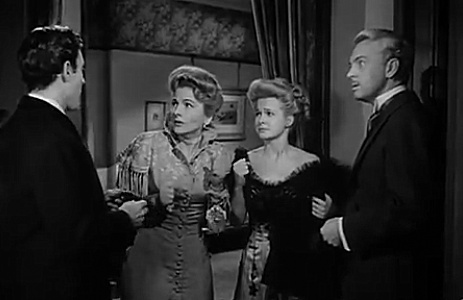
Scottish novelist James M. Barrie is today best remembered for penning the classic children's story "Peter Pan" (1905), but during the turn-of-the-century he was one of the most popular playwrights in England, writing such plays as "The Little Minister," "Quality Street," and "The Admirable Crichton." He had a flair for comedy and one of his best comedic plays "Alice-Sit-by-the-Fire" (1905) - a story of a couple's reunion with their children after several years absence - was brought to the screen in 1951 as the charming Darling, How Could You! starring John Lund and Joan Fontaine.

Dr. Mark Gray (Lund) and his wife Alice (Fontaine) return home to Boston after having spent five years in Panama aiding in the yellow fever epidemic during the construction of the Panama Canal in 1900. Their three children, Amy (Mona Freeman), Cosmo (David Stollery), and baby Molly (Maureen Lynn Reimer), had remained in Boston and were being cared for by Mark's mother and a nursemaid (Angela Clarke).

Both Mark and Alice are impatient to be reunited with their children, but while Mark builds a rapport with the children in a snap, Alice is overly-anxious for instant love and finds the initial greetings awkward. She also has to contend with jealousy from the nursemaid who grew attached to baby Molly while they were away. Meanwhile, their imaginative daughter Amy is convinced their mother is having an affair with a friend of the family (Peter Hansen) after having accidentally seen a theatrical play that portrayed the "seamy side of life". 

Darling, How Could You! is a little-remembered comedy today and yet it boasts a great cast of pros that handle their parts with ease and features some very humorous moments ...two qualities which should make it more memorable. 
While the film starts off rather slow it builds up considerably when Lund and Fontaine enter the scene and ends with a tickling good comedic sequence involving Alice's misunderstood romantic entanglement.

John Lund is especially charming as the understanding Victorian father of the family. He cuts a dashing figure and is an admirably loving husband to Alice. Joan Fontaine didn't often get a chance to play comedy parts so she tackled her role with gusto and looked particularly beautiful while doing so. And the children were perfectly cast: David Stollery, later a veteran of Walt Disney television series such as Spin and Marty, is adorable as Cosmo, their little tough-talking son, while the underrated Mona Freeman displays perfect comedic timing as their winsome teenage daughter Amy. 

It may seem strange today that any young couple would choose to be separated from their children, but James Barrie's original play was set in London with the Grays returning home from British India. It was quite common at the time for couples who were residing in India to send their children back to England to be cared for by family members or nannies due to the risk of disease or uprisings in India. For the film, the setting was changed to Boston to appeal to American audiences, and so the yellow fever epidemic in Panama was given as the reason for the Grays absence for such a long period. Pretty clever. 

Darling, How Could You! is currently not available on DVD but can be rented and viewed online through Amazon. 

Monday, January 8, 2018

From the Archives : George and his Gal in Bullet Code ( 1940 )


George O'Brien and Virginia Vale make a handsome rootin'-tootin' couple in this still from the 1940 RKO western Bullet Code. 

From the Archives is our latest series of posts where we share photos from the Silverbanks Pictures collection. Some of these may have been sold in the past, and others may still be available for purchase at our eBay store: http://stores.ebay.com/Silverbanks-Pictures

Thursday, December 28, 2017

The Impossibly Difficult Name that Movie Game

It's time to ring in the new year - and time to party!....just like this couple is doing. Those great pink balloons would make a festive midnight "ball drop" at your own party. Just it's too bad people don't dress up in tuxedoes anymore when they do a night on the town. 

As always, if you are not familiar with the rules to the Impossibly Difficult Name that Movie game or the prize, click here!