Showing posts with label Deborah Kerr. Show all posts

Thursday, February 6, 2025

The End of the Affair (1955)


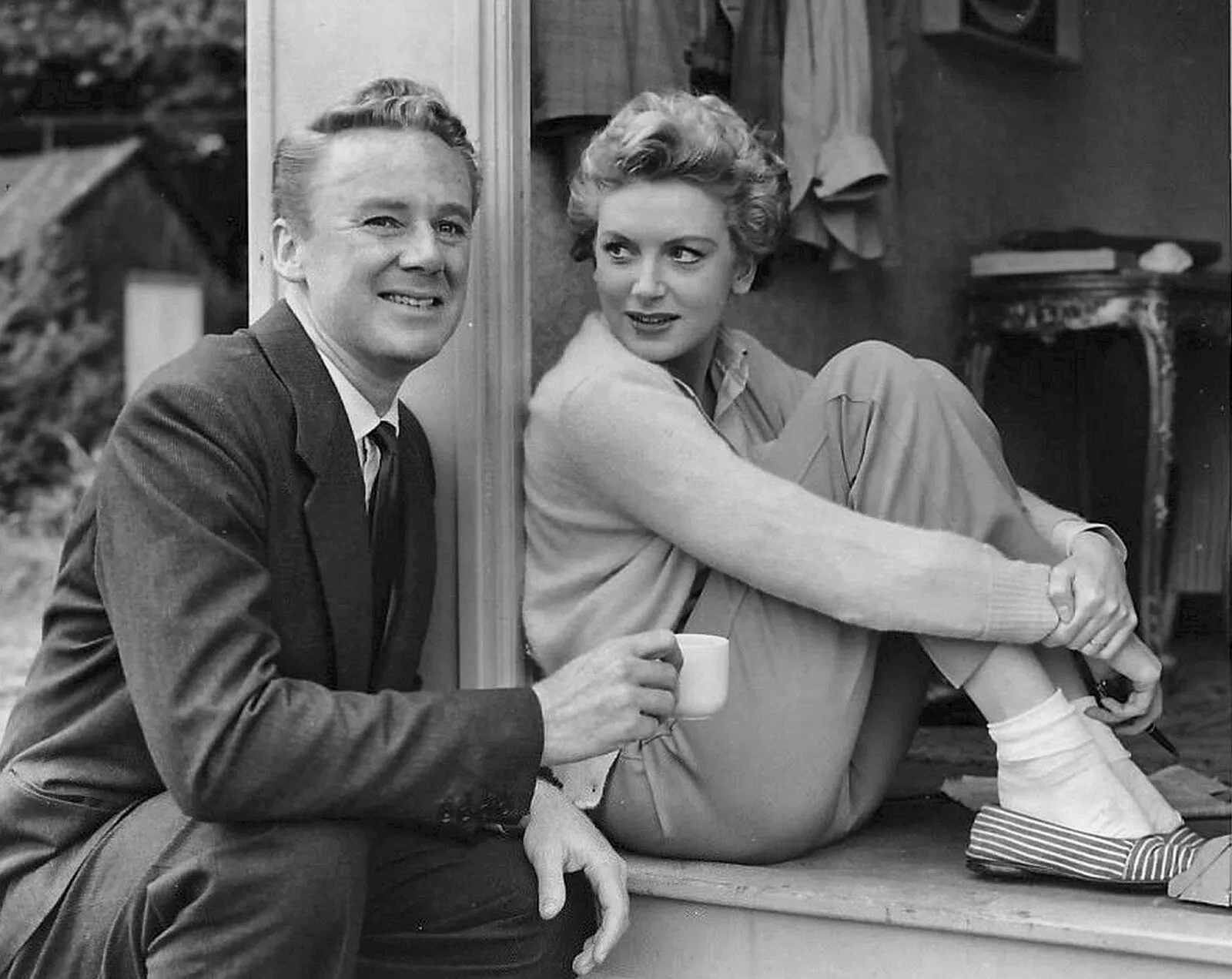
Van Johnson and Deborah Kerr are taking a quick break during the making of the romantic melodrama The End of the Affair (1955). This was several years before Kerr had her most famous affair with Cary Grant in An Affair to Remember (1957).

From the Archives is our latest series of posts where we share photos from the Silverbanks Pictures collection. Some of these may have been sold in the past, and others may still be available for purchase at our eBay store: http://stores.ebay.com/Silverbanks-Pictures

Wednesday, April 8, 2020

From the Archives: Quo Vadis ( 1951 )


Robert Taylor and Deborah Kerr in the MGM epic Quo Vadis ( 1951 ). The film was based upon the 1895 Polish novel by Henryk Sienkiewicz and was a huge blockbuster hit for Metro-Goldwyn-Mayer.

From the Archives is our latest series of posts where we share photos from the Silverbanks Pictures collection. Some of these may have been sold in the past, and others may still be available for purchase at our eBay store : http://stores.ebay.com/Silverbanks-Pictures

Tuesday, August 21, 2018

From the Archives - Black Narcissus ( 1947 )


In this scene from Powell & Pressburger's Black Narcissus ( 1947 ), Sister Clodagh ( Deborah Kerr ) works on a lovely needlepoint while in the convent of St. Faith high up in the Himalayan mountains. This is one of her few moments of relaxation before havoc breaks loose at the convent.

From the Archives is our latest series of posts where we share photos from the Silverbanks Pictures collection. Some of these may have been sold in the past, and others may still be available for purchase at our eBay store : http://stores.ebay.com/Silverbanks-Pictures

Saturday, November 21, 2015

The Films of Powell and Pressburger

The films of Michael Powell and Emeric Pressburger have developed a cult following in recent decades due to the increased exposure of their work through revival showings and the Criterion DVD and Blu-ray releases. Powell and Pressburger societies,fan clubs, tribute blogs and other websites devoted to their films are now in abundance. 

What makes the Powell and Pressburger films so endearing? Their unique style for one thing. Just as a Hitchcock film is instantly recognizable, so are Powell and Pressburger's movies in spite of the completely different subject matters they tackled. They created mesmerizing films that were different than any being made by their contemporaries; different in subject matter, set design, cinematography, and dialogue. Color was their forte and they were pioneers in the use of the new medium. Some of these productions ( Black Narcissus, The Life and Death of Colonel Blimp ) still rank among the most beautiful ever filmed. Each was of superior quality and well ahead of its time. Together this team utilized cinema to its maximum potential and elevated the art to new standards.  

THE ARCHERS 


Michael Powell was working as director on the WWI drama The Spy in Black ( 1939 ) for British film magnate Alexander Korda when he met with screenwriter Emeric Pressburger, a Jewish immigrant from Hungary, who was asked to do some rewrites for the film. There was an instant kinship and they were once again working hand in hand for Contraband and The 49th Parallel, two anti-Nazi propaganda thrillers released through Korda. The pair adopted a joint writer-director-producer credit for their next production One of Our Aircraft is Missing before they broke from the reigns of studio production companies and incorporated their own company under the banner of The Archers, utilizing an archery target as their logo. 

"He knows what I am going to say even before I say it - maybe even before I have thought it - and that is very rare. You are lucky if you meet someone like that once in your life." - Pressburger on Powell

The team would collaborate on 13 films before the disbandment of The Archers in 1957, but the string of work made back to back between 1943 and 1950 ( notably I Know Where I'm Going, Black Narcissus, A Matter of Life and Death, The Red Shoes ) remain their greatest contributions to world cinema.

While Pressburger is generally credited for writing the screenplays and Powell for directing, they often stepped into each other's realms and contributed ideas for the betterment of each film in its whole. Pressburger produced the pictures and also enjoyed being closely involved in the final edit, especially in the way music was being used since he was a musician himself. 

SUBTLE AND NOT SO SUBTLE 

"...Every single foot in our films is our own responsibility and nobody else's. We refuse to be guided or coerced by any influence but our own judgement," Pressburger wrote in a letter to Deborah Kerr explaining why she should join them for The Life and Death of Colonel Blimp. 

In the era of the studio systems, creative freedom was something all directors longed for and this was a driving force in their decision to create their own production company. With full control of their output they were free to imagine and develop stories that gave their audiences food for thought in an entertaining and aesthetically unique manner. 

A simple but strong message was the cornerstone of each film, although many had numerous subtexts woven into its script. The Powell and Pressburger films were never about artificial characters, instead each film focused on the common laborer and touched on issues that the audience would relate to - love, friendship, ambition, hatred, war, death. 

"No artist believes in escapism. And we secretly believe that no audience does. We have proved, at any rate, that they will pay to see the truth, for other reasons than her nakedness." - Emeric Pressburger

Their films were always out of step with mainstream British cinema...much to their credit. If they had a message that they desired to tell, they went ahead and wrote a film to tell it, regardless of how it would be accepted by the public. When The Life and Death of Colonel Blimp was released at the height of World War II, it was heavily attacked by critics and audiences for its sympathetic portrayal of a German soldier. Powell and Pressburger most likely foresaw that this would happen when they were developing their script but went ahead with the film anyway - they had the creative freedom to do so and a message to convey: the English were not at war with Germans merely in flesh, but in attitudes and ideals. Today, when we look back on other World War II films of the era we see patriotic flagwavers, films dealing with the folk on the homefront, and escapist musicals and comedies, but The Life and Death of Colonel Blimp stands out for its forthright message that this was a different war England was fighting and a different enemy, though it was still Germany. 
Often the messages they desired to tell were not as clear-cut as those that appeared in Colonel Blimp. In A Canterbury Tale ( 1944 ), a young woman and two soldiers journey to Canterbury for various reasons but are side-tracked by an incident in a small village involving a vandal. This inconsequential incident gives Powell and Pressburger an excuse to tarry around Britain's countryside and explore the values for which they believe the war was being fought. The soldiers held that their furlough was wasted hunting down a silly "glue man", but, instead, they come to realize that they had taken a personal journey further then any had anticipated and, upon eventually reaching Canterbury, find their desires fulfilled. 

The exact opposite of this premise was explored in I Know Where I'm Going! ( 1945 ), one of The Archers few black and white productions ( color film was in short supply in wartime Britain ). In this film we see a young ambitious woman determined to take a boat to the isle of Kiloran to wed her rich fiancee who awaits her, in spite of the fierce wind that is barraging the coast. She is a woman set on a path and determined to have her way, but Fate intervenes in the personage of a handsome lieutenant who sweeps her off her feet. Ambition has no power whatsoever over Love. 

As an author weaves his own viewpoints and personal passions into each book he writes, Powell shared his very soul with his audience through his directing. Powell had a deep love for film-making and desired to hold an unspoken communication with his audience. In Powell's own words : "I've had this said to me - 'There's things going on in your films, particularly in this sequence, which I didn't understand but it fascinated me' and I didn't say anything - what it is, is the direct contact with the audience with the director." 

Like many auteur directors, he had his favorite actors which he employed in numerous films, these included Anton Walbrook, Marius Goring, Roger Livesay, Finlay Currie, David Farrar, and Eric Portman. Powell had his particular favorites among the actresses too. Deborah Kerr, whom he was having an affair with during the mid-1940s, starred in two films for The Archers and was Powell's original choice for the role of Joan in I Know Where I'm Going ( 1945 ). Kathleen Byron and Pamela Brown were also special favorites ( and women whom Powell also had affairs with ). 

Many of their contemporary critics, even modern-day viewers, have questioned their taste and the motivations behind some their films, but what was running through Powell and Pressburger's minds when they made these films is inconsequential. They are cinematic works of art. A painting need not have a story or a moral behind it to remain beautiful. The Archer films would be captivating if they had no plot at all and were simply a tableau of imagery. You could spend a year picking out favorite scenes from the Powell and Pressburger films because there are just that many to choose from. Even when viewed out of context from the original film they are dramatic gems of visual splendor.
Most of this splendor can be accredited to one member of The Archers in particular - Jack Cardiff, the brilliant cinematographer on the majority of the Powell and Pressburger films. He used color and shadow not only for mere beauty's sake but to represent emotion and drive the story forward. Black Narcissus features some of his most stunning work. Witness this particular scene of Sister Ruth at her prayers. If Cardiff had used different lighting to create this scene he could have made her a devote woman but instead she appears to be wickedness in disguise, a nun with sinister intentions with her bold red lipstick and the light of the sunset upon her.

In one particular scene in A Canterbury Tale, Peter Gibbs remarks to Mr. Colpeper that "I'll believe that when I see a halo around my head" at which point shafts of sunlight beam through the window casting a glow around Gibb's head. A halo indeed. It was subtle techniques like this that Cardiff employed that raised the standard of The Archers' films. 

Michael Powell claimed in his autobiography "I had made the British film industry after my own image, and I gloried in it" a humorous - and quite egotistical - comment on the effect the team had upon British cinema. In spite of our praise of their films, we wouldn't be counted among the blind admirers of any work turned out by The Archers. A few of their films are suitable for mere tasting only and we would not be revisiting them for several years. Nevertheless, numerous filmmakers have been influenced by their works and have in turn passed on what they learned from these films unto their own. Directors David Lean, Carol Reed, Martin Scorsese and Francis Ford Coppola all claim that they were influenced by the films of Powell and Pressburger. 


THE FILMS 

Contraband ( 1940 )

A Danish sea captain and a girl in wartime London expose a gang of spies. A delightful light thriller that moves along at a brisk pace. Conrad Veidt, Valerie Hobson, Esmond Knight. 

The 49th Parallel ( 1941 )

Five survivors from a destroyed U-Boat that made its way into Canadian waters, journey through the country in an attempt to cross the 49th parallel into the United States. En route, they encounter people who demonstrate their love for freedom. This is a stirring drama written to entice Americans to enter the war to help fight the Nazis. Ralph Vaughan Williams' score is a highlight.  Eric Portman, Anton Walbrook, Laurence Olivier, Niall MacGinnis, Raymond Massey. 

One of Our Aircraft is Missing ( 1942 )

After a bomber is crashed in a raid, members of the Danish resistance bring aid to its crew. This picture has its charm but is shot in more documentary-style realism and is languidly paced. Godfrey Teale, Eric Portman, Hugh Williams, Bernard Miles. 

The Life and Death of Colonel Blimp ( 1943 )

A colonel looks back on his life in the army, the woman that eluded him, and the friendship he forged with a German. What he comes to realize is his military tactics are outdated in the new warfront. The Lawrence of Arabia for Powell and Pressburger - an epic film spanning three decades of a man's life...and a highly entertaining life it is. Roger Livesay, Deborah Kerr, Anton Walbrook, Ursula Jeans. 

A Canterbury Tale ( 1944 )

Two soldiers and a young woman journey to Canterbury unmasking a batty magistrate en route. A gentle lyrical film that is gloriously original and unclassifiable. Old England never looked as rosy as it does here. Eric Portman, Sheila Sim, John Sweet, Dennis Price, Edmond Knight.

I Know Where I'm Going! ( 1945 )

A woman is determined to marry her rich fiance but finds herself falling in love with a naval officer when she is delayed by foul weather for three days.  A delightful movie which captures in spirit a slice of the Hebrides which so many of us long to visit. Even today there are IKWIG tours to the locations used in this film. Wendy Hiller, Roger Livesay, Pamela Brown, Finlay Currie.

A Matter of Life and Death ( 1946 )

Set during WWII, a British pilot miraculously survives a crash due to an error in heaven. A messenger is sent to fetch him 24 hours later, but in the interval he falls in love with a young woman and decides to plea for his life before the heavenly court. This fantasy film remains one of the team's most popular works. David Niven, Kim Hunter, Roger Livesay, Marius Goring, Raymond Massey. 


Black Narcissus ( 1947 )

A group of Anglo-Catholic nuns inhabit a remote Himalayan palace as their convent and find the culture and climate of the region stir tumultuous emotions within themselves. A striking drama and one of cinema's most beautiful films. Jack Cardiff carried away the Best Cinematography Academy Award for his brilliant Technicolor work. Deborah Kerr, Flora Robson, David Farrar, Kathleen Byron, Sabu. 
The Red Shoes ( 1948 )

A young ballet student rises to become a star but must then decide between her career or her lover. A splendid production giving viewers a glimpse at life behind the curtain at a ballet. Nominated for five Academy Awards. Moira Shearer, Anton Walbrook, Marius Goring, Robert Helpmann.

The Small Back Room  ( 1949 )

A lame scientist takes to drinking to drown his frustration of his handicap. He gets a chance to redeem himself to his long-suffering girlfriend and prove his heroism when he risks his life to disarm an unexploded German bomb. One of Powell and Pressburger's most underrated gems and one of the few suspense thrillers they made. David Farrar, Kathleen Byron, Jack Hawkins, Leslie Banks. 
The Elusive Pimpernel ( 1950 )

A remake of The Scarlet Pimpernel which fails to entertain in spite of its great cast and almost gaudy Technicolor. David Niven, Margaret Leighton, Cyril Cusack, Jack Hawkins.

Gone to Earth ( 1950 )

Set during the 1890s, a wild Shropshire gypsy girl is desired by the local squire. Powell and Pressburger' seemed to be striving to recapture the splendor of their films of the 1940s, but it comes off as rather humorous instead. It features some beautiful location scenery of England however. Jennifer Jones, David Farrar, Cyril Cusack
Tales of Hoffman ( 1951 )

The poet Hoffman, in three adventures, is fated to enter a series of doomed love affairs with supernatural overtones. This overwhelming mixture of opera and ballet and fantastic art direction was pegged by critic Gavin Muir when he claimed "[its] the most spectacular failure yet acheived by P&P, who seem increasingly to dissipate their gifts in a welter of aimless ingenuity". Robert Rounesville, Robert Helpmann, Moira Shearer, Pamela Brown.

Oh, Rosalinda!! ( 1955 )

In post-war Vienna, a playboy performs a practical joke on an officer ( and their wives ) from each of the four ruling powers. An attempt to modernize "Die Fledermaus", which unfortunately falls flat. Anton Walbrook, Michael Redgrave, Mel Ferrer, Dennis Price, Anthony Quayle.
The Battle of the River Plate ( 1956 )

A semi-documentary account of the German pocket battleship Graf Spee which was trapped in Montevideo Harbour in 1939. A stellar cast cannot make this film rise above being just a routine battle epic. John Gregson, Anthony Quayle, Peter Finch, Bernard Lee. 

Ill Met By Moonlight ( 1957 )

A group of British officers land on the island of Crete to capture a Nazi commander. The last film released under The Archers banner, it bore very few marks of being a Powell and Pressburger production but was very popular at the box-office upon its release. Dirk Bogarde, Marius Goring, David Oxley, Cyril Cusack 
The Boy Who Turned Yellow ( 1972 )

A boy dreams that he and all the passengers on a subway turn yellow. Powell and Pressburger's last film together. This one is a bizarre one-hour children's story made for the Children's Film Foundation. Patrick Gowers, David Vorhaus. 

This post is our contribution to the Criterion Blogathon being hosted by Criterion Blues, Speakeasy and Silver Screenings. To view the impressive line-up of film articles visit any one of these blogs for a complete list. 

Monday, November 9, 2015

The Prisoner of Zenda ( 1952 )

Movies Silently is currently hosting the great Swashathon celebrating sword-wielding heroes and the films that featured them dating from the 1920s through the 1960s. This post is our contribution to the event.

The 1937 Ronald Colman classic The Prisoner of Zenda is often considered the definitive film adaptation of Anthony Hope's novel of the same name and you won't hear any statement to the contrary from us, however the 1952 Metro-Goldwyn-Mayer remake packs quite a punch on its own and since it is highly underrated we have decided to spotlight this swashbuckler instead. 

Hope's 1894 novel tells the story of a commoner, Rudolf Rassendyll, who is thrust into the royal household when he is called upon to impersonate his look-a-like, King Rudolf of Ruritania, who was drugged by the king's half-brother, Michael, the night before his coronation. At first he is unwilling to cooperate, especially since his visit to the Balkan country was purely for recreation, but after he meets the lovely Princess Flavia, the King's bride to be, he decides to comply, feigning the role of the king during the coronation and aiding the king's supporters in preventing Michael's conspiracy from taking over the country.

Stewart Granger was quickly becoming one of Metro's most popular leading actors when producer Pandro S. Berman decided to cast him in the duel role of the Rudolfs for The Prisoner of Zenda. Granger had made his American film debut two years prior in King Solomon's Mines, which became a box-office hit. 


After the highly successful swashbuckler Scaramouche was released in the summer of 1952, MGM thrust their new leading man into this sword-clashing costume drama and wasted no time in its production either. The Prisoner of Zenda took a mere thirty days to film and was released in November, 1952. Considering the scale of the production this is an amazing feat in itself. 

Stewart Granger was just the kind of star MGM was hoping for....he had a noble appearance, an affable nature, and the charisma and agility of the famous swashbucklers of past generations ( Douglas Fairbanks, Errol Flynn ) making him ideally suited to historical adventure films. After Zenda, he would go on to make Salome, Young Bess, All the Brothers Were Valiant, and Beau Brummel for the studio. 


The lovely English rose, Deborah Kerr, was cast as Granger's leading lady, Princess Flavia. Kerr and Granger had met during a European stage tour of Gaslight during the mid-1940s and this was their third US film together. Rudolf and Princess Flavia share many a tender moment together. 

Robert Douglas is featured as the King's nemesis Michael, but it is James Mason who captures the crown of villainy as Rupert of Hentzau, one of Michael's Nazi-like henchmen. Louis Calhern, Robert Coote, and Jane Greer also have strong supporting roles and the great character actor Lewis Stone makes an appearance as his eminence, the Cardinal. Stone had portrayed the leading role in the silent version of The Prisoner of Zenda so it was a nice touch to have him return to Ruritania thirty years later. Unfortunately, the political situation in the country hadn't changed any since he left.


"The Prisoner of Zenda" is one of the all-time great swashbuckling stories and this marked the fifth time the tale was brought to the screen. Metro-Goldwyn-Mayer had purchased the rights to Hope's novel in addition to buying the rights to United Artists 1937 adaptation starring Ronald Colman. Exactly fifteen years had passed since audiences thrilled to Colman's performance as the commoner-turned-hero and it was high time that audiences were given a chance to relive that thrill - this time in Technicolor. MGM did not want to tamper with success and so Richard Thorpe was called upon to smother his directorial skills and create a carbon-copy version of the original, utilizing a moviola projector on the set to duplicate even the same camera angles.

The film is often underrated because of this lack of originality but in truth The Prisoner of Zenda is distinctive on its own merit. It possesses all of the elements of an iconic swashbuckler - a dashing hero, a beautiful damsel in distress ( Princess Flavia was trapped into what she thought would be a loveless marriage ), a nefarious power-seeker who happens to be an expert swordsman, an exotic Balkan setting, and resplendent costumes ( by Walter Plunkett ) and marvelous split-screen special effects. One of the highlights of the movie is the swordfight scene during the finale. Fencing master Jean Heremans ( The Three Musketeers, Scaramouche ) was called in to train Granger and Mason for this fight scene, and the actors clearly take passion in attempting to destroy each other utilizing every object in the room as weapons. Granger even underwent stitches after receiving a wound near his mouth. This sterling bit of swordplay becomes the epee apex of the picture.

'Tis true, if one were to compare the two filmings of The Prisoner of Zenda, Colman's version will emerge the victor, but these films were not meant to be seen back to back. This was a telling of the story for a different generation and MGM captured the thrills and passion of the original with an entirely new cast - and the bonus attraction of Technicolor. Now honestly, if you take off your comparison-glasses and sit back and make yourself comfortable, you have a darn good swashbuckler to enjoy. 

Head on over to the silent headquarters, Movies Silently, to check out all the great posts on more swashy films from the golden age of cinema. To get more of Zenda, check out Now Voyaging's review of the 1937 classic and Scribblings line-up of the Ruperts of Hentzaus throughout the ages. 

Sunday, August 3, 2014

The Chalk Garden ( 1964 )

"The only hold we have on this world is the truth"...

Only the occasional cry of seagulls pierce the silence at Belle Fountain, a secluded country estate overlooking the chalky cliffs of Dover, which shelters an unusual array of individuals, each of them yearning for growth in its stifling environment. Here, Mrs. St. Maugham ( Edith Evans ) lives in contented bliss amidst the opulent facade of a well-ordered life. She is a regal dowager hearkening from an era of refinement - a time when two glasses were used for one wine. 

Living with her is Laurel ( Hayley Mills ), her granddaughter, a precocious and slightly neurotic darling whom Mrs. St. Maugham feels is in need of yet another governess. The "poor helpless child" ran away from her mother after she chose to marry another man. Casting aside the reality of her mother's love, Laurel has hardened herself with an artificial maturity, relying on no one for comfort. Suppressing her emotions she is "plagued with the compulsion to burn the house down" and has an insatiable appetite for mystery. Together with their beloved manservant Maitland ( John Mills ) Laurel is collecting "The Great True British Crime Series". In her desire to rid herself of caregivers she undertakes to expose them...one by one. "Everyone has something in their past. Some dark and terrible secret, " she explains. "I find it out and tell it to my grandmother".


The haughty Mrs. St. Maugham dotes on the child incessantly and believes she is nurturing Laurel as fastidiously as she has her beloved garden; but her garden is growing in chalk. When Miss Madrigal ( Deborah Kerr ) arrives, without references, for the position of governess, Mrs. St. Maugham is willing to hire her solely on the basis that she was once put in charge of a garden. Her past, shrouded in mystery, proves to be a challenge to Laurel's probing detective skills. Madrigal observes in Laurel shadows of her former self - a child who surrounded herself in lies and fantasies.  It takes the quiet strength and wisdom of this enigmatic stranger to revitalize the garden and each of the inhabitants of Belle Fountain. Faced with the opportunity of altering the girl's future Madrigal attempts to reunite her with the one person she feels she needs most - her mother. 

"The flowers need nourishment...you can't give them what they do not have"

"Then you give them what they need. You're in charge of my garden"

"Am I? I wasn't sure. I'll do my best to help with your garden, and the child. Their problems are similar"

Enid Bagnold's "The Chalk Garden" is a wonderfully odd psychological mystery which thrives on the confines of its solitary setting. Ten years after its successful stage run it was brought to the screen in Ross Hunter's lush production. The skillful hands of screenwriter John Michael Hayes pruned and weeded the overgrowth of characters and tangle of Bagnold's original play to bring out the literary blossoms of wit that her "Garden" had to offer. Hidden within the bright and cheery tones of its Technicolor palette is a highly engrossing cat-and-mouse thriller, pleasing to both the eyes and ears. 

Director Ronald Neame displays a green thumb as he guides the story and its cast with a steady hand, keeping the suspense taut as, midway through, the film changes viewer focus from Laurel to Miss Madrigal. Arthur Ibbetson's slanting camera angles and Malcolm Arnold's marvelous score emphasize the tension of the film. Strains of The Chalk Garden reverberate in Arnold's 1975 score for David Copperfield. 

Gladys Cooper, who had originated the role of Mrs. St. Maugham on stage, was Hunter's original choice for the screen adaptation, but the clever Edith Evans hoodwinked the producer into casting her in the part instead. Hunter was immensely pleased with her performance, as were the critics, and Evans was nominated for Best Supporting Actress for the role at the 1965 Academy Awards.


"Go ahead and cry Laurel. Cry as long and hard as you want.... God made tears to shed"

Hayley Mills gets to demonstrate her underrated dramatic acting ability in her second onscreen pairing with her father, John Mills. As Laurel, she plays the part with glib malice while retaining her childlike innocence. Sandra Dee was the original choice for the part of Laurel, but discovering that she was pregnant, had declined the role. 

The extremely talented Deborah Kerr is delightful as Madrigal, and although she does not possess a glimmer of mystery about her, manages to keep the audience in suspended bafflement until the conclusion. Felix Aylmer and Elizabeth Sellars round out the small cast in the role of Judge "Puppy" McWhirrey, one of Mrs. St. Maugham's former lovers, and her daughter Olivia, respectably.


The Chalk Garden is a simple story and yet one of multiple facets. Miss Madrigal's arrival at Belle Fountain disrupts the lives of each of the characters and through her they come to learn about themselves and grow as individuals. She instantly sees through Laurel's intricately tangled web of deceit and attempts to break down her barriers of falsehood by challenging her every lie. Laurel at first feels antagonistic towards her and then as the challenge of exposing her takes on the thrill of a game-hunt "Boss" Madrigal becomes a beloved enemy, until finally, near the climax, a surrogate mother and a true and trusted friend. In turn, Madrigal finds that the fear she dreaded most - exposure - has in truth set her free. 

"At our last meeting I died. It alters the appearance."

The Chalk Garden is rich and satisfying entertainment that has aged gracefully over the years. It provides the pleasure of the companionship of an old and dear friend, and like a glass of fine port, its tone improves with each subsequent viewing.

This post is our contribution to the British Invaders Blogathon being hosted by A Shroud of Thoughts. Be sure to check out all of the great posts on classic British films! 

Wednesday, April 30, 2014

Set Design - Black Narcissus ( 1947 )

Set high in the mountains, surrounded by the majestic Himalayas, stands the Convent of St. Faith, a rugged retreat for a group of English Angelican nuns. It was originally the Palace of Mopu, built for one of Calcutta's most extravagant generals. It was constructed solely as a housing for the general's numerous concubines. At first the nuns are happy to be given such a grand palace in order to establish their new school and hospital, but as the weeks - and then the months - slowly pass on, they find that India, and the palace in particular, reawaken their stifled passions.

Black Narcissus was Michael Powell and Emeric Pressburger's stunningly beautiful psychological masterpiece. It was the eleventh collaboration the director and screenwriter had worked together on and only their third film in Technicolor. 

Deborah Kerr, who was featured in three roles in Powell/Pressburger's The Life and Death of Colonel Blimp, returned to the Archers studio as the lead character, Sister Clodagh, in Black Narcissus. The marvelous Kathleen Byron, an Archer regular, plays one of the most mesmerizing characters in the film - the unstable Sister Ruth. Flora Robson, David Farrer ( another favorite of Powell's ), Jean Simmons and Sabu rounded out the stellar cast. 


Behind the scenes we see some of Britain's top talent in their tip-top form : Jack Cardiff painted with all the colors of the rainbow in his beautiful cinematography of the film; Brian Easdale created a marvelous score; editor Reginald Mills was a wizard with the scissors; and best of all...Alfred Junge transported us to the very heart of mysterious Calcutta with his extraordinary set designs. 


It is Alfred Junge's work that we wish to spotlight in this post, although all of the elements in the film worked together extremely well and no one person could get credit for making Black Narcissus the masterpiece that it is. 


Junge was a German production designer who worked for UFA from the early-mid 1920s up until the 1930s when he moved to Britain and worked at Gaumont-British, and later for MGM on their British productions. In 1939, he went to the Archers studio to do work on Contraband, one of Powell/Pressburger's first spy thrillers and enjoyed the experience so much that he created sets for the next eight Powell/Pressburger films. 


Junge began work on Black Narcissus in early 1946. The war had just ended and color film was no longer in shortage, as it had been when Powell/Pressburger filmed I Know Where I'm Going ( 1945 ). Most of the following production stills and sketches were created between Feb. 23, 1946 -May 3, 1946. 

The scaffolding holding up the Palace of Mopu
The Palace with the "Himalyan mountains" seen in the distance

Junge's talent is best demonstrated in the fact that not one of the principal actors ever set foot in India. In fact, the entire Palace of Mopu was constructed and filmed at Pinewood.  Junge's fleet of talented designers included six draughtsmen, three sketch artists, three set dressers, three scenic artists, and one outside buyer. 


Matte paintings and painted backdrops provided the views of the Himalayas and clever filming angles by Jack Cardiff helped convince the audience that the palace was high atop the mountains, perched precariously on a cliff. 


Matte paintings are a technique that are no longer being used in the film industry but during the 1940s-1970s were used extensively in science fiction films and "on location" movies. The technique is quite simple and just involves placing a large sheet of glass between the camera and the scene being filmed. This glass is then painted with the view needed. 


Huge cycloramas surrounding the Palace set at Pinewood were painted with mountain scenery and tilted at an angle in order to be lit by natural sunlight. 

Many of the other backdrops used in Black Narcissus were enlarged black and white photographs which the scenic artists color tinted with pastel chalks. It gave the film a marvelously exotic coloring. Jack Cardiff was a great admirer of 17th century Dutch painter Vermeer and created the color palette and lighting of Black Narcissus to evoke the sense of a fine painting. 


A miniature model of the convent was filmed for the opening shots to save on costs, while the interior shots and the grounds directly outside of the convent were filmed on the Palace set.

   
Junge was a gifted sketch artist, and Michael Powell greatly appreciated his talent in bringing the atmosphere of a picture to life on paper, months before production even began. The set decorators adhered faithfully to his sketches and his detailed purchasing lists and you can see how accurately the final film resembled his initial sketches. 


Leonardslee gardens, once belonging to a retired colonial army officer, served as the valley below Mopu during the scenes involving Sabu, and for the closing sequences. The lush tropical gardens perfectly mimicked the kind of gardens one would expect to find in India. Today, the grounds are temporarily closed to the public but plan on being reopened in the near future. They are apart of the National Trust and are located in Horsham, West Sussex. 


Alfred Junge was never one to let any minute detail go by as "good enough"...each and every object and intricate carving within the convent walls was meticulously crafted according to traditional designs. Throughout the palace are many beautiful hand-painted murals as well. 


Alfred Junge received the Academy Award for Best Art Direction for his work on Black Narcissus which sadly was the only award he received for the film and the only Oscar he ever won. When filming wrapped on Black Narcissus, Deborah Kerr gave him an autographed photo of herself with the inscription, " To Alfred Junge, of all art directors the most brilliant ". We won't disagree with Ms. Kerr.